

Key takeaways (quick answers):
- The Gulf runs on two clocks a wholesaler must plan around: a heat clock (the UAE summer midday work ban each year from 15 June to 15 September, no sun work roughly 12:30-15:00, per the Ministry of Human Resources and Emiratisation) and a conformity clock (Saudi's SASO technical regulations and the SABER certification route every PPE shipment passes through).
- Heat reshapes the assortment, not just the size chart: long northern winters don't sell here — breathable knits, mesh, sun-coverage headwear and a genuine night-shift program (because work moves to early morning and after-dusk in summer) do.
- Visibility standards are European-lineage: EN ISO 20471 is the common reference on Gulf tenders, the same class logic our general wholesale guide teaches — but market entry is a conformity-documents problem (SASO/SABER for Saudi), not a standards problem.
- Payment terms skew documentary: project mobilisations and irrevocable letter-of-credit practice dominate large Gulf accounts; the payment-risk discipline from our due-diligence work applies directly to new GCC buyers.
- Dubai/Jebel Ali is the re-export engine: a lot of "Middle East" hi-vis actually lands in a UAE bonded warehouse and re-ships onward to Saudi, Qatar and beyond — plan packaging and labelling for redistribution, not one end market.
Publisher disclosure: published by Jinhua Aoke New Materials Co., Ltd, a reflective-apparel manufacturer that sells into B2B and export channels including the Gulf, and which benefits commercially from inquiries. Regulatory notes summarise the publicly documented positions of the UAE Ministry of Human Resources and Emiratisation (midday summer work ban) and Saudi Standards, Metrology and Quality Organization (SASO) PPE technical regulation and its SABER conformity platform, reviewed November 23, 2026. Rules and technical-regulation scopes are revised — verify current requirements with the issuing authority or a licensed conformity body before contracting. B2B information, not legal or customs advice. Companion reads in our market cluster: the US guide, the AU/NZ guide and the UK guide.
Building a Gulf program? Send your destination country, conformity questions, garment mix and quantities or start from the product list.
What is the UAE midday work ban and how does it change a hi-vis program?
Short answer: from roughly 15 June to 15 September each year, outdoor and under-the-sun work in the UAE is prohibited during the hottest midday hours (the published window is about 12:30-3:00 pm), a worker-protection rule enforced by the Ministry of Human Resources and Emiratisation. For a wholesaler that single fact re-cuts the entire summer program in three ways. First, shifts move to dawn and dusk and after-dark — so retroreflective performance, not just daytime fluorescence, carries the summer season; a Gulf summer program that ignores night-shift visibility is half a program. Second, the selling window compresses: crews work around the ban, so the gear they need is the breath-plus-reflective combination our summer guide details, stocked to arrive before June, not after. Third, compliance is a project-bid requirement — main contractors price heat-management into tenders, and the suppliers who show they understand the midday rule (night-rated SKUs, cooler fabrics, hydration-schedule accessories) quote into a warmer conversation than the ones selling winter weight into the desert.
Does Saudi Arabia require special certification for hi-vis clothing?
Short answer: yes — plan for a conformity-document gate, not just a purchase order. Saudi imports regulated products, personal protective equipment among them, through SASO technical regulations and the SABER electronic platform: shipments clear against certificates issued via that route (commonly a product Certificate of Conformity and a per-shipment certificate), assessed to the applicable technical regulation and referenced standards. For a wholesale seller this is a preparation task, not a surprise: the exact technical-regulation scope, referenced standard list and certificate path should be confirmed for your specific garments with a licensed conformity body or your Saudi importer before you commit to delivery terms, because the documentation — not the fabric — is what stops a container at a Gulf port. Our supplier scorecard guide's document-first discipline reads the same way in reverse: a supplier who can name your destination's conformity path is qualified; one who is surprised by it is a risk. The visibility standard itself is familiar — EN ISO 20471-lineage classes as mapped in the wholesale guide — so the engineering transfers; it is the paperwork lane that is country-specific.
What survives Gulf heat that dies elsewhere — and vice versa?
Short answer: the Gulf rewards the light, breathable, sun-covering end of the range and punishes the heavy end. Concretely: ventilated mesh vests, short-sleeve certified polos and tees from the summer assortment playbook, and legionnaire-style caps with a rear neck flap (a sun-cover item that barely sells in Manchester and moves volume in Riyadh) all over-index here; quilted winter shells from the winter guide under-index except in the short cool months and in air-conditioned-logistics cold-chain pockets. Two second-order points: fluorescent yellow-green dominates Gulf roadwork as in Europe, so hold the colour system the AU/NZ sun-market logic describes — and because summer work runs into the dark and pre-dawn hours under the midday ban, keep genuine class-compliant retroreflective stock available through the heat, the mistake being to read "hot country" as "no night-shift PPE." Dust, not rain, is the durability threat here — the abrasion-and-laundry testing logic in the durability guide applies to Gulf grit that grinds into bands and seams.
Why does so much hi-vis "for the Middle East" actually ship to Dubai first?
Short answer: because the UAE is the region's distribution hub, and buying behaviour follows the map. A large share of Gulf hi-vis volume lands at Jebel Ali, sits in bonded or free-zone warehousing, and re-exports onward to Saudi Arabia, Qatar, Kuwait and beyond — which changes three wholesale decisions. (1) Packaging should survive double handling: the carton your Dubai consignee receives will be opened, split and re-labelled; strong export cartons, clear size-runs and neutral packs for redistribution beat retail-ready pretty packs in this channel — the carton-and-packout discipline from our bulk-order planning guide applies. (2) Language and labels should be ready for multi-market: the destination may not be the landing point, so English-plus-Arabic labels and market-flexible documentation keep a re-export smooth; check what the final market's conformity route demands rather than assuming the UAE is the end. (3) Re-order tempo is Dubai's, not yours: hub traders top up fast off bonded stock, which rewards suppliers who hold stock-shell capacity (the stock-vs-flow split in the wholesale guide) and punishes those who quote bespoke-only lead times.
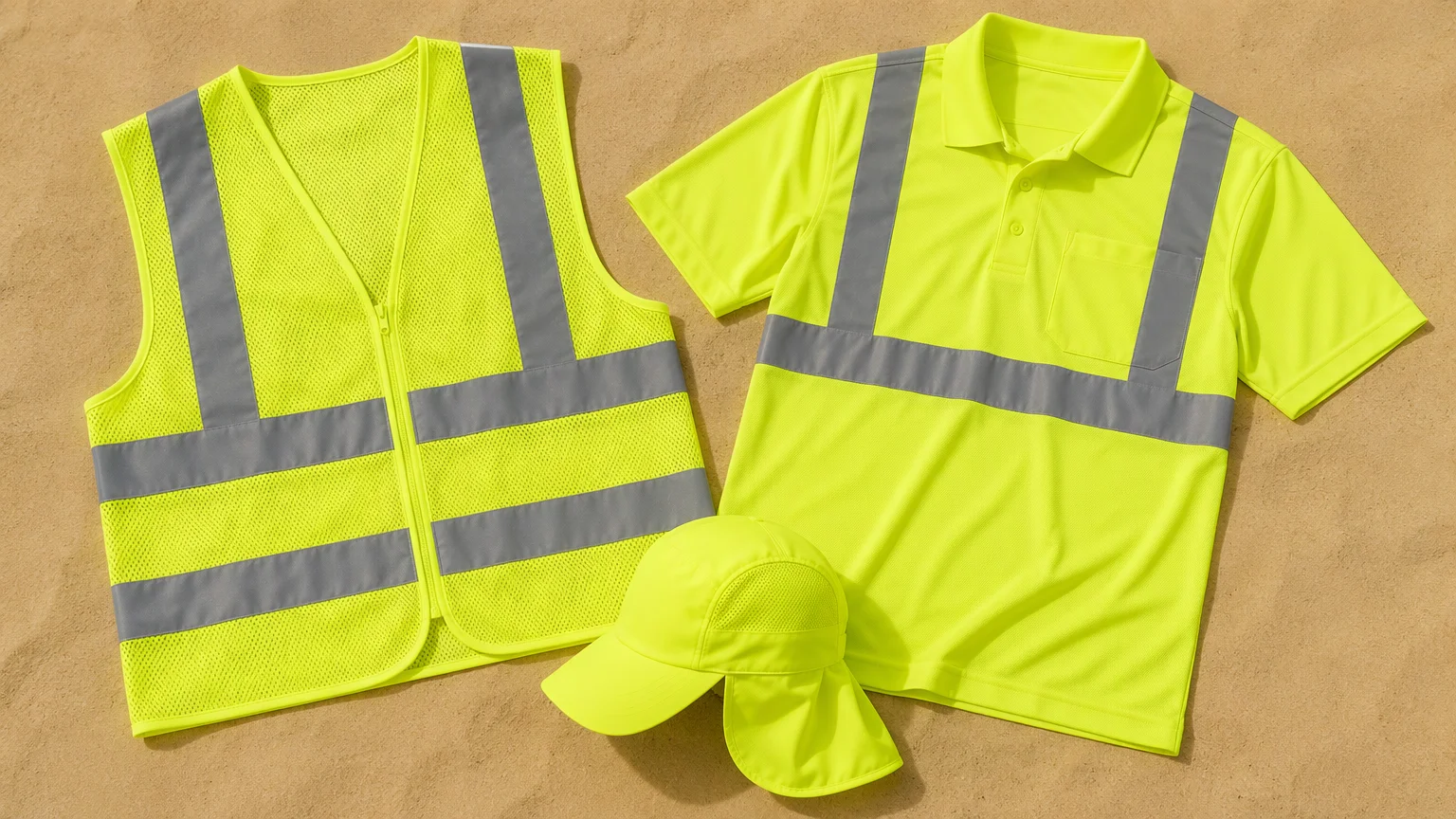
The Gulf summer basket: mesh vest, certified polo and neck-flap cap in one colourway (illustrative image).
What do Gulf buyers actually ask their Chinese supplier for?
Short answer: four things, in a rough priority order that differs from the West. Conformity readiness — can you document the product for SABER/SASO and label it correctly; this fronts the conversation in a way it rarely does for EU buyers. Heat-appropriate range — the breathable knits and mesh and sun-cover headwear above, offered as a coherent light-program rather than a winter catalogue with a summer page bolted on. Project-scale dependability — Gulf demand is project-driven (megaproject mobilisations, contractor renewals, event build-outs) that swing in large waves; the availability-and-reorder scoring in the scorecard guide is what separates suppliers who can ride those swings from ones who chase them. Documentary payment fit — large accounts commonly settle through irrevocable letters of credit and expect shipping-document precision (the LC mechanics in the UK guide's payment section apply identically here); the buyer-risk discipline we apply in every market says: for a first-time Gulf account, verify the entity, cap open credit, and lean on an L/C or a T/T advance-and-balance structure until the relationship earns more. Cross-check any new buyer against the manufacturer-selection discipline in reverse — the same document-first skepticism protects you when you are the seller.
How do colours, sizing and the calendar differ for Gulf programs?
Short answer: colours follow the European norm, sizing follows the workforce, the calendar follows the heat. Fluorescent yellow-green dominates Gulf roadwork and site use as in Europe (the market-colour mapping in the US guide contrasts this with America's orange lean). Sizing in Gulf workwear is less about a British/American body block and more about a large, multinational, largely male labour force with wide variance — the practical answer is a broad, deep size run into larger sizes and a real decision on women's cuts for the growing female workforce in logistics and facilities, per the fit-sampling discipline in the planning guide. The calendar is the Gulf's sharpest edge: the June-September midday ban slows daytime site work and shifts it to cooler hours and night; Ramadan further reshapes shift patterns toward early morning and evening; and the October-to-April cool window is when heavy outdoor construction and big event mobilisations peak — which is why, reading this in the northern winter, your Gulf cool-season and post-Ramadan restock is exactly the order conversation happening right now, the mirror-image seasonality our rain guide calls out for the southern hemisphere.
How does project-driven procurement actually work in the Gulf?
Short answer: you sell into mobilisation waves, not into a shelf. Gulf hi-vis demand arrives in the rhythm of megaproject mobilisations, contractor framework renewals and event build-outs: a general contractor wins a package, mobilises thousands of workers over weeks, and buys in a compressed burst — then re-orders on attrition and shift growth, then goes quiet between phases. Three supplier consequences: capacity reservation beats price wins — being able to ship several containers inside a mobilisation window is the qualification, echoing the availability scoring in the scorecard guide; stock-shell programs with decoration-on-demand (the tier logic in our custom-logo playbook) fit the wave shape perfectly, since mobilisations need plain certified volume fast and brand the slow tail; and vendor pre-qualification paperwork is the front door — large contractors and national oil companies run approved-supplier lists with audit and document requirements that reward exactly the certificate-and-file discipline this cluster preaches, and quietly exclude traders who cannot produce it.
What language and labelling should Gulf-bound cartons carry?
Short answer: bilingual discipline is the safe default, with destination rules as the final word. Gulf market-access regimes and consumer-protection practice commonly expect Arabic on labels and instructional material for regulated goods (often alongside English rather than instead of it); within the GCC, a hub-then-destination flow means the landing label and the final-market label can differ — plan for both. Practical build: English-first care/performance labels that already satisfy the EN ISO 20471 marking logic from the wholesale guide, an Arabic companion insert or hangtag in the polybag, bilingual carton markings for the customs file, and language content reviewed against each destination's current technical-regulation wording rather than copied from a competitor's carton — because mislabelled conformity text is the classic re-export-side rejection, and a label matrix costs one design afternoon per model. The same document-first habit that protects Saudi clearance protects the Dubai split-and-relabel operation downstream.
Frequently asked questions (Gulf wholesale buyers ask these first)
Do I need a different standard for the Gulf, or is EN ISO 20471 enough?
The visibility performance is almost always specified in EN ISO 20471-lineage classes on Gulf tenders, so your certified European-range engineering transfers directly (class-area logic in the wholesale guide). What you cannot copy is the market-access layer: Saudi conformity runs through SASO technical regulations and SABER, and other Gulf states have their own schemes — so "same garment, same EN certificate" plus the correct destination-country conformity documents is the honest answer, confirmed per shipment with a licensed body or your importer.
Can I ship to a UAE trader and let them handle Saudi clearance?
Common, but price the risk. Re-export from a Dubai hub is how much Gulf volume moves (the Jebel Ali section above), and it is efficient — but if the goods are ultimately for Saudi, someone still has to satisfy the SASO/SABER route, and "the trader will handle it" too often surfaces as a rejection your consignee cannot move. Put the destination market and who-owns-conformity in the order confirmation, not the WhatsApp chat — a specific application of the "assumptions surface as complaints" rule from the wholesale guide.
What should I not sell into the Gulf summer?
Winter weight, and any night-visibility blind spot. Quilted shells from the winter guide are cool-season and cold-chain items here, not summer stock — pushing them in June is deadstock by August. Equally wrong is assuming a hot country means no reflective: the midday ban pushes work into dawn and after-dark hours, so keep class-compliant retroreflective stock year-round. The correct summer play is the breathable-plus-reflective combo in the summer guide.
Is FR relevant to Gulf markets?
Strongly, in the right segments — oil-and-gas, petrochemical and utility projects across the Gulf are core FR demand, exactly the hazards the FR guide covers (flash-fire and arc-rated programs, certified bill-of-materials, wash-life). Gulf energy-sector frameworks are among the most documentation-strict buyers anywhere, so the FR five-document verification there is even less negotiable, and FR hi-vis overgarments tie the two guides together for site-compliant day-and-night visibility.
How do I manage payment risk on a new Gulf account?
The same verified-entity, capped-exposure discipline that governs every new buyer. For first-time Gulf accounts lean on an irrevocable letter of credit from a sound bank or a T/T advance-and-balance structure, verify the company before shipping (the document-first skepticism we apply across the cluster), and keep open credit short until a payment history exists. The UK guide's payment-mechanics section covers L/C and collection trade-offs identically — the instrument is international even when the market is regional.
Does the midday work ban apply everywhere in the Gulf?
Similar summer heat-protection rules exist across the region, but the exact months, hours and enforcement are set country by country and are revised — so treat the UAE dates (mid-June to mid-September, roughly midday) as the documented example and verify each destination's current rule with the authority or your local partner. The commercial pattern holds even where specifics vary: summer compresses the outdoor workday, shifts visibility needs toward low-light hours, and moves the order calendar earlier — the heat-and-hour rhythm this whole guide plans around.
What packaging does a Dubai re-export buyer want?
Hub-ready, not shelf-ready: robust export cartons that survive a second handling cycle, clean size-runs and neutral or dual-language labels that let the trader split and re-label for onward Gulf markets, and packing lists precise enough for a re-export customs file. That is the packout logic from the planning guide pointed at a distribution hub rather than a single storefront — spec it in the PO and the same cartons serve every destination they fan out to.
Should I build a dust strategy into Gulf specs?
Yes — Gulf dust is an abrasive that attacks the two most expensive elements: retroreflective band surfaces and seam threads. Spec bands with protective edging tape intact over every cut edge (the same trim-discipline logic as the rain guide's taped-seam argument), prefer tighter weaves in the shoulder zone where grit concentrates with pack straps, and put abrasion grades on the fabric sheet exactly as the durability guide teaches. On the service side, dust-loaded garments wash heavier and age faster — fold a slightly shorter measured replacement cadence into program pricing than European norms suggest, and the arithmetic stops being a surprise mid-framework.
Can I consolidate Gulf orders into one shipment with split destinations?
That is the normal shape of Gulf logistics — one vessel to Jebel Ali, then bonded split to Saudi, Qatar and Kuwait consignees — and it rewards preparation. Build the packing list as a mini manifest (carton-level size runs, consignee-coded carton marks, per-destination document sets), keep conformity text per destination correct on labels (the label-matrix section above), and confirm which leg each certificate must accompany before the container loads, because a single-lot file that serves three destinations exists only when it was designed that way from the PO. The same manifest-grade packing discipline from the bulk-order planning guide turns a consolidation into savings instead of a re-work fee.
How does Ramadan affect my re-order calendar?
It shifts everything earlier and quieter for a defined window: site hours move toward early morning and evening work, procurement teams slow approvals, and freight demand ahead of the period historically tightens before it eases during it. Plan the pre-Ramadan buffer like the heat-window buffers elsewhere in this guide — stock-shell cover ordered one cycle early per the reorder-rhythm logic from the wholesale guide — and treat the post-Ramadan restart, when projects push to recover pace, as the second mobilisation wave of the year rather than a surprise. Dates follow the lunar calendar and move each year, so pin them into your program calendar per the planning discipline in the bulk-order planning guide, not by habit.
Why source Gulf-market hi-vis with Jinhua Aoke (publisher of this guide)?
Claim boundary: manufacturer self-description from published materials; run the conformity and document checks against us as you would any supplier, and confirm each destination's current market-access rules independently.
Jinhua Aoke New Materials Co., Ltd has produced reflective and protective apparel since 2010 across three plants (Jinhua, Chongqing and Myanmar per our company profile), for export programs worldwide including Gulf destinations. The Gulf-specific fit: EN ISO 20471-lineage certified colourways shared across vests, the breathable knits and sun-cover headwear the heat section demands, and the FR range the energy-sector projects require (EN 11612/14116, NFPA/UL marks in our published list — see the FR guide). We prepare destination-conformity documentation alongside each quote so the SABER/SASO conversation starts before the container, not at the port, and the dual-country footprint sequences Gulf project waves across normal and duty-managed lanes. Hub-ready neutral packaging and broad size runs follow the re-export and sizing rules above.
Next step: send destination country, conformity questions, garment mix, quantities and preferred payment instrument through the contact page or inquiry center — Gulf quotes arrive with the conformity path, colour-cert map and heat-appropriate assortment pre-listed.
Related reading from our B2B library
- Hi Vis Polo & Summer Workwear Wholesale — heat-climate strategy
- FR & Hi-Vis Workwear Wholesale — Gulf energy-sector needs
- Reflective Safety Clothing Wholesale — the complete B2B buying guide
- Hi Vis Winter Jackets Wholesale — the cool-season Gulf restock
- Hi Vis Wholesale UK — conformity & payment-mechanics reference
- Hi-vis supplier selection — the 12-point scorecard
Research basis: the UAE summer midday work ban (roughly 15 June to 15 September, prohibiting under-the-sun/outdoor work during the midday hours, about 12:30-15:00) reflects the published position of the UAE Ministry of Human Resources and Emiratisation; Saudi conformity reflects the publicly documented SASO technical regulation for personal protective equipment and the SABER conformity platform as described by Saudi Standards, Metrology and Quality Organization. Both are revised periodically — verify current dates, hours, technical-regulation scopes and certificate requirements with the issuing authority or a licensed conformity body before contracting. EN ISO 20471 class logic follows the standards summary in our wholesale guide; FR and payment-mechanics detail follows the linked cluster guides. Supplier capability statements are publisher self-description from our published profile. B2B editorial information, not legal or customs advice. Reviewed November 23, 2026.