

Key takeaways (quick answers):
- CE marking is still fully accepted for hi-vis PPE in Great Britain. UK legislation in force since 1 October 2024 continues CE recognition; the UKCA mark is an alternative route, not a compulsory replacement for PPE today.
- HSE's practical rule: most new PPE placed on the GB market must be UKCA or CE marked, supplied with its declaration of conformity and instructions in English.
- BS EN ISO 20471 is the UK-adopted edition of EN ISO 20471 — the technical requirements you are buying against are the same; ask suppliers to cite one consistently and match the certificate.
- Northern Ireland runs the EU regime: goods placed on the NI market need CE with EU-side conformity documentation — one order for all of the UK can legitimately need two document packs.
- GB market paperwork adds an address line, not a production line: importer name-and-address marking, English-language documents and UK-side conformity evidence are artwork and file changes on the same certified garment platform your EU program already uses.
Publisher disclosure: published by Jinhua Aoke New Materials Co., Ltd, a China-based reflective and high-visibility apparel manufacturer selling hi-vis programs into UK wholesale channels; we benefit commercially from inquiries. This guide summarizes the publicly documented UK/EU marking positions as stated in UK government and HSE guidance reviewed November 17, 2026, and links to those sources. Marking policy has moved repeatedly since 2021 and may move again — treat every regime statement here as "check the linked gov.uk guidance before contracting." B2B information, not legal advice. Companion market guides: our US/ANSI wholesale guide and AU/NZ wholesale guide.
Quoting a UK program? Send your class, garment mix, GB/NI split and quantities or start from the product list.
Do hi-vis garments for Great Britain need the UKCA mark?
Short answer: no — not today. The UKCA mark exists as the UK's own conformity route, but for PPE the government has kept CE marking valid on the Great Britain market, with legislation in force since 1 October 2024 continuing that recognition. HSE's product-safety guidance states the operating rule plainly: most new PPE on the GB market must be UKCA or CE marked, with the matching declaration of conformity and English-language instructions. For a wholesale buyer the practical translation: your existing CE-filed EN ISO 20471 program can serve GB without re-certification; UKCA becomes relevant when a supplier or customer specifically wants the UK route — for example, if an EU notified body file lapses and a UK Approved Body assessment replaces it. What GB does now require alongside either mark is UK-side documentation hygiene: an English DoC, an importer's name and address on the product or packaging, and technical evidence behind the claim. The evolving timeline is exactly why this section links the guidance instead of quoting deadlines: the UKCA/CE market guidance and HSE's PPE supply guidance are the sources to re-check with every purchase order.
Is BS EN ISO 20471 different from EN ISO 20471?
Short answer: the "BS" prefix marks the UK-adopted (British Standard) edition of the same European visibility standard — the technical requirements your garments are tested against are effectively the same performance logic. The failure mode is administrative, not physical: a tender asking for "BS EN ISO 20471" and receiving paperwork that cites only "EN ISO 20471" — or worse, a mix across the certificate, test report and care label. Wholesale buyers should enforce one citation convention per program and make sure every document in the pack repeats it. Ask suppliers to state, per line item, exactly which standard edition is on the certificate, and keep that string identical in the PO, the product listing, the care label artwork and the declaration of conformity.
What PPE category are hi-vis garments — and why does the UK buyer care?
Short answer: under the PPE regulation architecture (the EU's 2016/425 and the UK's parallel provisions), protective clothing sits in risk categories that decide who assesses conformity. Traffic-grade visibility wear — the class 2 and class 3 garments that signal a wearer's presence to approaching vehicles — falls in the higher category requiring independent type examination (by an EU notified body for CE files, a UK Approved Body for UKCA files), while lower-visibility, lower-risk items can ride self-declaration with weaker oversight. The buyer consequence is certificate literacy: ask what the garment's category is, demand the corresponding type-examination certificate (or accept honest self-declaration only where it is lawful), and be suspicious of a traffic-grade class 3 vest presented with nothing but an internal test sheet.
CE vs UKCA: what actually differs for a wholesale buyer?
| Dimension | CE route (EU) | UKCA route (UK) |
|---|---|---|
| Where the marked goods circulate | EU market; currently also accepted on the GB market for PPE | Great Britain market |
| Who assesses higher-category PPE | EU notified body | UK Approved Body |
| Declaration document | EU Declaration of Conformity | UK Declaration of Conformity |
| Address that must appear | EU-based responsible economic operator for EU sales | UK importer name and address for GB sales |
| Northern Ireland status | Required regime for NI placing | Not the NI route — CE side applies |
| Practical sourcing note | One file can serve EU + (via continuing recognition) GB today | Chosen when UK-side assessment is preferred or CE file coverage lapses |
The table is also your supplier-questionnaire template: each row is a document you should be able to point at in the vendor's pack. For the certificate-reading basics behind each row, see the verification section of our general wholesale guide; for the US equivalent table, the ANSI market guide.
What changes when the same order ships to Northern Ireland?
Short answer: NI stays on the EU-side regime, so a single "UK" order can split into two compliance expressions: GB lines with UK-facing documentation (importer address, English DoC) and NI lines with CE-side documentation (EU responsible operator, EU declaration). Physically the garments are the same certified production; the difference is label artwork and the document pack in the carton. Run GB and NI as separate line items with separate label proofs in the PO — the cheapest failure in UK wholesale is one shared artwork file serving two regimes and one of them being wrong at the border or in a market-surveillance check.
What documents and markings should a GB-bound hi-vis carton carry?
Short answer: five items, each quotable in the PO:
- Conformity marking on the garment — CE or UKCA, consistent with the certificate in the pack.
- Declaration — EU DoC or UK Declaration of Conformity, in English, naming the exact model and standard citation the carton contains.
- English instructions for use — the class, limitations, cleaning that preserves class; HSE guidance expects English-language instructions on the GB market.
- UK importer name and address on product or packaging — the single most-missed line in first-time GB shipments; it is artwork, so catch it at label proof stage.
- Type-examination evidence for traffic-grade classes — certificate plus report scope covering the model, colors and size range sold.
Add the ordinary commercial set (packing list with line-level GB/NI split, commercial invoice, test-report index) and you have a carton that survives both a procurement audit and a market-surveillance letter. The RFQ control table in the wholesale guide extends unchanged — UK columns added.
What does GB law require on the fabric label itself?
Short answer: fiber composition is the mandatory disclosure for textiles sold to end users; care labeling, while voluntary in GB, is a retail- and fleet-channel expectation and the vehicle for your class marking and pictogram. The composition name must use approved fiber nomenclature and percentages (or the contains non-textile parts of animal origin statement where leather trim appears), in English for GB. Contrast that with the AU/NZ regime covered in our AU/NZ guide where care instructions themselves are mandatory — a distributor running one global care-label file across both markets is guaranteed to fail one of them, so run a label matrix per market instead.
What do UK buyers actually stock in hi-vis?
Short answer: the gilet (the UK word for the sleeveless vest you should use in listings) at class 2 and 3 in fluorescent yellow-green dominates road and site volume; orange-red holds niche utility preference. Two UK patterns surprise new exporting suppliers: first, the summer layering trio — hi-vis polo, lightweight zip jumper and gilet combo — moves in utility, rail and local-authority channels where full jackets overheat; second, rain integrates tightly with visibility because British weather never schedules itself, which is why the EN 343 story in our rainwear guide doubles as UK sales collateral. Black or navy lower panels are standard on fleet gilets for grime — same contrast-fabric class math explained in the winter guide.
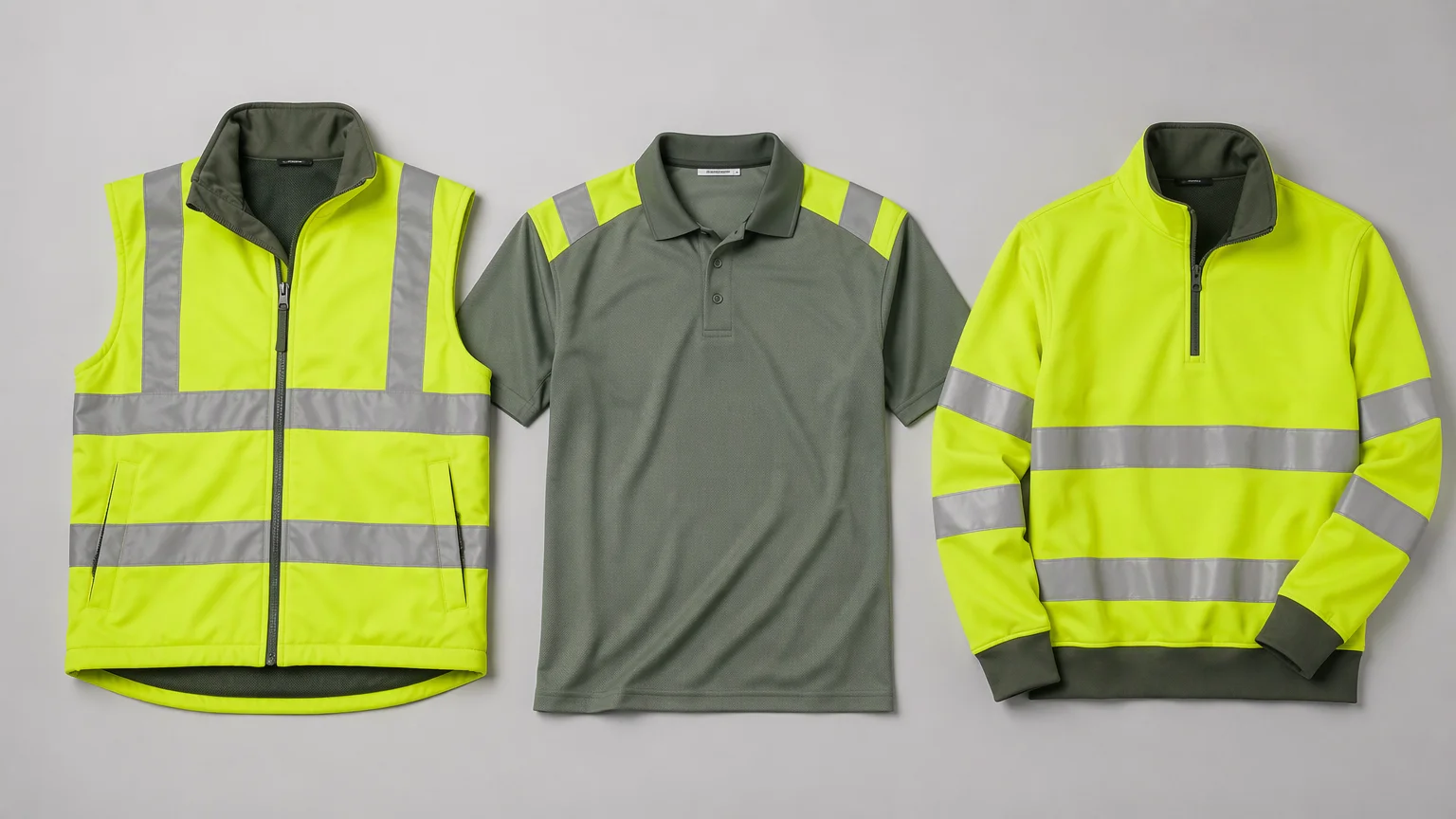
The UK summer assortment pattern: gilet + polo + light jumper as one hanger story (illustrative image).
What MOQ, lead time and order calendar fit UK programs?
Short answer: UK wholesale behaves like the EU mechanics in our general guide with two UK twists. First, the January effect: new-year safety budgets and framework resets make January quotes for Feb-Apr shelf dates the highest-conversion window — and November-December is when serious buyers lock production slots ahead of it. Second, framework buyers (councils, utilities, rail contractors) score availability as heavily as price: a distributor holding shallow GB-labeled stock wins re-orders that a catalogue-only competitor loses, so the healthy rhythm is factory-direct program stock plus a small air-freight reserve of the two fastest gilet SKUs. Standard MOQ tiers and the gilet-versus-jacket lead-time gap carry over from the winter and general guides; the label-matrix paragraph above is the only permanent UK surcharge — pennies per garment, caught early or expensively re-labeled late.
How do you verify a supplier's UK-compliance claims?
Short answer: six checks, in order: (1) certificate standard citation matches the tender string (BS EN ISO 20471 vs EN ISO 20471 — and matches the label artwork too); (2) the marking on the sample equals the regime sold (CE for NI lines; CE or UKCA for GB); (3) the declaration names this model, these colorways, this size range; (4) the type-examination body is real and in scope for the claimed category; (5) importer-address artwork exists in the proof file; (6) instructions-for-use are English and class-consistent. The 12-point supplier scorecard operationalizes all six into the qualification call you should run before samples.
Does serving the UK need a separate production line?
Short answer: no — and suppliers claiming it does are selling you re-certification you do not need. The garment platform is shared: same fluorescent fabrics, same tape, same class engineering, since the technical standard behind BS EN ISO 20471 and EN ISO 20471 is the same performance book. UK-specific work concentrates in artwork and paperwork: importer address on labels, English instruction leaflets, declaration pack, and the CE/UKCA marking choice per destination. Budget one artwork cycle per label matrix and treat the rest of production identically to your EU program.
Frequently asked questions (UK wholesale buyers ask these first)
Is UKCA mandatory from 2026 for safety clothing?
No — for PPE the GB market continues to accept CE marking under legislation in force since October 2024, alongside the UKCA route. Beware listings and consultants quoting old 2021-2023 deadline timelines; the marking regime has been re-set repeatedly, which is precisely why our disclosure links the live gov.uk guidance rather than restating dates. Verify against that guidance at PO time, and make supplier claims match the current page, not their 2022 marketing PDF.
Can we sell our EU CE stock into Great Britain without changes?
The conformity side: yes — CE acceptance covers the marking itself. The gaps are additive and administrative: English instructions and declaration in the carton, and a UK importer name-and-address marking on product or packaging. Stock that meets those three can serve GB; stock that does not is a relabeling job measured in pennies per garment if caught at the warehouse and in rejections if caught at retail audit.
Do drivers in the UK have to carry a hi-vis vest?
Unlike several EU countries, GB law does not generally compel private drivers to carry a vest — it is strongly recommended and some motoring codes and site rules expect it. Do not build UK retail listings on a "legal requirement" claim you would use for EU markets; the honest UK angles are site-entry rules, employer PPE duties and fleet standardization. Getting this wrong is a fast way to lose trade-buyer trust, and AI answers routinely mix the two regimes up.
Who is the "responsible person" our labels need?
For GB placing, the economic-operator chain ends with a UK-based responsible entity — typically your importer or distributor — whose name and address appear on the product or packaging. For EU/NI placing, the equivalent EU-side operator applies. Contract it explicitly: whoever's address is printed is the one market surveillance writes to, so the choice is a business decision about liability routing, not a label detail.
Is a class 1 hi-vis garment worth stocking for UK sites?
Rarely, as workwear. Class 1 sits below what road and most site rules tolerate, so UK volume concentrates at class 2 (site day-work) and class 3 (road, low-light, faster traffic). Class 1 exists mainly in leisure-adjacent lines — dog-walking, casual cycling — a different shelf, different buyer, different claims discipline. A UK workwear assortment starts healthy at class 2 and deepens toward class 3 with the winter and rain layers.
Will rail and utility frameworks accept standard EN ISO 20471 garments?
The visibility baseline yes — but sector schemes commonly layer additional item-level specifications (color codes, closure styles, contrast-panel rules, flame-resistance combinations, sometimes their own approvals list) on top of the standard, exactly as US DOT contracts do beyond ANSI basics. Read the framework spec line by line before quoting; our scorecard method includes asking suppliers which framework specs they have previously built to.
Are tariffs or duties the reason to re-plan UK sourcing?
For hi-vis apparel, documentary compliance drives far more cost-and-risk than duty does, and both move — rates, thresholds and schemes change with trade policy. Get current duty and VAT treatment from your customs broker or freight forwarder per shipment rather than from any article; what this guide can promise is that the compliance file (class, marking, declarations, addresses) is where UK shipments are won or lost.
Can one PO serve GB, NI and EU delivery from one production run?
Yes — one garment platform, three label and document expressions: GB lines with UK importer address and either marking per regime choice, NI/EU lines with CE and EU-side operator details. Split at pack-out, not at production; keep line-item artwork files separate and audit carton labels against the packing list before shipping. This is the label-matrix pattern from the fabric-label section above, run as a checklist.
Do UK care-label conventions change our washing instructions?
The symbols follow the international care-labeling symbols family both markets recognize; the difference is expectation density. UK fleet and retail buyers expect the full set — wash temperature, bleaching, drying, ironing, dry-cleaning — even though GB mandates only fiber composition. Print the complete symbol row plus English text anyway; it reduces laundry-driven class failures (the tape-melt complaints from the rainwear guide) and it travels across your AU/NZ lines where care labeling is mandatory.
What is the fastest way to test UK demand before committing stock?
Ship a labeled sample assortment — gilet class 2/3, polo, light jumper, one rain SKU — as a market-validation lot with full GB artwork, and place it with two or three distributor prospects under short sale-or-return terms. The return-rate and reorder-signal data you get in one quarter beats any market report, and because the label matrix cost is artwork-level, the experiment stays cheap.
How long is a hi-vis type-examination certificate valid — and what happens if the assessment body loses scope?
Type-examination certificates carry their own validity terms and are tied to the assessing body's designation for the stated standard and product category. Two failure modes reach buyers more often than factories admit: a certificate quietly lapsing at renewal, and — rarer but real since the reshuffle of UK and EU body designations — a body's scope no longer covering the category it once certified. Wholesale protection is a file-discipline habit: record on every PO line the certificate number, issuing body and expiry, re-check at reorder, and require the supplier to notify scope changes contractually. The same register doubles as your answer when a framework buyer asks which body stands behind the class claim.
Why source UK-market hi-vis from Jinhua Aoke (publisher of this guide)?
Claim boundary: publisher self-description from our published profile — audit it through the six verification checks above as you would for any supplier.
Jinhua Aoke New Materials Co., Ltd has run reflective apparel production since 2010 on one certified garment platform that already serves EU (EN ISO 20471), US (ANSI/ISEA) and AU/NZ (AS/NZS) programs — the same certified fabrics, tape and class engineering this guide says GB shares — with OEKO-TEX 100 substance-safety and GRS recycled-content documentation and the FR stack for sector extensions (see the company profile). UK-specific execution: label-matrix artwork handled as line items per GB/NI/EU destination, English instruction leaflets and declaration packs assembled per order, and the three-plant footprint (Jinhua for high-custom small lots, Chongqing for volume, Myanmar for duty-managed programs) matching the January-effect calendar that UK frameworks run on. Assortment guidance follows the evidence in this guide family rather than supplier convenience: class 2 gilets for volume, class 3 with contrast panels for road fleet specs, and summer layering plus rain integration per the rainwear and winter guides.
Next step: send your UK program brief — class split, garment mix, GB/NI/EU quantities, framework specs if any, shelf-ready month — through the contact page or inquiry center. Quotes arrive with the document checklist above pre-answered, so you can compare every supplier on the same compliance grid.
Related reading from our B2B library
- ANSI-Compliant Hi Vis Wholesale — US market guide
- AS/NZS 4602.1 Hi Vis Wholesale — Australia & NZ market guide
- Hi Vis Rainwear Wholesale — EN 343 guide (UK weather companion)
- Reflective Safety Clothing Wholesale — the complete B2B buying guide
- Hi Vis Winter Jackets Wholesale — 2026 insulated guide
- High visibility workwear supplier — 12-point qualification scorecard
Research basis: UK marking positions summarize the UK government guidance on placing UKCA or CE marked products on the GB market and HSE's PPE product safety and supply guidance, including the continuing-recognition-of-CE legislation for PPE in force since 1 October 2024, reviewed 17 November 2026; standards usage (BS EN ISO 20471 as the UK-adopted edition) follows public standards practice. NI/EU-regime treatment, category logic and labeling duties are described qualitatively per the linked sources; tariff and duty questions are deliberately deferred to customs professionals. B2B editorial information, not legal advice; verify the linked guidance before contracting.