
Key takeaways (quick answers):
- EN 343 rates rain protection with two numbers (X.Y): X is resistance to water penetration (higher keeps heavier rain out), Y is water-vapour permeability — breathability (higher lets sweat escape). An all-season work program usually wants both numbers respectable, not one maxed and one ignored.
- "Water-repellent coating" is not waterproof construction: durable rainwear depends on membrane/coating rated to EN 343 plus taped seams; stitched seams without tape are the number-one leak point that field reviews and returns expose.
- Rain jackets are hi-vis garments too: the shell still has to carry its EN ISO 20471 class through hood, cuffs and pocket placement — the class is earned by the finished cut, same as a vest.
- Ratings fade with care: coatings crack with flex and heat, DWR top-finish washes out, tape lifts when drying temperature is exceeded — specify laundering instructions that protect the rating, and test decorated/taped samples after wash cycles, not before.
- EU/UK rainy-season demand cycles opposite to winter: spring-summer programs are quoted in Q4 and shipped January-March; a rainwear program ordered in April arrives with the season already lost.
Publisher disclosure: published by Jinhua Aoke New Materials Co., Ltd, a China-based hi-vis and weather-resistant workwear manufacturer selling rain programs into EU/UK wholesale channels; we benefit commercially from inquiries. This guide summarizes the publicly published structure of EN 343 (two-number class system) and its interaction with EN ISO 20471 visibility classes, reviewed November 16, 2026. It does not reproduce threshold tables — buyers should specify the class numbers and let accredited test reports carry the detail. B2B information, not legal advice; standards editions change, verify current citations. Companion guides: our winter jackets wholesale guide and weather-resistant field-matrix article.
Building a rain program? Send your class targets (EN 343 X.Y + visibility class), garments and quantities or browse catalog SKUs.
What do the two numbers in EN 343 actually mean?
Short answer: EN 343 answers one question twice — "how hard can it rain before you get wet" (resistance to water penetration) and "how fast can sweat escape" (water-vapour permeability). The garment carries a pair of class numbers; the first scales protection against hydrostatic pressure, the second scales how freely moisture passes through the fabric. A maximum-protection, minimum-breathability combination is ideal for a stationary worker in a storm and unbearable for a walking crew in drizzle. Wholesale consequence: stop treating "EN 343" as a single checkbox — quote and stock at least two X.Y tiers (a premium weather grade and a decent all-rounder), because your customers' jobs differ more than their tenders admit.
Two reading rules matter in documents: older stock and datasheets may quote the pre-2019 single-class scheme, so date your references; and an "X" marking on the second position means breathability was not tested or not claimed — cheap listings love that blank.
What construction actually keeps rain out — membrane, coating, or DWR?
Short answer: three different jobs, routinely confused in catalog copy. The waterproof layer (PU coating or a laminate membrane inside the shell) is what EN 343's first number rates — it stops pressure-driven water. Seams decide whether that layer survives assembly: every stitched needle-hole leaks until covered with heat-applied seam tape; "water-resistant" stitching alone is a drizzle product wearing a raincoat photo. DWR (the durable water-repellent top finish that makes droplets bead) is cosmetic physics — it sheds surface water and delays fabric wet-out, but it washes and abrades away and proves nothing about the layer beneath. Buyer questions that separate real rainwear from marketing: What is the EN 343 class pair? Are seams taped — and at what width? Is the tape still bonded after the launder test? Is DWR refresh available in the care instructions (good factories admit it wears)?
Can a rain jacket still be a certified hi-vis garment?
Short answer: yes — but the shell rules the same way a vest does. Hood and sleeve geometry change where bands can sit; dark lower panels for road grime eat fluorescent area; storm flaps can interrupt band continuity exactly where the standards demand it. The class (1-3 under EN ISO 20471, class/type under ANSI 107-2020) is determined by the finished cut — a rain jacket that shares fabric with a certified vest can still fail by design. This is why our winter guide pushes the same audit: get the class determination for the actual model, plus the EN 343 report, plus the laundered-sample re-check. A dual-marked jacket (visibility class + rain class pair on one care label) is the single most defensible SKU an EU distributor can stock — two claims, two reports, no improvisation.
What fabric stack should a wholesale rain program specify?
Short answer: match weight and hand-feel to the job, not to the spec sheet's ego.
| Stack | Typical build | Best for | Watch-outs |
|---|---|---|---|
| Budget coated rainset | PVC or PU-coated polyester, unlined, welded seams | Emergency stock, municipalities, price-led promos | Stiff in cold, coating migration in heat storage, vent complaints |
| Mainstream workwear rain | PU-coated 190T-type shell, mesh venting, taped seams, adjustable hood | Construction, facilities, utility fleets — the volume tier | Verify tape width and pocket-bag sealing; check cuff closure style |
| Premium breathable shell | Laminated membrane, taped seams, pit zips, storm two-way zip | Active crews, long shifts, cold-wet shoulder seasons | Price gap vs mainstream only sells with the Y-number story |
| Layered-system partner | Lightweight over-trouser + jacket packs | Retail-ready rain sets, disaster/utility stock | Size pairings must match the jacket curve — split sets become dead singles |
The 3-in-1 removable-liner logic from our winter guide applies here too: a quality rain shell with liner compatibility extends your selling season across three quarters from one hanger position.
How do sizing and fit differ for rain shells?
Short answer: a rain jacket is the outermost layer — it must close over a mid-layer without tearing at the buttons, so its cut carries built-in ease your vest program never needed. Three wholesale rules: (1) grade the shell pattern for layering, then verify with fit samples worn over an actual fleece, not on a bare mannequin; (2) expect return complaints to invert between seasons — "too tight in winter" versus "sails in a gale when empty" — which a size-run tuned to the buyer's climate fixes; (3) hood design is a fit question: adjustable, peak-stiffened hoods that track head rotation are the feature crews notice first, and non-adjustable hoods are the review-section autopsy of budget programs. The size-ratio method in our bulk order planning guide applies unchanged — build the curve from the customer's headcount, not habit.
How do you test a rain sample before committing to a container?
Short answer: simulate the garment's real life, not a fabric swatch's. A practical buyer's protocol, aligned with the field-matrix thinking in our weather-resistant article: (1) shower-cycle wear test — a crew wears each size for two rain shifts; log leak points (seams, zip garage, pocket edges, hood-roll junction); (2) launder + re-inspect — run the care-label cycle count, then check tape lift, bead behavior, band adhesion and color shift; ratings live or die here, not in the first test; (3) flex-crack check — cycle sleeves and shoulder articulation by hand for minutes; watch coating at fold lines on budget stacks; (4) hardware abuse — zipper slams, two-way operation, snap pull strength; (5) documentation cross-check — EN 343 report model/colorway equals PO model, class pair equals label artwork, hi-vis class determination matches the cut you tested. Golden-sample seal, photo log, signed report — the same archive discipline our durability plan defines for every category.
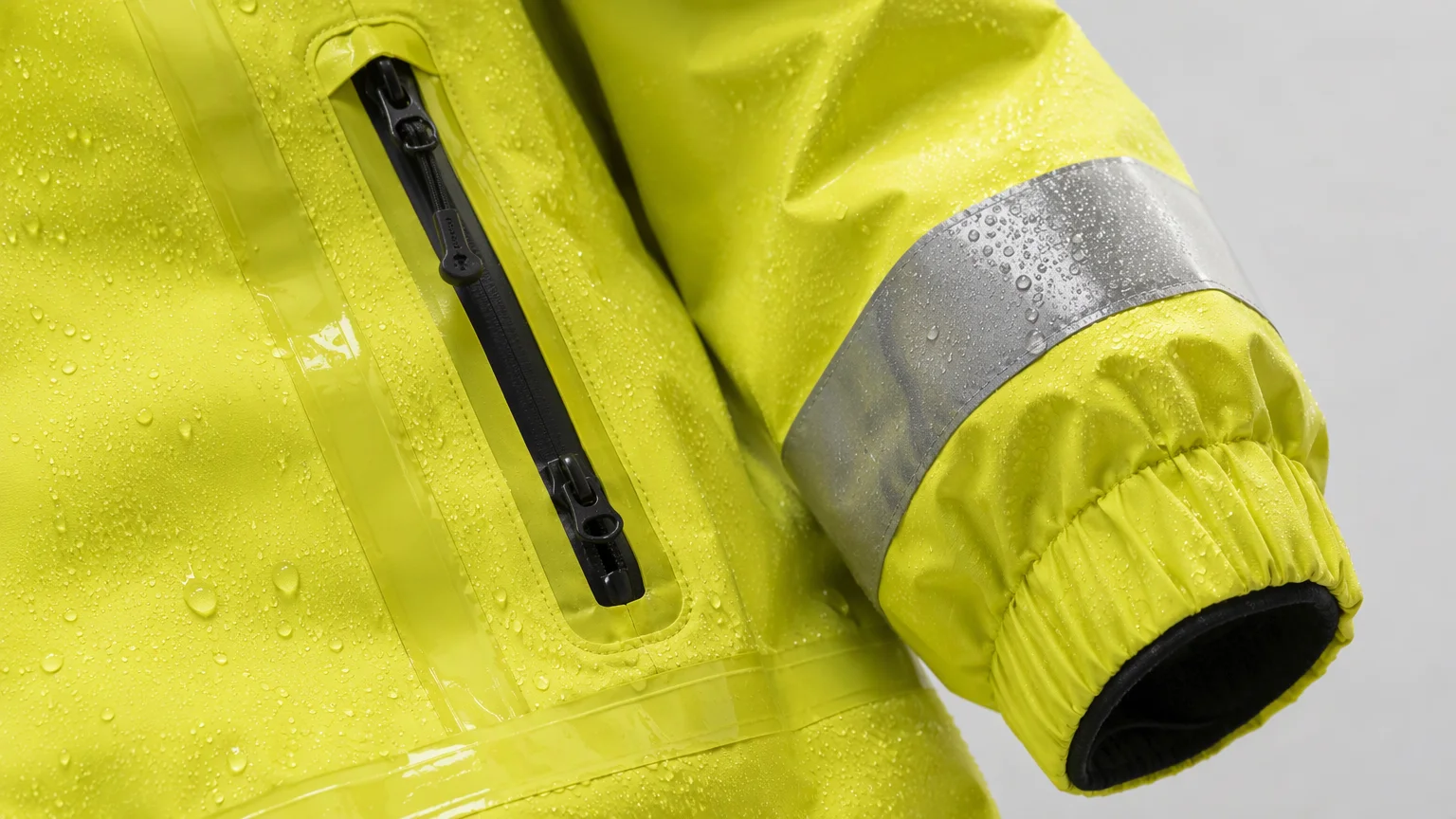
Where rain programs are won or lost: taped seam, storm cuff, band junction — inspect exactly these on every new lot (illustrative image).
What kills rainwear in storage and how do distributors prevent it?
Short answer: heat, compression and time. Coatings migrate and block in hot containers or attic racking (the "blocked" two-jackets-stuck-together smell is a storage failure, not a factory one); folded creases under load crack coatings at the fold; and dark-damp pallet corners grow hydrolysis spots on some PU stacks. Off-season playbook: store cool, dry and uncrushed; rotate stock FIFO by production month; keep cartons off hot warehouse floors; and ask the factory for the coating's shelf-life guidance in writing — serious laminators publish it. When quoting Q4 for a spring program, put the storage terms in the conversation early; a distributor who resells your May stock out of a July heat-trap will blame the tape, not the rack.
What MOQ, price tiers and calendar fit rain programs?
Short answer: rainwear sits one tier above vests on MOQ because cut-and-seal work is assembly-heavy: expect stock-welded PVC sets in the low hundreds, taped-seam workwear rain in the mid hundreds to low thousands per colorway, and laminated membrane shells behaving like the winter jackets in our winter guide — deeper minimums, longer lines, real setup conversations. Price spread is brutal and honest: coated sets anchor the floor, mainstream taped-seam workwear carries the volume margin, membrane shells earn the premium quote — the same same-spec-comparison rule from the wholesale guide stops most bad buys here: compare price per EN 343 class pair and seam construction, never per garment photo. Calendar for the EU/UK wet season: quote in November-December, approve samples January, ship February-March for shelf-ready spring; Northern-hemisphere buyers should note our AU/NZ counterparts run this calendar inverted, covered in the AU/NZ guide.
How does rainy demand differ across EU/UK regions?
Short answer: the wet season is one calendar with three intensities. UK/Ireland and the Atlantic fringe buy rain as core PPE across nine months, with the premium breathable tier genuinely turning; Central/Nordic markets concentrate demand in shoulder seasons where rain rides along with cold, which makes the shell-plus-liner compatibility story from the winter guide the winning quote; Mediterranean and Mid-Atlantic-continent markets buy event-driven — autumn storm spikes that reward distributors holding shallow stock ready for four-week air-lift rather than deep seasonal bets. A pan-European catalog should therefore quote the same two tiers with different stocking advice per country — the wholesale mechanics in our general guide multiply by climate, not replaced by it.
Quick glossary for rain-program conversations
Hydrostatic head: the pressure a fabric withstands before water passes — the physics behind EN 343's first number. RET / vapour resistance: how hard sweat has to push through the fabric — the second number's physics, lower is more breathable. Seam tape: heat-applied waterproof ribbon covering stitch lines. Welded seam: seam bonded without thread — inherently water-tight, limited repair story. DWR: the beading top finish that buys time but is not the barrier. Wet-out: outer fabric saturation that kills breathability claims while the barrier may still hold. Blocking: coatings sticking together in hot storage — a logistics fault that looks like a factory fault. Two-number class pair: the EN 343 identity to quote in POs (e.g., 3.1) — and the number an improvised listing never shows.
Frequently asked questions (rain wholesale buyers ask these first)
Is a vented rain suit less waterproof than a sealed one?
Not by construction — vents defend a trade-off, not a shortcut. A pit-zip or back-vent opens a controlled path for vapour while the barrier layer behind it still carries the EN 343 rating; it is open mesh channels sewn through unsealed needle-holes that leak, which is why vent areas are exactly where your shower-cycle wear test should concentrate. Catalog language should match: "vented for active work" is honest; "fully breathable sealed shell" with vents listed in the same row is marketing with a seam-warranty claim hiding inside it.
How many rain pieces per worker should fleet programs carry?
Working fleets settle on one two-piece set per head for rotation duty plus a buffer sized to loss-and-forget rates — commonly a low double-digit percentage per season in open-air segments like road maintenance and rail, less in depot-heavy logistics where jackets hang in lockers. Distributors grow repeat revenue by selling the rotation logic explicitly (set + buffer + replacement cycle with the care card attached) instead of quoting single garments; the same replacement-window economics argued for vests in the wholesale guide apply to shells at roughly triple the unit value.
Is EN 343 the same as the IPX water ratings electronics use?
No — different standard, different test philosophy, and mixing them in a catalog destroys credibility with professional buyers. EN 343 rates garments under simulated rain and hydrostatic pressure with a two-number class pair covering waterproofness and breathability; IPX codes rate enclosures against ingress. A rain jacket spec sheet quoting IPX4 is a supplier either confused or improvising — walk toward the supplier who quotes EN 343 classes and can show the report.
What is the difference between water-resistant and waterproof workwear?
Water-resistant sheds light rain briefly through tight fabric or a DWR finish; waterproof pairs a rated barrier layer with sealed seams so driven, sustained rain cannot reach the body. In wholesale terms the difference is where returns come from: water-resistant items get returned when weather exceeds their marketing photo, waterproof items get returned only for workmanship. Sell water-resistant honestly as a drizzle/fairweather tier and waterproof as the rated tier — the label discipline protects margin from expectations.
Are taped seams worth the price gap over welded coated sets?
For any program expecting real wear years, yes. Welded-seam PVC sets win on price and emergency-stock duty, but they age stiff, and their repair story is weak. Taped-seam construction on woven shells keeps performance through laundering, accepts logos and lining options, and reads as professional workwear to crews — the three reasons contractor-channel buyers keep repurchasing the higher tier despite the floor price. Budget it like consumables versus equipment, not like one or the other jacket.
Does the EN 343 rating survive washing?
The rating describes the garment as tested, and laundering is exactly what tests over time: coatings crack at flex points, tape lifts under heat, DWR finishes deplete after cycles. What protects the claim is specified care (low-temperature wash, no tumble or low heat, no softener that clogs vents, DWR refresh allowed) and your wash-then-recheck sample gate. Ask factories whether they test EN 343 performance after laundering cycles for premium lines — the answer instantly sorts equipment-grade suppliers from trading-stock sellers.
Can hi-vis rain jackets also be flame resistant?
Yes — FR rain systems stack a third evidence chain: FR barrier fabrics and tapes certified to the relevant FR standards, plus the visibility class, plus EN 343. Every added layer must be tested on the finished combination, and the cost sits clearly above commodity rain because each layer is a specialty. Treat FR rain as its own catalog lane with its own certificate discipline — same never-cross-sell warning this cluster gives for FR vests and FR winter wear.
Do rain trousers need the same class markings as jackets?
If they are sold as certified hi-vis, yes — trousers carry their own visibility-class logic (band placement around legs), and EN 343 applies to leg garments too. If they are sold as plain weather trousers paired with a certified jacket, market them honestly that way; the audit trap is the photo where a non-certified trouser appears inside a certified-suit story. Set listing templates so "suit claimed" requires class evidence for both pieces.
What warranty period makes sense on rain programs?
Anchor warranty on the tested claim, not the calendar. Serious programs warranty the barrier system — delamination and seam-tape failure under specified care for a defined wear period — while abrasion cuts, snags and misuse stay excluded in writing. Distributors should pass that same structure down the channel; a blanket "1 year waterproof" promise inherits every heat-trapped carton and tumble-dried jacket in the territory as your liability.
Should stock programs hold the premium membrane tier at all?
Hold it shallow and earn it in quotes. The membrane tier moves slower than mainstream taped-seam workwear but wins the spec-driven tenders (utility contractors, rail maintenance, municipal frameworks) where the class pair is scored, and it anchors your range's price psychology in showrooms. A practical rhythm: deep stock in the mainstream tier, quarterly capsule orders of the premium tier sized to named tenders, unlimited patience never — re-see our MOQ logic in the wholesale guide.
Should distributors stock repair kits alongside rain programs?
Yes, and they are margin you keep. Seam tape repair tape, patch fabric color-matched to your shell SKUs, and zip replacement cards convert "damaged — write off" into "repaired — retained customer," especially with municipal and utility buyers whose procurement rules favor repairability evidence. Stock the kits beside the shells in the same carton pack-out, print the repair instructions on the care card already mandated by your laundering story, and quote kits in the original PO instead of as a forgotten accessory line.
Why source rain programs with Jinhua Aoke (publisher of this guide)?
Claim boundary: publisher self-description from our published profile — audit it through the same report, sample and wash-test gates above.
Jinhua Aoke New Materials Co., Ltd has produced reflective and weather-exposed workwear since 2010, with EN ISO 20471 visibility certification, substance-safety (OEKO-TEX 100) and recycled-content (GRS) documentation published on the company profile, plus testing practice aimed at weather claims — the same field-matrix logic this guide applies is documented in our own waterproofing article. For rain programs specifically: the two sample rooms build layering-fit prototypes over real mid-layers before bulk; in-house testing covers tape adhesion and band junctions after laundering cycles rather than before; and the three-plant footprint (Jinhua ≈50,000 pcs/month for high-custom runs, Chongqing ≈200,000 pcs/month, Myanmar ≈1.5M pcs/month) absorbs the Q4-quote/February-ship calendar EU/UK rain programs require. Logo and private-label work on shells follows our custom-logo playbook — including where heat transfers may touch taped panels.
Next step: send the class targets you want quoted (EN 343 X.Y pair + visibility class), the garment mix, quantities and shelf-ready month through the contact page or inquiry center. Every quote arrives with the report references, seam-construction sheet and the same comparison checklist your other suppliers should be held to.
Related reading from our B2B library
- Hi Vis Winter Jackets Wholesale — 2026 insulated workwear guide
- Weather-resistant workwear — field-test matrix for wholesale buyers
- Reflective Safety Clothing Wholesale — the complete B2B buying guide
- Top 10 Reflective Vest & Hi Vis Clothing Manufacturers in China — 2026 shortlist
- Custom Reflective Vests with Logo — bulk & private-label playbook
- Heavy-duty workwear durability — the test plan before the PO
Research basis: standard structures summarize EN 343's publicly documented two-number class system (water penetration resistance / water vapour permeability; "X" denoting untested second position) and its combination with EN ISO 20471 visibility class marking, reviewed November 16, 2026; pre-2019 single-class markings appear in legacy listings and are noted accordingly. Construction terminology (coating vs membrane vs DWR; taped vs welded seams) follows public workwear-industry usage. MOQ, calendar and storage patterns reflect publisher export experience and public B2B practice. B2B editorial information, not legal advice.