Outdoor workers rarely face one weather condition throughout an entire shift. A logistics employee may move between a heated warehouse and a windy loading yard. A road maintenance crew may begin work in light drizzle, encounter stronger rain, and finish the day in cold, damp conditions.
For B2B buyers, choosing weather resistant workwear means finding the right balance between protection, breathability, movement, durability, and cost. Selecting a heavy waterproof jacket for every situation can create unnecessary discomfort, while choosing lightweight water-resistant clothing for prolonged rain may leave workers inadequately protected.
Quick Answer: Weather resistant workwear should be selected according to rainfall intensity, wind exposure, activity level, working duration, and jobsite hazards. Buyers should compare fabric construction, water penetration resistance, moisture management, seams, closures, and layering compatibility. For industrial purchasing, a practical field assessment and documented sample evaluation provide stronger evidence than product descriptions such as "all-weather" or "waterproof."
This guide provides a rain-and-wind selection matrix, technical specification checklist, manufacturing considerations, and procurement recommendations for PPE importers, workwear distributors, industrial uniform buyers, and private-label brands.
1. What Is Weather Resistant Workwear?
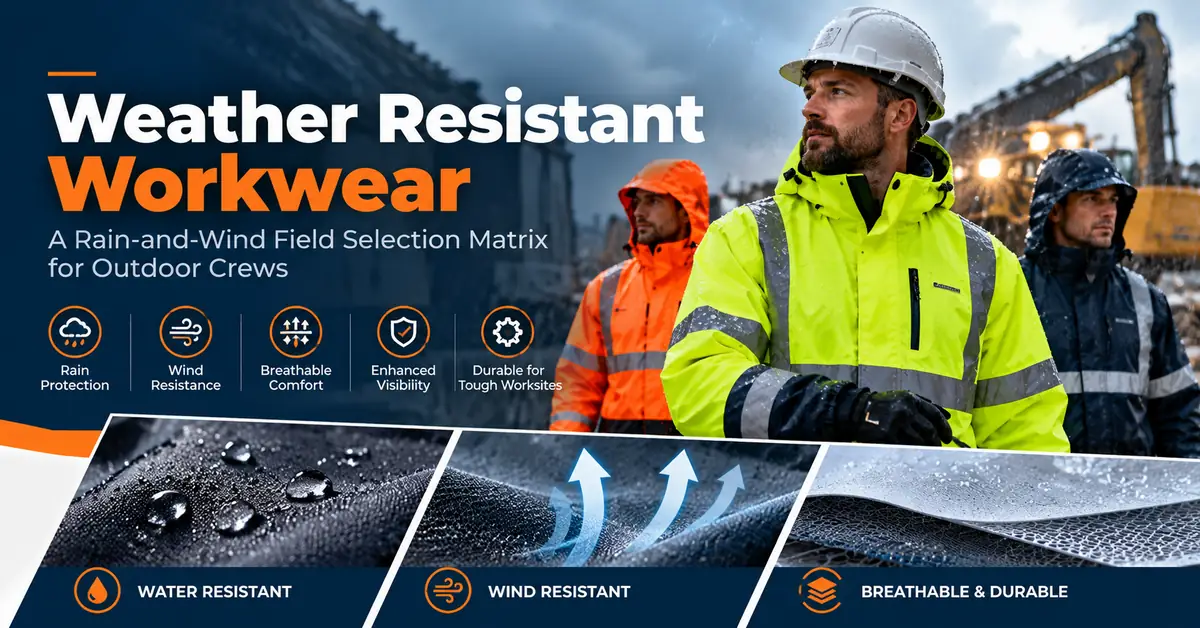
Weather resistant workwear refers to occupational clothing designed to help workers manage exposure to environmental conditions such as wind, light rain, dampness, and changing temperatures.
Depending on its construction, it may provide a combination of:
-
Resistance to light precipitation
-
Reduced wind penetration
-
Moisture management during physical activity
-
Thermal comfort when combined with suitable layers
-
Freedom of movement during industrial tasks
-
High visibility where required by workplace risk assessments
However, weather resistant does not automatically mean waterproof.
Water-resistant garments may repel light rain for a limited period. Waterproof garments are designed to resist liquid-water penetration under defined conditions, although their performance still depends on seams, openings, construction, and appropriate testing.
Wind-resistant fabrics reduce airflow through the garment. Breathable fabrics or systems facilitate moisture-vapor transfer, but their performance varies with temperature, humidity, activity level, and garment design.
These characteristics should be evaluated separately.
Who Should Purchase Weather-Resistant Industrial Clothing?
This category is particularly relevant to construction contractors, logistics companies, road maintenance teams, public utilities, municipal services, ports, airport ground operations, and outdoor maintenance providers.
PPE importers and private-label workwear brands also need reliable technical specifications to build weather-appropriate clothing collections for different customers.
It may not be sufficient for workers facing electrical arcs, flash fires, chemical exposure, extreme cold, or other specialized hazards. Those applications require their own protective specifications and appropriate verification.
2. Use a Weather Exposure Matrix Before Selecting Workwear
The most effective starting point is identifying the conditions in which employees will wear their clothing.
Weather exposure should be considered alongside working intensity and the time employees spend outdoors.
Weather Resistant Workwear Selection Matrix
| Working Conditions | Typical Activities | Suggested Clothing System | Primary Buying Priority |
|---|---|---|---|
| Light drizzle, mild wind | Delivery, facility inspection | Water-resistant softshell or light shell | Mobility and ventilation |
| Intermittent rain, active work | Construction, maintenance | Weather-resistant outer layer with adjustable ventilation | Moisture management |
| Sustained rain | Road maintenance, port operations | Verified waterproof outer shell and suitable trousers | Water penetration resistance |
| Dry but strong wind | Utility inspection, outdoor logistics | Wind-resistant work jacket | Air penetration and closure design |
| Cool, wet conditions | Municipal services, outdoor repairs | Weather-protective shell with removable insulation | Layering compatibility |
| Warm, humid conditions with showers | Transport, outdoor warehousing | Lightweight breathable outer protection | Heat management and practical rain protection |
These are preliminary selection guidelines, not guaranteed temperature ranges or certified protection levels.
For professional workwear programs, buyers should record actual exposure patterns instead of relying exclusively on regional climate descriptions.
Why Activity Level Matters
A worker who spends most of the shift walking, lifting, and bending generates more body heat than someone standing outdoors monitoring equipment.
A highly impermeable garment may reduce rain penetration but also contribute to discomfort if internal moisture cannot escape effectively.
Conversely, a lightweight breathable jacket may be comfortable during active work but unsuitable for prolonged heavy rain.
The ideal garment must support the real working activity, not simply perform well in a product photograph.
3. Water Resistant vs Waterproof vs Wind Resistant Workwear
These terms describe different performance requirements and should not be used interchangeably.
| Performance Type | Main Function | Common Construction | Important Limitation |
|---|---|---|---|
| Water resistant | Reduces penetration during limited water exposure | Repellent finish or suitable fabric structure | May not withstand prolonged rain |
| Waterproof | Resists liquid-water penetration under defined conditions | Coating, membrane, protective seams | Performance depends on garment construction |
| Wind resistant | Limits airflow through clothing | Dense weave, laminate or wind-blocking layer | Does not necessarily resist rain |
| Breathable | Facilitates moisture-vapor transfer | Permeable fabric or engineered membrane | Does not guarantee comfort in every climate |
| Insulated | Reduces heat loss | Fleece, synthetic insulation or layered construction | Insulation is not a substitute for rain protection |
A jacket may combine several of these properties.
For example, a laminated softshell can offer wind resistance and some water protection, while a technical rain shell may focus more strongly on water penetration resistance.
Neither construction is universally superior.
The DWR Misunderstanding
Durable Water Repellent (DWR) treatments can help water bead on a fabric surface.
However, visible water beading alone does not establish that a finished garment is waterproof.
A DWR finish may also change after laundering, abrasion, or prolonged use.
Professional buyers should confirm the base fabric's properties, protective layers, care requirements, and any relevant water-resistance test results.
4. Technical Specifications Buyers Should Request
A dependable specification allows multiple suppliers to quote against comparable requirements.
For weather resistant workwear, material details should be accompanied by garment-level performance requirements.
Technical Specification Checklist
| Specification | Information to Request | Procurement Purpose |
|---|---|---|
| Fabric composition | Fiber content and construction | Material identification |
| Fabric weight | Nominal GSM and tolerance | Consistent fabric selection |
| Water resistance | Test method and measured result | Rain protection evaluation |
| Wind resistance | Air permeability or appropriate test data | Wind exposure suitability |
| Moisture management | Water-vapor resistance or breathability data | Comfort assessment |
| Seam construction | Stitched, sealed or otherwise protected | Leakage risk control |
| Surface treatment | DWR or other finish, where applicable | Repellency expectations |
| Closures | Zippers, storm flaps, cuffs and hood | Protection at openings |
| Reflective materials | Type, placement and relevant evidence | High-visibility requirements |
| Durability | Abrasion, tear and laundering criteria | Expected service performance |
| Sizing | Measurements and tolerances | Fit across clothing layers |
| Care instructions | Washing, drying and maintenance | Product consistency |
A buyer should specify which characteristics are mandatory and which can be adjusted to control price.
For instance, verified rain protection may be essential for exposed road crews, while a particular pocket arrangement may be negotiable.
Waterproofness and Breathability Must Be Considered Together
Hydrostatic water-pressure testing can help characterize how a material resists liquid-water penetration.
Water-vapor resistance testing provides a different measure associated with moisture transfer.
Neither result alone fully describes how a garment will perform in an actual work environment.
Garment construction, body movement, exposure duration, and environmental conditions all influence the experience of the wearer.
A technically balanced specification is more useful than simply demanding the highest available waterproof rating.
5. Material Systems Used in Outdoor Workwear
Different material systems offer different combinations of protection, comfort, manufacturing complexity, and cost.
Woven Polyester Workwear
Woven polyester can be used in industrial jackets and outer layers because it offers flexible design possibilities and can be combined with different coatings or finishes.
Its actual resistance to water and wind depends on the fabric construction and treatment.
Polyester-Cotton Blends
Polyester-cotton blends are used in some industrial uniforms where comfort, appearance, and routine wear are priorities.
They should not be assumed to offer waterproof performance without additional construction or suitable protective treatment.
Laminated Softshell Fabrics
Softshell constructions may combine an outer fabric, membrane or functional layer, and inner backing.
They are often considered when flexibility and wind protection are important.
Performance differs substantially between constructions, so the buyer should request measured results for the proposed material.
Waterproof Coated or Membrane Fabrics
Coated and membrane-based fabrics can support stronger rain protection when the complete garment is appropriately designed.
Seams, zipper areas, pocket openings, and attachment points require particular attention because they may provide entry paths for water.
Fleece and Insulating Layers
Fleece is primarily useful as an insulating layer rather than a complete solution for prolonged rain exposure.
For variable weather, an insulating mid-layer can be combined with an appropriate protective outer garment.
Buyers can review AOKE's reflective clothing collection to explore different workwear categories and compare possible clothing configurations.
6. Why Garment Construction Matters as Much as Fabric
A jacket made from a suitable protective fabric can still perform poorly if construction details are inadequate.
Common moisture-entry locations include shoulder seams, chest openings, zippers, hood connections, cuffs, pocket openings, and the lower hem.
These areas deserve close inspection during product development.
Seam Protection
Stitching can create openings through protective fabric layers.
For garments intended to resist sustained rain, the supplier should explain the seam construction and whether additional seam sealing is needed.
Zippers and Storm Flaps
The design should account for water exposure at front openings.
Covered zippers, appropriate flaps, and suitable closure systems may help reduce potential water entry, depending on the final garment construction.
Hood Design
A hood should fit properly, allow useful movement, and avoid interfering with necessary visibility or other PPE.
A detachable or adjustable hood may be practical, but it should be evaluated against the actual working environment.
Cuffs and Hem
Adjustable cuffs and hems can help manage wind exposure and improve fit.
However, overly restrictive designs may reduce comfort or interfere with gloves and other equipment.
Functional Pockets
Pocket construction should consider both accessibility and protection of stored items.
A pocket that collects rainwater or becomes difficult to access while wearing gloves may be unsuitable for industrial users.
7. Compare Weather-Resistant Workwear Options by Application
The following comparison is based on garment types rather than unverified specifications of individual AOKE models.
| Product Option | Main Advantage | Main Limitation | Suitable Buyer |
|---|---|---|---|
| Lightweight water-resistant jacket | Lower bulk, greater mobility | Limited prolonged rain protection | Logistics and facility services |
| Wind-resistant softshell | Flexible construction and wind management | Waterproofness varies | Maintenance and utility teams |
| Waterproof outer shell | Designed for stronger rain exposure | Comfort depends on breathability and ventilation | Road and outdoor service contractors |
| Insulated weather-resistant jacket | Warmth during cool weather | May cause overheating during active work | Municipal and seasonal operations |
| Modular shell and mid-layer | Adaptable to changing conditions | Requires compatible sizing and garments | Multi-season industrial uniform programs |
This comparison helps determine which product system deserves sampling.
It should not be interpreted as a guarantee that every garment in a particular category has the same test performance.
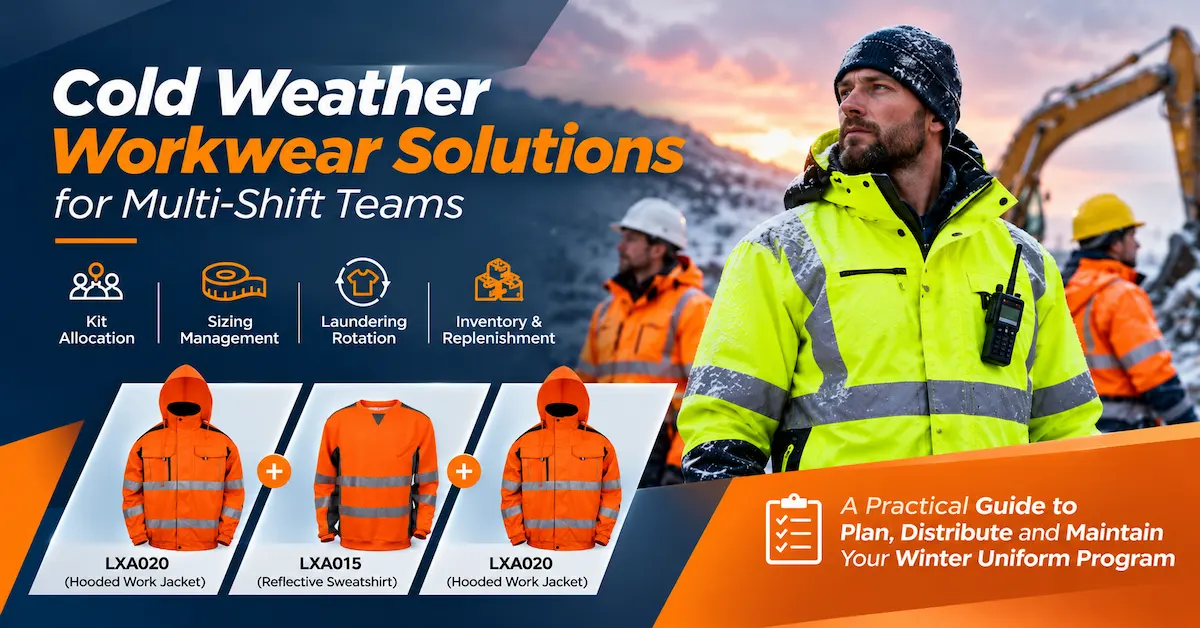
For a specific reference, AOKE presents its LXA020 reflective jacket as an outdoor workwear design incorporating reflective elements and weather-related features.
Buyers should request the exact jacket's material specification, applicable test documentation, and intended usage limitations before making a purchase decision.
8. How to Test Weather Resistant Workwear Samples
For professional procurement, sample evaluation should include more than checking color and appearance.
The objective is to identify practical weaknesses before placing a bulk order.
Recommended Five-Stage Sample Evaluation
Stage 1: Document Review
Confirm the submitted fabric description, construction drawings, garment measurements, test documentation, and intended applications.
Stage 2: Physical Inspection
Examine seam quality, zipper operation, pocket construction, hood adjustment, reflective material placement, and visible workmanship.
Stage 3: Fit and Movement Assessment
Have representative users perform normal movements such as reaching, bending, lifting, walking, and wearing necessary equipment.
Stage 4: Controlled Field Evaluation
Observe the garment in representative working conditions where safe and appropriate.
Record comfort, wind exposure, moisture accumulation, and any obvious leakage concerns. Field trials help assess usability but do not replace standardized laboratory testing.
Stage 5: Post-Laundering Inspection
Following the relevant care instructions, assess dimensional changes, appearance, seam integrity, surface performance, and reflective components where applicable.
Sample Acceptance Record
| Evaluation Area | Acceptance Question |
|---|---|
| Water protection | Does evidence support the specified level? |
| Wind protection | Does the garment satisfy the agreed requirement? |
| Comfort | Can workers perform normal tasks comfortably? |
| Construction | Are seams and closures correctly manufactured? |
| Sizing | Does the garment fit with required layers? |
| Visibility | Is the design appropriate for the identified risk? |
| Laundering | Does it meet agreed post-care requirements? |
| Branding | Are decoration and labels approved? |
The signed sample and technical specification should become references for production.
9. Standards and Compliance for Weather Protective Clothing
When weather-related protection is a workplace requirement, purchasers must distinguish general product descriptions from verified protective performance.
Three relevant standards or standard families are particularly important.
EN 343 — Protective Clothing Against Rain
EN 343 addresses clothing designed to provide protection against rain.
Its assessment includes resistance to water penetration and water-vapor resistance, among other requirements.
When purchasing rain-protective garments for relevant markets, buyers should confirm the applicable standard edition, performance classification, and supporting documentation for the proposed garment.
EN ISO 20471 — High Visibility Clothing
EN ISO 20471 addresses high-visibility clothing intended to improve the wearer's conspicuity.
It includes requirements relating to background materials, retroreflective performance, and garment design.
A jacket cannot be assumed to achieve a particular high-visibility class simply because it includes reflective tape.
ANSI/ISEA 107 — High Visibility Safety Apparel
ANSI/ISEA 107 provides requirements for high-visibility safety apparel relevant to applicable US occupational environments.
Purchasers should confirm the appropriate Type and Performance Class rather than treating all reflective clothing as equivalent.
What Buyers Must Verify
A supplier's general company certification list is not sufficient evidence for every finished product.
Request product-specific records, verify the stated standard and edition, and confirm that materials, sizing, and decorative changes do not invalidate relevant conformity requirements.
For rainwear, remember that a fabric test report may not establish the performance of every assembled seam and opening.
10. OEM Customization and Manufacturing Requirements
Private-label workwear buyers frequently need garments adapted to their own markets, customer requirements, and branding systems.
Customization may involve fabric selection, color combinations, reflective tape arrangements, size grading, pockets, closures, printed logos, labels, and packaging.
However, these changes can influence performance and manufacturing complexity.
OEM Development Checklist
Before approving an order, confirm:
-
The intended working conditions and garment function.
-
The proposed fabric and construction.
-
Required performance tests and documentation.
-
Approved garment measurements and tolerances.
-
Logo placement and decoration method.
-
Component references and substitution rules.
-
Pre-production sample approval requirements.
-
Final inspection and packaging arrangements.
Why AOKE Is Relevant to Outdoor Workwear Sourcing
Jinhua Aoke New Materials Co., Ltd. focuses on reflective clothing and industrial safety apparel.
According to its company profile, AOKE operates manufacturing facilities in Jinhua, Chongqing, and Myanmar, with different production functions supporting customization, reflective clothing, and larger-scale apparel manufacturing.
The company also describes technical sample rooms, garment cutting and sewing operations, and quality-control activities.
These published capabilities provide a starting point for discussions about custom outdoor workwear.
Actual material availability, performance specifications, MOQ, production allocation, and delivery arrangements should be confirmed for each project.
11. How to Control Quality in Bulk Orders
Weather resistant workwear often contains several components that must function together.
Quality control should cover material identification, surface treatments, seams, closures, sizing, reflective components, and packaging.
Key Bulk Production Controls
| Production Stage | Recommended Control |
|---|---|
| Fabric receiving | Check material identity, shade, and agreed performance evidence |
| Cutting | Verify pattern and size accuracy |
| Sewing | Inspect seams, reinforcement, and assembly |
| Seam protection | Check application consistency where required |
| Finishing | Inspect closures, hoods, cuffs, and surface condition |
| Final inspection | Verify measurements, workmanship, and labeling |
| Packing | Confirm size ratios, carton quantities, and identification |
For repeat orders, the supplier should maintain approved material and trim references.
Any proposed change to a membrane, finish, reflective tape, or zipper should be reviewed before production.
This reduces the risk of receiving garments that look similar but perform differently from the originally approved sample.
12. What Determines the Cost of Weather Resistant Workwear?
Weather-resistant garments can vary considerably in price because they use different material systems and manufacturing processes.
The main cost drivers include protective fabric construction, coatings or membranes, seam sealing, insulation, reflective components, garment complexity, customization, testing, and order volume.
A more useful purchasing comparison considers total cost rather than unit price alone.
Total Procurement Cost = Garment Purchase Cost + Testing + Inspection + Freight + Maintenance + Expected Replacement Costs
A lower-cost jacket may be suitable for limited outdoor exposure but become expensive if it requires frequent replacement in demanding environments.
Conversely, the most technically advanced garment may add unnecessary cost if the working conditions do not require its performance.
Practical Cost-Control Strategies
Choose the correct protection level instead of automatically requesting the highest specification.
Standardize common components and colors where appropriate, finalize designs before production, and coordinate seasonal replenishment.
For repeated industrial uniform programs, evaluate replacement frequency and wearer acceptance alongside the initial quotation.
13. How to Request a Weather Resistant Workwear Quotation
A clear RFQ allows suppliers to recommend relevant constructions and identify which requirements need further testing or development.
| RFQ Information | What to Provide |
|---|---|
| Customer type | Distributor, brand, contractor, industrial user |
| Destination market | Country and applicable requirements |
| Work environment | Rain, wind, temperature, humidity, activity |
| Product type | Softshell, rain shell, insulated jacket, other |
| Material requirements | Composition, GSM, finish, performance |
| Safety requirements | Visibility or other specific protection |
| Sizes | Size chart and order breakdown |
| OEM details | Logos, labels, colors, packaging |
| Order volume | Initial order and expected repeat demand |
| Delivery | Destination, schedule, commercial terms |
For international importers, it is useful to provide both a technical specification and an explanation of actual end-user conditions.
This helps manufacturers distinguish necessary protection from optional product features.
Explore AOKE Reflective Workwear Products
Request an OEM Weather Resistant Workwear Quote
Frequently Asked Questions
1. What is the difference between weather resistant and waterproof workwear?
Weather resistant workwear is a broad category covering different levels of protection against outdoor conditions. Waterproof workwear specifically addresses liquid-water penetration under defined requirements. A water-resistant garment should not automatically be treated as suitable for sustained heavy rain.
2. Is softshell workwear suitable for rainy conditions?
Some softshell garments provide resistance to light rain and wind. However, their performance depends on the material construction, finish, seams, and closures. For prolonged rain, buyers should evaluate a garment with appropriate verified rain protection.
3. Which fabric is best for outdoor workwear?
There is no universally best fabric. Woven polyester, laminated constructions, coated materials, and layered systems offer different advantages. The correct choice depends on rainfall, wind, work intensity, comfort requirements, and expected wear.
4. Does waterproof workwear need to be breathable?
Breathability is important for managing moisture generated during physical activity. However, the necessary balance between water protection and moisture transfer depends on the working environment. Both properties should be assessed rather than assuming one automatically guarantees the other.
5. What is EN 343 used for?
EN 343 concerns protective clothing against rain. Buyers use the relevant requirements and performance classifications to assess rain-protective garments for applicable applications. The standard edition and product-specific documentation should be verified.
6. Can weather resistant workwear also be high visibility?
Yes. Weather-related protection and high-visibility performance can be combined in a garment when properly designed and verified. The buyer should confirm the applicable visibility requirements and the specific finished garment's supporting documentation.
7. How should buyers test weather resistant clothing samples?
Buyers should review technical documents, inspect construction, evaluate fit and movement, check the stated performance evidence, and assess laundering behavior. Controlled field evaluations can provide additional practical feedback but should not replace required laboratory testing.
8. Can AOKE provide customized outdoor workwear?
AOKE publicly describes reflective apparel manufacturing and garment customization capabilities. Buyers should contact the company with their intended application, design, material, testing, quantity, and branding requirements to confirm suitable project options.
9. How can businesses reduce the cost of bulk weather resistant workwear?
Businesses can reduce unnecessary cost by matching specifications to real working conditions, standardizing suitable components, finalizing designs early, and planning repeat orders. Total procurement cost should include inspection, care, and expected replacement expenses.
10. What information should I send when requesting an OEM quotation?
Provide the garment type, destination market, weather conditions, order quantity, size range, material requirements, necessary safety standards, customization details, and preferred delivery schedule. This information supports a more accurate technical and commercial discussion.
Conclusion
Selecting weather resistant workwear requires a practical understanding of weather exposure, employee activity, fabric performance, and garment construction.
For construction contractors, logistics operators, municipal services, PPE distributors, and private-label brands, the goal should be to create a clothing system that provides appropriate protection without unnecessary bulk, discomfort, or procurement cost.
The most reliable purchasing approach begins with a weather exposure matrix, continues through measurable material specifications and sample evaluation, and ends with controlled quality requirements for bulk production.
Buyers should distinguish water resistance from waterproof performance, evaluate breathability alongside protective characteristics, and verify relevant standards for the intended working environment.
By focusing on real working conditions rather than broad marketing claims, businesses can make more informed purchasing decisions and improve consistency across their outdoor workwear programs.
AOKE supports international B2B customers with reflective clothing manufacturing and customized workwear development. Buyers seeking weather-appropriate apparel can explore the company's existing range and discuss project-specific technical requirements.
Browse AOKE Workwear Solutions
Contact AOKE for Custom Workwear Development and Bulk Pricing