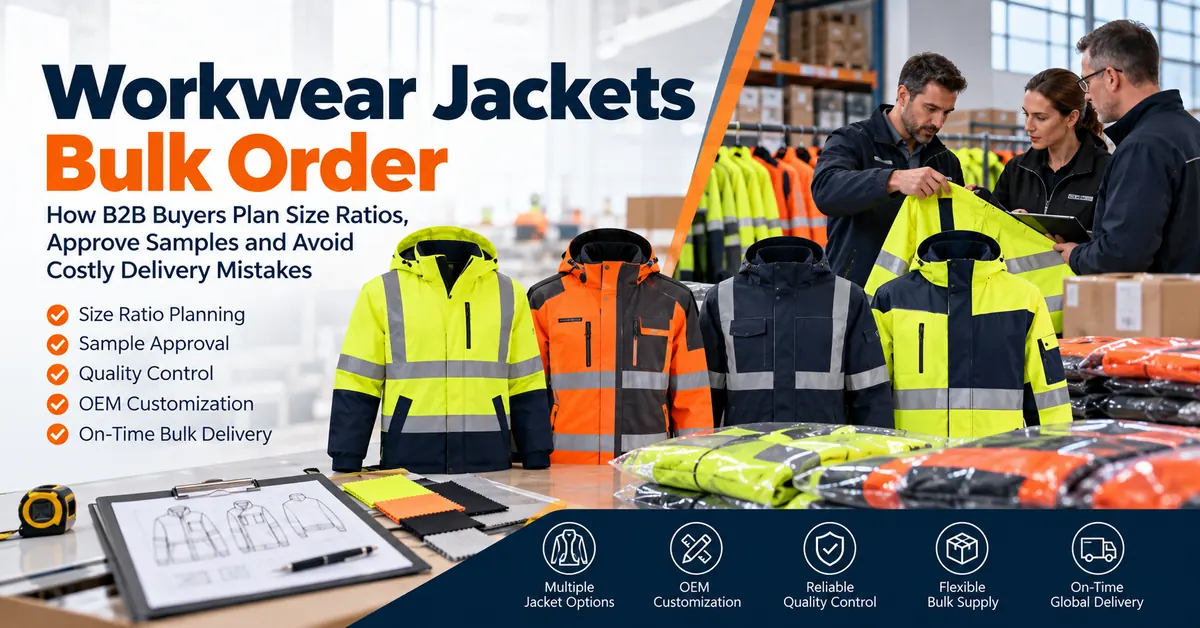
A workwear jackets bulk order can become expensive when buyers focus on unit price but overlook sizing accuracy, fabric consistency, sample approval, and delivery coordination. For industrial uniform programs, a shipment of 1,000 jackets is only successful when the garments match workplace requirements, fit the intended employees, and arrive correctly sorted for distribution.
Quick Answer: To manage a workwear jackets bulk order successfully, buyers should define the working environment, select the appropriate jacket construction, establish a measurable technical specification, calculate the size distribution, approve a pre-production sample, confirm manufacturing milestones, and agree on quality inspection criteria before production starts.
For PPE distributors, construction contractors, industrial purchasing managers, and private-label workwear brands, these steps reduce preventable mistakes while improving long-term procurement efficiency.
This guide explains how to build a practical bulk jacket purchasing plan, compare options, control OEM customization, and work with an experienced manufacturer such as AOKE.
1. Why Bulk Workwear Jacket Orders Require More Planning
Ordering workwear jackets in bulk is different from purchasing ordinary retail outerwear.
Industrial jackets must satisfy requirements associated with workplace conditions, repeated movement, cleaning, durability, and employee comfort. When high-visibility performance is required, reflective materials and fluorescent background fabrics introduce additional design and compliance considerations.
The larger the order, the greater the potential impact of a specification mistake.
For example, a jacket with sleeves that are slightly too short may create limited inconvenience during sampling. However, the same problem across hundreds of garments can generate exchanges, employee complaints, and unexpected replacement costs.
Bulk procurement involves five interconnected decisions: product suitability, material specifications, size distribution, manufacturing consistency, and delivery management.
A reliable supplier should help buyers establish these requirements before confirming the purchase order.
2. Who Should Consider a Workwear Jackets Bulk Order?
Different B2B customers purchase industrial jackets for different operational purposes.
| Buyer Type | Purchasing Requirements | Main Challenge |
|---|---|---|
| PPE distributors | Multiple jacket styles, sizes, repeat supply | Consistent specifications and documentation |
| Workwear wholesalers | Competitive pricing, stock planning, packaging | Inventory and replenishment |
| Construction contractors | Visibility, durability, practical design | Fit and workplace suitability |
| Logistics companies | Lightweight jackets, comfort, easy movement | Seasonal workforce requirements |
| Industrial manufacturers | Reinforced construction, functional pockets | Long-term garment durability |
| Municipal service operators | Weather protection, high visibility | Working conditions and cleaning |
| Private-label brands | OEM designs, custom labels, branding | Product differentiation |
| Corporate procurement teams | Standardized jackets across locations | Size ratios and distribution accuracy |
Buyers seeking disposable rain protection, fashion jackets, or specialized chemical and electrical protective clothing may require a different product specification.
The most important starting question is not “How many jackets do we need?” but “What must these jackets do for the people wearing them?”
3. Which Types of Workwear Jackets Are Suitable for Bulk Purchasing?
The correct jacket category depends on climate, activity level, worksite hazards, and the intended wearing period.
Softshell Work Jackets
Softshell jackets are commonly selected for outdoor maintenance, logistics, and transitional weather.
They can offer flexible construction, wind resistance, and varying levels of water resistance. Performance depends on the specific fabric system rather than the name “softshell.”
High Visibility Reflective Jackets
High-visibility jackets are designed to improve worker conspicuity where visibility is part of the workplace risk assessment.
Selection should consider fluorescent background materials, retroreflective components, garment layout, sizing, and the applicable standard.
Waterproof Work Jackets
Rain jackets are intended for wet environments, including outdoor maintenance, transport yards, and municipal operations.
Important characteristics include fabric water resistance, seam construction, closures, hood design, and moisture-management performance.
Insulated Winter Work Jackets
Winter jackets incorporate insulating components to support thermal comfort in colder conditions.
Buyers should evaluate insulation construction, layering compatibility, wind exposure, and freedom of movement rather than assuming heavier jackets are always better.
Woven Industrial Work Jackets
Structured woven jackets are useful for industrial uniforms where abrasion resistance, reinforced seams, pockets, and repeated laundering are important.
Workwear Jacket Comparison Table
| Jacket Type | Primary Advantage | Typical Application | Main Specification Focus |
|---|---|---|---|
| Softshell | Flexible movement | Outdoor maintenance | Fabric construction and breathability |
| Hi-vis reflective | Improved conspicuity | Roadwork and industrial sites | Relevant visibility standard |
| Waterproof shell | Wet-weather protection | Transport and municipal work | Water resistance and seam protection |
| Insulated jacket | Thermal insulation | Cold-weather outdoor work | Insulation and fit over layers |
| Woven work jacket | Structured durability | Factories and engineering | Fabric strength and workmanship |
A buyer ordering for several departments may need more than one jacket type.
You can examine AOKE's reflective clothing collection and review examples such as LXA020 and LXE025 when discussing possible workwear jacket designs.
Final material specifications and certification details should be confirmed for the exact model.
4. How to Prepare Technical Specifications for Bulk Work Jackets
A professional request for quotation should define measurable requirements.
General descriptions such as “premium fabric,” “heavy-duty quality,” or “fully waterproof” are insufficient because different suppliers may interpret them differently.
Technical Specification Checklist
| Specification | Information to Confirm | Procurement Value |
|---|---|---|
| Fabric composition | Polyester, cotton blend, or selected material | Material consistency |
| Fabric weight | Nominal GSM and tolerance | Comparable quotations |
| Fabric construction | Woven, laminated, or knitted | Application suitability |
| Color | Approved reference and shade tolerance | Uniform appearance |
| Jacket lining | Mesh, fleece, or other specified lining | Comfort and construction |
| Reflective components | Material type, width, position | Visibility design |
| Closures | Zipper type, storm flap, fasteners | Functional reliability |
| Seams | Construction and reinforcement | Durability |
| Waterproof details | Applicable fabric and garment requirements | Rain protection |
| Size specifications | Measurements and tolerances | Fit consistency |
| Branding | Logo method, size, location | OEM accuracy |
| Packaging | Bag, labels, carton configuration | Distribution efficiency |
A technical specification should distinguish required performance from optional design preferences.
For example, a buyer may require improved wind resistance but consider a detachable hood optional.
This distinction helps manufacturers offer suitable solutions without increasing costs unnecessarily.
Material Performance and Construction
For bulk workwear jackets, buyers should examine abrasion resistance, tear strength, dimensional stability, seam strength, and colorfastness where relevant.
If waterproof performance is required, request applicable test information and clarify whether the rating applies to fabric alone or the assembled garment.
A fabric that resists water does not automatically make every completed jacket waterproof.
Similarly, a heavier fabric does not necessarily provide better insulation or durability.
A measurable specification allows buyers to compare products based on performance rather than marketing language.
5. How to Calculate Jacket Size Ratios Before Bulk Production
Size distribution is one of the most underestimated aspects of a workwear jackets bulk order.
Manufacturers may produce accurately against an approved purchase order, but an incorrect size breakdown can still leave the buyer with unusable inventory.
Consider an illustrative order of 600 jackets.
| Size | Order Percentage | Quantity |
|---|---|---|
| XS | 5% | 30 |
| S | 15% | 90 |
| M | 30% | 180 |
| L | 30% | 180 |
| XL | 15% | 90 |
| 2XL | 5% | 30 |
| Total | 100% | 600 |
This is an example calculation, not a recommended universal size ratio.
A buyer should determine actual quantities from employee measurements, historical uniform issuance, regional sizing expectations, and intended layering.
Three Ways to Reduce Sizing Mistakes
Use an approved measurement chart. Define chest, garment length, sleeve length, shoulder width, and other relevant measurements, including tolerances.
Test several sizes. A sample that fits one person does not prove the grading is correct across the entire range.
Consider jackets worn over additional clothing. Outdoor employees may wear sweatshirts or thermal layers underneath their work jackets.
For multinational buyers, US, European, and Asian size labels should not be assumed to represent identical garment dimensions.
The manufacturer and buyer should approve actual measurements rather than rely solely on letter-size labels.
6. Why Pre-Production Sample Approval Matters
A pre-production sample serves as the physical reference for the agreed product specification.
It helps prevent misunderstandings about fabric, fit, reflective materials, construction, branding, and packaging.
Recommended Sample Approval Process
Step 1: Review initial design requirements. Confirm the intended jacket type, working environment, fabric direction, and target market.
Step 2: Develop a representative sample. Use identified materials and construction methods wherever possible.
Step 3: Evaluate fit and function. Check shoulder movement, bending, reaching, zipper operation, pocket accessibility, and comfort.
Step 4: Verify important performance claims. Arrange appropriate testing or document review when specific visibility or weather-protection performance is required.
Step 5: Approve the final reference. Record the sample version, measurements, fabric references, logo placement, and labeling.
Step 6: Release bulk production. Use the approved sample and technical documents as manufacturing references.
A photograph should not replace a physical sample when construction, sizing, or material performance is critical.
For private-label projects, artwork files and approved label designs should also be included in the production documentation.
7. Quality Control Requirements for Large Jacket Orders
Large-volume manufacturing requires inspections throughout production.
Final inspection alone may detect visible defects but cannot always reveal substituted materials, incorrect internal construction, or missing performance documentation.
| Production Stage | Quality Control Focus |
|---|---|
| Material receiving | Fabric identity, shade, reflective materials, trims |
| Fabric cutting | Pattern accuracy, material direction, size allocation |
| Sewing | Stitch consistency, reinforcement, assembly |
| Reflective application | Placement, continuity, attachment |
| Logo application | Position, dimensions, workmanship |
| In-process inspection | Defects and measurement consistency |
| Final inspection | Appearance, dimensions, functionality |
| Packaging inspection | Size labels, quantity, carton identification |
Buyers should establish defect definitions and an agreed sampling or inspection procedure before production.
AQL-based inspection may be appropriate for certain workmanship and packaging defects, but it should not replace mandatory protective-performance verification.
Preventing Repeat-Order Quality Problems
A successful initial shipment should establish a controlled reference for future orders.
The supplier should be able to identify approved fabric, color, reflective components, trims, measurement tables, artwork, and packaging versions.
Any proposed substitution should be reviewed before implementation.
This matters because a replacement jacket delivered six months later should remain consistent with the customer's approved uniform program.
8. Compliance and Safety Standards for Workwear Jackets
Safety requirements depend on product function and destination market.
Common references include:
EN ISO 20471: Relevant to high-visibility clothing where the applicable risk assessment requires that type of warning apparel.
ANSI/ISEA 107: Relevant to high-visibility safety apparel specified for applicable American markets and workplaces.
EN 343: Relevant to protective clothing against rain.
EN ISO 13688: General requirements commonly used alongside specific protective clothing standards.
For special hazards, additional standards may apply.
Importers should verify the applicable editions, target-market regulatory requirements, labeling, technical documentation, and conformity evidence for the exact jacket design.
A reflective component's test result is not automatically evidence that the entire garment satisfies a specified class.
Likewise, an ordinary high-visibility jacket should not be presented as flame-resistant, arc-rated, or chemically protective without appropriate supporting evidence.
When requesting a quotation, specify the required protection and ask which relevant test reports or certificates can be supplied for the proposed configuration.
9. OEM and Private Label Options for Bulk Workwear Jackets
OEM customization is an important purchasing requirement for workwear brands, distributors, and industrial uniform programs.
Possible customization areas include company logos, color combinations, pocket arrangements, size labels, woven labels, packaging, and selected construction details.
Common Branding Methods
| Customization Method | Typical Advantage | Buyer Consideration |
|---|---|---|
| Heat transfer printing | Detailed multicolor graphics | Fabric compatibility and durability |
| Screen printing | Efficient repeat graphics at volume | Design complexity and setup |
| Reflective ink printing | Decorative reflective effects | Must not replace required safety materials |
| Embroidery | Textured, professional appearance | Suitability for selected fabric and protective design |
| Private labels | Brand ownership | Label content and legal requirements |
Availability should be confirmed for the specific jacket and order.
AOKE presents several printing processes on its product pages, including heat transfer and screen printing. Certain techniques or garment configurations may require additional review.
Branding must not compromise required reflective placement, material area, protective performance, or garment functionality.
For large orders, suppliers should confirm the approved artwork and decoration method before manufacturing begins.
10. MOQ, Production Capacity and Lead-Time Planning
A workwear jackets bulk order should be planned around actual manufacturing requirements.
MOQ is project-dependent. A stock-style jacket with a simple logo may have different minimum quantities from a custom jacket requiring newly sourced fabric, patterns, trims, and packaging.
Lead time also varies with material availability, order volume, complexity, inspection requirements, and shipping arrangements.
A practical bulk order schedule includes the following milestones:
| Project Stage | Buyer Confirmation |
|---|---|
| Requirements review | Product specification and destination market |
| Quotation approval | Quantity, price basis, MOQ |
| Sampling | Sample cost and development schedule |
| Pre-production approval | Final sample and technical pack |
| Material preparation | Fabric and trim availability |
| Manufacturing | Planned production milestones |
| Quality inspection | Agreed acceptance criteria |
| Packing | Carton labels and size breakdown |
| Shipment | Logistics terms and dispatch date |
The supplier should specify whether a quoted timeline begins at deposit, material availability, or final sample approval.
AOKE Manufacturing Capabilities
According to its published company profile, Jinhua Aoke New Materials Co., Ltd. operates manufacturing facilities in Jinhua, Chongqing, and Myanmar.
The company reports indicative monthly capacities of approximately 50,000 pieces, 200,000 pieces, and 1.5 million pieces, respectively, across these operations.
Its facilities serve different production requirements, including customized garments, reflective clothing, and larger-scale clothing manufacturing.
These figures describe company-published general capacity rather than guaranteed availability for a particular jacket order.
Buyers should confirm the actual production facility, current schedule, style-specific capacity, and proposed delivery date during quotation.
11. What Determines the Price of Bulk Workwear Jackets?
The lowest quoted unit price does not necessarily represent the lowest procurement cost.
Jacket pricing depends on several interacting factors.
| Cost Factor | Why It Matters |
|---|---|
| Fabric selection | Different materials and finishes have different costs |
| Garment construction | Complex pockets, linings, and reinforcements add labor |
| Reflective materials | Specification and layout affect material requirements |
| Order quantity | Production efficiency varies with volume |
| Size distribution | Unusual grading or proportions can affect material use |
| Branding | Printing, labels, and artwork require setup |
| Testing | Required laboratory verification may add expense |
| Packaging | Individual packing and carton configuration affect costs |
| Shipping | Freight and delivery terms influence landed cost |
Consider the total program cost:
Total Procurement Cost = Garment Cost + Sampling + Testing + Inspection + Freight + Duties + Expected Replacement Costs
This framework is more useful than comparing prices without checking whether suppliers are quoting the same product specification.
A buyer should ask suppliers to identify exclusions, tooling or setup charges, testing responsibilities, and shipping terms.
12. Common Mistakes in Workwear Jackets Bulk Orders
Mistake 1: Ordering Before Confirming Fabric
Risk: The delivered jackets differ from the expected weight, appearance, or performance.
Prevention: Approve material references and measurable specifications.
Mistake 2: Guessing the Size Ratio
Risk: Excess stock accumulates in unpopular sizes while frequently required sizes run out.
Prevention: Use workforce data and representative fittings.
Mistake 3: Approving Only Digital Artwork
Risk: Actual logo placement, materials, or workmanship differs from expectations.
Prevention: Review a representative decorated sample where appropriate.
Mistake 4: Assuming All Reflective Jackets Are Certified
Risk: Purchased garments may not meet the actual workplace or market requirements.
Prevention: Check the finished product's relevant documentation and required classification.
Mistake 5: Leaving Packaging Instructions Until Shipment
Risk: Warehouses receive incorrectly mixed sizes or cartons with unusable labels.
Prevention: Finalize packing instructions before production.
Mistake 6: Ignoring Reorder Specifications
Risk: Later shipments have different shades, components, measurements, or branding.
Prevention: Maintain a controlled specification and approval record.
These risks become more expensive as order quantity increases. Early clarification is usually more efficient than correcting problems after arrival.
13. How AOKE Supports Bulk Workwear Jacket Sourcing
AOKE focuses on reflective apparel and safety workwear for domestic and international business customers.
Its published product range includes reflective jackets, safety vests, shirts, sweatshirts, and other industrial workwear categories.
The company also describes technical sampling facilities, garment production operations, and quality-control activities.
For jacket procurement, buyers can use AOKE's reflective clothing products as a starting point and communicate their required application, target market, specifications, branding, and order quantity.
AOKE's About Us page provides further information about its manufacturing organization and capabilities.
The appropriate jacket configuration, technical documentation, MOQ, manufacturing schedule, and commercial terms should be confirmed on a project-specific basis.
Planning a bulk jacket program? Contact AOKE for a tailored quotation and share your product requirements before requesting sample development.
14. Bulk Workwear Jacket RFQ Checklist
To receive comparable quotations, buyers should prepare the following information.
| RFQ Field | Information to Provide |
|---|---|
| Buyer profile | Importer, distributor, brand, or direct user |
| Destination market | Country and applicable market requirements |
| Jacket type | Softshell, rain, insulated, woven, or hi-vis |
| Application | Workplace, environment, and intended use |
| Fabric requirements | Material, construction, weight, performance |
| Jacket details | Closures, pockets, lining, reflective layout |
| Sizes | Size chart and quantity per size |
| Customization | Logo files, color, labels, packaging |
| Order quantity | Initial quantity and estimated repeat demand |
| Compliance | Applicable standards and evidence required |
| Inspection | Testing and acceptance requirements |
| Delivery | Destination, requested schedule, shipping terms |
A complete RFQ helps suppliers understand the project and reduces repeated clarification.
If your team already has a technical drawing, reference jacket, or approved material specification, include it with the inquiry.
Send Your Workwear Jackets Bulk Order Requirements to AOKE
Frequently Asked Questions
1. What is a workwear jackets bulk order?
A workwear jackets bulk order is a quantity purchase intended for commercial distribution, industrial uniforms, construction teams, or other organized workforce programs. Orders generally require defined specifications, size distributions, inspection arrangements, and coordinated delivery.
2. What is the MOQ for wholesale workwear jackets?
Minimum order quantity depends on the jacket design, fabric sourcing, customization, and manufacturing arrangement. Stock-style jackets and newly developed OEM jackets may have different requirements. Request a project-specific MOQ before confirming the order.
3. Can I order custom logos on work jackets?
Logo customization may include heat transfer, screen printing, or other suitable decoration methods. The supplier should confirm the proposed method for the specific material. For protective clothing, decoration must not compromise required performance.
4. How can I select the correct sizes for a bulk jacket order?
Use actual workforce measurements, the supplier's garment measurement chart, sample fittings, and the intended clothing layers. Confirm size ratios and acceptable measurement tolerances before production.
5. Which jacket fabric is best for industrial use?
There is no universally best material. Softshell, woven, waterproof, and insulated constructions serve different requirements. Buyers should evaluate worksite conditions, movement, durability, weather exposure, and the performance evidence needed.
6. How do I verify high-visibility jacket compliance?
Identify the applicable standard for the target market and intended workplace, then request documents covering the exact garment configuration. Verify relevant classifications, labels, and any changes to the original approved design.
7. Why should I approve a pre-production sample?
A pre-production sample helps confirm materials, dimensions, reflective layout, workmanship, logo placement, and functional details before bulk manufacturing. It also provides a reference for subsequent inspection.
8. How long does bulk workwear jacket production take?
Production time varies with quantity, available materials, sample approval, manufacturing complexity, and the factory schedule. Buyers should request separate estimates for sampling, material preparation, manufacturing, inspection, and shipping.
9. How can I reduce the cost of a bulk jacket order?
Improve quotation comparability by finalizing specifications early, selecting appropriate materials, simplifying unnecessary construction, planning realistic size ratios, and coordinating repeat-order demand. Evaluate total landed and replacement costs rather than unit price alone.
10. How do I request a bulk workwear jacket quotation from AOKE?
Visit the AOKE contact page and provide the jacket category, target market, quantity, size breakdown, technical requirements, customization details, required compliance documents, and desired delivery schedule. These details allow the team to assess suitable options.
Conclusion
A successful workwear jackets bulk order starts with clearly defined requirements and ends with consistent products delivered according to an agreed plan.
For PPE distributors, workwear brands, industrial purchasing teams, and construction contractors, the most important decisions involve jacket suitability, measurable material specifications, accurate size ratios, pre-production sample approval, and controlled manufacturing quality.
OEM branding, packaging, production capacity, and shipping arrangements should be incorporated into the purchasing process rather than addressed after the order has been placed.
By following a structured sourcing approach, buyers can reduce avoidable costs, improve garment consistency, and establish a stronger foundation for repeat procurement.
Looking for a manufacturing partner for your next bulk jacket project? Explore AOKE's reflective workwear range, learn more about its manufacturing capabilities, or contact AOKE to discuss your jacket specifications, OEM requirements, target order quantity, and delivery expectations.