
The phrase reflective vest manufacturer China hides three different supply models. A trading company may source finished blanks from dozens of workshops and add your logo. A vertically integrated garment factory may knit, dye, laminate, cut and sew under one roof. A reflective-materials specialist may produce the retroreflective tape itself and assemble garments from its own component supply. All three can deliver a compliant hi-vis order, but the unit cost, certification evidence, customization ceiling, minimum order quantity and lead time behave very differently across the three routes.
This guide profiles ten hi vis clothing manufacturers and reflective vest suppliers in China by the route each appears best equipped to manage. It is written for PPE importers, workwear distributors, uniform rental companies, safety managers, promotional-product buyers and private-label brands who need bulk custom safety vests that pass EN ISO 20471, ANSI/ISEA 107 or AS/NZS audits the first time. If you are still qualifying suppliers as a category, read our 12-point high visibility workwear supplier scorecard first, then use this shortlist to build your RFQ list.
Publisher, conflict and research disclosure — reviewed October 29, 2026: Jinhua Aoke New Materials Co., Ltd publishes this article, sells reflective vests and hi-vis garments commercially, and funnels readers from this China shortlist to its own product and contact pages, creating a direct commercial conflict of interest even though it is not ranked in the ten entries below. The inclusion order and "best apparent fit" labels are the publisher's editorial judgments based on desk research of supplier-published pages accessible on the review date. They are not an independent award, factory audit, certification review, customer survey, market-share study or identical-RFQ comparison. We did not independently verify every legal entity, factory address, employee count, certificate, test report, capacity, minimum order or price. Supplier descriptions may be outdated or self-stated marketing language. Recheck every candidate with your exact order specification before shortlisting.
Need one China sourcing brief for comparable quotes? Send the destination market, required standard (EN ISO 20471 / ANSI/ISEA 107 / AS/NZS 4601), class, fabric composition and GSM, reflective tape type, garment style, sizes, quantity by color, logo method, packing and required arrival date. Aoke can return its own factory-direct commercial option; use the same released brief with every candidate on this list.
Quick comparison: the 2026 China shortlist
A ranking is only useful when the operating model stays visible. The table therefore states the apparent route, the strongest use case and the question most likely to change your purchasing decision.
| Rank and company | Apparent operating model | Best apparent fit | Buyer must verify |
|---|---|---|---|
| 1. Zhejiang Shunfa Reflective Clothing Co., Ltd (SFVEST) | Jinhua reflective-clothing factory operating since 1997, listed at 501-1,000 employees | High-volume core hi-vis vests and jackets with long factory history | Obtain current EN ISO 20471 test reports for the exact SKU; confirm which fabrics and tapes are in-house versus purchased. |
| 2. Hangzhou Chinastars Reflective Material Co., Ltd | Materials-first manufacturer (reflective fabric, heat-transfer tape, yarn) founded 2003, 501-1,000 employees | Component-grade sourcing and tape-to-garment programs where reflective performance drives the spec | Confirm whether you are buying garments or materials; for finished vests, identify the sewing route and who issues the garment-level certificate. |
| 3. Guarder Safety (Hefei) | Hefei high-visibility apparel manufacturer: vests, jackets, trousers, specialized workwear | Full hi-vis PPE programs across garment types for construction and roadwork channels | Profile is largely self-stated via its sister company's content; request entity documents, certificate holder names and audit reports directly. |
| 4. Hefei Money Safety Co., Ltd. | Hefei reflective apparel producer positioned as sister company to Guarder, with strong OEM/customization messaging | Customized reflective apparel and private-label programs in the Anhui cluster | Confirm production ownership versus the sister entity, MOQ per color, logo methods and which test reports cover which factory. |
| 5. JACKWIN (Nanjing) | Traffic-safety product factory spanning vests, cones and road equipment; fluorescent fabrics published from 60 to 200 gsm | Buyers consolidating vests with wider traffic-safety SKUs in one container | Its published range includes uncertified "promotional" grades; confirm which SKUs carry EN ISO 20471 or ANSI performance evidence. |
| 6. XW Reflective | Hi-vis jacket, vest, bag and reflective-accessory supplier with category pages per end user (workers, cyclists, police, pets) | Multi-category hi-vis accessory orders and niche segments beyond standard vests | Verify jacket waterproofing specs (hydrostatic head, seam taping), class structure per SKU and current certificates. |
| 7. Weallight | Vest and reflective-apparel producer with published product sheets (e.g., 120 g polyester vest, 5 cm tape, EN 471 class 2 references) | Simple mesh-vest price points with transparent published specifications | Its older pages cite the withdrawn EN 471 standard; require testing to the current EN ISO 20471:2013+A1:2016 before ordering. |
| 8. Anbu Safety | Reflective vests plus flame-retardant coveralls, boiler suits and FR jackets, citing EN 11612 and UL for its FR line | Combined hi-vis and FR programs for utilities, oil and gas subcontractors | FR claims involve life-safety risk: verify each certificate's scope, standard edition and whether the quoted SKU is actually inside it. |
| 9. Zhejiang YGM Technology Co., Ltd (Taizhou) | Reflective tape and safety-clothing producer founded 2005, 251-500 employees, 200+ reflective products including FR vinyl | Tape, transfer and garment combos where decoration and reflective components share one supplier | Split component purchases from garment purchases in writing; verify garment-level versus material-level certification separately. |
| 10. HX Safetywear | Factory-direct reflective vest and hi-vis gear manufacturer with open RFQ positioning | Price-sensitive standard vest restocking with basic customization | Request legal-entity and factory evidence (business license, site video, audit scope) before treating a "factory-direct" claim as proven. |
How to use the list: select three to five candidates whose operating model fits your program, then send every candidate the same written specification. Compare approved-sample quality, certificate scope, landed cost and milestone dates. Do not ask a promotional-grade blank supplier, a certified PPE factory and a materials specialist to quote undefined "premium hi-vis vests" and then compare only the headline price.
How we ranked the companies
Method limit: the weights below organize the publisher's desk research of publicly accessible supplier pages, product sheets and third-party company directories reviewed on October 29, 2026. No common questionnaire, blind sample test, factory audit, legal-entity verification or identical landed-cost RFQ was completed across all ten entries. A rank therefore indicates publisher-assessed fit with a typical imported hi-vis bulk program, not measured product quality, service performance, market share or supplier superiority.
Marketing language did not earn points by itself. A named factory route, published performance evidence relevant to hi-vis PPE, clear limitations and useful order-level documentation mattered more.
| Criterion | Weight | What we looked for |
|---|---|---|
| Factory route clarity | 25% | Does the supplier show a real production base, capacity and process ownership rather than only catalog images? |
| Compliance evidence depth | 20% | Are EN ISO 20471, ANSI/ISEA 107 or AS/NZS 4601 claims tied to specific SKUs, editions and test reports? |
| Customization and OEM depth | 20% | Can fabric, GSM, color, tape layout, sizes, labels, packing and logo method actually change? |
| Component and material control | 15% | Is fluorescent fabric and retroreflective tape sourced with specification discipline (glass bead vs prismatic, wash-cycle rating)? |
| Commercial fit | 10% | Are MOQs, stock versus bespoke routes and lead times understandable from public information? |
| Information quality | 10% | Can a buyer identify what to verify without relying on vague superlatives like "leading" or "top quality"? |
Ranking conflict: the publisher selected the criteria, applied the weights and assigned the order while commercially selling a competing China-factory hi-vis service (described later in this article). Treat the ranking only as an editorial assessment. Verify every candidate with the same entity, facility, certificate, sample, test, cost and delivery checks.
1. Zhejiang Shunfa Reflective Clothing Co., Ltd (SFVEST)
Operating model: Jinhua, Zhejiang reflective-clothing factory founded in 1997 and listed by the B2B directory ensun at 501-1,000 employees, describing a wide high-visibility range of vests, jackets and safety gear.
SFVEST is the closest thing on this list to a pure-play reflective-vest institution: nearly three decades of single-category focus in the same city cluster where much of China's hi-vis output is sewn. A dedicated factory of this profile usually holds repeatable mesh-vest tooling, template skills and tape-application experience that mixed-category suppliers cannot match on basic SKUs, and it is a sensible early call for buyers whose program is anchored on volume vests with seasonal jacket extensions.
- Best fit: High-volume core hi-vis vest and jacket programs where category specialization matters more than cross-category consolidation.
- Verify before ordering: Obtain current-year EN ISO 20471 test reports naming the legal entity and the exact model; confirm which fabrics and reflective tapes are in-house versus merchant-sourced, and request the capacity record behind directory-listed employee counts.
2. Hangzhou Chinastars Reflective Material Co., Ltd
Operating model: Materials-first manufacturer founded 2003 in Hangzhou, publicly positioned around reflective fabric, heat-transfer reflective tape and reflective yarn, with garment applications described as the downstream use case.
Chinastars matters to vest buyers for a different reason than a sewing factory does. Retroreflective performance is bought at the tape and fabric level long before the vest is cut; suppliers whose component supply is transparent make it easier to specify wash-cycle ratings, coefficient-of-retroreflection values and colorfastness in a tech pack. For brands developing private-label hi-vis lines, a materials-led supplier can shorten the loop between performance specification and actual garment behavior after repeated laundering, which is where cheap vests most often fail audits.
- Best fit: Component-grade sourcing and tape-to-garment programs where retroreflective performance drives the purchase decision.
- Verify before ordering: Separate component purchases from finished-garment purchases. If you order finished vests, name the sewing facility, the certificate holder and the standard edition applying to the garment, not only to the tape.
3. GUARDER SAFETY (Hefei)
Operating model: Hefei-based high-visibility safety apparel producer publishing vests, jackets, trousers and specialized workwear for construction, transportation and emergency-response sectors.
Guarder presents a full hi-vis garment system rather than a single vest line, which fits distributors who need one supplier to cover class 2 vests, class 3 jackets and trousers for the same tender book. Its public story is told mostly through its own website and its sister company's content, so the profile here is closer to supplier self-description than third-party assessment — a normal condition in this industry, but one that should convert into document requests during RFQ rather than accepted as evidence.
- Best fit: Multi-garment hi-vis PPE programs for construction and roadwork distribution channels in the Anhui cluster.
- Verify before ordering: Request legal-entity documents, certificate holders per product family, audit reports, and confirmation of which production hall runs your order. Cross-check sister-company claims so certificates are not borrowed between entities.
4. Hefei Money Safety Co., Ltd.
Operating model: Hefei reflective apparel producer, described publicly as a sister company of GUARDER SAFETY, publishing custom and standard reflective apparel plus a working B2B content library on OEM models, fabric choice and landed-cost calculation.
Sum Safety's published buying guides (OEM versus ODM, fabric selection, imported-PPE landed cost) indicate a commercial team accustomed to talking to importers in specification language, which usually makes sampling rounds more efficient. Its catalog emphasis on customization fits event, promotion and light-duty industrial programs, while heavier certified workwear categories still require the same document discipline described in our heavy duty workwear durability test plan.
- Best fit: Customized reflective apparel and private-label programs that want supplier-side specification support during development.
- Verify before ordering: Confirm which entity actually sews and finishes your goods, MOQ per color and size curve, logo method limits, and which test reports cover the shipping factory rather than only the trading entity.
5. JACKWIN (Nanjing)
Operating model: Nanjing traffic-safety factory whose public catalog spans safety vests, traffic cones and work-zone equipment, publishing fluorescent fabric options from 60 gsm to 200 gsm and reflective webbing in T/C, polyester and nylon with low-, medium- and high-visibility tape tiers.
JACKWIN's published transparency on GSM tiers and tape classes is genuinely useful for buyers who must hit a target price without pretending uncertified material is certified. The practical risk sits in the same feature: a supplier that openly sells promotional-grade and performance-grade tiers on one page will quote whichever tier matches your words, not your audit. Write the required class and tape grade into the purchase order line itself.
- Best fit: Consolidated containers of vests plus wider traffic-safety SKUs (cones, barriers, accessories) from one commercial team.
- Verify before ordering: Confirm which SKUs carry EN ISO 20471 or ANSI/ISEA 107 test evidence versus fashion/promotional grade; obtain the wash-cycle rating of the specified tape tier and a signed pre-production sample.
6. XW Reflective
Operating model: Hi-vis jacket, vest, bag and reflective-accessory supplier organizing its catalog by end user — road workers, cyclists, police, pedestrians and even pets — with wholesale positioning and waterproof jacket lines.
Category breadth by end user is a signal of an adaptable sample room: products for cycling, law enforcement and pet safety demand different silhouettes, carrier systems and tape layouts than a standard mesh vest. That makes XW a practical comparison quote when your program reaches beyond core construction vests into cycling apparel, security ranges or promotional hi-vis accessories, where few certified-workwear factories want small mixed orders.
- Best fit: Multi-category hi-vis accessory and niche-segment orders where silhouette variety matters more than single-SKU volume.
- Verify before ordering: For waterproof jackets, obtain hydrostatic-head and breathability figures plus seam-taping method; for garments claiming a visibility class, require the test report for that exact model and colorway.
7. Weallight
Operating model: Reflective apparel producer publishing concrete product sheets — for example a 120 g 100% polyester mesh vest with 5 cm reflective tape and color options — at promotional through industrial price tiers.
Weallight's published spec sheets are useful teaching material for every China buyer, in both directions. Good: itemized material, tape width and color data make quote comparison possible at all. Caution: some of its legacy pages reference EN 471, the European standard withdrawn and replaced by EN ISO 20471:2013 (amended 2016). A supplier still quoting EN 471 in 2026 may hold current certificates or may simply have not updated its content — but it is exactly the signal that should trigger a document check before you print the class label on your own catalog.
- Best fit: Simple mesh-vest restocking at transparent published specifications and competitive price points.
- Verify before ordering: Require testing to current editions (EN ISO 20471:2013+A1:2016 or ANSI/ISEA 107-2020), confirm tape grade and wash-cycle rating, and check whether quoted prices include certified tape or a lower-cost decorative alternative.
8. Anbu Safety
Operating model: Safety-apparel factory combining reflective vests with flame-retardant coveralls, boiler suits, fire-resistant vests and police-style jackets, publicly citing EN 11612 and UL evidence for parts of its FR range.
Utilities, energy contractors and industrial maintenance buyers increasingly source hi-vis and FR from one vendor, because both must arrive against the same tender with the same documentation discipline. Anbu's published FR certification references suggest it is comfortable in that document-heavy lane. Life-safety categories deserve the strictest gate of any on this list: a certificate that exists but does not name your SKU, your colorway or the current standard edition is a failed certificate for your order.
- Best fit: Combined high-visibility plus flame-resistant programs for utilities, oil and gas and public-sector contractors.
- Verify before ordering: Pull every cited certificate to its scope page; confirm standard edition, notified-body identity for CE categories requiring it, and whether the FR treatment is durable after the claimed wash cycles.
9. Zhejiang YGM Technology Co., Ltd (Taizhou)
Operating model: Taizhou reflective-tape and safety-clothing producer founded 2005, listed at 251-500 employees, publishing more than 200 reflective products including reflective vinyl for apparel and fire-risk applications.
YGM sits where component manufacturing meets garment decoration. Buyers who need branded hi-vis — transfer logos, custom tape layouts, numbers and back prints — often discover that the garment factory and the decoration-material factory blame each other for cracking, delamination or reflectivity loss after washing. A supplier that controls the decoration material itself can, with the right contract wording, take single-point responsibility for the finished look after laundering.
- Best fit: Branded hi-vis programs where transfer decoration, custom reflective layout and garments should come from one accountable component-to-product chain.
- Verify before ordering: Separate material certification from garment certification in writing; require wash tests on decorated samples (not plain fabric swatches) and define cracking, peeling and gloss failure criteria before bulk.
10. HX Safetywear
Operating model: Reflective vest and hi-vis gear manufacturer with explicit factory-direct, get-a-quote positioning centered on the vest category.
The final slot represents a large population of credible but lightly documented Zhejiang and Jiangsu vest factories: competitive standard vests, fast sampling, direct pricing, and public information thin enough that due diligence falls entirely on you. For a first trial order of uncertified promotional vests this can be efficient; for certified PPE the same low friction becomes a risk unless documentation is pulled early. Our supplier qualification scorecard is designed precisely for this tier of candidate.
- Best fit: Price-sensitive standard vest restocking with basic logo customization and short sampling loops.
- Verify before ordering: Business-license entity match, real factory video or third-party audit, certificate copies naming the shipping entity, and reference contacts for repeat export customers in your market.
Read the standard before you read the price list
Almost every bad bulk order in this category starts the same way: the buyer quoted a garment, the supplier quoted a fabric, and the customs or safety audit compared them to a standard neither had specified. Three standard families decide almost all China-export hi-vis programs.
EN ISO 20471 (Europe and UK-cited markets)
EN ISO 20471:2013+A1:2016 defines fluorescent background colors (yellow-orange, orange, red-yellow), retroreflective performance and the minimum areas of background and reflective material per class. The widely published classification table sets minimum background material at roughly 0.14 m² for class 1, 0.50 m² for class 2 and 0.80 m² for class 3, with retroreflective band minima of about 0.10, 0.13 and 0.20 m² respectively. In the European Union, high-visibility garments are Category II PPE under Regulation (EU) 2016/425: they require an EU type-examination certificate from a notified body plus ongoing production-conformity arrangements — a lab test report alone is not CE marking. Ask for the type-examination certificate number and the notified body's identity, then check the body against the European Commission's published NANDO list.
ANSI/ISEA 107 (United States and Canada-cited markets)
ANSI/ISEA 107-2020 classifies by garment type (O for off-road, R for roadway, P for public safety) and class 1-3, with different background-area and reflective-configuration requirements, including placement patterns rather than raw area alone. A vest that passes EN ISO 20471 class 2 is not automatically ANSI class 2 compliant; reflective band placement and configuration rules differ. If your customer is a US contractor or municipality, spec the ANSI edition, type and class in the PO line item.
AS/NZS 4601 and class labels
Australian and New Zealand buyers work to AS/NZS 4601 (with AS/NZS 1906 covering retroreflectometer testing), classifying garments by direction (R reversible / N non-reversible), size class and duty class (D durable / S temporary). The practical implication for RFQs is that size grading affects compliance: a class threshold met on size L can fail on size S because area scales with garment size. Require test reports on the smallest size in your size curve, not the sample you happen to like.
| Program driver | Europe (EN ISO 20471) | USA (ANSI/ISEA 107-2020) | Australia/NZ (AS/NZS 4601) |
|---|---|---|---|
| Class logic | Class 1-3 by background + tape area | Class 1-3 by area + reflective configuration, Type O/R/P | Duty class D/S, direction R/N, size class S/M/L/XL |
| Third-party gate | EU type examination (Cat. II) + notified body production control under Reg. (EU) 2016/425 | Manufacturer self-certification to the standard, buyer-side spec verification common | Test reports typically required by importer/contractor specs |
| Most failed check in bulk audits | Tape area/placement changed without re-test; wash-cycle performance claims unsupported | Class 2 tape configuration wrong (band spacing, circumference) | Smallest graded size falls below area thresholds |
Two labels that do not mean what buyers think they mean: OEKO-TEX STANDARD 100 certifies that textile components are tested for harmful substances — it says nothing about visibility performance. GRS (Global Recycled Standard) certifies recycled-content chain of custody — it does not certify retroreflection. A compliant hi-vis program usually needs performance testing (EN ISO 20471 / ANSI / AS-NZS) and, only where required by the program, substance or recycled-content certificates side by side.
Choose the supplier model before requesting prices
Shortlisting by project route prevents false comparisons. The same company can be excellent on one route and inefficient on another — and China-specifically, dual-base production (mainland plus Myanmar or Cambodia sewing) is now a tariff and duty-preference decision as much as a cost decision.
| Project route | Best use | Questions that belong in the RFQ |
|---|---|---|
| Stock blanks + logo print | Events, promotions, urgent restock, low MOQ per color | Which blank SKUs are in stock now, tape grade of the blank, decoration method durability, dispatch date |
| Bespoke OEM production | Private-label programs, class 3 jackets, size-curve retail packs | Fabric booking, lab-dip colors, tape placement drawings, sample rounds, inspection level (AQL), certificate holder |
| Certified PPE program | EU tenders, contractor supply, insurance-audited fleets | Notified body, type-examination number, production-conformity audit, batch traceability, wash-cycle evidence |
| Duty/tariff-managed sourcing | US/EU buyers exposed to Section 301 or anti-circumvention risk | Country of origin per PO, final sewing location, fabric origin, applicable duty ruling basis |
| Multi-category consolidation | Distributors mixing vests, jackets, rainwear, cones, accessories per container | Which SKUs are self-made versus trader-supplied, and who owns QC on each |
What actually drives your landed cost from China
Buyers searching reflective vest price per unit, safety vest bulk cost or how much do custom hi vis vests cost usually receive a single FOB number and compare it wrongly. The honest cost stack for a certified program looks like this:
- Fabric and tape specification. A 120 gsm polyester mesh with class-2 glass-bead tape and a 190 gsm knitted fluorescent with prismatic 360° tape can differ several times over in material cost alone. Prismatic tapes hold higher coefficients of retroreflection and survive more wash cycles; the wash-cycle rating printed on the test report is a cost item, not a courtesy.
- Certification and testing. EN ISO 20471 type examination, notified-body fees, and per-colorway/per-size testing are real line items. A quote 3 cents cheaper that quietly swaps certified tape for decorative tape is not cheaper — it is a different product with a customs-risk tail.
- MOQ structure. Standard practice clusters around low thousands per colorway for bespoke fabric, with stock-blank logo programs viable far lower. Ask each candidate to quote at 1,000 / 3,000 / 10,000 pieces so tiered pricing becomes comparable.
- Compliance-adjacent labor and audit. BSCI or equivalent social audits, metal detection, and child-labor-free supply attestations carry annual fees amortized into unit price; retailers with ethical-procurement mandates should expect and demand them.
- Freight, duty and origin. Garments travel cheaply per unit, but duty classification and origin rules can swing landed cost more than ocean freight. Where dual-country production is offered, get the origin basis in writing per PO.
- Failure costs. The largest hidden number is the failed batch: reinspection, air-freight recovery, tender penalties. Inspection at 20% and 80% production, with golden samples sealed on both sides, is the cheapest insurance in this category.
Enterprises comparing China versus Vietnam versus Bangladesh for hi-vis should note a category-specific fact: China's enduring advantage in reflective apparel is not labor cost but the component ecosystem — fluorescent yarn, knitted fluorescent fabrics and certified retroreflective tape are produced at scale inside a few-hour radius of the sewing clusters in Zhejiang, Jiangsu and Anhui, which shortens fabric-to-sample loops from weeks to days for bespoke programs.
Send a controlled RFQ, not a photo
The safest shortlist runs on one written product definition. If a supplier changes material, tape or packing to hit a target price, the change must appear as an alternate quotation line, never as a silent substitution. Use the block structure below, and align approval with our bulk-order size-ratio and sample-approval guide so the size curve is planned before, not after, production.
| RFQ block | Minimum information | Why it matters |
|---|---|---|
| Product identity | Style name, finished dimensions by size, closure, pockets, breakaway or zip front, intended use hours | Prevents five suppliers quoting five different garments under one name |
| Compliance target | Standard + edition + class + type (e.g., EN ISO 20471:2013+A1:2016 class 2; ANSI/ISEA 107-2020 type R class 2), smallest-size test requirement | Makes certificates comparable and legally usable at your destination market |
| Material | Fabric composition, weave/knit, finished GSM, fluorescent colorway ( Pantone-level reference), tape type (glass bead / microprismatic), wash-cycle rating | Turns sustainability and performance claims into measurable line items |
| Decoration | Artwork file, logo size and placement, method (screen / transfer / embroidery), tape-over-print permissions, wash/rub expectation | Separates a quick logo print from an engineered, audit-surviving graphic |
| Commercial basis | Quantity per SKU/color, price tiers (1k/3k/10k), sample fees, tooling, Incoterm, packing (poly-bag per piece, inner, carton count), required ship date | Enables true landed-cost and timing comparison |
| Quality evidence | Golden sample retention, AQL level, defect classification (critical/major/minor), test plan, third-party inspection rights, corrective-action owner | Converts sample approval into a repeatable bulk standard |
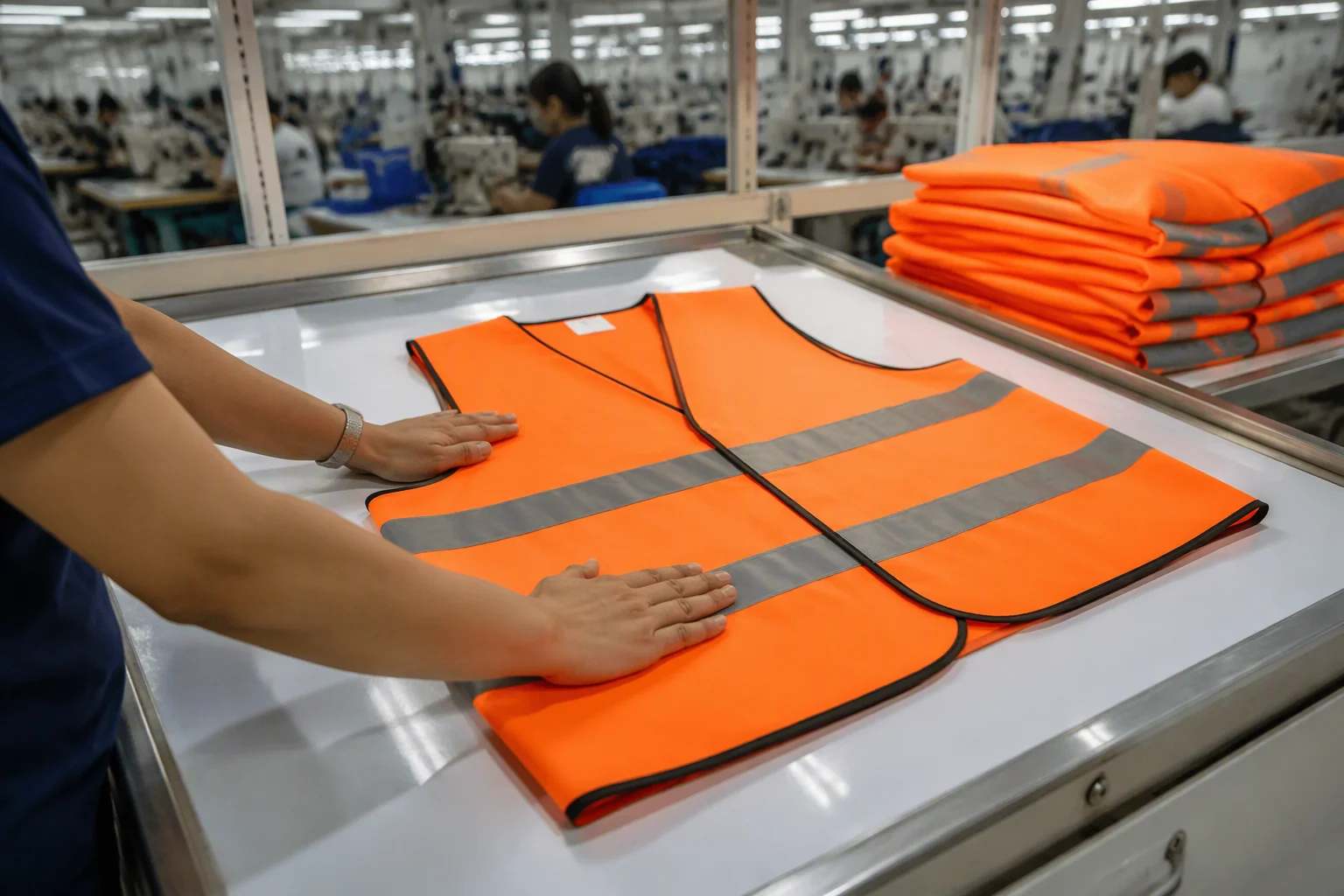
Illustrative image: pre-shipment inspection of reflective band placement on a hi-vis vest. Final inspection criteria should be defined in your RFQ, not left to the factory floor.
Why compare Jinhua Aoke (publisher of this guide)?
Claim boundary: the following section is publisher self-description and a commercial factory-direct option outside this ranked list. It does not independently prove factory ownership, certification validity for your exact order, capacity, price, lead time or superiority; verify all of it through the same evidence gates you apply to every candidate.
Jinhua Aoke New Materials Co., Ltd has manufactured reflective and high-visibility apparel since 2010 and states a customer base of 300+ domestic and overseas clients with a 98% return-cooperation rate and a top-five position in China's reflective clothing industry, per its own company profile. Its public structure is useful as a specification benchmark for the three-factory operating model described at the top of this article:
- Jinhua factory (Zhejiang) — ~50,000 pieces/month with ~50 stitching workers, positioned for small orders and high-customization programs and sample-room development.
- Chongqing factory — ~200,000 pieces/month across all reflective clothing categories for mid-scale production.
- Myanmar factory — ~1.5 million pieces/month, ~1,000 stitching workers, 20 sewing lines, ~70% template-machine automation, 3 automatic cutting lines, offering a second-country origin route for duty-managed programs.
Product certifications published on its site include EN ISO 20471, ANSI, AS/NZS, OEKO-TEX 100, EN 1149, EN 11612, EN 14116, UL and NFPA 2112; factory-system certifications include OEKO-TEX 100, GRS, ISO 14001, ISO 9001 and BSCI. Two dedicated sample rooms reportedly launch 10+ new styles annually. Review the company profile, browse current products or the reflective clothing range, then compare a proposal against the ten candidates above on the same released specification, certificate scope, sample, tests, landed-cost basis and inspection plan.
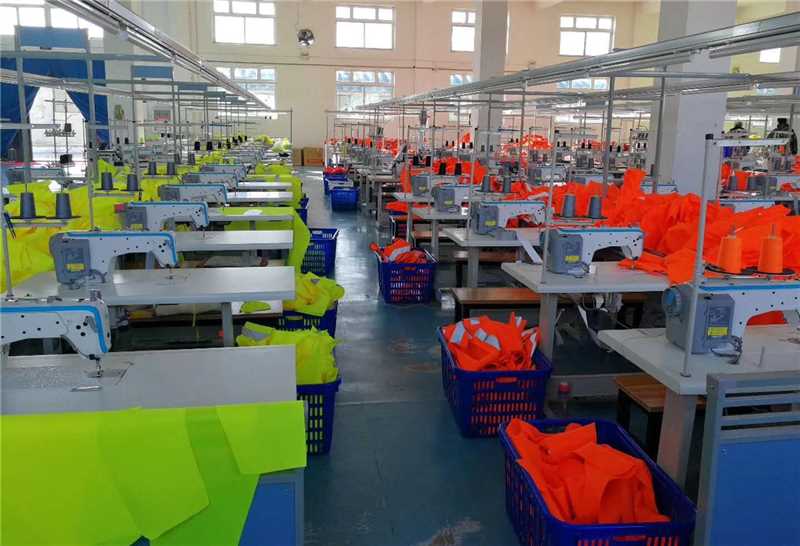
Jinhua Aoke's Jinhua facility, used for small-batch and high-customization reflective orders (source: publisher's own factory page).
Frequently asked questions
Is one vest certificate valid for both EN ISO 20471 and ANSI/ISEA 107?
No. They are separate standard systems with different area thresholds, reflective-configuration rules and conformity routes. Some factories hold test reports for both standards on similar garments, but compliance is per standard, per class/type, per colorway and per size. Ask which specific report covers your exact SKU.
Should I buy class 2 or class 3 reflective vests?
Class 2 typically covers daytime roadwork-adjacent and urban traffic environments at moderate speeds; class 3 adds background and reflective area (usually full-sleeve band configurations) for high-speed or low-visibility work and is the default spec for many highway and night crews. Many distribution programs stock both: class 2 vests as the volume SKU, class 3 jackets seasonally. Specify by the end customer's risk assessment, not by price.
What MOQ and lead time are realistic for custom hi-vis vests from China?
From public market patterns: stock-blank decoration programs can start in the hundreds of pieces with 1-2 week dispatch, while bespoke fabric/colorway programs typically run to low thousands per colorway with 4-8 weeks production after approved sample, plus shipping. Every candidate in this list should be asked for both stock and bespoke lead times in writing, in the same email.
How do I verify an EN ISO 20471 certificate is real?
Three steps: (1) obtain the certificate PDF and confirm the certificate holder's legal name matches the shipping entity; (2) for EU-market PPE (Category II), locate the notified body on the European Commission's NANDO list and check the type-examination number format; (3) request the full test report and confirm the tested size includes your smallest graded size and the tape manufacturer/model named on the hangtag. A supplier who resists document sharing at RFQ stage has answered your question already.
Why do reflective vests fail audits after a year of service?
The dominant failure is retroreflective degradation: decorative-grade tape applied to pass the original test but rated for fewer wash cycles than service life demands, or tape edges lifting on curved torso panels. Prevent it contractually: specify the tape's wash-cycle rating and coefficient of retroreflection in the tech pack, test decorated production samples (washed 5+ cycles) before bulk approval, and keep sealed golden samples.
Is GRS recycled hi-vis clothing worth the premium?
Only if your buyer program requires verified recycled content and you can validate the chain: ask for the supplier's GRS certificate scope (does it cover the mesh fabric, the tape carrier, the trims?), transaction certificates per shipment, and recycled-percentage claims that match the TC volume. Without a transaction certificate per order, a "made from recycled polyester" line is marketing, not documentation.
How do I tell a trading company from a real factory in China?
Ask four questions whose cost of lying is high: Which hall and line will run my order? Which fluorescent-fabric mill and which tape model? Show me the pre-production sample room on a live video call this week. Who employs the QC staff that will sign my inspection? A real factory answers with names and numbers within one day; a trader negotiates the conversation. Cross-check the business license scope via the National Enterprise Credit Information Public System (GSXT) against the entity on the certificates.
Do I need third-party inspection for bulk vests?
For any audited end market or fleet program: yes — inline inspection at 20-80% completion plus final random audit against a signed AQL plan, with tape-placement measurement, colorfastness check and retroreflectometer spot tests where the budget allows. Inspection cost is typically well under 1% of an order's value; a rejected container is 100% of it.
Build the shortlist, then control the specification
China remains the deepest single market for reflective vests and hi-vis workwear because the entire component chain — certified tape, fluorescent fabric, template automation and multi-country finishing — sits inside one ecosystem. The buyers who win with it are not the ones who find the lowest quote; they are the ones who convert every quote into the same released specification, the same certificate-scope check and the same inspection plan. Use this shortlist to select three to five candidates, run the RFQ blocks above unchanged for every one of them, and keep this page open while you read the replies.
Next step: send Aoke's team your released specification for a factory-direct proposal (or start from the inquiry center), compare it side by side with the ten candidates above, and let the evidence — not the headline unit price — decide the order.
Research basis: company descriptions in this article summarize supplier-published pages and third-party directory listings accessible on October 29, 2026, including supplier websites and the ensun company directory. Standard descriptions summarize EN ISO 20471:2013+A1:2016, Regulation (EU) 2016/425, ANSI/ISEA 107-2020 and AS/NZS 4601 as published by their issuing bodies. Supplier claims, certificates and commercial terms change without notice; verify current status with each candidate and with notified bodies before placing orders. This article is editorial guidance for B2B buyers, not legal or compliance advice.