
Quick Answer: What makes heavy duty workwear clothing worth buying?
The best heavy duty workwear clothing is not necessarily the heaviest. It is clothing whose fabric, seams, fit, pockets, closures and care performance match the stresses of a specific job. Industrial buyers should identify likely failure points, approve a measurable sample specification, test garments after realistic washing and movement, and compare replacement cost rather than purchase price alone.
Two jackets can look equally substantial on a product page yet behave differently after ten weeks in a workshop. One may retain its shape while the other develops fraying cuffs, loose pocket corners or a zipper that catches. These problems affect employee acceptance, reorder schedules and the real cost of an industrial uniform program.
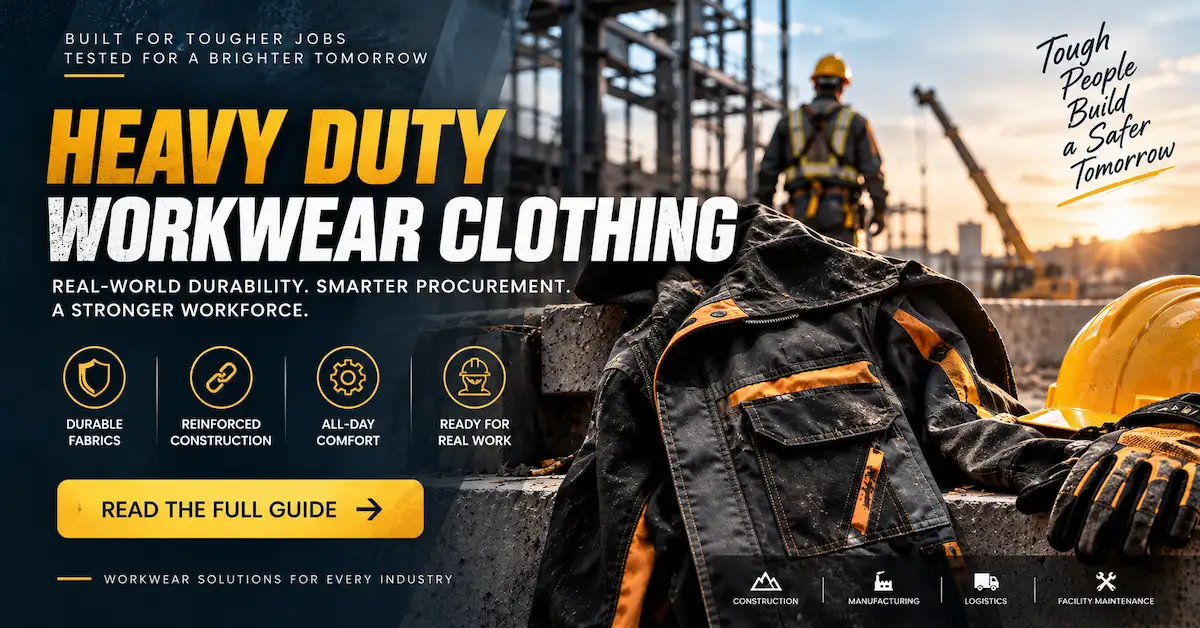
This guide is for PPE distributors, workwear brands, plant procurement teams, contractors and facility managers buying durable uniforms for repeated use. Instead of another broad supplier-selection article, it provides a practical field-validation method: define the job, predict failures, set acceptance criteria, examine the sample and document the result before placing a bulk order.
Need to develop a durable industrial uniform?
Send AOKE your work environment, reference garment, target order quantity and performance priorities for a project-specific discussion.
Discuss Your OEM Workwear Project →1. Heavy Duty Means Job-Specific Durability, Not Just Thick Fabric
"Heavy duty" is a commercial description, not a universal safety certification or a fixed grams-per-square-meter (GSM) threshold. For one team, durability means resisting abrasion at the knees. For another, it means surviving daily industrial laundering without unacceptable shrinkage. For outdoor crews, the weakest point may be the cuff, rainwear seam or reflective attachment.
Start by writing a one-sentence use case: "Technicians kneel on workshop floors, carry small tools and wear the uniform for five shifts between washes." That sentence makes requirements more meaningful than asking for the "strongest fabric." A garment that is unnecessarily stiff or hot can hinder movement and reduce consistent wearing.
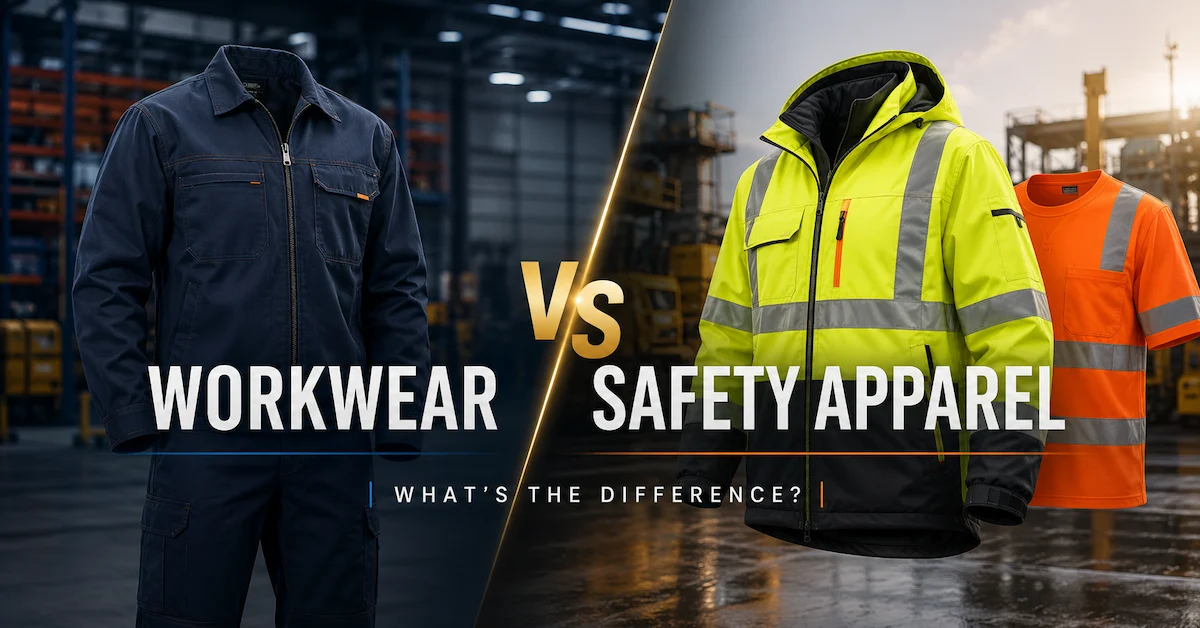
Separate mechanical durability from hazard protection. Ordinary heavy duty industrial workwear does not automatically protect against flame, electrical arc, chemicals or moving machinery. Where those hazards exist, the employer must identify appropriate protective garments and verify the relevant product-level evidence.
2. Match Common Garment Failures to the Worksite
Instead of buying one uniform for every department, map the contact surfaces, movements and washing conditions of each role. This table is a starting point for a site assessment, not a substitute for an occupational risk evaluation.
| Work Environment | Likely Failure Point | What to Specify and Check |
|---|---|---|
| Construction & installation | Knees, hems, tool pockets | Targeted reinforcement, pocket load test, kneeling fit |
| Industrial maintenance | Crotch seam, elbows, closures | Crouching mobility, seam strength, fastening cycles |
| Warehouse & logistics | Pocket edges, cuffs, wash appearance | Abrasion, fit across shifts, repeat-wash stability |
| Road maintenance | Reflective trim, soil, weather exposure | Visibility design, attachment and care requirements |
| Outdoor utilities | Shoulders, cuffs, layering, closures | Full-range motion, glove operation, suitable weather protection |
A simple improvement is to ask the site supervisor for the three most frequent garment complaints. Record the location, task and time-to-failure. This creates a more useful garment brief than generic phrases such as "premium quality" or "extra strong."
3. Choose Fabric by Performance Evidence, Not GSM Alone
GSM describes fabric mass per area; it does not directly prove tear strength, abrasion life or comfort. A dense, moderately weighted twill may be more practical for active workers than a substantially heavier cloth that restricts movement. Fabric performance also depends on yarn type, weave, finishing, washing and garment construction.
Cotton-rich canvas and duck fabrics
These can be considered for structured garments and friction-prone tasks. Ask about hand feel, shrinkage, abrasion behavior and drying requirements. A heavy cotton garment may be unsuitable for a hot, continuously active team even when mechanical performance is acceptable.
Polyester-cotton twill and blended fabrics
Blends allow designers to balance appearance, care characteristics and mechanical properties. However, the fiber percentage alone cannot establish durability. Compare proposed fabrics under the same test method and laundering conditions.
Stretch-woven workwear
Stretch construction can improve crouching and reaching comfort. Buyers should examine stretch recovery, seam behavior and dimensional change after care. A fabric that feels excellent when new may still lose fit if its components are not appropriate for the laundering program.
Procurement rule: Request composition, nominal GSM, weave or construction, finish, approved shade and relevant test results as one fabric specification. Never approve material by weight or a swatch photograph alone.
4. Inspect Garment Engineering Where Failures Actually Begin
Fabric is only one part of heavy duty workwear clothing. A stronger panel will not rescue an underbuilt pocket opening or a poorly balanced pattern. During sample review, pay attention to the following components:
- Seams: Examine stitching consistency, seam allowance, thread and the way joints withstand bending. Ask whether the seam method suits the fabric and expected stress.
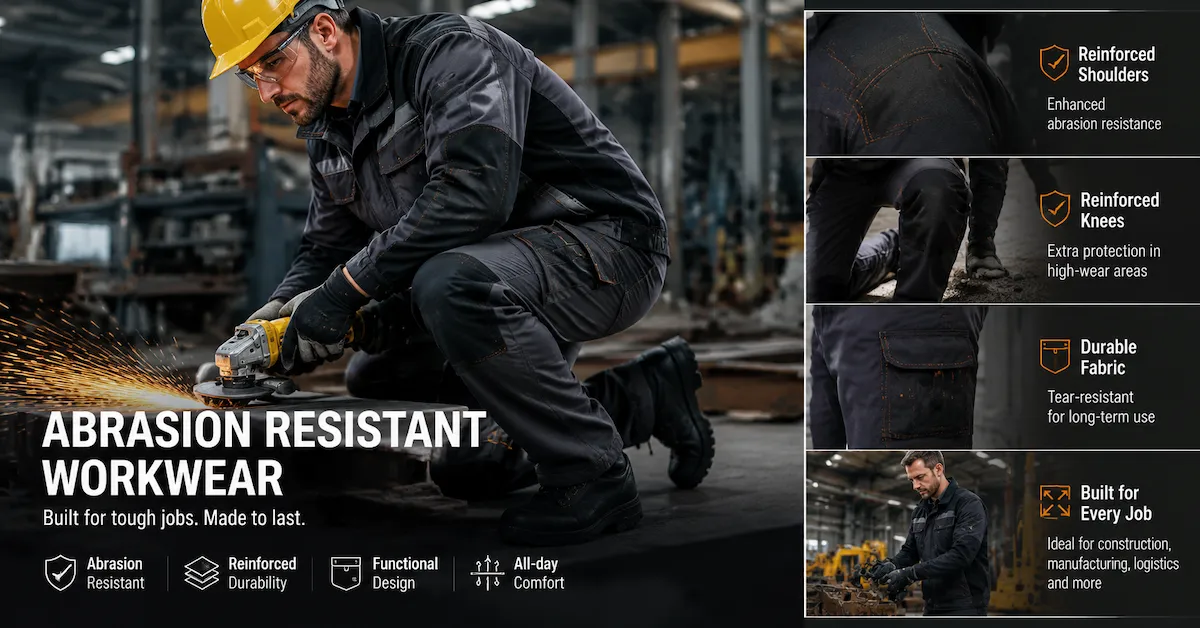
- Stress-point reinforcement: Evaluate pocket corners, belt loops, crotch intersections, elbows and knees. Bar tacks or patches should support a clear function rather than simply decorate the garment.
- Closures: Check zipper movement, snap retention, button attachment and glove accessibility. Repeated operation is more informative than opening a new jacket once.
- Fit and movement: Test kneeling, lifting, overhead reaching, sitting and walking. Inspect where fabric pulls or the waistband shifts.
- Internal workmanship: Look for sharp edges, rough seam ends, loose threads and trim that rubs against skin or adjacent equipment.
Reinforcement should be selective. Extra panels everywhere can add heat, weight and stiffness without solving the main cause of failure. Related material-level guidance is available in AOKE's abrasion-resistant workwear guide; the next step is to validate an actual garment.
5. Run a Three-Stage Durability Trial Before Bulk Approval
Use the same approved reference garment, documented care conditions and inspection form throughout the trial. Define the number of samples, wash cycles, wear period and rejection criteria before testing. There is no universal trial duration suitable for every job or hazard.
Stage A: Initial sample inspection
Photograph each garment under consistent lighting. Record the measured chest, waist, inseam, sleeve and other critical dimensions. Examine pockets, seam intersections, reinforcement placement, trim operation, shade and visible manufacturing defects. Record which features must match the approved sample in bulk production.
Stage B: Controlled wash and function checks
Apply the agreed washing and drying procedures. Measure key points again and note shrinkage, distortion, color change, seam puckering, pocket deformation and loss of closure function. Repeat simple job movements after laundering; fit deterioration can be a major reason garments are rejected even without obvious fabric damage.
Stage C: Representative wear trial
Have a small group of actual users wear the garments while performing normal tasks, under appropriate workplace supervision. Capture complaints about temperature, reach, pocket access and movement. Inspect recurring wear zones and document any premature failure. The goal is to identify a design change while the order is still small, not to claim a guaranteed service life from a short trial.
Sample approval decision
Record one of three outcomes: Approve (evidence meets agreed limits), Revise and retest (correctable issue), or Reject (unacceptable performance or missing critical evidence). Attach photographs, the revised tech pack and the approved sample identifier.
Turn your trial results into an OEM specification
Share your required stress zones, wash method, sizing and branding brief. Confirm available development and test support for your exact project.
Ask AOKE About Sampling →6. Which Testing Methods Support a Heavy Duty Workwear Decision?
Buyers should specify a method, conditioning, sample selection and acceptance limits where relevant. The following recognized standards help structure discussions; mentioning them does not mean a particular AOKE garment has passed them.
| Evaluation | Relevant Method | Decision It Supports |
|---|---|---|
| Abrasion breakdown | ISO 12947-2:2016 | Fabric resistance under the specified Martindale procedure |
| Fabric tensile force | ISO 13934-1:2013 | Maximum force under a strip test |
| Sewn-seam strength | ISO 13935-2:2026 | Force to seam rupture in a grab test |
| Domestic laundering | ISO 6330:2021 | Repeatable home-washing and drying conditions |
| Industrial laundering | ISO 15797:2017 | Workwear assessment after relevant industrial washing and finishing |
Laboratory tests describe a defined property under controlled conditions; they do not predict every real-world failure. Choose acceptance thresholds based on the job, applicable specifications and responsible technical review. For protective garments, additional hazard-specific standards and conformity evidence may be necessary.
7. Laundering and Fit Retention Can Matter More Than First-Wear Appearance
Workwear can fail commercially without tearing. A jacket that becomes short, trousers that twist, or colors that vary noticeably after repeated cleaning may be unsuitable for a uniform contract. Ask how garments will actually be laundered: at home, by a commercial service or through an industrial laundry process.
The selected care procedure affects meaningful testing. ISO 6330:2021 describes domestic washing and drying methods for textile testing. ISO 15797:2017 addresses industrial washing and finishing procedures for workwear assessment. Neither is a blanket certificate of garment durability or a universal pass mark.
Agree on measurable results for critical dimensions, seam appearance, shade changes and function after washing. If the clothing includes reflective elements, their condition and any applicable performance requirements must also be considered after the stated care process.
8. When Should Industrial Workwear Be Repaired or Replaced?
A replacement policy should distinguish cosmetic wear from functional failure. Fading at a noncritical location may be handled differently from a torn load-bearing seam, inaccessible closure or damaged required reflective area.
Consider three practical levels: monitor minor appearance changes; repair or replace failed pockets, closures or stitching according to the program's rules; and remove from service immediately any protective garment that no longer meets the required safety condition. The last category needs site-specific safety procedures, not a generic clothing checklist.
Ask team leaders to record failure locations and approximate use duration. If the same pocket seam fails repeatedly, investigate the pattern or load specification before simply purchasing more of the same garment.
9. Compare Cost per Wear, Not Only Unit Price
The relevant purchasing metric is total uniform-program cost: purchase price, branding, testing, freight, replacement frequency, inventory handling and any associated administrative effort. Higher-specification garments only produce savings when their field performance justifies the additional initial cost.
Illustrative comparison (not an AOKE price or product claim)
Uniform A: $26 per garment, replaced four times annually = $104/year.
Uniform B: $38 per garment, replaced twice annually = $76/year.
The model favors B by $28 per wearer per year only if the assumed replacement rates are supported by field evidence. Cleaning, downtime, shipping, repairs and inventory costs are excluded.
For a workforce spread across sites, use different replacement assumptions for warehouse, construction and maintenance roles. A uniform with excellent test numbers can still be a poor investment if the fit causes workers to avoid wearing it.
10. When Heavy Duty Workwear Also Needs High Visibility
Roadwork, yard operations and some logistics roles may involve both mechanical wear and moving-vehicle hazards. In these environments, fabric durability must be considered alongside visibility requirements. Bright fabric or the presence of reflective tape alone does not establish conformity with a specific high-visibility clothing standard.
Use the hazard assessment and relevant market requirements to establish the garment class or type, minimum visible areas, design and verification documentation. Check whether reinforcement panels, pockets, logos or wear patterns could interfere with required visibility features. This is particularly important when adjusting a standard pattern for a private-label order.
To view AOKE's published high-visibility product direction, explore its reflective clothing collection and the LXA020 product page. These are related product references, not proof that an off-the-shelf item meets your project's heavy-duty specification or selected protective standard.
11. OEM Details That Must Stay Consistent During Bulk Production
Custom heavy duty workwear can include changed pocket layouts, reinforced zones, labels, colors, packaging or logo applications, subject to technical and commercial confirmation. Every approved change should appear on the final tech pack, not remain in a message thread.
For example, a large printed logo across the back may affect fabric hand feel or interfere with other garment requirements. An added tool pocket changes local loading. A new contrast fabric may behave differently in washing. Branding should therefore be reviewed as part of performance engineering, not merely artwork placement.
Require a final approved sample, measurement tolerances, bill of materials, color references, trim specifications, care instructions and a clear change-control rule. These records make later reorders more repeatable and reduce disputes over whether delivered garments match the sample.
12. What Can AOKE Contribute to a Custom Industrial Workwear Project?
Jinhua Aoke New Materials Co., Ltd. describes a multi-facility workwear manufacturing network, technical sample rooms and quality-control activities on its official About Us page. Its Myanmar facility is identified as suitable for knitted and woven clothing, while its other factories serve different production requirements.
These published capabilities make AOKE relevant to a discussion about custom industrial uniforms and associated high-visibility apparel. They do not establish the fabric weight, service life, test results, MOQ or delivery date of a particular heavy duty workwear clothing order. Buyers should confirm the exact product scope, approved specification, available tests, factory assignment and quotation for the project.
You can also browse the AOKE product catalog for related styles before sending a technical inquiry.
Build a specification your supplier can actually quote.
A product photo is useful, but a worksite brief, expected wear points and proposed wash conditions help make the project actionable.
Send Your Workwear Requirements →13. Copy This RFQ Checklist for Heavy Duty Workwear Clothing
A well-prepared request for quotation helps avoid price comparisons between garments built to different specifications. Complete the fields below before requesting samples or bulk terms.
| RFQ Field | Buyer Input |
|---|---|
| Garment and use | Jacket / trousers / coverall; work tasks and exposure |
| Materials | Fabric type, composition, GSM, finish and color |
| Construction | Stress zones, seams, pockets, fasteners and fit |
| Evidence | Requested tests, pass limits and wash procedure |
| Order detail | Quantity per style, color and size; packaging |
| Commercial detail | Target market, delivery term, expected schedule, sample process |
Attach a marked-up photograph or a tech pack, and explicitly label any requirement that is still open to supplier recommendations. Ask for a quotation that identifies exclusions as clearly as included services.
14. Frequently Asked Questions
Is heavy duty workwear clothing the same as PPE?
No. "Heavy duty" generally describes intended durability, whereas PPE is selected to address identified workplace hazards and may require specific regulatory conformity. A garment can be durable without providing flame, arc, chemical or certified visibility protection. Ask for the correct hazard-specific documentation.
What GSM is best for heavy duty workwear?
There is no single best GSM. Climate, movement, fiber, weave, finish and wear conditions all matter. Choose a suitable fabric range during development, then compare representative swatches and samples against the project's comfort and durability criteria.
Which is better: canvas or polyester-cotton twill?
Neither is universally better. Canvas may suit some structured, high-contact garments; polyester-cotton twill may suit other uniforms with different laundering and wear needs. Request comparable test data, assess fit and use the same trial protocol before deciding.
How can I test workwear without a full laboratory program?
Start with controlled measurements, careful visual inspection, repeated movement and a representative laundering trial. A structured wearer pilot can reveal practical failures. For critical performance claims or protective requirements, commission appropriate laboratory testing rather than relying on a home-grown inspection alone.
Does industrial laundering require a different workwear specification?
Often yes. Industrial washing and finishing can differ substantially from domestic care. State the actual process and request appropriate assessment, such as relevant procedures under ISO 15797:2017. Confirm dimensions, fasteners, markings and any required protective performance after care.
Can AOKE customize reinforced jackets or industrial uniforms?
AOKE describes technical sampling, customization and production capabilities relevant to woven and reflective clothing. The availability of a particular reinforced design, fabric or test package should be confirmed from the project drawing, requested volume and target market. Contact AOKE with these details for a specific discussion.
What should a bulk-order inspection report include?
It should identify the approved sample and version, inspection date, lot and sample selection, measured dimensions, visible workmanship, key trim and branding checks, failures, corrective action and release decision. Performance test reports should be traceable to the relevant material or product configuration.
Conclusion
Purchasing heavy duty workwear clothing is a durability-management decision, not a contest to find the thickest material. First identify the tasks and likely failure locations. Then compare fabrics and construction, verify comfort and care performance, document measurable acceptance criteria and use a representative trial before releasing a bulk order.
For distributors and industrial uniform buyers, this process supports better product consistency, more defensible replacement budgets and fewer surprises after deployment. AOKE's published sampling and manufacturing capabilities provide a starting point for discussing custom workwear, while the final specification, compliance evidence and commercial terms must be agreed for each project.
Ready to validate your next workwear collection?
Share your reference sample, worksite conditions, wash requirements, quantities and destination market.
Request a Project-Specific Workwear Quote →