
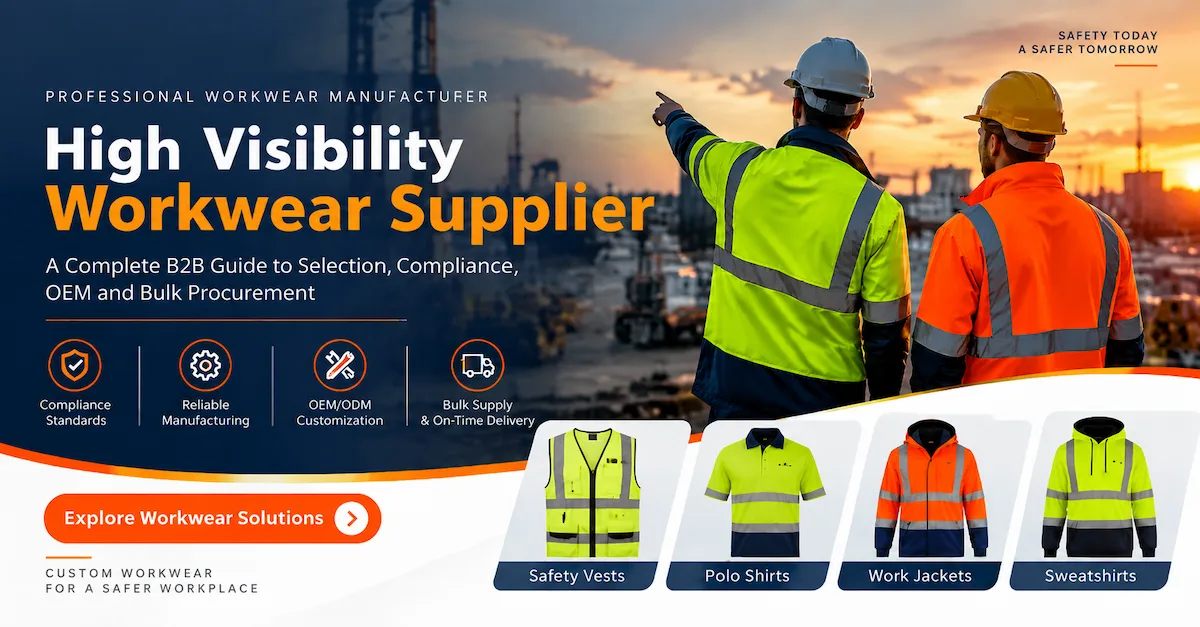
Quick Answer: The most reliable way to evaluate a high visibility workwear supplier is to separate non-negotiable safety and documentation requirements from factors you can compare commercially. First, establish the intended work environments and applicable garment standards. Next, request evidence for the exact garment, fabric, reflective materials, sizing system, and proposed manufacturing process. Finally, test the supplier against a weighted scorecard covering samples, quality control, production planning, landed cost, and repeat-order consistency. A low price or a photograph of a reflective vest does not establish that a finished product is suitable for a particular occupational risk.
For PPE importers, private-label workwear brands, regional distributors, and procurement managers coordinating several sites, the supplier decision affects more than a single shipment. One unstable fabric shade, substituted reflective tape, poorly graded size, or undocumented design change can trigger field complaints and expensive replenishment problems. This guide introduces a practical, 100-point, 12-factor supplier qualification method that can be reused across a portfolio of safety vests, hi vis polo shirts, sweatshirts, rainwear, jackets, and other workwear.
Need a technical quotation rather than a generic price list? Review AOKE's reflective clothing range and send your project requirements to AOKE. State your target market, workforce environment, preferred styles, estimated quantities, and documentation requirements so the discussion starts with the right specification
Why Multi-Site High-Visibility Workwear Procurement Needs a Different Supplier Strategy
A one-off purchase of unbranded safety vests is not the same assignment as a year-round high-visibility clothing program. In a multi-site operation, employees may work under different temperatures, lighting, traffic conditions, and laundering schedules. An importer may need several sizes and styles with consistent branding; a logistics group may reorder the same polo shirt every quarter; a road contractor may use a vest in summer and a weather-protective jacket in winter.
The buyer therefore has to manage four interconnected outcomes: the garment must suit the identified jobsite risk, employees must be willing and able to wear it correctly, the bulk shipment must match the approved sample, and future replenishment must remain consistent. If one of these outcomes is not controlled, a seemingly inexpensive purchase can become an expensive uniform program.
This article is intended for PPE importers, industrial safety distributors, private-label brands, EHS and procurement teams, construction contractors, logistics operators, and municipal purchasing departments. It is particularly useful when comparing several shortlisted suppliers or setting up a recurring OEM arrangement.
It is not a substitute for a workplace risk assessment or specialist PPE selection where workers face arc flash, open flame, chemical splashes, chainsaw hazards, or other exposures requiring distinct protective performance. High visibility alone does not provide those protections. The responsible safety professional must establish the complete PPE requirements before supplier selection.
Start With Four Pass-or-Fail Qualification Gates
Before comparing factories by score, request basic evidence. A supplier that fails a non-negotiable gate should not be selected simply because it offers a low unit price.
| Qualification gate | What the buyer must establish | Evidence to request | What a failure means |
|---|---|---|---|
| Defined end use | Garment type and visibility requirements fit actual tasks | Jobsite brief, proposed garment specification, risk-based selection rationale | Do not quote a generic garment as an approved solution |
| Market-specific conformity | Claimed performance is supported for the finished style | Applicable test reports, declaration or conformity documents as required, product labeling and scope | Do not represent the item as compliant until verified |
| Controlled approved sample | The exact design, materials, fit, and decoration can be approved | Dated sample, specification revision, bill of materials and tolerance agreement | Do not authorize uncontrolled bulk manufacturing |
| Material and change traceability | Critical inputs can be identified and substitutions managed | Fabric/tape references, lot records, written change-approval method | Replenishment risks becoming unpredictable |
A supplier can meet all four gates without being the cheapest. These gates protect the buyer from comparing proposals that are fundamentally different products. When reports are confidential, arrange a secure verification method and check the issuing organization and the report's scope instead of accepting unsupported screenshots or certification logos.
The 12-Point High Visibility Workwear Supplier Scorecard
The following 100-point qualification model is an original buyer-side evaluation tool, not an official industry certification or a published rating of AOKE or any competitor. Score each factor from 0 to 5 using documented evidence; calculate weighted points = factor weight × rating ÷ 5. Keep the four pass-or-fail gates above separate from the score.
| Evaluation factor | Weight | What strong evidence looks like |
|---|---|---|
| 1. Worksite and market suitability | 18 | Risk brief, correct garment architecture, written market requirements |
| 2. Compliance document traceability | 12 | Style-specific reports, label details, document revision and scope |
| 3. Visibility material and layout control | 10 | Material identity, positioning drawings, post-care verification plan |
| 4. Fabric performance and laundering | 9 | Defined composition, construction, GSM, care and test requirements |
| 5. Workmanship and component quality | 7 | Seam and trim specifications, workmanship acceptance criteria |
| 6. Fit, grading and size repeatability | 8 | Measurement chart, tolerances and multi-size fit approval |
| 7. Sampling and reference control | 8 | Approved pre-production sample and locked technical pack |
| 8. In-process QC and corrective action | 9 | Inspection stages, defect logs, documented corrective action |
| 9. Production allocation and traceability | 6 | Actual producing site, schedule, material-lot identification |
| 10. Quotation and MOQ transparency | 5 | Itemized commercial offer, assumptions and change costs |
| 11. Packaging and shipment readiness | 4 | Carton specs, labeling, shipment documentation responsibilities |
| 12. Reorder and change management | 4 | Revision control, retention samples and replenishment protocol |
| Total | 100 | Rank only suppliers that pass the four gates |
How to use the score: A rating of 5 requires convincing evidence; 3 indicates an acceptable but incomplete process; 1 indicates weak support; 0 means the supplier cannot demonstrate the factor. A hypothetical supplier rated 4/5 in a 10-point category earns 8 weighted points. Scores help organize a decision; they never override mandatory compliance or safety requirements.
1. Worksite and Target-Market Suitability — 18 Points
Ask the potential supplier to translate the end user's risk description into garment requirements. “We need orange reflective jackets” is not an adequate brief. The request should describe vehicle exposure, operating speed where relevant, daytime versus nighttime work, rain, temperature, visibility of body movement, and whether other PPE will cover parts of the garment.
A road maintenance team working beside traffic may need a different combination of conspicuity and coverage than an employee walking in a low-speed warehouse. An outdoor winter jacket worn over multiple layers creates additional sizing and visibility questions. Ask why a recommended style fits the environment and which decisions require approval by the buyer's safety team. A competent supplier identifies missing information instead of assigning a protection class from a catalog photograph.
2. Compliance Documentation and Report Traceability — 12 Points
The supplier should identify the exact claimed standard, edition, garment type, class, and tested style. For example, ANSI/ISEA 107-2020 classifies high-visibility apparel by Type and Performance Class; ISO 20471 addresses high-visibility clothing and its test methods and requirements. These systems are not interchangeable certifications, and the appropriate requirement depends on jurisdiction and exposure.
Match the garment model, fabric, reflective tape, color, smallest marketed sizes, labeling, and permitted design changes against the supporting documents. Request the report issuer's identity and, where applicable, the conformity documents required by the destination market. A factory-level quality management certificate does not prove that a particular jacket meets a high-visibility garment class.
3. Fluorescent Material and Retroreflective Layout — 10 Points
Fluorescent background material improves daytime conspicuity, while retroreflective material helps a wearer become more visible when illuminated by a light source such as vehicle headlights. Both the amount and arrangement of visible materials matter under applicable garment standards. A bright color alone, or reflective tape on an otherwise ordinary jacket, is not proof of compliance.
Evaluate tape placement on the torso, shoulders and sleeves as appropriate for the garment and intended class. Check whether pockets, corporate logos, ventilation panels, dark contrast fabric, or open front closures affect the finished design. For a multi-size order, do not assume a layout that works on XL automatically qualifies the smallest size. Request approved drawings and post-laundering or post-care evidence appropriate to the claimed requirements.
4. Fabric Selection, Wear Comfort and Laundering — 9 Points
The best fabric depends on the wearing environment, not on GSM alone. Lightweight polyester mesh may improve ventilation for some vest applications, while a structured woven blend can be useful where abrasion, pocket loading, and shape retention matter. Knitted polos, fleece layers, softshell jackets, and rain shells serve different movement, warmth, and moisture-management needs.
Ask for fiber composition, fabric construction, nominal mass per unit area, dimensional stability, colorfastness, breathability where relevant, and agreed laundering instructions. If garments will be industrially laundered, include that requirement before sampling. A material qualified only for ordinary domestic washing should not be assumed suitable for high-temperature or chemical-intensive laundry processes.
5. Sewing Workmanship, Closures and Functional Details — 7 Points
Workmanship should be assessed against the tasks workers perform. Inspect shoulder and side seams, armhole comfort, zipper installation, pocket reinforcement, edge finishing, and the method used to attach reflective materials. A garment can look good on a mannequin but fail early where a radio clips to a pocket or where repeated bending stresses a seam.
Choose a small number of relevant tests and inspections rather than requesting unrelated certificates. For example, verify seam strength and pocket attachment in loaded workwear, closure durability in jackets, and tape bond or stitch integrity after the specified care cycles. Agree which issues are critical, major, or minor defects in your inspection contract.
6. Fit, Size Grading and Workforce Coverage — 8 Points
A single medium-size sample tells little about a workforce spanning XS through extended sizes. Define body measurements, finished garment measurements, tolerances, intended underlayers, and whether sizing is unisex or separately graded. Perform movement trials that include reaching, bending, walking, seated work, and use of other PPE.
Evaluate at least representative small, middle, and large sizes during development. Confirm whether shorter body lengths, broad shoulders, or layered winter wear change tape positioning or required visibility material area. Request a reproducible measurement method: which points are measured, whether the garment lies flat, and whether measurements are taken before or after the agreed laundering procedure.
7. Sampling Discipline and the Golden Sample — 8 Points
A professional OEM process distinguishes an early prototype from the approved pre-production reference, often called a golden sample. During development, fabric, pocket locations, decoration, tape widths, closures, and color may change. After approval, those details should be recorded in a version-controlled technical pack rather than left in an email thread.
Ask who signs the sample approval, where the retained reference is stored, and what happens if an approved component becomes unavailable. If a logo is moved or a reflective panel is resized after testing, the change may require further technical review or retesting. The score should reward suppliers who document change impacts, not suppliers who promise to change everything immediately.
8. Quality Control, Inspection Records and CAPA — 9 Points
Do not accept “100% quality guaranteed” as a substitute for a documented quality plan. A credible plan identifies incoming material checks, first-article approval, line inspections, finished garment measurement checks, label verification, and a final inspection method. The buyer and supplier should agree sampling levels and acceptance criteria suited to product risk.
For nonconforming production, ask for containment, root-cause analysis, corrective action, and evidence of effectiveness. This is often abbreviated CAPA. Photographs of reworked garments are useful but not enough to show a repeat defect has been prevented. Track major recurring issues such as reflective tape misplacement, color drift, wrong size labels, or damaged zipper assemblies.
9. Real Production Allocation and Lot Traceability — 6 Points
Large headline production capacity is not the same as spare capacity for your particular garment or deadline. Ask which site will produce the confirmed SKU, who controls fabric and reflective tape procurement, whether subcontracting requires approval, and what percentage of planned line time is available for the requested delivery window.
A multi-factory group can provide flexibility, but consistency must be controlled through shared specifications, approval samples, inspection records, and site-specific traceability. If an order moves between factories, the buyer should know before production, especially when the change may affect certificates, country-of-origin declarations, or the approved manufacturing setup.
10. Clear Pricing, MOQ and Commercial Assumptions — 5 Points
Two quotes may use the same product name while including different fabric weight, tape quality, decorations, labels, packaging, sampling, testing, or delivery terms. Require an itemized offer showing order quantity, size and color split, design assumptions, sample fees, decoration setup, test costs, and the agreed Incoterms rule with named place.
Separate stock customization MOQ, new OEM development MOQ, and repeat bulk production MOQ. They are not the same commercial promise. A fast turnaround advertised for logo printing on stock vests should not be treated as the standard lead time for a newly developed winter jacket or a container-size uniform program.
11. Packaging, Marking and Export Coordination — 4 Points
Plan packaging before the first purchase order. Confirm size stickers, item labels, care labels, barcode formats, brand marks, carton assortment, carton dimensions, packing lists, and whether individual wrapping is needed. For distributors, inconsistent product identifiers can cause warehouse receiving problems even when the garments themselves are acceptable.
Determine who arranges transport, what documents the seller is responsible for, and how carton quantities will be reconciled against the purchase order. Buyers importing PPE should separately verify applicable destination-market documentation, customs classification, origin declarations, and importer obligations.
12. Repeat-Order Governance and Engineering Changes — 4 Points
A good supplier can repeat an approved garment months later. Define the master specification revision, fabric shade reference, reflective material designation, approved trim suppliers, size tolerances, artwork version, and care-label content. Use reference samples and written records rather than relying on how an earlier shipment was described.
Set a formal approval path for material substitutions, manufacturing-site changes, revised logos, pattern changes, and supply interruptions. For a multi-site buyer, include a replenishment forecast and identify which styles should be held stable over the life of the program. This is where supplier performance becomes a durable business advantage rather than a one-time purchasing success.
Ready to compare a real offer against these criteria? Request a project-specific OEM quotation from AOKE →
Match the Product Architecture to the Jobsite—Not the Supplier's Bestselling SKU
A high visibility workwear supplier should recommend different garment systems for different exposure profiles. Start with the worksite's tasks and hazards, then select garment architecture and required standards. The examples below are decision prompts, not automatic compliance recommendations.
| Workforce / environment | Potential garment architecture | Key practical checks | Procurement question |
|---|---|---|---|
| Warehouse and distribution centers | Lightweight vest or hi vis polo | Comfort, forklift visibility, sizing, wash frequency | Can workers move freely during a full shift? |
| Road maintenance or traffic-adjacent crews | Risk-appropriate vest, shirt or outerwear | Required class/type, body coverage, night visibility, closures | What certified finished garment is supported by evidence? |
| Construction sites | Vest over site clothing or integrated hi vis shirt | Heat, dust, snags, layers, abrasion | Does the design suit the site's traffic and machinery hazards? |
| Port, dock and outdoor logistics | Hi vis rain jacket or layered system | Weather protection, seam sealing, hood design, ventilation | Which fabric and seam tests support the rainwear claim? |
| Utility and field maintenance | Polo, softshell, insulated jacket depending on conditions | Mobility, tool access, temperature, other PPE interaction | Does the garment remain suitable over underlayers? |
| Cold-weather municipal crews | Insulated outerwear and compatible inner layers | Fit, visibility of outermost layer, closures, comfort | Is the complete wearing configuration documented? |
| Industrial maintenance teams | Woven workwear with appropriate visibility design | Durability, pockets, cleaning, exposure to additional hazards | Does the job also require separate specialist protection? |
For product-level discussions, AOKE's reflective clothing collection contains reference styles for different needs. Buyers can also examine the LXE008 vest listing, LXA012 reflective polo listing, LXA015 sweatshirt listing, and LXA020 jacket listing to start a design conversation. These links are style references, not claims that every listed model has a particular class, composition, or test result; confirm such details directly for your intended order.
What to Specify in a High-Visibility Garment Technical Pack
A technical pack prevents an RFQ from becoming a contest between noncomparable garments. The buyer does not need to prescribe every engineering decision in advance, but each supplier must quote against the same functional requirements and acceptance method.
| Technical-pack field | Minimum information to provide or request | Approval evidence |
|---|---|---|
| End-use environment | Industry, tasks, lighting, traffic or moving equipment, climate | Buyer-approved risk and use brief |
| Destination market | Country, applicable legal and customer requirements | Agreed compliance-document list |
| Garment and fit | Style, intended layering, size range and finished measurements | Multi-size measurement chart and fitting review |
| Background material | Fiber content, structure, target GSM, color reference | Approved fabric swatch and required test data |
| Reflective components | Component identity, width, placement, attachment method | Approved layout and applicable test evidence |
| Workmanship | Seams, stitch details, closures, reinforcement, pockets | Approved construction sheet and physical sample |
| Care and durability | Domestic/industrial laundering, cycles and performance goals | Documented test protocol and results |
| Branding | Logo artwork, position, method, label and packaging | Decoration proof and compliance impact review |
| Commercial scope | Sizes by quantity, MOQ, schedule, destination, Incoterms | Itemized RFQ and purchase order |
| Inspection | Critical defects, sampling, tolerances, rework process | Signed inspection and acceptance plan |
Do not fill the specification table with invented defaults such as “all vests are 120 GSM” or “every jacket is certified Class 3.” Specific materials and performance limits must come from the selected design and its verified evidence.
Standards: What a Supplier Should Explain—and What a Buyer Must Verify
EN ISO 20471 and ANSI/ISEA 107 Are Related but Not Interchangeable
ISO 20471:2013, with its amendment and relevant national adoption, specifies test methods and requirements for high-visibility clothing. It addresses visual signaling of the wearer in daylight and under vehicle-headlight illumination. In North America, ANSI/ISEA 107-2020 defines design, testing, performance and marking requirements for high-visibility safety apparel, including Types based on use and Performance Classes based on garment characteristics. Both systems require attention to the finished garment, not simply an ingredient branded as reflective tape.
The International Organization for Standardization's published standard information and ANSI's official standard description are appropriate starting points for verifying current editions and scope. U.S. Federal Highway Administration work-zone guidance further illustrates why visibility requirements must be assessed in the context of traffic exposure. This article summarizes procurement principles; the official standards, governing regulations, and site risk assessment control the final decision.
For European procurement, determine the applicable PPE conformity obligations and obtain the correct documentation for the garment. For U.S. procurement, confirm which ANSI/ISEA Type and Performance Class the customer's environment and contract require. Canada, Australia, New Zealand, and other markets may use additional or different requirements. Verify the current edition and local adoption at the time of purchase rather than copying a standard number from an old catalog.
Five Common Compliance Misunderstandings
- A fluorescent garment is automatically certified. False: design, material area, photometric and other applicable requirements still matter.
- Certified reflective tape makes the entire product compliant. False: the garment's finished configuration must be evaluated.
- One large-size report automatically covers every size. Not necessarily: check the testing and certification scope, particularly where surface areas change.
- ISO 9001 or an environmental certificate is a high-visibility garment certificate. No: management systems and product conformity address different subjects.
- A logo, dark panel or pattern change cannot affect the rating. It may: changes can reduce qualifying visible area or alter the tested design.
Practical rule: Before paying for a “certified” style, request the model-specific evidence and confirm that the quoted color, size range, decorations, construction and intended market are within scope. If the supplier cannot demonstrate the claim, specify the product as pending verification, not approved PPE.
Compare Styles by Workwear Program Value, Not by Product Name
Different styles solve different operational problems. A multi-site program may require a base vest, a comfortable daily shirt, a cooler-weather layer and an outer weather shell. The following comparison is a procurement design guide rather than a performance claim for any specific AOKE SKU.
| Style family | Primary operational benefit | Typical buyer trade-off | Sample test priority |
|---|---|---|---|
| Mesh safety vest | Lightweight additional visible layer | Mesh durability, pocket loading, fit over clothing | Tear resistance, edge finish, closures |
| Multi-pocket safety vest | Tools and identification access | Weight, snag exposure, pocket positioning | Pocket reinforcement and movement trial |
| Hi vis polo or T-shirt | Day-long wearing comfort and team identity | Heat, perspiration, shade and wash change | Colorfastness, size stability, tape comfort |
| Reflective sweatshirt / fleece | Comfort in cooler conditions | Bulk under outerwear, pilling, wash behavior | Fit over base layers and material durability |
| Softshell or work jacket | Outdoor versatility and mobility | Breathability versus weather protection | Closure durability, mobility, weather-related tests |
| Waterproof rainwear | Protection from rain in outdoor operations | Condensation, seam leakage, hood interference | Appropriate waterproof and seam testing |
| Insulated winter outerwear | Thermal comfort in cold environments | Weight, laundering, fit with multiple layers | Layered fitting and performance evidence |
An OEM program might combine two or three families. For instance, a warehouse network could standardize daily hi vis polos for indoor teams and use separate weather-protective outerwear for yard staff. That reduces the temptation to force one uniform to perform under incompatible conditions.
Turn Sample Approval Into a Measurable Acceptance Protocol
Samples should be treated as engineering evidence, not just attractive sales pieces. A disciplined sample program has three stages and a documented decision at each stage.
Stage A — Development prototype. Confirm garment architecture, material options, safety objectives, pocket placement, and initial fit. Record all open issues; do not confuse a design mockup with a qualified PPE sample.
Stage B — Pre-production approval. Test the proposed production materials and complete construction, check target size coverage, confirm logo position, and review applicable conformity documents. Freeze the bill of materials and technical-pack revision only after deviations are resolved. If approval depends on a specific report, record the report reference alongside the sample.
Stage C — Bulk verification. Compare actual production against the approved sample, measurement chart, material references, label artwork and inspection checklist. Confirm that defects are classified and handled according to an agreed sampling and corrective-action process.
A useful approval checklist includes fabric identity, fluorescent shade, reflective material placement, tape adhesion or stitching, seam quality, closure function, representative size measurements, care labels, logos, packing and traceability marks. Ask a designated owner to sign and date the approval. A verbal “looks good” should not be the only authorization to begin production.
Five Sample Tests That Reveal Expensive Bulk Problems
Fit under movement: Have wearers bend, extend arms, sit, lift and wear the garment with relevant PPE. This can reveal restricted mobility, riding-up hems, tight armholes or poorly positioned pockets.
Care-cycle review: Apply the agreed domestic or industrial laundering method before judging shrinkage, appearance or reflective component integrity. Do not advertise a specific cycle life unless the test supports it.
Trim and seam inspection: Examine closures, pocket stress points, seams and tape edges before and after relevant handling or care tests.
Visibility design review: Verify the agreed layout and relevant material areas after sizes, panels, or logos are finalized. Aesthetic approval is not conformity approval.
Packing-line rehearsal: Build a trial carton with the actual assortment, labels and barcodes. It is cheaper to correct a packing rule before thousands of garments are sealed.
Make Supplier Quotes Comparable: Calculate the Cost of Accepted, Usable Garments
The lowest unit price is rarely the whole story. To compare a high visibility workwear supplier fairly, put all bids on the same specification, quantity breaks, size mix, testing requirements and delivery basis. Distinguish fixed development charges from recurring unit costs and clarify which tests or documents are included.
A practical buyer-side formula is:
Effective cost per accepted garment = (product cost + development + required testing + packaging + freight + duties + inspection + documented remediation) ÷ accepted usable units.
This is a decision model, not a standardized accounting formula. It illustrates that rejects, rework and surprise logistics costs can erase a nominal unit-price advantage. A second metric, cost per successful wear, can be useful where replacement intervals differ substantially, provided wear-life assumptions are based on comparable use conditions.
| Quote line item | Buyer question | Common hidden cost |
|---|---|---|
| Fabric and reflective components | Are grade, source and test requirements identical? | Cheaper substitutions that change performance |
| Size distribution | Does the price include all requested sizes? | Surcharges for extended sizing |
| Custom logo and labels | Are artwork setup, print method and approvals included? | New screens, artwork or reapproval |
| Samples and testing | Which approval rounds and reports are included? | Retesting after changes |
| MOQ and volume break | Is this stock printing or newly developed OEM production? | Incorrect price comparison |
| Quality inspection | Who pays for reinspection and defects? | Rework, shortage and delayed dispatch |
| Export terms | Which Incoterms rule and named place apply? | Unexpected freight, insurance or destination charges |
| Reorders | Are materials and unit costs held under defined conditions? | Shade changes and obsolete components |
A buyer should also ask about order concentration. If only one style consumes all available production time, a supplier may meet an initial deadline but struggle with smaller replenishment orders. Ask for a realistic allocation plan instead of relying on a generic “fast delivery” badge
OEM and Private-Label Workwear: Protect Both Your Brand and Compliance Position
Private-label sourcing involves more than adding a logo. A brand owner needs product identification, size labeling, care instructions, consistent packaging, and an agreement defining ownership and permitted use of artwork. For regulated products, the party placing goods on a market may also hold particular conformity and documentation responsibilities; those obligations should be clarified before the purchase order.
When requesting OEM high visibility clothing, include a vector logo file, desired colors, print method, brand label artwork, care-label language, packaging design, size specifications, and any special restrictions on logo positioning. Check whether an embroidery patch or printed area changes the visible surface area or the performance of the garment. A well-managed supplier will flag those interactions during approval.
Create a single source of truth for your SKU: specification revision, approved sample photographs, material references, artwork version, size table, packing rules, QC criteria and destination-market documents. Use change-request numbers for later revisions and require explicit approval for substitutions. This protects a private-label collection as it scales across several distributors or worksites.
AOKE's Manufacturing Model: What Its Public Information Shows
AOKE, operated by Jinhua Aoke New Materials Co., Ltd., presents itself as a reflective clothing and safety workwear manufacturer serving international B2B customers. The company's About Us page describes three production facilities with different roles: Jinhua for smaller customized orders, Chongqing for reflective clothing manufacturing, and a Myanmar facility for larger garment production. It lists indicative monthly output capacities of 50,000, 200,000 and 1.5 million pieces, respectively, and describes sampling rooms, automated cutting capability and garment inspection activities.
These are company-published production figures, not evidence of available capacity for a specific order or automatic proof of certification for a product. A sensible buyer should confirm the proposed manufacturing site, approved materials, live production schedule, sample milestones, country-of-origin implications, and product-specific test records during quotation.
That distinction makes AOKE relevant to several buying situations. An importer considering multiple reflective clothing styles can start with its reflective clothing category, while a brand creating a new design can discuss the specification and sampling needs through the OKE quotation form. For repeat purchasing, ask AOKE how it would maintain the same approved technical specification across production runs and, where applicable, across production locations.
A useful first conversation should answer five practical questions: Which factory would make this SKU? What exactly is included in the price? Which product evidence will be supplied? What constitutes sample approval? How will changes and repeat orders be controlled? These answers are more useful than broad promises of “premium quality.”
A Buyer-Controlled 30/60/90-Day Program Launch Plan
The following is an illustrative buyer planning framework, not a promise that a supplier can manufacture or ship to these timelines. Actual sampling, testing, production and shipping durations depend on complexity, materials, certification needs and confirmed capacity.
| Planning window | Buyer milestone | Required output |
|---|---|---|
| Days 1–30: qualify and define | Risk brief, market requirements, shortlist, four hard gates and initial scorecard | Approved supplier candidates and first technical pack |
| Days 31–60: validate and freeze | Sample iterations, representative size trials, document review, pricing normalization | Signed pre-production reference and agreed inspection criteria |
| Days 61–90: prepare controlled scale-up | Confirmed production plan, material traceability, packaging rules, pilot or first bulk checks | Reorder-ready master specification and launch decision |
Do not compress critical testing to preserve an arbitrary calendar. If sample approval or product conformity is incomplete, move the launch decision rather than treating the plan as authorization to ship unverified goods. Buyers with urgent replenishment requirements should explore whether an existing approved style can legitimately meet the need without changing the essential specification.
Standards and Evidence Note for Procurement Teams
Primary references for technical verification: ISO 20471:2013, High visibility clothing — Test methods and requirements, including Amendment 1:2016 (International Organization for Standardization); and ANSI/ISEA 107-2020, American National Standard for High-Visibility Safety Apparel (International Safety Equipment Association). The ISO publication describes conspicuity, color, retroreflection and material placement; the ANSI/ISEA publication addresses performance requirements and finished-garment Type/Class designations. Current revisions, national adoptions, legislation, workplace exposure, and the actual garment's documentation must be checked before purchase. These primary source names are provided as traceable references without outbound links because this article links only to AOKE pages.
Seven Supplier Red Flags That Deserve Immediate Follow-Up
1. One certificate shown for every style. Ask exactly which model, material, size and manufacturing location the document covers.
2. No agreed technical pack. Without a version-controlled specification, later disputes become subjective.
3. A large capacity number but no allocation plan. Monthly output claims do not establish availability for your order.
4. Unexplained reflective tape substitution. The component change may affect performance, consistency or required evidence.
5. Pricing without declared assumptions. A cheap quote is not comparable if shipping, sizes or testing are missing.
6. No accountable sample approver. Unapproved changes can migrate into bulk production unnoticed.
7. Repeated defects with no root-cause response. Reworking one batch without correcting the process leaves the next shipment at risk.
These red flags are not proof that a supplier is incapable. They are reasons to require clarification, written evidence, or a controlled corrective plan before increasing exposure.
Copy-Ready RFQ Checklist for PPE Importers and Workwear Distributors
Send the following information in one structured inquiry. Complete data leads to more meaningful recommendations and makes responses easier to score:
- Buyer profile: company, destination market, resale channel or operational use.
- Application: worker task, environment, lighting, moving vehicles, climate and required protection.
- Garment range: vest, polo, sweatshirt, jacket, rainwear or a defined combination.
- Compliance needs: applicable standard, class/type, required reports and market documents.
- Materials: fiber composition, structure, GSM target, color, reflective components and care requirements.
- Sizing: full size chart, proportions of each size, fitting and layering requirements.
- Branding: logo artwork, preferred application method, labels, barcode and packaging rules.
- Commercial scope: estimated pilot and annual quantity, target shipment windows and Incoterms basis.
- Quality plan: sample approval, measurement tolerances, inspection and defect-handling expectations.
- Replenishment: frequency, forecast horizon, revision control and approved component continuity.
If your company is planning its first private-label collection, request a quotation for one clearly specified reference style first, then expand to adjacent styles after materials, size grading, care and artwork rules are proven. If you already operate a mature uniform program, prioritize repeatability, documentation and production allocation from the first discussion
Frequently Asked Questions
1. What should I check first when selecting a high visibility workwear supplier?
Begin with the intended workplace risk, destination market and required garment performance. Then check model-specific supporting documents and whether the supplier can produce a controlled sample using agreed materials. Price, production capacity and branding options should be compared only after the proposed garments meet the essential requirements. A supplier scorecard helps structure the assessment but cannot replace safety or regulatory verification.
2. Is a high visibility clothing manufacturer the same as a general workwear supplier?
Not necessarily. A general workwear supplier may specialize in ordinary uniforms or industrial clothing without relevant experience in conspicuity, retroreflective components and finished-garment high-visibility requirements. A specialist supplier should be able to discuss both fabric and garment design, identify the applicable performance claims, and explain how material changes or logo positioning may affect those claims. Evaluate actual evidence rather than the company's self-description.
3. What is the difference between ANSI/ISEA 107 and EN ISO 20471?
They are distinct high-visibility apparel standards used in different regulatory and purchasing contexts. ANSI/ISEA 107 addresses Types and Performance Classes for high-visibility safety apparel, while ISO 20471 establishes high-visibility clothing requirements and testing. The buyer must determine the governing requirements for the destination market and work environment. A garment tested to one framework must not automatically be marketed as compliant with the other.
4. Can I customize a high visibility vest or jacket with my company's logo?
Yes, logo placement and private labeling are common OEM requirements, but customization must be reviewed against the garment design and its intended conformity. A large print, embroidery patch or additional contrast panel can change the qualifying high-visibility material area. Submit artwork and placement details before sampling, request a revised drawing, and confirm whether any design change requires further verification.
5. What MOQ should I expect for bulk high visibility workwear?
MOQ depends on whether you are decorating an existing stock style, changing trims and labels, or developing a completely new garment with unique materials and patterns. It also depends on fabric availability, factory setup and color-size assortment. Do not assume that the MOQ displayed for a simple printed safety vest applies to custom jackets or a multi-style OEM program. Ask for the MOQ by SKU, color and order stage.
6. How can I compare quotes from two hi vis workwear suppliers?
Provide both suppliers with the same technical pack and request itemized offers. Compare fabric and tape identity, conformity evidence, size split, branding, inspection requirements, sampling charges, packaging, logistics and Incoterms. Assess the cost per accepted usable garment instead of unit price alone. A supplier that excludes testing or substitutes materials should not be treated as commercially equivalent without adjusting the comparison.
7. How do I verify reflective tape quality after washing?
Specify the garment's intended care method and the performance requirement to be checked. Request relevant material or finished-garment reports, then conduct sample evaluation using the agreed laundering conditions and applicable testing method. Check tape attachment, appearance and required retroreflective performance rather than relying only on how bright the tape looks in a photograph. Do not claim a fixed number of successful washes without supporting evidence.
8. Can one high visibility workwear supplier support several climate zones?
A supplier may offer multiple garment architectures—lightweight vests or shirts for warm sites, layered garments for cool conditions, and weather-protective outerwear for wet environments. The key is to treat each configuration as a separately specified and validated product. Check fit over layers, whether the outermost visible garment meets required conditions, and whether sourcing consistency can be maintained across all relevant styles.
9. How should I manage product consistency between repeat orders?
Maintain a version-controlled technical pack, retained approved sample, defined material and color references, size chart, logo master and packing specification. Require written approval for fabric or tape substitutions, pattern alterations and manufacturing-site changes. Compare new production against the baseline through incoming, in-process and finished-garment checks. Track defects and corrective actions across order cycles so recurring problems are not silently repeated.
10. What information should I send AOKE to receive a useful high visibility workwear quote?
Share the destination country, intended workplace application, garment styles, quantities by size and color, required standards, fabric or performance preferences, logo files, labeling and packaging needs, preferred shipment window and any existing reference samples. If a requirement is uncertain, explain the worker task and risk rather than guessing a certification class. Use AOKE's contact page to start a project-specific discussion and request confirmation of exact specifications, documentation, capacity and commercial terms.
Conclusion
Choosing a high visibility workwear supplier is ultimately a risk-control and operational-continuity decision, not a search for the cheapest reflective garment. The strongest purchasing process begins with a defined jobsite brief, four non-negotiable qualification gates, and a weighted 12-point supplier assessment. It continues through market-specific product evidence, controlled sampling, measurable quality checks, transparent quotations and disciplined repeat-order management. This approach helps PPE importers, distributors and multi-site employers compare suppliers on an equivalent basis and reduce avoidable errors as their uniform programs grow.
AOKE's public manufacturing profile and reflective apparel collection offer a practical starting point for sourcing discussions, while product-specific conformity, materials, capacity and delivery terms should always be confirmed for the actual order. To evaluate a new OEM workwear program or improve an existing replenishment plan, explore AOKE's reflective clothing styles and request a tailored sourcing quotation with your technical brief.