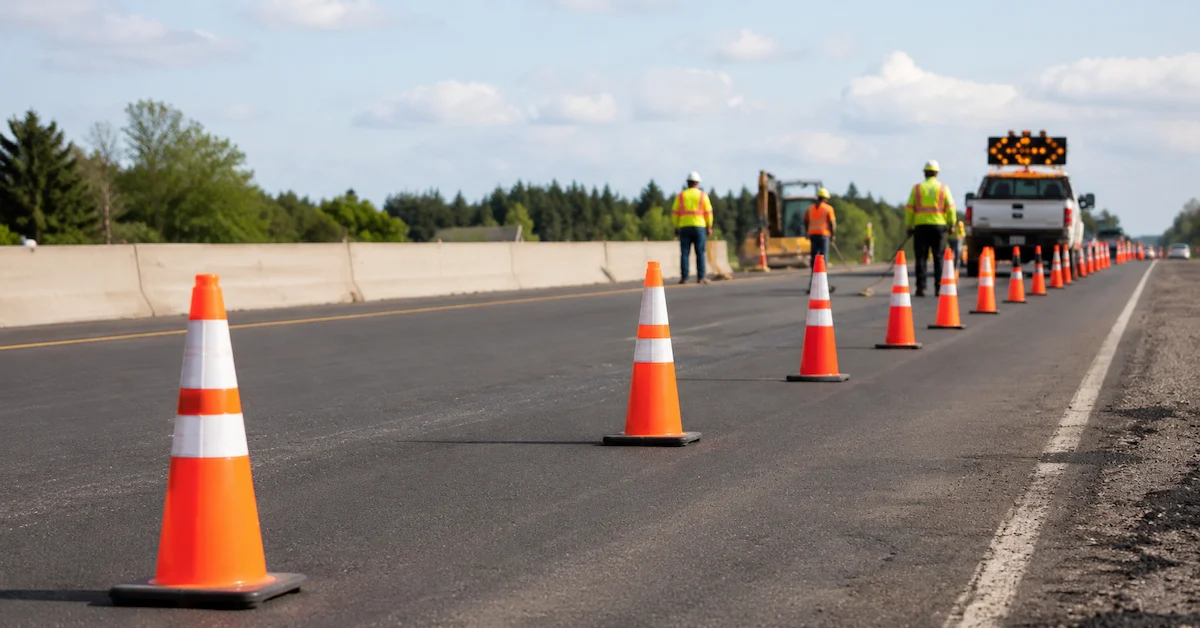

What Should Buyers Expect From a PE Traffic Cone Supplier?
A reliable PE traffic cone supplier should do more than send a product photo and a unit price.
Traffic cones are temporary traffic-control devices used around roadworks, maintenance zones, parking facilities, factories, airports, events, and other areas where vehicles or pedestrians need clear guidance. For B2B buyers, their value depends on whether the cones remain visible, stable, recognizable, and suitable for the intended environment.
That makes supplier selection a practical risk-management decision.
Before approving a bulk order, buyers should know:
- what material formulation is being supplied;
- which cone heights and base options are available;
- whether reflective configurations match the intended use;
- which target-market requirements apply;
- how samples and production lots are controlled;
- whether specifications remain consistent on repeat orders;
- how packaging and international delivery are managed.
A supplier that answers these questions clearly is usually more valuable than one that competes only on the lowest quotation.
Who Typically Buys PE Traffic Cones in Bulk?
The commercial requirements for PE traffic cones vary substantially by buyer type.
| Buyer Type | Typical Requirement | Main Procurement Risk |
|---|---|---|
| Road safety distributor | Multiple sizes and repeat supply | Inconsistent specifications |
| Construction contractor | Durable cones for project deployment | Poor stability or visibility |
| Traffic management company | Rapid deployment and retrieval | Product weight and handling issues |
| Municipal or public buyer | Specification-driven procurement | Non-matching documents |
| Parking facility supplier | Standardized cones for daily use | Premature damage or fading |
| Industrial safety distributor | Multi-category safety supply | Supplier fragmentation |
| Airport or logistics operator | Clearly defined traffic-control zones | Incorrect product configuration |
| Private-label buyer | Branding and packaging | Uncontrolled customization |
A PE traffic cone supplier serving these customers should understand that a municipal tender, distributor replenishment order, and construction project are not the same purchasing scenario.
Why Traffic Cone Quality Matters in Temporary Traffic Control
Traffic cones are channelizing devices. Their job is to warn road users about temporary conditions and guide traffic through or around work areas.
The U.S. Federal Highway Administration's MUTCD 11th Edition describes channelizing devices as tools for warning road users about work activities and providing smooth, gradual traffic guidance through temporary traffic-control zones. It also requires channelizing devices to remain visible and properly positioned.
From a procurement perspective, that means a traffic cone cannot be evaluated only by how it looks when new.
Buyers should consider whether it can maintain:
- recognizable color;
- structural shape;
- base stability;
- reflective visibility when required;
- consistent dimensions;
- usable condition over the expected service period.
Low initial cost loses its advantage quickly if products require frequent replacement or cannot be used for the intended project.
PE Material: What Should Procurement Teams Actually Check?
PE means polyethylene, but the words “PE traffic cone” do not tell buyers everything about product performance.
Actual durability depends on the formulation, manufacturing process, wall structure, additives, temperature exposure, UV exposure, storage conditions, and intended use.
That is why professional buyers should avoid vague questions such as:
Is this made from good PE?
Instead, ask the supplier to confirm the actual product specification and provide a production sample.
Important Material Questions
A buyer can ask:
- Is virgin, recycled, or blended material used?
- Is the material formulation consistent between orders?
- Are UV stabilizers or other additives used where required?
- How does the cone behave after repeated bending or impact?
- Is the cone intended for cold, hot, or general outdoor environments?
- Can the supplier provide samples from the intended production configuration?
Not every application requires the same formulation.
For example, a temporary indoor warehouse marker has a different operating environment from a cone continuously exposed to sunlight, traffic movement, rain, and temperature variation.
PE Traffic Cone vs PVC Traffic Cone
Buyers often search for both PE and PVC cones, but neither material should be selected based on a simplified claim that one is always better.
The actual decision depends on construction, weight, formulation, application, and local procurement specifications.
| Factor | PE Traffic Cone | PVC Traffic Cone |
| Material family | Polyethylene | Polyvinyl chloride |
| Flexibility | Depends on PE grade and design | Depends on PVC formulation |
| Weight | Varies by construction and base | Varies by construction and base |
| Outdoor suitability | Depends on formulation | Depends on formulation |
| Impact behavior | Product-specific | Product-specific |
| Best procurement approach | Compare tested samples and specification | Compare tested samples and specification |
A professional PE traffic cone supplier should be able to explain why a specific model is appropriate instead of relying on broad material marketing claims.
AOKE's Stock Safety Products section includes both PE and PVC traffic cone categories, allowing buyers to discuss the appropriate configuration according to project requirements.
Compliance Should Be Defined by the Destination Market
One of the most common procurement mistakes is asking whether a traffic cone is simply “internationally compliant.”
There is no single universal specification that automatically covers every country, road authority, municipality, project, and application.
United States
For U.S. public-road applications, buyers should review the current Manual on Uniform Traffic Control Devices and any applicable state or agency requirements.
Section 6K.03 of the MUTCD 11th Edition states that cones used in temporary traffic-control applications must be predominantly orange and made from material that can be struck without damaging the impacting vehicle.
For daytime, low-speed roadways, the federal minimum height is 18 inches. For freeways, other high-speed highways, nighttime use, or situations requiring greater conspicuity, cones must be at least 28 inches high. Nighttime cones also require retroreflectorization or appropriate lighting.
For 28- to 36-inch cones used at night, the MUTCD specifies a 6-inch white retroreflective band near the top plus a second 4-inch band below it.
These are procurement-critical details because a visually similar cone may not be suitable for every traffic-control application.
Canada
Canada uses the Manual of Uniform Traffic Control Devices for Canada, published by the Transportation Association of Canada.
The current Sixth Edition is a national guideline used to support consistent traffic-control practices across federal, provincial, territorial, and municipal authorities. TAC notes that technical corrections and updates were incorporated as of April 28, 2026.
However, buyers still need to review relevant provincial, municipal, project, or tender specifications.
Other Markets
For Europe, Australia, the Middle East, Latin America, and other export markets, procurement teams should provide the applicable project specification to the supplier.
A useful RFQ should therefore say:
Product required for [country/authority/project specification]
rather than:
Need international standard traffic cones.
Visibility Is More Than Bright Orange Plastic
A traffic cone needs to be recognized quickly under the conditions in which it will actually be used.
Important visibility factors include:
- body color;
- cone height;
- reflective collar configuration;
- reflective material condition;
- background contrast;
- nighttime lighting;
- placement and spacing.
For nighttime U.S. roadway applications, the MUTCD specifically requires retroreflective treatment or lighting for cones.
For buyers, this means “reflective cone” is not a complete specification.
An RFQ should identify:
- number of reflective bands;
- band width;
- band position;
- reflective material requirement;
- target regulation or project specification.
If your project also requires other reflective safety products, AOKE's Reflective Material Solutions can be referenced when discussing visibility-related sourcing requirements.
How to Choose the Right Cone Height
Cone height should follow the target application and applicable road authority requirements.
Do not select height simply because one version is cheaper to ship.
For example, under the U.S. MUTCD federal framework:
| Application Example | Federal MUTCD Baseline |
| Daytime, low-speed roadway | Minimum 18 inches |
| Freeway or high-speed highway | Minimum 28 inches |
| Nighttime highway use | Minimum 28 inches |
| Greater conspicuity required | Minimum 28 inches |
These figures are not a substitute for state, local, tender, or project-specific requirements.
A distributor serving several markets may therefore need more than one cone height.
Before placing an order, ask the PE traffic cone supplier which dimensions are available and whether the same specification can be maintained across repeat shipments.
Base Weight and Stability Matter
An upright cone is useful. A cone blown into a traffic lane is not.
Traffic movement, wind, passing trucks, weather, uneven surfaces, and accidental contact can all affect stability.
The MUTCD specifically advises taking steps to reduce the possibility of cones being blown over or displaced by wind or moving vehicles. It also recognizes weighted and ballast-based approaches to improve stability.
For B2B sourcing, buyers should confirm:
- base material;
- base dimensions;
- finished cone weight;
- weight tolerance;
- one-piece or multi-component construction;
- stacking behavior;
- expected use environment.
Two cones of the same height can perform differently if their bases are configured differently.
Do Not Buy Traffic Cones Without an Approved Specification
Photos are useful for initial sourcing, but they should not become the final product standard.
Create an approval specification before the bulk order.
Recommended PE Traffic Cone RFQ Checklist
| Item | Information to Confirm |
| Material | PE grade/formulation as agreed |
| Height | Required finished height |
| Base | Dimensions, construction and weight |
| Finished weight | Target and tolerance |
| Color | Required body color |
| Reflective bands | Quantity, width and location |
| Reflective material | Project-specific requirement |
| Logo | Position, dimensions and method if required |
| Packaging | Quantity per bundle/carton/pallet |
| Target market | Country and authority |
| Applicable requirement | Standard, tender or project specification |
| Quantity | Trial and bulk volume |
| Delivery | Required destination and schedule |
This reduces the risk of receiving technically different products from suppliers that appear identical in online listings.
What Should a Good PE Traffic Cone Supplier Provide?
The best supplier is not necessarily the company with the largest catalog.
For a B2B buyer, the supplier should provide useful commercial and technical information.
Clear Specifications
Dimensions, material, weight, reflective configuration, and packaging should be defined before production.
Sample Support
A production-representative sample allows buyers to inspect:
- flexibility;
- finish;
- color;
- reflective bands;
- dimensions;
- base stability;
- stacking;
- branding.
Repeat-Order Control
Distributors need confidence that the second order will match the first.
Ask how specifications, samples, packaging, and revisions are controlled.
Transparent Product Source
A supplier may be a direct manufacturer, sourcing supplier, assembler, exporter, or distributor.
The business model matters less than transparency.
Buyers should know:
- where the product is produced;
- who controls the specification;
- who performs inspection;
- who is responsible when products do not match approval.
Export and Packaging Support
Traffic cones are bulky products.
Packaging configuration can materially affect:
- freight cost;
- container utilization;
- handling;
- storage;
- product deformation.
For international buyers, logistics should therefore be discussed before final price comparison.
Bulk Pricing: Compare Total Purchase Cost, Not Unit Price
Traffic cone quotations can look simple because the product itself appears straightforward.
But total procurement cost can include:
- product price;
- reflective material;
- customization;
- packaging;
- pallet requirements;
- inspection;
- inland transportation;
- ocean or air freight;
- duties;
- local delivery;
- damaged-product replacement.
Suppose Supplier A offers a lower cone price but uses packaging that reduces container efficiency.
Supplier B may quote slightly more per cone but produce a lower landed cost.
This is why purchasing teams should compare:
Landed Cost per Usable Cone
rather than only:
Factory Unit Price
Availability and Lead Time Are Important for Project Buyers
The original procurement problem is often not:
Can you supply traffic cones?
It is:
Can you supply the correct cones before our project starts?
That changes supplier evaluation.
Ask about:
- current stock status;
- production lead time;
- custom-order lead time;
- sample timing;
- repeat-order timing;
- seasonal capacity;
- packaging time;
- estimated shipping schedule.
Do not assume a product shown in a catalog is currently available.
For AOKE projects, current PE traffic cone availability, MOQ, specification, and lead time should be confirmed for the individual inquiry rather than inferred from the category page.
OEM and Private-Label PE Traffic Cones
Distributors may want branded products, but customization should never interfere with required visibility or traffic-control markings.
Possible requirements include:
- company logo;
- distributor identification;
- customized packaging;
- barcode;
- carton mark;
- private-label documentation.
If the cone will be used under the U.S. MUTCD framework, note that Chapter 6K restricts owner/manufacturer information visible to approaching road users. The manual allows certain identifying information on non-retroreflective surfaces under specified conditions.
Therefore, branding should be reviewed against the actual target-market requirement before production.
How to Audit a PE Traffic Cone Supplier Before Bulk Ordering
Use a structured scorecard instead of approving suppliers based on quotation price alone.
| Evaluation Area | Suggested Weight |
| Product specification accuracy | 20% |
| Target-market requirement support | 20% |
| Sample quality | 15% |
| Bulk consistency | 15% |
| Delivery capability | 10% |
| Packaging and logistics | 10% |
| Communication and documentation | 5% |
| Customization support | 5% |
Red Flags to Watch For
Be cautious if a supplier:
- cannot provide exact dimensions;
- changes material descriptions during negotiations;
- promises compliance without identifying a standard;
- refuses sample approval;
- cannot explain reflective specifications;
- provides significantly different weights for the same model;
- avoids discussing packaging before quoting freight;
- gives unrealistic delivery promises;
- claims every cone is suitable for every market.
The purpose of supplier qualification is to identify these risks before the purchase order is issued.
PE Traffic Cone Supplier vs Manufacturer: Which Should You Choose?
A direct factory relationship can be valuable, but being called a “manufacturer” does not automatically make a supplier better.
A qualified sourcing supplier can also create value when buyers need multiple traffic-safety categories.
For example, AOKE's Stock Safety Products category brings together PE traffic cones, PVC traffic cones, caution tape, warning posts, corner guards, wheel stoppers, traffic mirrors, and other safety products.
This type of sourcing model can be useful for distributors that want to consolidate several related products.
The correct question is therefore:
Who can control the product specification, quality, documentation, and delivery most reliably?
Not simply:
Who owns the molding machine?
Common Applications for PE Traffic Cones
Road Construction and Maintenance
Cones can guide vehicles around:
- resurfacing;
- utility work;
- repairs;
- temporary lane closures;
- maintenance crews.
Parking Facilities
They can support:
- temporary parking restrictions;
- lane guidance;
- reserved areas;
- loading zones.
Industrial Facilities
Factories and logistics sites may use cones to identify:
- vehicle routes;
- temporary hazards;
- maintenance areas;
- restricted zones.
Airports and Transport Facilities
Traffic cones may support controlled vehicle movement and temporary ground-operation zones, subject to the facility's own procedures and specifications.
Events and Temporary Operations
Cones can help organize temporary vehicle and pedestrian movement where the applicable safety plan permits their use.
The required cone configuration should always be selected according to the actual application rather than assuming one model is universal.
Questions to Include in Your PE Traffic Cone RFQ
Before contacting a supplier, prepare these details:
- What country will the cones be used in?
- What authority or specification governs the project?
- What cone height is required?
- What finished weight is required?
- Is a weighted base needed?
- Will cones be used during daytime, nighttime, or both?
- What reflective configuration is required?
- What quantity is required now?
- What is the expected annual reorder volume?
- Is custom branding required?
- What packaging is preferred?
- When must the shipment arrive?
Sending this information helps a PE traffic cone supplier provide a meaningful quotation rather than simply returning the cheapest available model.
For project-specific requirements, buyers can use the AOKE Contact Us page to submit product, quantity, destination, and customization details.
Frequently Asked Questions
What should I look for in a PE traffic cone supplier?
Check specification accuracy, material information, available sizes, base configuration, reflective options, target-market documentation, sample quality, bulk consistency, packaging, lead time, and communication.
Is PE always better than PVC for traffic cones?
No. Material alone does not determine whether a cone is suitable. Compare the complete product design, formulation, weight, stability, application, and required specification.
What size PE traffic cone should I buy?
The correct size depends on the application and governing requirement. For example, the U.S. MUTCD requires at least 18-inch cones for daytime low-speed roadway use and at least 28-inch cones for freeway, high-speed, or nighttime highway applications.
Do traffic cones need reflective bands?
It depends on the application and target-market requirements. Under the U.S. MUTCD, cones used at night must be retroreflectorized or equipped with lighting devices.
Can PE traffic cones be used outdoors?
PE can be suitable for outdoor products, but actual performance depends on material formulation, additives, construction, climate, and exposure conditions. Ask for model-specific information rather than assuming all PE cones perform identically.
What affects PE traffic cone prices?
Key factors include cone height, finished weight, base design, material formulation, reflective configuration, order quantity, customization, packaging, and freight.
Can I customize PE traffic cones with my logo?
Customization may be possible, but the logo position and design should be checked against the intended market's traffic-control requirements.
Should I request a sample before ordering?
Yes. For significant B2B orders, an approved sample helps establish the expected appearance, dimensions, weight, reflective configuration, and construction.
What is the MOQ for PE traffic cones?
MOQ varies by product, customization, packaging, and supplier. AOKE's current MOQ should be confirmed for the specific cone model and inquiry rather than assumed from other product categories.
How do I reduce risk when ordering traffic cones internationally?
Define specifications before quotation, approve samples, confirm target-market requirements, document packaging, clarify inspection criteria, and calculate total landed cost before placing the bulk purchase order.
Conclusion
Choosing a PE traffic cone supplier requires more than finding a company that can provide orange cones at a low unit price.
Professional road safety buyers should evaluate the complete purchasing package:
- material and product specification;
- cone height and base stability;
- reflective configuration;
- destination-market requirements;
- sample quality;
- repeat-order consistency;
- packaging efficiency;
- delivery reliability;
- total landed cost.
The best supplier is the one that can consistently deliver the product configuration your project actually requires.
For B2B buyers sourcing PE traffic cones together with warning posts, caution tape, parking safety products, or other industrial safety equipment, explore AOKE's Stock Safety Products, review the company's background on About Us, or submit your purchasing requirements through Contact Us.