
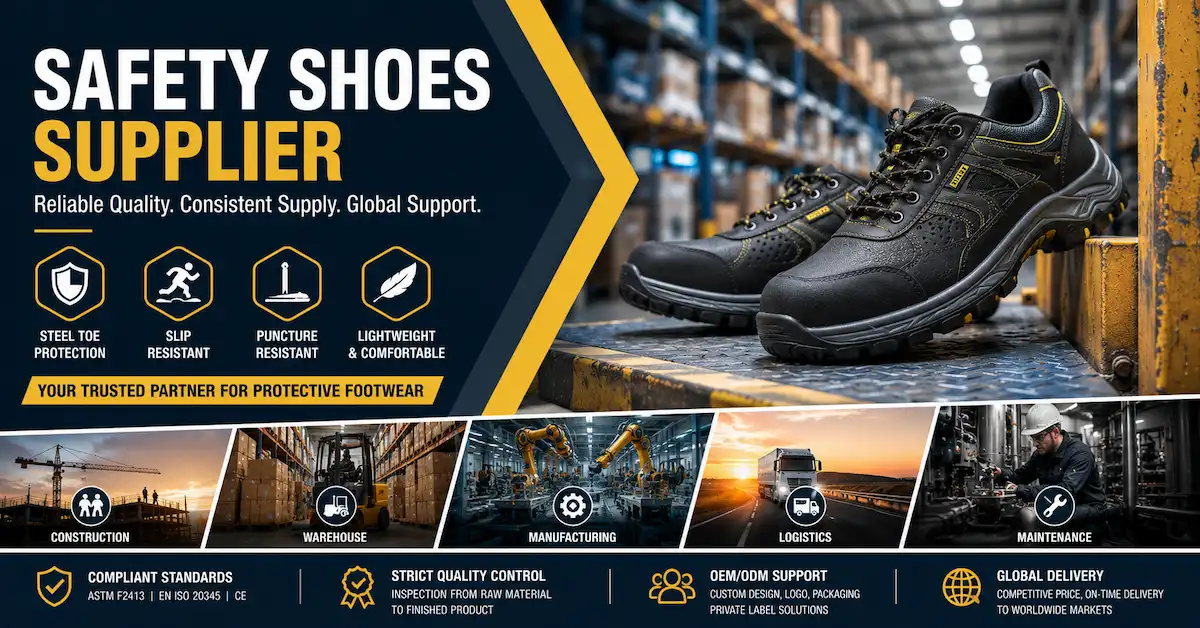
How to Choose a Safety Shoes Supplier for B2B Procurement
Finding a reliable safety shoes supplier is a critical step for PPE distributors, industrial procurement teams, construction suppliers, contractors, and private-label safety brands.
Safety footwear is a protective product, so buyers need to evaluate much more than appearance and price. The right product must match the hazards of the workplace, the requirements of the target market, and the purchasing model of the buyer.
For B2B procurement, a good supplier should be able to provide clear product specifications, consistent samples, appropriate documentation, reliable quality control, and a practical path from initial quotation to repeat orders.
The procurement decision should therefore answer five questions:
- Is the product suitable for the intended workplace hazard?
- Does the specification match the target market?
- Can the supplier maintain consistent quality?
- Can the supplier support the required quantity and delivery schedule?
- Can the supplier support long-term commercial cooperation?
These questions are more useful than simply asking which supplier offers the lowest unit price.
Who Needs a Safety Shoes Supplier?
Safety footwear is purchased by several different B2B customer groups, and each group has different priorities.
| Buyer Type | Typical Requirement | Key Procurement Concern |
|---|---|---|
| PPE distributor | Multiple models and sizes | Stable repeat supply |
| Safety equipment wholesaler | Competitive bulk purchasing | Landed cost |
| Construction supplier | Job-site protection | Durability and protection |
| Industrial buyer | Employee PPE programs | Hazard suitability |
| Contractor | Project-based quantities | Lead time |
| Private-label brand | Branded footwear | OEM capability |
| Government/project buyer | Defined specifications | Documentation and compliance |
A distributor may need a broad product range, while a factory purchasing team may need one or two models in large quantities.
A reliable safety shoes supplier should be able to understand these differences and recommend products based on actual use rather than simply pushing the highest-volume model.
Start With Workplace Hazards Before Selecting Safety Shoes
The most important sourcing principle is simple:
Choose the protection requirement first, then choose the footwear.
In the United States, OSHA 29 CFR 1910.136 requires protective footwear where employees face hazards from falling or rolling objects, objects piercing the sole, or certain electrical hazards.
Typical workplace hazards include:
- Falling objects
- Rolling equipment
- Sharp objects
- Slippery floors
- Electrical exposure
- Heat
- Heavy machinery
- Long periods of standing or walking
This means the same safety shoe may not be appropriate for every industry.
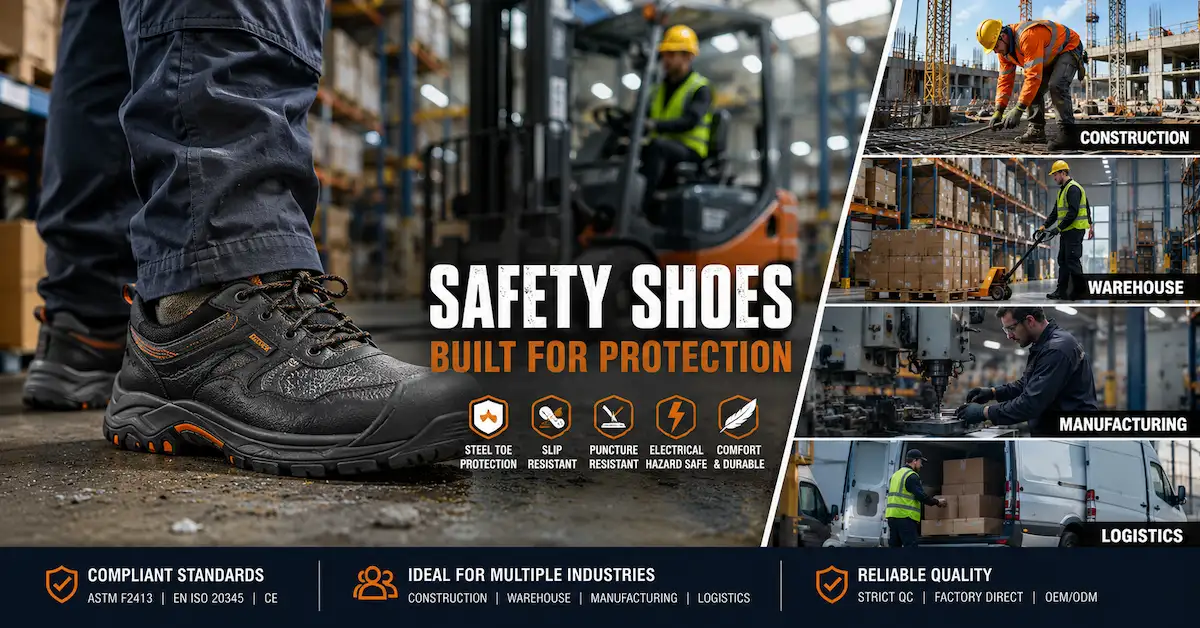
Construction
Construction workers may require protection against:
- Falling materials
- Sharp debris
- Uneven surfaces
- Slips
- Heavy equipment
Manufacturing
Factory environments may require combinations of:
- Toe protection
- Slip resistance
- Puncture resistance
- Electrical properties
- Durable outsole construction
Warehousing and Logistics
Warehouse workers often need footwear that balances:
- Toe protection
- Traction
- Comfort
- Low weight
- Long wearing periods
Maintenance and Industrial Services
Maintenance teams may require more specialized protection depending on:
- Equipment
- Floor conditions
- Electrical exposure
- Chemicals
- Temperature
A professional supplier should therefore ask about the application before recommending a product.
What Should Buyers Ask a Safety Shoes Supplier?
Before requesting a quotation, prepare a technical and commercial checklist.
| Requirement | What to Confirm |
|---|---|
| Product type | Safety shoe, work shoe, boot, etc. |
| Toe protection | Steel, composite, or required construction |
| Outsole | Slip, abrasion, oil, heat, or other requirements |
| Puncture protection | Required or not required |
| Upper | Leather, synthetic, textile, mesh, etc. |
| Size range | Required market sizes |
| Target market | USA, Europe, Middle East, etc. |
| Standard | Applicable market/product standard |
| Quantity | Trial and bulk volume |
| Packaging | Individual box, carton, pallet |
| Branding | Logo and private label |
| Delivery | Destination and required date |
The supplier's ability to respond clearly to these questions is itself an important qualification signal.
Key Safety Shoes Specifications for B2B Buyers
Safety footwear should be evaluated as a complete system.
Toe Protection
Toe protection helps address impact and compression hazards.
Common configurations include:
- Steel toe
- Composite toe
- Other protective toe constructions
ASTM F2413-24 specifies performance requirements for protective safety-toe footwear and covers areas including toe impact and compression, metatarsal protection, electrical properties, static dissipation, puncture resistance, chain-saw cut resistance, and dielectric insulation.
Not every model requires every protection feature.
The correct specification should correspond to the actual workplace risk.
Outsole Performance
The outsole influences:
- Traction
- Abrasion resistance
- Flexibility
- Durability
- Application suitability
For workplaces where wet or slippery floors are a concern, buyers should request applicable test information instead of relying only on marketing descriptions such as “non-slip.”
Upper Material
Common materials include:
- Leather
- Synthetic leather
- Textile
- Mesh
- Engineered materials
Material selection affects:
- Breathability
- Durability
- Flexibility
- Weight
- Water resistance
- Appearance
Product Weight
Weight matters for employees who wear safety shoes throughout a full working shift.
A lighter shoe may improve comfort, but weight should never be considered separately from the required protective construction.
Safety Shoes Standards and Documentation
One of the biggest differences between an experienced B2B supplier and an inexperienced supplier is the ability to discuss standards precisely.
U.S. Market
ASTM F2413-24 is an active ASTM specification covering protective safety-toe footwear. It establishes minimum performance requirements and can be referenced in purchase contracts.
However, buyers should not simply ask:
“Is this shoe ASTM certified?”
Instead, ask:
- Which product model?
- Which standard edition?
- Which tests apply?
- Does the test documentation correspond to this exact construction?
- Are the markings consistent with the documentation?
This distinction is particularly important for OEM projects.
International Markets
ISO 20345:2021 specifies basic and additional requirements for general-purpose safety footwear, including mechanical risks, slip resistance, thermal risks, and ergonomic behavior. ISO also identifies complementary standards for specialized risks such as firefighting, electrical insulation, chainsaw protection, chemicals, and molten-metal splash.
Therefore, buyers should identify the destination market and required protection class before selecting a model.
Sample Evaluation: The Step Many Buyers Skip
For a B2B order, product samples should be treated as part of supplier qualification.
A sample evaluation should include:
Physical Construction
Check:
- Stitching
- Sole bonding
- Toe-cap position
- Upper material
- Surface finish
- Overall symmetry
Wearing Experience
Where possible,actual workers should evaluate:
- Fit
- Comfort
- Weight
- Flexibility
- Heel stability
- Breathability
Product Specification
Compare the physical sample against the supplier's:
- Specification sheet
- Product photos
- Size chart
- Packaging information
- Applicable documentation
The approved sample should then become the reference point for mass production.
How a Safety Shoes Supplier Should Control Quality
Quality control should extend from incoming materials to finished footwear.
| QC Stage | Main Check |
|---|---|
| Material inspection | Upper,sole and protective components |
| Cutting | Component dimensions |
| Stitching | Seam quality and alignment |
| Assembly | Component positioning |
| Sole bonding | Bonding consistency |
| Toe protection | Correct construction |
| Finished product | Size, appearance and workmanship |
| Functional testing | Applicable performance requirements |
| Packaging | Model,size and quantity |
| Pre-shipment inspection | Bulk-order consistency |
The goal is not merely to produce one good sample.
The goal is to reproduce the approved specification consistently across production batches.
Why Repeat-Order Consistency Matters
For B2B buyers, the first shipment is only part of the relationship.
A distributor may reorder the same model several times a year.
If the supplier changes:
- Upper material
- Sole material
- Toe-cap component
- Color
- Insole
- Packaging
- Component supplier
without controlling the change, the next shipment may differ from the approved sample.
This can lead to:
- Customer complaints
- Returns
- Re-labeling
- Inventory problems
- Additional inspection costs
Buyers should therefore ask how product changes are documented and approved.
Safety Shoes Supplier vs Manufacturer
A safety shoes supplier may be a direct manufacturer, sourcing company, exporter, or a combination of these roles.
The label itself is less important than supply-chain transparency.
Ask:
- Where is the product manufactured?
- Who controls production?
- Who controls the product specification?
- Who performs QC?
- Who manages testing documentation?
- Can the same model be reproduced?
- Who handles quality claims?
For long-term B2B cooperation, accountability matters more than terminology.
MOQ, Lead Time and Production Planning
MOQ is an important consideration for distributors and private-label buyers.
However, MOQ should be evaluated together with:
- Product model
- Size assortment
- Color
- Branding
- Packaging
- Production planning
A standard stock model may have different requirements from a completely customized OEM product.
Lead Time
Buyers should separate:
Sample lead time
from
Bulk production lead time
and from
Shipping time.
A supplier should clearly communicate the different stages so buyers can plan inventory and customer commitments.
How to Compare Safety Shoes Supplier Quotes
The cheapest quotation may not be the lowest total cost.
Compare suppliers using a broader framework.
| Evaluation Factor | Supplier A | Supplier B | Supplier C |
|---|---|---|---|
| Product price | Compare | Compare | Compare |
| Product specification | Verify | Verify | Verify |
| Sample quality | Verify | Verify | Verify |
| Documentation | Verify | Verify | Verify |
| MOQ | Compare | Compare | Compare |
| Lead time | Compare | Compare | Compare |
| Packaging | Compare | Compare | Compare |
| Customization | Compare | Compare | Compare |
| Inspection | Verify | Verify | Verify |
| Landed cost | Calculate | Calculate | Calculate |
The objective is to find the supplier offering the best balance between:
Protection + Quality + Compliance + Cost + Supply Reliability
OEM and Private-Label Safety Shoes
Private-label buyers often need more than a standard shoe with a logo.
Potential customization includes:
- Logo
- Upper color
- Outsole appearance
- Insole branding
- Shoe box
- Product label
- Barcode
- Carton markings
However, safety footwear requires additional care during customization.
ASTM F2413-24 notes that changes to original components, such as replacing or adding certain footbeds/inserts or resoling, can cause the footwear to fail to meet the standard and render its ASTM marking invalid.
This means OEM customization should be evaluated together with product testing and compliance.
Do not treat safety shoes like ordinary promotional footwear.
When Safety Shoes Are Part of a Complete PPE Program
Many B2B buyers need several safety products from the same sourcing program.
Typical combinations include:
- Safety shoes
- Safety helmets
- Work gloves
- Hearing protection
- Reflective clothing
- Traffic cones
- Warning posts
- Caution tape
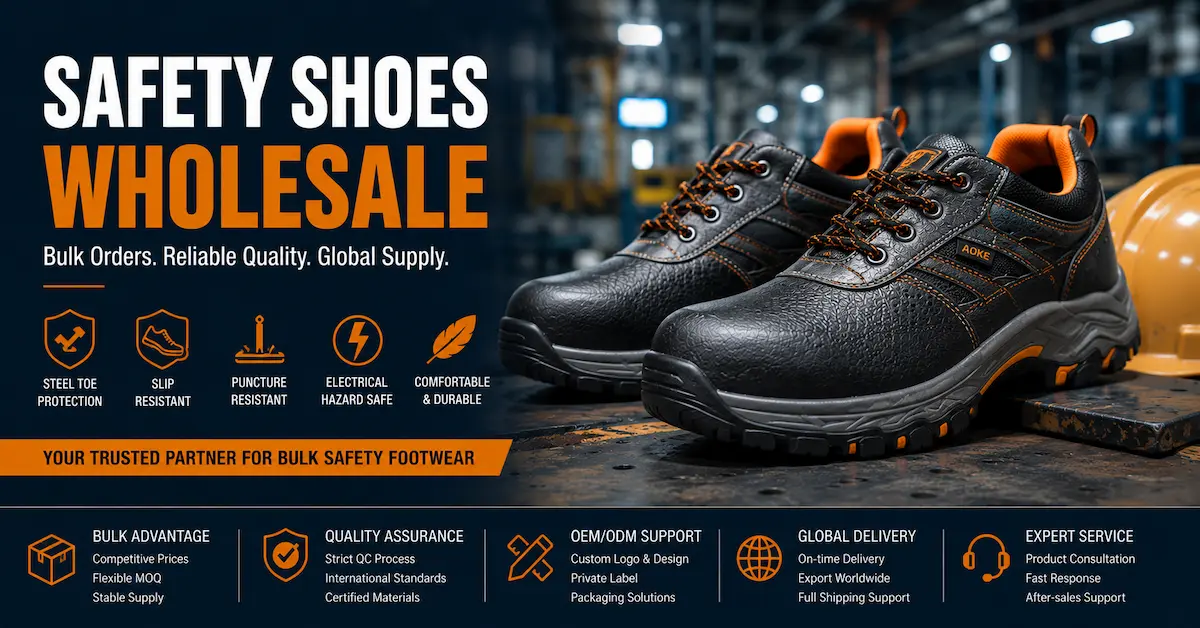
AOKE's Stock Safety Products category currently includes Safety Shoes together with traffic cones, work gloves, safety helmets, warning posts, caution tape, wheel stoppers, and other safety products.
For buyers who also need high-visibility workwear, AOKE provides a dedicated Reflective Clothing category.
This type of product consolidation can simplify supplier communication, quotation comparison, packaging coordination, and repeat purchasing.
Why Consider AOKE as a Safety Product Supplier?
AOKE's public company information identifies Jinhua Aoke New Materials Co., Ltd. as a brand manufacturer since 2010. The company reports more than 300 domestic and international customers, three production facilities, and quality systems including ISO 9001 and BSCI.
Its documented manufacturing and certification capabilities are primarily centered on reflective clothing and safety garments. The company reports three factories with a combined monthly production capacity of 1.75 million pieces, while its public product structure also lists Safety Shoes within the Stock range.
For safety-shoe procurement specifically, buyers should still qualify the exact model independently. AOKE's public Stock page does not provide a complete safety-shoe technical specification or footwear-specific certification package. Therefore, the correct B2B process is to request the exact model, manufacturing source, applicable documentation, MOQ, sample, and current availability before placing a bulk order.
This transparent qualification approach helps buyers avoid assuming that certifications or manufacturing capabilities for one product category automatically apply to another.
What to Send When Requesting a Safety Shoes Quote
A detailed RFQ makes it much easier for a supplier to provide a useful quotation.
Recommended RFQ Information
Product
- Safety shoe or boot type
- Preferred toe protection
- Upper material
- Sole requirements
- Required protection features
Market
- Country
- Industry
- End-user application
- Applicable standard
Order
- Trial quantity
- Bulk quantity
- Expected annual volume
- Size breakdown
Customization
- Logo
- Color
- Packaging
- Labels
- Barcode
Logistics
- Destination
- Required delivery date
- Preferred packaging
- Shipping method
A complete RFQ can significantly reduce back-and-forth communication and help suppliers provide more accurate commercial proposals.
For project requirements, buyers can submit specifications directly through AOKE's Contact Us page.
A Practical Safety Shoes Supplier Evaluation Checklist
Before approving a supplier,use this checklist:
- Application and workplace hazards defined
- Product specification confirmed
- Target-market requirements identified
- Sample received and evaluated
- Applicable documentation verified
- Material specification confirmed
- Toe protection confirmed
- Sole performance reviewed
- QC process understood
- MOQ confirmed
- Lead time confirmed
- Packaging confirmed
- OEM requirements documented
- Repeat-order process discussed
- Total landed cost calculated
A supplier that passes this process is much easier to evaluate objectively than one selected solely on price.
Frequently Asked Questions
How do I choose a reliable safety shoes supplier?
Evaluate product suitability, materials, protective features, applicable standards, documentation, sample quality, QC, MOQ, lead time, customization, and repeat-order capability.
What information should I give a safety shoes supplier?
Provide the target market, workplace application, required protection, product type, quantity, size range, customization requirements, packaging, and delivery destination.
What standards should safety shoes meet?
Requirements depend on the destination market and application. ASTM F2413-24 is an important U.S. protective safety-toe footwear specification, while ISO 20345:2021 covers general-purpose safety footwear internationally.
Are steel-toe safety shoes better than composite-toe shoes?
Neither is universally better. The correct choice depends on workplace hazards, weight requirements, thermal considerations, metal-free requirements, and the applicable product specification.
What should I check when receiving a safety shoe sample?
Check fit, comfort, weight, stitching, sole bonding, toe protection construction, materials, dimensions, appearance, packaging, and documentation.
Can a safety shoes supplier provide OEM services?
Many suppliers can support OEM or private-label programs.Buyers should confirm available customization, MOQ, tooling or development requirements, packaging, and compliance implications.
Does changing an OEM safety shoe affect certification?
It can. Changes to original components may affect compliance with the applicable standard. ASTM specifically warns that certain component changes can cause the footwear to fail the standard and invalidate its marking.
What affects safety shoes wholesale pricing?
Major factors include materials, protective construction, outsole design, quantity, size assortment, customization, packaging, testing, and logistics.
How important is MOQ when choosing a supplier?
MOQ matters because it affects inventory investment and product risk. A suitable supplier should offer an MOQ that matches the buyer's business model and order volume.
How can I reduce safety footwear sourcing risks?
Approve a physical sample, define specifications in writing, verify applicable documentation, establish QC criteria, confirm packaging and delivery, and use the approved sample as the production reference.
Can I buy safety shoes together with other PPE products?
Yes.AOKE's Stock Safety Products category currently includes Safety Shoes alongside other workplace safety products, allowing buyers to discuss broader safety-product sourcing requirements.
Conclusion
Choosing a safety shoes supplier should be treated as a product qualification and supply-chain decision, not simply a price comparison.
For B2B buyers, the strongest supplier evaluation process is:
Define the hazard → specify the product → verify the applicable standard → evaluate samples → confirm QC → review MOQ and lead time → calculate landed cost → approve bulk production.
The right supplier should be able to provide consistent product quality, clear technical information, appropriate documentation, realistic delivery schedules, and practical support for repeat orders.
AOKE can support broader workplace-safety sourcing through its Stock Safety Products. For safety-shoe projects, buyers should provide the target market, required protection, quantity, model requirements, and documentation expectations so the exact product and supply capability can be qualified before ordering.
For OEM, wholesale, or project-based requirements, use AOKE's Contact Us page to submit your specifications.