
How to Choose a Safety Shoes Manufacturer for B2B Supply
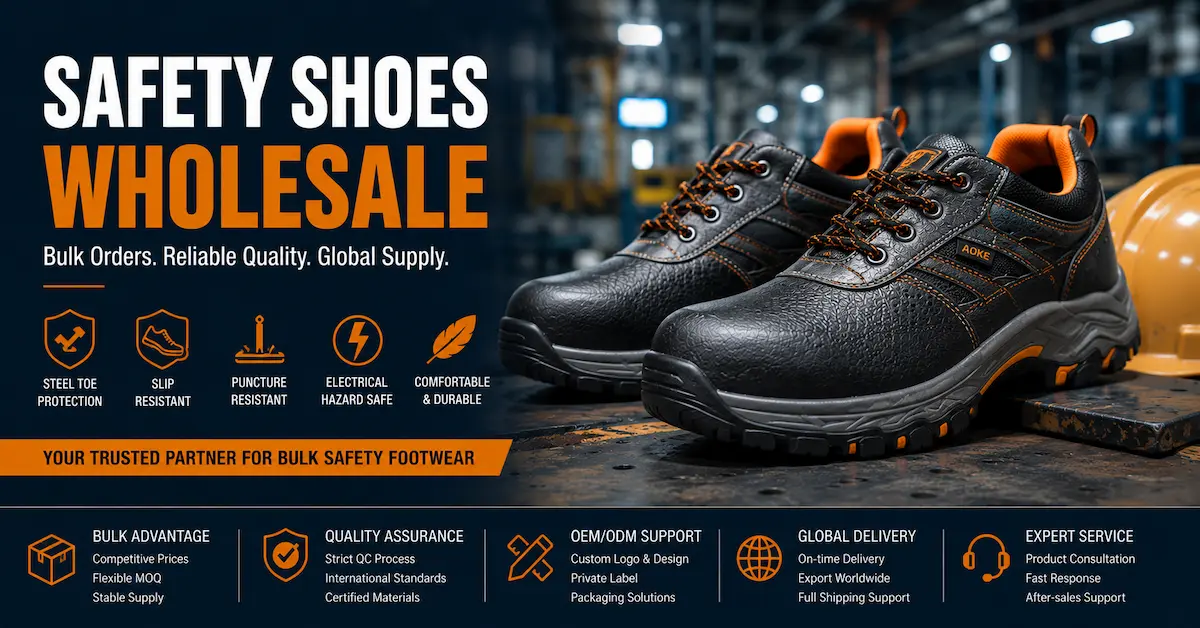
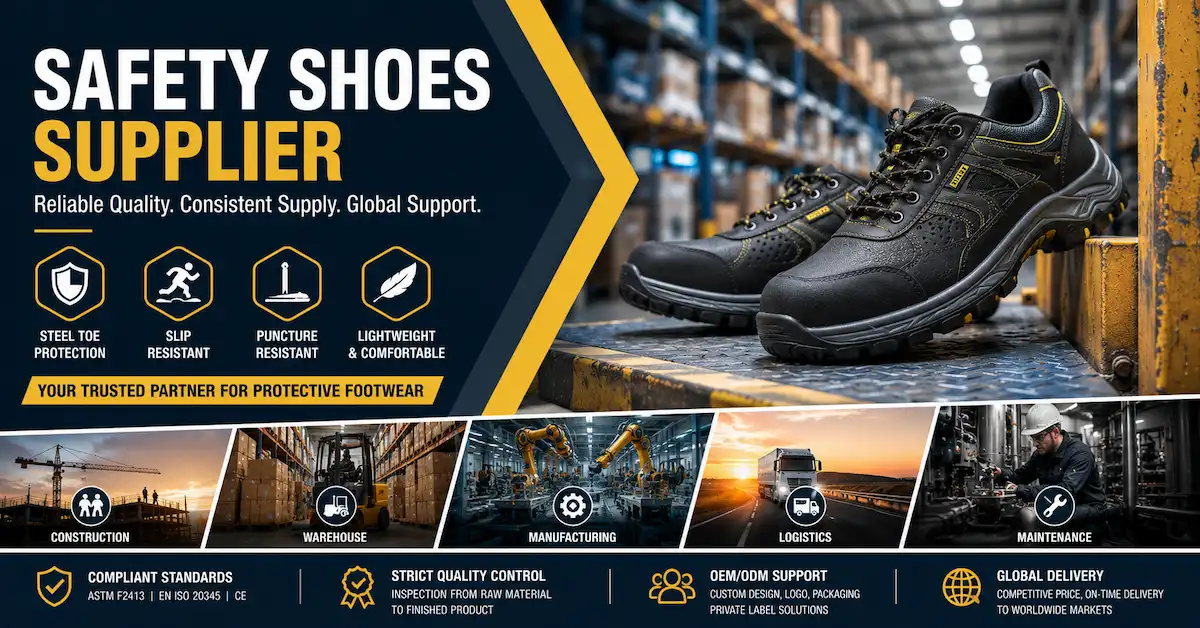
Choosing a safety shoes manufacturer is a critical sourcing decision for PPE distributors, industrial buyers, construction suppliers, contractors, and private-label safety brands.
Safety footwear is not simply ordinary footwear with a protective toe. Depending on the application, buyers may need protection against falling objects, compression, puncture hazards, slipping, electrical risks, heat, or other workplace hazards.
For this reason, a professional procurement process should evaluate the complete product rather than focusing only on appearance or price.
The key questions are:
- What workplace hazards does the footwear need to address?
- Which toe protection and sole construction are appropriate?
- What materials are used?
- Which market-specific requirements apply?
- How is product quality controlled?
- Can the supplier maintain consistent specifications across repeat orders?
- Can the product be customized for a distributor or private-label brand?
A reliable supplier should be able to answer these questions with clear product specifications and supporting documentation.
Who Should Work With a Safety Shoes Manufacturer?
Different B2B buyers have different purchasing priorities.
| Buyer Type | Main Requirement | Key Concern |
|---|---|---|
| PPE distributor | Stable catalog and repeat supply | Quality consistency |
| Safety equipment wholesaler | Competitive bulk purchasing | Total landed cost |
| Construction supplier | Job-site protection | Durability and fit |
| Industrial buyer | Workforce protection | Hazard suitability |
| Contractor | Project-based supply | Lead time |
| Private-label brand | Customized footwear | OEM and packaging |
| Government/project buyer | Specification-based sourcing | Compliance documentation |
A distributor may need several styles and sizes, while an industrial company may prioritize a specific protective function.
The first step is therefore to define the application before requesting a quotation.
Start With the Workplace Hazard, Not the Product Catalog
One of the most common procurement mistakes is selecting safety shoes first and identifying the hazard afterward.
The correct process should be reversed.
Identify the Main Foot Hazards
Typical workplace hazards may include:
- Falling or rolling objects
- Sharp objects penetrating the sole
- Slippery floors
- Electrical hazards
- Heat exposure
- Heavy industrial equipment
- Chemical or liquid exposure
- Long periods of standing or walking
OSHA's foot-protection requirements state that protective footwear is required in workplaces where there is a danger from falling or rolling objects, objects piercing the sole, or certain electrical hazards.
This means buyers should provide the manufacturer with the actual work environment rather than simply asking for “the strongest safety shoes.”
What Should a Safety Shoes Manufacturer Provide?
A capable supplier should provide enough technical information for a buyer to evaluate the product.
Important information includes:
| Product Information | Why It Matters |
|---|---|
| Toe protection | Addresses impact and compression hazards |
| Sole construction | Influences traction and durability |
| Upper material | Affects comfort and environmental suitability |
| Insole | Influences support and wearing comfort |
| Outsole | Affects grip, wear,and application |
| Weight | Important for extended use |
| Size range | Required for workforce or distribution |
| Water resistance | Relevant to wet environments |
| Electrical properties | Required for specific applications |
| Testing information | Supports product qualification |
The exact specification should be established according to the target market and application.
Safety Toe Protection: What Buyers Need to Know
Toe protection is one of the most important characteristics of industrial safety footwear.
Different markets use different standards and conformity systems.
For U.S.procurement, ASTM F2413-24 is the current ASTM specification for protective safety-toe footwear. It covers minimum design, performance, testing, classification, fit, function, and performance requirements for footwear intended to protect against various workplace hazards.
The standard addresses areas including:
- Toe impact resistance
- Toe compression resistance
- Metatarsal protection
- Conductive properties
- Electrical shock resistance
- Static dissipative properties
- Puncture resistance
- Chain-saw cut resistance
- Dielectric insulation
Not every safety shoe needs every feature.
The buyer should specify the hazards that actually exist in the target workplace.
Steel Toe vs Composite Toe Safety Shoes
Toe-cap selection is often an important purchasing consideration.
| Feature | Steel Toe | Composite Toe |
|---|---|---|
| Protection | Strong mechanical protection | Strong mechanical protection depending on design |
| Weight | Usually heavier | Often lighter |
| Thermal behavior | Conducts heat/cold more readily | Lower thermal conductivity |
| Metal-free requirement | Not suitable | Potentially suitable |
| Common use | General industrial applications | Construction, industrial, metal-free environments |
The choice should be based on the workplace, required standard, user preference, and product specification rather than assuming one construction is universally superior.
For large orders, sample testing with actual workers can provide useful information about comfort and usability.
Safety Footwear Standards: U.S. and International Buyers
Compliance requirements vary by destination market.
ASTM Requirements for U.S. Buyers
ASTM F2413-24 provides performance requirements for protective safety-toe footwear. ASTM also maintains separate test methods such as F2412-24 for foot protection.
For procurement teams, the important point is that a standard reference should correspond to the actual product being supplied.
Do not accept a generic statement such as “ASTM approved” without asking:
- Which standard?
- Which edition?
- Which product model?
- Which tests were performed?
- Does the documentation match the supplied construction?
ISO 20345 for International Markets
ISO 20345:2021 specifies basic and additional requirements for general-purpose safety footwear, including mechanical risks, slip resistance, thermal risks, and ergonomic behavior.
The standard also recognizes different requirements for specialized risks, which may require complementary job-specific standards.
This is why “CE” or “ISO” alone should not be treated as a complete product specification.
Materials Used in Safety Shoes
A safety footwear product is a system of multiple components.
Upper Materials
Common upper materials can include:
- Leather
- Synthetic leather
- Textile
- Mesh
- Other engineered materials
Material selection affects:
- Breathability
- Durability
- Water resistance
- Flexibility
- Weight
- Appearance
Midsole and Puncture Protection
For workplaces with sharp-object hazards, buyers may require puncture-resistant construction.
The protection may be provided through different structural approaches depending on the product.
Outsole Materials
The outsole has a direct effect on:
- Traction
- Abrasion resistance
- Flexibility
- Oil resistance where applicable
- Temperature performance where applicable
ISO 20345 specifically includes slip resistance among the performance requirements addressed by the standard.
Slip Resistance Is a Procurement Issue, Not Just a Marketing Claim
Slip resistance is particularly important in:
- Warehouses
- Manufacturing plants
- Kitchens
- Logistics facilities
- Construction sites
- Maintenance environments
A buyer should not rely solely on phrases such as “non-slip” or “anti-slip.”
Instead, request the applicable test information and determine whether it matches the intended application.
ASTM currently lists F2913-24 for measuring the coefficient of friction for evaluating footwear slip performance and F3445-24 for performance requirements when evaluating slip resistance using the ASTM F2913 whole-shoe tester.
This creates a more objective basis for supplier comparison.
How a Safety Shoes Manufacturer Should Control Quality
Quality control should cover the complete footwear, not only the final appearance.
A practical B2B QC process can include:
| QC Stage | What to Check | Risk Controlled |
|---|---|---|
| Incoming materials | Upper, sole,toe-cap and component specifications | Material substitution |
| Cutting | Component dimensions | Size inconsistency |
| Stitching/assembly | Seam quality and alignment | Structural defects |
| Sole bonding | Bonding consistency | Sole separation |
| Toe-cap assembly | Position and construction | Protection inconsistency |
| Finished footwear | Appearance and dimensions | Batch variation |
| Functional testing | Applicable performance characteristics | Technical failure |
| Packaging | Size, labels and quantity | Distribution errors |
| Pre-shipment inspection | Finished-order sampling | Bulk-order risk |
For B2B buyers, the most important principle is repeatability.
A supplier should be able to reproduce the approved product across multiple production batches.
How to Evaluate a Safety Shoes Manufacturer Before a Bulk Order
A supplier audit should combine product, technical, commercial, and operational evaluation.
1.Verify the Product Specification
Request:
- Product model
- Size range
- Materials
- Toe protection type
- Sole construction
- Product weight
- Available colors
- Packaging specifications
2. Verify Applicable Documentation
Ask for documents relevant to the target market and exact product model.
The documentation should match:
- Product construction
- Model number
- Markings
- Packaging
- Test configuration
3.Approve a Physical Sample
A sample should be checked for:
- Fit
- Comfort
- Stitching
- Sole construction
- Toe-cap position
- Surface finish
- Weight
- Packaging
4. Confirm Production Consistency
Ask how the manufacturer controls changes to:
- Materials
- Components
- Suppliers
- Production process
- Product design
Uncontrolled component substitutions can create significant problems for repeat orders.
Safety Shoes Manufacturer vs Safety Shoes Supplier
The words manufacturer and supplier are sometimes used interchangeably, but they can represent different business models.
A manufacturer may directly control:
- Product development
- Production
- Assembly
- QC
- Packaging
A sourcing supplier may coordinate production through qualified manufacturing partners.
Neither model should automatically be considered better.
For B2B buyers, the more important questions are:
- Who controls the product specification?
- Who performs quality inspection?
- Where is the product manufactured?
- Who owns the technical documentation?
- Can the same specification be reproduced?
- Who is responsible when a batch does not meet the approved standard?
Transparency is more valuable than a label.
OEM and Private-Label Safety Shoes
Private-label buyers often require more than a standard shoe with a logo.
An OEM project may involve:
- Custom colors
- Logo application
- Customized insoles
- Packaging
- Shoe boxes
- Hangtags
- Barcode labels
- Carton marks
- User information
However, safety footwear should not be treated like ordinary promotional merchandise.
ASTM notes that changes to original components of safety-toe footwear, such as adding or replacing certain components, can affect compliance with the standard.
Therefore, buyers should discuss customization before finalizing the approved product.
A change that looks cosmetic may affect the tested configuration.
How to Compare Safety Shoes Manufacturer Quotes
Do not compare only the EXW or FOB unit price.
A better comparison includes:
| Cost Factor | Buyer Question |
|---|---|
| Product price | What exactly is included? |
| Packaging | What packaging specification is included? |
| Testing | Are required tests included? |
| Customization | What is included in OEM pricing? |
| Inspection | Who performs inspection? |
| Freight | How efficient is the packaging? |
| Replacement risk | What happens if a batch fails inspection? |
| Lead time | When can the goods actually ship? |
The objective is to calculate the total cost of ownership and supply risk, not simply the lowest quotation.
Production Capacity and Lead Time
Safety footwear buyers should confirm capacity before committing to large orders.
Important questions include:
- What is the normal production lead time?
- What is the capacity for repeat orders?
- How are urgent orders handled?
- What happens during peak production periods?
- Can the supplier maintain the same model for future orders?
For distributors, this is particularly important because product availability directly affects customer service.
A supplier with attractive samples but unreliable replenishment may create more business risk than a slightly more expensive but stable partner.
Packaging and Export Considerations
Safety shoes are usually sold as individual pairs, making packaging an important part of international procurement.
Buyers should define:
- Individual shoe protection
- Pair packaging
- Shoe box
- Master carton
- Carton quantity
- Size labeling
- Barcode
- Pallet requirements
For distributors, packaging should also match the sales channel.
A retail brand may need individual branded boxes, while a project buyer may prioritize compact export packaging.
When Safety Shoes Are Part of a Larger PPE Program
Many industrial buyers do not purchase footwear alone.
A complete PPE program may include:
- Safety shoes
- Safety helmets
- Hearing protection
- Work gloves
- Reflective clothing
- Traffic safety products
This creates an opportunity to simplify procurement by working with a supplier that can coordinate multiple safety categories.
AOKE's current product structure includes Safety Shoes within its Stock range, alongside traffic cones, work gloves, safety helmets, warning posts, caution tape, wheel stoppers, and other workplace safety products. This makes the Stock section relevant for buyers evaluating a broader safety-product sourcing program.
For reflective workwear requirements, AOKE also maintains a dedicated Reflective Clothing product category.
Why Consider AOKE for Safety Product Sourcing?
AOKE's public company information identifies Jinhua Aoke New Materials Co., Ltd. as a brand manufacturer since 2010. The company reports cooperation with more than 300 domestic and international customers, three strategically located production facilities, and quality systems including ISO 9001 and BSCI. Its documented product certifications include EN ISO 20471, ANSI, AS/NZS, OEKO-TEX 100, EN 1149, EN 11612, EN 14116, UL, and NFPA 2112.
Its documented manufacturing infrastructure is primarily described around reflective clothing: the company reports Jinhua customization capacity, Chongqing reflective-clothing production, and a Myanmar facility with 20 sewing lines and more than 265 flat sewing machines.
For safety-shoe buyers, this distinction is important. AOKE's public site currently places Safety Shoes within its Stock product structure, but does not publish a detailed safety-shoe factory specification or certification package on that page. Therefore, buyers should request the exact safety-shoe model, manufacturing source, applicable test documents, MOQ, and current availability during qualification rather than assuming the reflective-clothing certifications apply to footwear.
This transparent qualification process helps buyers determine whether the specific footwear solution matches their market and project requirements.
What to Include in a Safety Shoes RFQ
A high-quality RFQ should contain enough information for the supplier to recommend the correct product.
Recommended RFQ Information
| Requirement | Example Information |
|---|---|
| Target market | USA, EU, UK, Middle East, etc. |
| Application | Construction, factory, warehouse, logistics |
| Quantity | Trial order + expected annual volume |
| Size range | Required sizes |
| Toe protection | Required protection type |
| Sole requirement | Slip, puncture, electrical, etc. |
| Upper material | Preferred or required material |
| Branding | Logo, colors, packaging |
| Documentation | Required standards and reports |
| Packaging | Individual box, carton, pallet |
| Delivery | Destination and required date |
The more complete the RFQ, the more useful the supplier's quotation will be.
A Practical Supplier Evaluation Scorecard
For repeat B2B purchasing, buyers can use a weighted scorecard.
| Evaluation Area | Weight |
|---|---|
| Product suitability | 20% |
| Applicable compliance/documentation | 20% |
| Sample quality and fit | 15% |
| QC and traceability | 15% |
| Production and supply stability | 10% |
| Pricing and total landed cost | 10% |
| OEM/customization | 5% |
| Communication and service | 5% |
| Total | 100% |
This approach prevents a supplier from winning the order simply because its initial quotation is the cheapest.
Frequently Asked Questions
What does a safety shoes manufacturer produce?
A safety shoes manufacturer develops and produces protective footwear designed for workplace hazards. Depending on the product, this can include safety-toe footwear and footwear with additional properties for hazards such as puncture, slipping, electrical exposure, heat, or other risks.
How do I choose a reliable safety shoes manufacturer?
Evaluate the exact product specification, applicable standards, sample quality, manufacturing and QC processes, documentation, production capacity, lead time, customization capability, and repeat-order consistency.
What standard should safety shoes meet?
It depends on the target market and application. ASTM F2413-24 is a key U.S. specification for protective safety-toe footwear, while ISO 20345:2021 specifies requirements for general-purpose safety footwear in international markets.
Are steel-toe safety shoes better than composite-toe shoes?
Not universally. Steel and composite constructions have different characteristics. The correct choice depends on the required protection, workplace conditions, weight preferences, metal-free requirements, and applicable product standard.
What should I check in a safety shoe sample?
Check fit, comfort, toe-cap construction, sole grip, stitching, bonding, weight, materials, finish, size accuracy, and packaging. For safety-critical projects, also verify the sample against the applicable technical documentation.
Can a safety shoes manufacturer provide OEM services?
Many manufacturers can support private-label programs, but the available options vary. Buyers should define logo, color, packaging, labeling, and other requirements before approving the final product.
What affects safety shoes wholesale pricing?
Main factors include materials, toe protection, sole construction, product complexity, quantity, customization, packaging, testing, and logistics.
How important is slip resistance?
Slip resistance can be critical in workplaces where floors are wet, oily, smooth, or otherwise hazardous. Buyers should identify the relevant application and request applicable test information instead of relying only on “non-slip” marketing claims.
Can safety shoes be customized after certification?
Buyers should not assume that every modification is acceptable. Changes to components can affect the tested configuration or applicable conformity requirements. ASTM specifically warns that changes to original components can affect the validity of its marking.
What documents should I request before a bulk order?
Request the exact product specification, applicable test reports, conformity documentation, product markings, packaging information, user instructions, and an approved production sample.
Can AOKE supply safety shoes together with other PPE products?
AOKE's website currently lists Safety Shoes within its Stock range alongside other safety products. Buyers should confirm the specific model, current availability, manufacturing source, MOQ, documentation, and lead time before placing an order.
Conclusion
Choosing a safety shoes manufacturer should begin with the workplace hazard and end with a verified, repeatable supply solution.
For B2B buyers, the most important factors are not simply appearance or unit price. Product suitability, toe protection, sole performance, materials, compliance documentation, sample quality, QC controls, production stability, packaging, and total landed cost all affect the success of a safety-footwear purchasing program.
The safest sourcing approach is straightforward:
Define the hazard → specify the product → verify the standard → approve the sample → audit QC → confirm production capability → compare total cost → place the bulk order.
AOKE can support broader workplace-safety sourcing through its Stock Safety Products, while its documented manufacturing and company capabilities can be reviewed through About AOKE. For safety-shoe projects requiring a specific model, certification, OEM configuration, or bulk quantity, buyers should contact AOKE with the target market and technical requirements for model-specific confirmation.