
Key takeaways (quick answers):
- ANSI/ISEA 107-2020 sorts garments by type and class: Type O for off-road, Type R for roadway, Type P for public-safety personnel whose duties include traffic stops; classes 1-3 scale the amount of fluorescent background and retroreflective material.
- ANSI class 2 is not the same certificate as EN ISO 20471 class 2 — related philosophies, different test setups, marking and configuration rules; a vest documented to one standard should not be marketed into the other's market without its own test file.
- The clearest US mandate is federal-roadwork: 23 CFR 634 requires workers with exposure to traffic in federal-aid highway rights-of-way to wear high-visibility safety apparel to the MUTCD-referenced ANSI edition — flaggers to the highest configuration.
- OSHA does not have a blanket hi-vis rule — requirements arrive through specific standards, customer site rules and contract specs, which is why "OSHA approved vest" is a phrase to question, not trust.
- US wholesale needs a different size reality: deeper XL-5XL penetration and a fit-first sample round; a China/EU curve imported into a US program turns into returns and dead stock.
- Importing hi-vis into the US is a document stack: commercial set plus FTC fiber-content/care/origin labeling, flammability compliance for apparel textiles, and HTS classification confirmed with your broker — duty exposure, not just unit price, decides landed cost.
Publisher disclosure: published by Jinhua Aoke New Materials Co., Ltd, a China-based hi-vis manufacturer selling into US wholesale channels; we benefit commercially from inquiries. This guide summarizes publicly published rule structures (ANSI/ISEA 107-2020, MUTCD-referenced federal requirements 23 CFR 634, FTC textile and care labeling rules, CPSC apparel flammability) reviewed November 13, 2026. It is B2B information, not legal advice; confirm current editions and your obligations with counsel and your customs broker. Companion articles: wholesale buying guide (general mechanics) and China manufacturers shortlist.
Sourcing for the US season? Send your class/type spec, quantities and delivery window or start from catalog SKUs.
What do ANSI/ISEA 107-2020 classes and types actually mean?
Short answer: the standard crosses two axes. Type answers "what kind of worker movement environment" — O (off-road, vehicles ≤25 mph), R (roadway exposure), P (public safety needing balance, radio and badge access with 360° visibility). Class answers "how much material" — class 1 minimal, class 2 intermediate roadworker level, class 3 the fullest coverage with sleeves or full-body silhouettes. 2020 also tightened performance-class expectations around the whole garment — including construction and durability properties, not just fabric optics — which rewards factories that document their build, not just their cloth.
Wholesale consequence: an RFQ written as "ANSI class 2 vest" is ambiguous nonsense to a serious supplier unless it adds Type (nearly always R for US workwear programs) and confirms the 2020 edition. Ask suppliers to quote per the published compliance table and label path, and require the care label art to show the correct class/type pictogram configuration — the label is where auditors and buyers both look first.
Is ANSI Class 2 the same as EN ISO 20471 Class 2?
Short answer: no — they rhyme but don't translate. Both tier visibility by minimum background and retroreflective areas with band geometry rules, and the area logic is broadly comparable at class 2; but the test setups, color gamut tables, retroreflection measurement conditions, configuration drawings and labeling systems are separate publications. A garment certified against EN ISO 20471 (with its EU notified-body route for PPE Regulation 2016/425) is not thereby "ANSI compliant," and vice versa. Serious export factories hold parallel test files per model/colorway, not a universal claim.
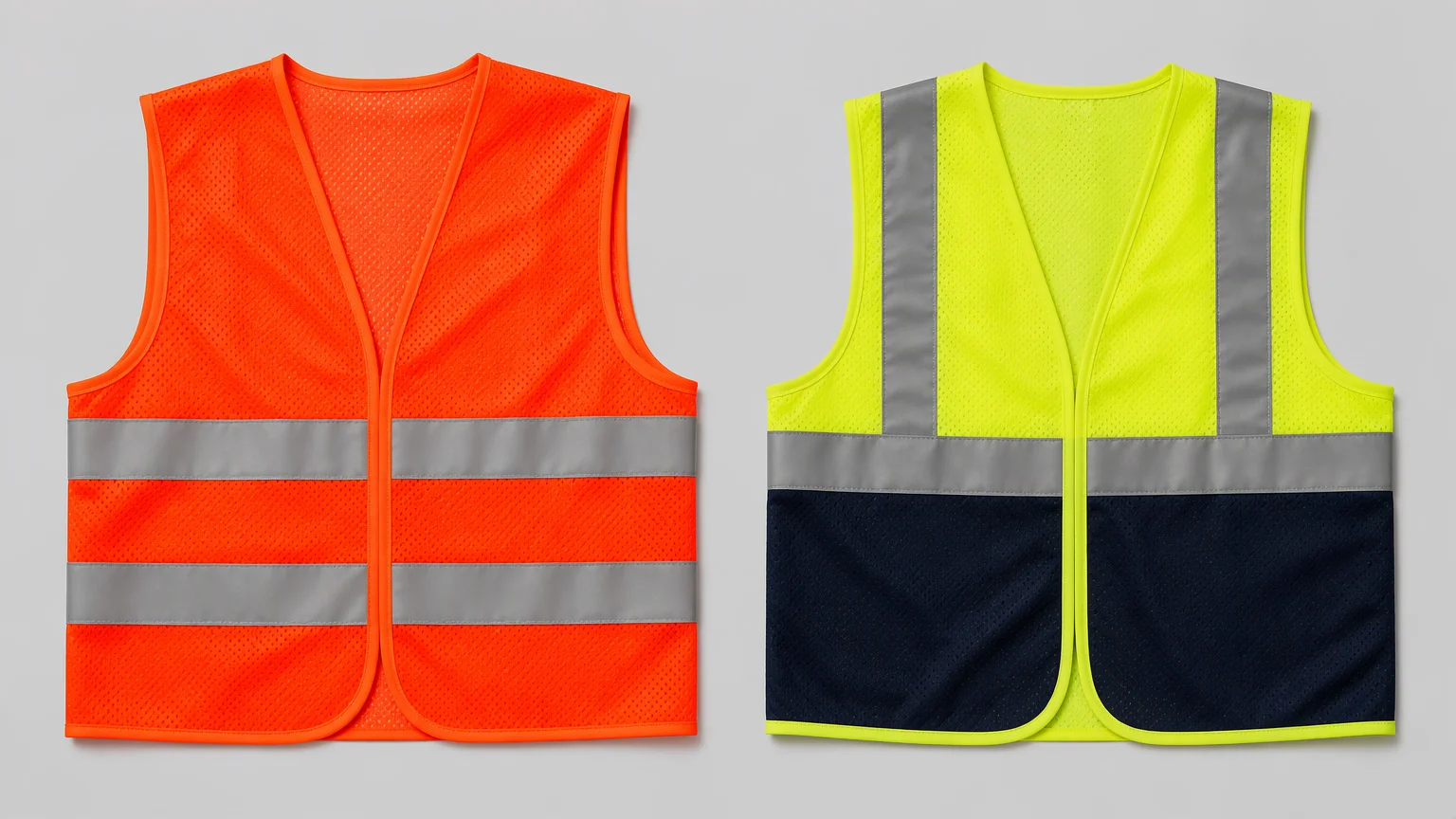
Illustrative image: US roadway programs skew fluorescent orange-red Type R; yellow-green with shoulder-band coverage is the common class-3 silhouette. Configuration drives the class, not color preference.
| Dimension | ANSI/ISEA 107-2020 (US) | EN ISO 20471:2013+A1:2016 (EU/UK) |
|---|---|---|
| Tiering | Type O/R/P × Class 1-3; performance-class garment construction criteria | Class 1-3 by minimum areas (background / retroreflective) |
| Approval route | Manufacturer certification to the standard with accredited-lab evidence; no EU-style notified body | Cat II PPE under Regulation 2016/425: EU type examination by a notified body + production control |
| Marking | Class/type pictogram per the standard's labeling scheme | Class pictogram + standard number on the care label |
| Practical import | US buyers should hold a 107-2020 test file naming the exact model and colorway | EU buyers should hold the certificate + test report naming the same |
When do US rules actually require high-visibility apparel?
Short answer: the hard federal mandate is roadway work. Under 23 CFR 634, workers on or near right-of-way of federal-aid highways with exposure to moving traffic must wear high-visibility safety apparel compliant with the MUTCD-referenced ANSI/ISEA edition, at class 2 or 3 by task — and flaggers have the highest configuration requirement. Beyond that corridor, requirements are set by employer risk assessments, client site rules (refineries, ports, warehouses, airports), contractor flow-downs and some state DOT add-ons. Know the corridor your buyer serves — it changes which SKU sells.
Does OSHA require reflective vests on every jobsite?
Short answer: no, and this is the most-Googled wrong question in the category. OSHA has no blanket hi-vis standard for general industry. Visibility obligations reach US worksites through the General Duty Clause and hazard assessment, specific rules (work-zone traffic exposure under the federal-highway regime, certain signal/flag duties), and — most often in practice — customer safety programs written into contracts. For wholesalers this is commercially decisive: "OSHA-approved vest" is a marketing ghost; sell to the ANSI class/type the site rule actually names.
Which ANSI class and type does each industry buy?
| Segment | Typical spec | Why | Wholesale note |
|---|---|---|---|
| Road construction / utility crews | Type R class 2 vest; class 3 in high-speed or night work | Traffic exposure corridor; 23 CFR 634 for federal projects | Breakaway styles and mic/sleeve options ride along |
| Flaggers | Class 3 highest configuration | MUTCD-referenced requirement | Smaller unit counts, stricter spec — no substitutions |
| Warehousing / logistics yards | Type O class 1-2; Class 2 R for yard-forklift traffic | Vehicle speed zones internal vs public road | Huge replenishment volume, logo-friendly |
| Public safety / security | Type P class 2-3 outerwear and vests | 360° visibility with duty-gear access | Coat silhouettes, dark panels constrained by class math |
| Energy / industrial sites | Class 2-3 site-rule driven; FR+hi-vis where required | Client flow-down specs | FR lane needs its own certificate discipline — see FR guides on this blog |
What changes in the size curve for US programs?
Short answer: plan deeper big sizes and a fit round, not just longer grading. US workforce distributions and layering habits push materially more demand into XL-5XL than typical export default curves; tall fits appear in fleet specs. Wholesale failure pattern: a distributor imports the domestic-China curve (small-medium weighted), the first two fleet orders return or dead-stock in XL+, and margin evaporates quietly. Fix at PO stage — build the curve from the buyer's own headcount or historical returns data, keep a reserve buffer of XL+, and confirm fit on layers with a graded sample set, as detailed in our bulk order size-ratio guide.
Orange-red or yellow-green — what do US buyers actually stock?
Short answer: roadway and utility fleets skew fluorescent orange-red (the classic highway look, strong contrast against green foliage and urban grey); warehousing, parking and non-highway crews skew fluorescent yellow-green (highest raw luminance). Neither color alone proves class — the band configuration and area do. A sane US starter assortment stocks both colors in the same class 2 Type R pattern, so one site spec never splits your catalog; the color/compliance trade is explained further in our wholesale guide's class section.
What paperwork does importing hi-vis apparel into the US involve?
Short answer: a commercial set and a labeling/compliance set. Commercial: commercial invoice, packing list, bill of lading, HTS classification (apparel falls under HTSUS chapters 61/62 by knit-vs-woven and fiber; confirm the exact code and current duty — including any trade-remedy measures on China-origin goods — with your licensed customs broker, since rates change and this article deliberately does not quote volatile numbers). Compliance/labeling: FTC Textile Fiber Products Act requirements (fiber content by percentage, country of origin, RN or manufacturer ID on the label), FTC Care Labeling Rule (care instructions before first sale), and CPSC apparel-textile flammability standards (16 CFR 1610). Certified hi-vis adds its own evidence file — the ANSI/ISEA 107-2020 test report — which lives with your product claims, not your customs broker.
- Origin matters commercially, not just for duty: buyers on Buy-America-adjacent public projects may need documented non-restricted sourcing; a supplier with a second-country facility (as several China-headquartered hi-vis makers now operate, including the publisher's Myanmar plant) can quote origin options — ask.
- Packaging barcodes and carton marks belong in the PO too; US big-box and distributor channels reject on labeling defects the same way PPE audits reject on class areas.
- Do not import "certified" stock without the report in your name-or-accessible form: customs won't ask, but a customer audit or an injury claim will, and a report naming a different model/colorway is worthless.
How do I verify a supplier's "ANSI compliant" claim before bulk?
Short answer: six checks that separate documented garments from label-printed hopes.
- Current test file, right edition: an accredited-lab report against ANSI/ISEA 107-2020 naming the exact model, colorway and size range — not a 2015 report, not a fabric-only report.
- Coverage: retroreflection across the laundering cycles the standard's care claims imply, plus chromaticity for the fluorescent color you are buying.
- Configuration audit: measure the actual sample — band widths, spacing and the class-3 shoulder coverage where claimed — against the standard's minimum-areas tables. Class is earned by the finished cut, not the fabric roll.
- Performance-class build evidence: seam strength, hardware and construction claims are part of the 2020 garment story — request the factory's in-process and final inspection records (our 12-point scorecard covers the audit questions).
- Label art proof: care label must carry the correct class/type pictogram matching the tested configuration; marketing that says class 3 on a class-2-tested garment is the single most common distributor liability.
- Golden-sample archive: keep a sealed approved unit per SKU — the reference for every container and every dispute.
What MOQ, lead time and order calendar fit the US season?
Short answer: US construction and utility demand front-loads in spring, so replenishment POs land in October-January for a February-April arrival. Stock-lane class 2 Type R vests move in the 100-500 replenishment band with 1-2 week dispatch; bespoke colorway/label programs at the 800-3,000 band need 25-45 days plus ocean transit — which is exactly why the calendar matters more than the unit price in Q4. Hurricane season and public-works catch-up years create demand spikes that late buyers pay air-freight for. Full mechanics (MOQ tiers, price drivers, payment terms) are in the wholesale buying guide; winter programs for northern states have their own calendar in the winter jackets guide.
What does "DOT approved" really mean on a safety vest listing?
Short answer: it is shorthand, not a certificate — and wholesale buyers should treat it as a question, not a spec. The Department of Transportation does not run a certification program for vests. What the highway world actually references is the chain: federal rule 23 CFR 634 → the MUTCD → an ANSI/ISEA 107 edition, class and type. When a listing says "DOT approved," the honest translation is "we believe this garment suits MUTCD-referenced work-zone use" — which is only meaningful if the seller can produce the 107-2020 test file and class determination behind that belief. Distributors building catalogs should replace "DOT approved" with the actual class/type string (e.g., Class 2 Type R) in every product line; it converts a vague claim into an auditable one and filters out suppliers who cannot support either.
Quick glossary for US hi-vis wholesale conversations
Right-of-way (ROW): the highway land corridor where the federal apparel rule bites. MUTCD: the federal work-zone traffic control manual whose referenced apparel specs 23 CFR 634 invokes. Flagger: the traffic-control role with the strictest apparel configuration. Type R / P / O: ANSI roadway / public-safety / off-road use families. Performance class: the 2020-edition's whole-garment construction and durability dimension beyond optics. RN: FTC Registered Identification Number appearing on US textile labels. HTS: the tariff classification line your customs entry — and duty math — hangs on. Breakaway: quick-removal closure design, compatible with (but never proof of) a class. Golden sample: the sealed approved unit your whole container gets judged against.
Frequently asked questions (US wholesale buyers ask these first)
What is the difference between ANSI Class 2 and Class 3 vests?
Class 3 requires substantially more fluorescent background and retroreflective coverage than class 2, and its geometry usually forces sleeves or a full-body silhouette — which is why most class 3 garments are jackets, coveralls or shirts rather than simple vests. Buying decision: class 2 for typical roadway exposure at moderate speeds, class 3 for high-speed, high-risk or night corridor work and for flaggers, whose configuration requirement is fixed by the MUTCD-referenced federal rule rather than by preference.
Do reflective safety vests expire?
Not by a printed date, but by condition. Fluorescent dyes fade with UV and laundering; retroreflective glass beads or microprisms degrade with flexing, abrasion and washing. The standards' test evidence is written around a laundering-cycle expectation, so the honest wholesale rule is: replace on your launderer's cycle count or on visible damage, whichever comes first, and put the number in your catalog so customers buy replacements on schedule — it is legitimate recurring revenue, not upsell.
Can I sell EN-certified stock into the US market?
You can physically import it, but you cannot market it as ANSI/ISEA 107 compliant without a current 107-2020 test file for that model and colorway — and sophisticated buyers read the care label pictogram before they read your datasheet. The clean pattern for mixed-market distributors: buy dual-documented models where the factory genuinely holds both files, and split SKUs in your catalog so a class-2-EN garment never lands on a spec that names ANSI class 2.
What are the FTC label requirements on imported safety vests?
The three-piece basics: fiber-content declaration with percentages and country of origin (RN or manufacturer identification), a permanent care label with washing instructions, and compliance with the apparel-textile flammability standard. On certified garments add the ANSI class/type pictogram label. Non-negotiable detail: the fiber content on the neck label, the test report and the invoice must all match — mismatched label content is a US-market seizure and re-labeling event, not a paperwork nit.
Is a breakaway vest ANSI compliant?
Breakaway refers to the closure (hook-and-loop or snap shoulders for quick removal in snag environments) and is compatible with ANSI class compliance if the closed configuration still delivers the required areas and band geometry. Verify on the actual sample: the open breakaway seam is exactly where band continuity is most often compromised. Flaggers in snag-free roles should not be issued breakaway as default — buy the closure per hazard, not per fashion.
Do I need class 3 if my vests have sleeves?
Sleeves help, but class 3 is an area and configuration calculation, not a feature checkbox. A sleeved shirt with thin reflective strips can sit below class 3 thresholds; a properly engineered two-band vest with shoulder coverage can reach it. Ask for the class determination worksheet on the specific model — a supplier who cannot produce one is quoting marketing, not compliance.
How do I stop counterfeit-look "ANSI" vests from suppliers?
Trust documents and measurements, not photos: current-lab report for the exact SKU/colorway (verify report numbers with the lab), a physical golden sample measured against the class tables, care-label artwork proofed against the tested configuration, and pre-shipment inspection against that sample. Price that sits far below certified-grade input costs (fabric, certified tape, testing) is the first signal — the second is a "certificate library" that answers every question with a PDF of a different model.
Can I add our logo to ANSI class 2 vests and stay compliant?
Yes, within the same constraints that apply in every market: artwork never covers retroreflective bands, and the remaining fluorescent area after subtracting the logo still meets class 2 minimums — checked per size, since small sizes carry the thinnest margin. Method choice, private-label files and wash testing are covered in our custom reflective vests with logo playbook.
What payment and shipping terms are typical?
Standard China-export practice for these programs is 30% deposit with balance against B/L copy, L/C at sight for large first orders, and Incoterms quoted honestly (FOB/Ningbo or Shanghai most commonly) so landed cost can be modeled against your broker's duty figure. Distributors ordering seasonal US stock should also negotiate a documented fabric-lot continuity clause so spring replenishment matches the golden sample's color and tape batch.
Why source US-market hi-vis with Jinhua Aoke (publisher of this guide)?
Claim boundary: publisher self-description from our published profile — verify through the same sample, test-report and inspection gates described above.
Jinhua Aoke New Materials Co., Ltd has produced reflective and high-visibility apparel since 2010 and lists ANSI among its product-standard coverage alongside EN ISO 20471 and AS/NZS, with management-system audits including ISO 9001 and BSCI published on the company profile. For US wholesale programs the operationally relevant facts are: the two sample rooms that produce measured, class-checked golden samples before bulk; in-house testing that mirrors external-lab checks across fabric, tape and finished garments (the layer that catches label/configuration mismatches before containers move); and the three-facility footprint — Jinhua (≈50,000 pcs/month, small-batch and high-custom), Chongqing (≈200,000 pcs/month) and Myanmar (≈1.5M pcs/month) — which lets US buyers address origin-diversification questions with real production, not paperwork. Our standard class 2 Type R catalog programs run at the stock-tier MOQs described in the wholesale guide, with logo programs per the custom-logo playbook.
Next step: send the class, type, colors, size curve (with your XL+ distribution if you have it), quantity and target in-stock date through the contact page or inquiry center. You will receive a quote with the 107-2020 test-file references for each quoted SKU, care-label artwork, and the same landed-cost factor checklist used in our manufacturers shortlist — so your comparison sheet stays apples-to-apples across all five guides in this cluster.
Related reading from our B2B library
- Reflective Safety Clothing Wholesale — the complete B2B buying guide
- AS/NZS Hi Vis Wholesale — 2026 Australia & NZ guide
- Top 10 Reflective Vest & Hi Vis Clothing Manufacturers in China — 2026 shortlist
- Hi Vis Winter Jackets Wholesale — 2026 insulated workwear guide
- Custom Reflective Vests with Logo — bulk & private-label playbook
- Workwear jackets bulk order — size ratios and sample approval
- High visibility workwear supplier — 12-point qualification scorecard
Research basis: rule structures summarize ANSI/ISEA 107-2020 as published by its issuing body, the federal high-visibility safety apparel requirement at 23 CFR 634 with MUTCD-referenced specifications, FTC textile/care labeling rules and CPSC apparel flammability standards as publicly published, reviewed November 13, 2026. Duty rates, trade-remedy measures and edition references change; confirm with a licensed customs broker and the current standards. MOQ, calendar and failure patterns reflect publisher export experience and public B2B practice. B2B editorial information, not legal or customs advice.