Key takeaways (quick answers):
- Yes, logos go on certified vests — as long as artwork never covers retroreflective bands and the remaining fluorescent background still meets the class area after printing; smaller sizes need the same check because their area margin is thinnest.
- Decoration method is a durability decision: screen print wins unit cost at volume, heat transfer handles multi-color detail, embroidery reads premium, and DTF bridges both on knits — but mesh fabric rejects embroidery and limits heavy transfers.
- You cannot print over reflective tape. Ink cracks the reflective layer and voids both tape warranty and class evidence; route artwork to background panels or specify a decorative printed reflective-grade transfer instead.
- Custom logo MOQ tiers run fast: stock-vest + one logo location from roughly 100-300 pcs dispatching in 1-2 weeks; multi-location or private-label programs from ~500-1,000 pcs; fully bespoke vest with woven labels and custom packing at the volumes described in our wholesale MOQ framework.
- Private label is a document stack, not just a hangtag: neck label, sewn care label carrying the class pictogram and standard number, fiber-content declaration, and traceable packing — the labels themselves are part of PPE compliance.
Publisher disclosure: this guide is published by Jinhua Aoke New Materials Co., Ltd, a China-based reflective apparel manufacturer that runs custom-logo programs on its catalog and sells private-label production; we benefit commercially from inquiries. Standard statements summarize EN ISO 20471:2013+A1:2016 and ANSI/ISEA 107-2020 decoration-relevant rules as published by their bodies, reviewed November 12, 2026. This is the decoration-and-branding deep dive behind the compliance basics in our reflective safety clothing wholesale guide.
Have artwork ready? Send your logo file, target vest, quantity and market for a placement-checked quote, or browse candidate base vests first.
Can I put a logo on a reflective vest and keep it EN ISO 20471 or ANSI compliant?
Short answer: yes — certified garments are printed, transferred and embroidered every day in industrial programs. The standard constrains three things around your artwork: required fluorescent background area must survive what the logo covers, retroreflective bands must stay continuous and unprinted, and the class marking sewn on the care label must still describe the finished garment. Run the area math per size — not on the XL sample — and the approval becomes a checklist instead of a debate. Our wholesale guide covers the class-area basics; here we go one level deeper into placement engineering.
Placement map that passes in most programs: left chest logo up to roughly 10 × 10 cm on background fabric; back yoke print above the top band or between shoulder seams; right chest small mark; center-back graphics only between bands where the remaining upper fluorescent area still clears the class minimum after subtracting both the artwork and any second logo. Hard no-zones: anywhere on the two torso bands, the shoulder band continuity, and the vertical band suspender area where configuration rules apply under ANSI type R.
Which decoration method is best for custom reflective vests?
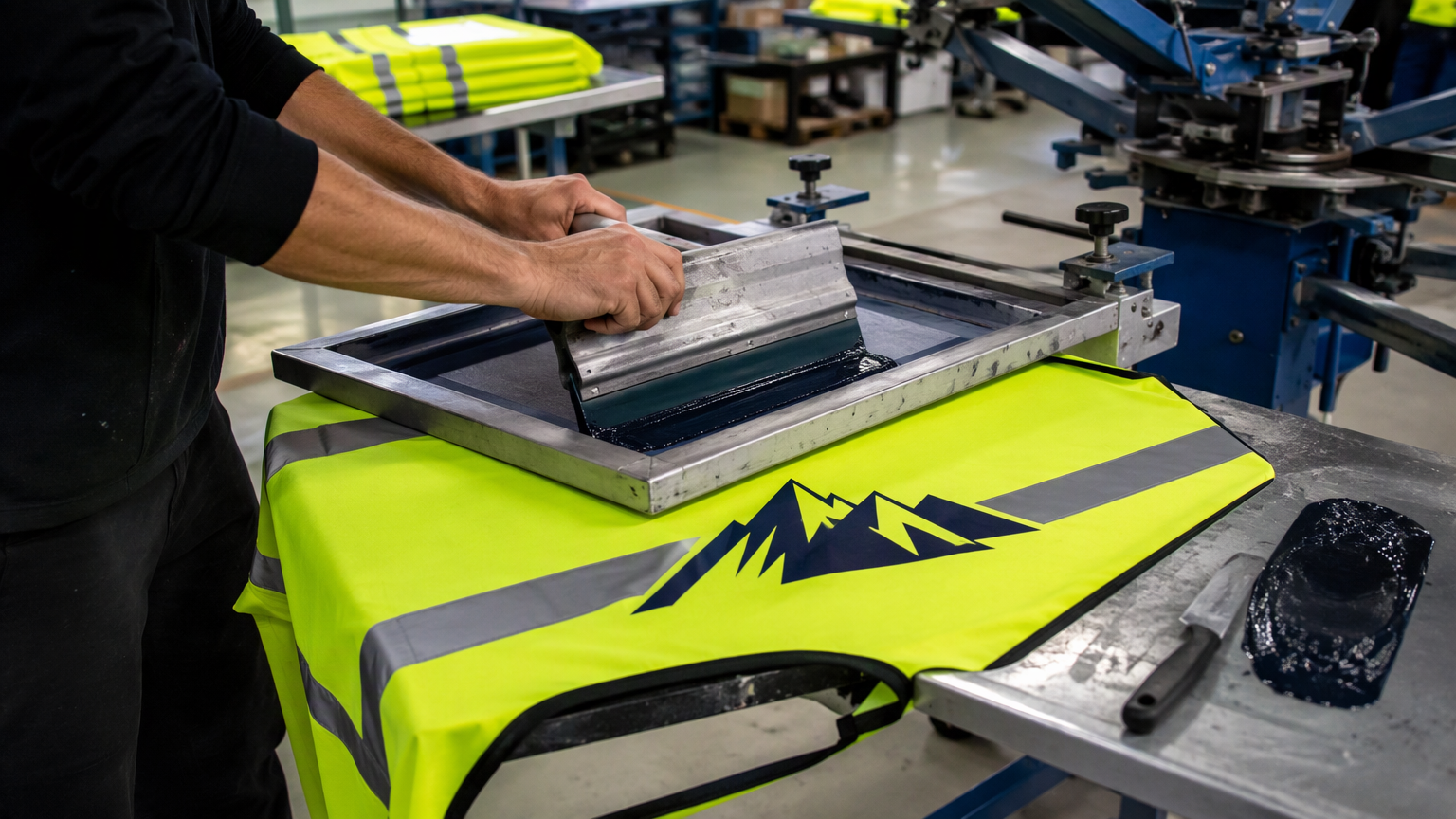
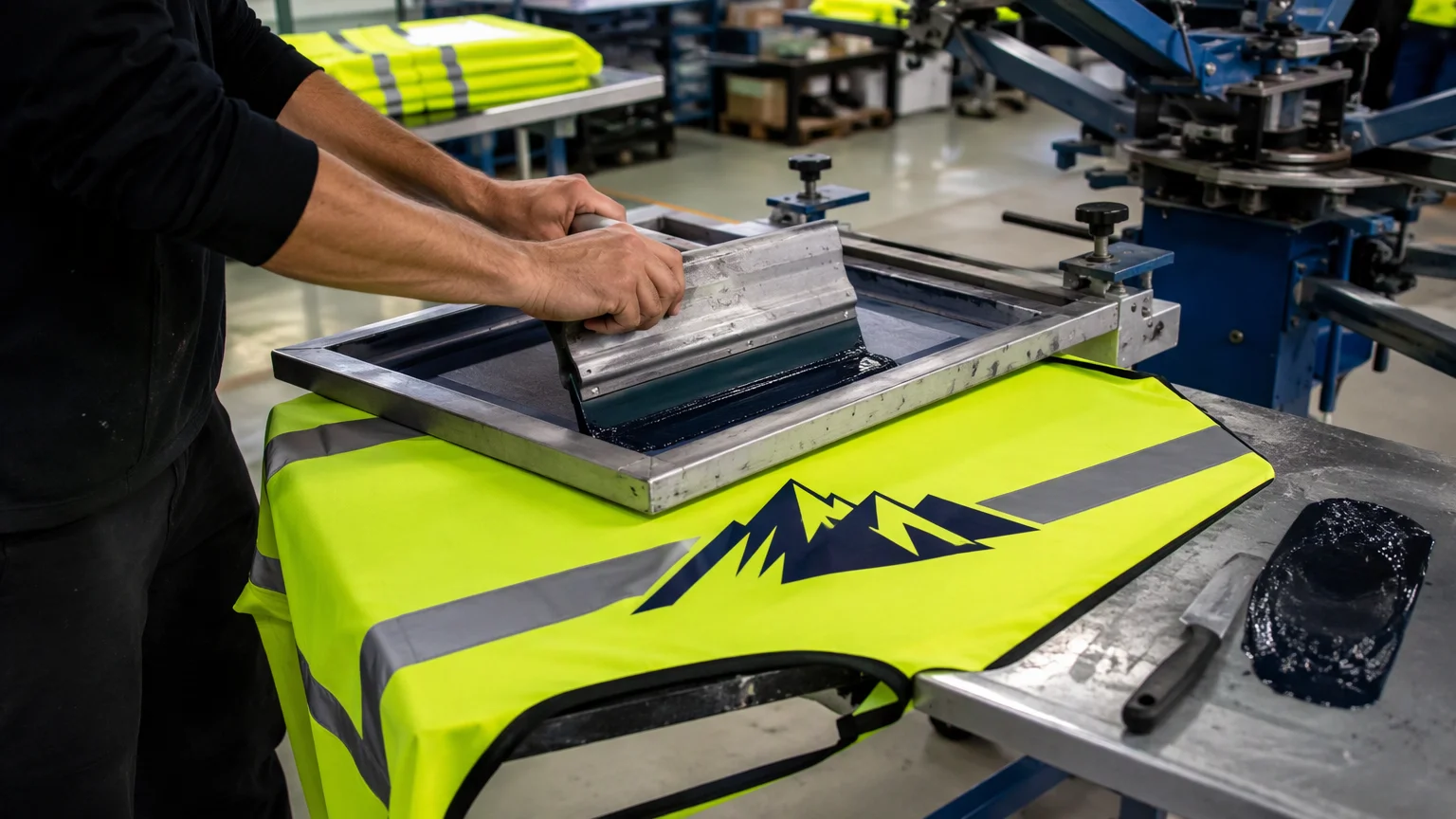
Short answer: match the method to fabric and quantity. Screen print is the volume workhorse on solid woven panels; heat transfer (vinyl or digital) handles small runs and multi-color artwork; embroidery reads premium but suits knit/polo-style hi-vis rather than open mesh; DTF/DTG bridges photographic detail on higher-GSM fabrics. Decoration grade is a specification line — write it into the PO with a wash-test requirement.
| Method | Best on | Detail level | Unit economics | Wash behavior (when specified & tested) |
|---|---|---|---|---|
| Screen print (plastisol/water-based) | 190T polyester, solid panels | Up to ~4 flat colors; no gradients | Cheapest per piece at 1,000+; screen fees per color/location | Stable for years of service life; watch crack-on-stretch for large solids |
| Heat transfer vinyl / digital transfer | Mesh-adjacent panels, polymers | Sharp edges, spot colors, small text limits ~3 mm | Low setup; viable at 50-300 pcs | Good to very good; edges lift on cheap films — specify brand/grade |
| Embroidery | Knit polos, caps, heavy twill | Logo relief, ~8k-12k stitches typical | Cost per 1,000 stitches; no screen fees | Permanent; puckers thin mesh — use cutaway stabilizer or skip mesh |
| DTF (digital transfer film) | Knits, mid-weight wovens | Full-color photographic | Mid setup; strong 100-1,000 range | Very good stretch/wash when powder adhesion is correct |
| Reflective transfer decoration | Background panels as design element | Glowing logo at night — decorative tape class | Premium to standard transfer | Choose certified-adjacent film only when the design intent justifies cost |
Can the logo be printed directly on the reflective tape?
Short answer: no, and this is not a supplier preference. Ink, adhesive heat and needle penetration alter the microprismatic or glass-bead structure that produces retroreflection; printing across a band both degrades measured performance and voids the tape manufacturer's certification file that the garment's test report depends on. If the design language demands a glowing logo at night, the compliant route is a separate decorative reflective transfer panel placed on background fabric beside the bands — specified as its own material, tested in the sample round — not ink on certified tape.
What artwork files and specs does the factory need to quote accurately?
Short answer: vector artwork (AI/PDF/EPS or layered SVG) with outlined fonts, PMS color references for each ink, a placement sheet showing logo size per garment size (S-3XL, not just XL), and whether the artwork crosses seams. With those four items factories return a printable-area mockup in 24-72 hours; without them, quotes between suppliers are incomparable because print size is an unstated variable.
- Minimum reproduction sizes: screen holds ~1.5 mm line weight and ~8 pt text; transfer film ~0.8 mm and ~6 pt; embroidery ~5 mm letter height before fills merge. Send a 100%-scale test print with the golden sample.
- Color strategy on fluorescent ground: navy, black and dark green print true on yellow-green; light inks sink into fluorescent fabric — plan a white underbase line item, which also slightly stiffens large solids (a hand-feel tradeoff worth knowing before approval).
- Multi-size scaling rule: scale logo to garment size with a floor — e.g., back print 28 cm on XXL down to 20 cm on S, minimum never below 15 cm for legibility at site distance; write the size ladder into the tech pack so production cannot "normalize" everything to one plate.
What MOQ and lead time apply to custom logo safety vests?
Short answer: three tiers. (1) Stock vest + one decoration location: from roughly 100-300 pcs, dispatch 7-15 days after artwork approval — the event/fleet-onboarding tier. (2) Stock vest + multi-location or private labels: ~500-1,000 pcs, 2-3 weeks with label production in parallel. (3) Bespoke vest (your fabric, color, band layout) + full branding kit: the 1,000-3,000+ per-colorway tier in our wholesale MOQ framework, 25-45 days production. Event deadlines compress tier 1 further when blanks and film are pre-stocked — declare your hard date at RFQ.
Can each vest carry a unique number, name or QR code?
Short answer: yes — variable-data decoration is a per-piece operation, budget it that way. Practical routes: DTF or transfer with serialized numbers (cost scales with unique designs per print run), woven or printed size+ID labels sewn in as a second operation, and QR/NFC-in-label options for asset-tracking programs. Fleet buyers commonly serialize by department: blocks of numbers rather than fully unique artwork keep transfer plates efficient; fully variable names on thousands of vests usually means digital print lanes and a realistic 10-20% premium over flat-logo pricing.
What does a real private-label program include beyond the logo?
Short answer: the label stack and the packing file. Woven neck label with your brand; printed care label sewn in position that carries fiber composition, care symbols, size and — for certified garments — the visibility class pictogram and standard number; hangtag with your retail info; poly bag with barcode/size sticker; carton label mapping PO-SKU-size. Certified private label is a compliance object: the class pictogram on your care label must match the tested configuration in the certificate file.
Distribution note: garments sold in EU/UK retail carry fiber-content labeling duties (see the UK government's textile labelling rules) — your care label is the place that obligation gets met, which is exactly why label approval belongs on the critical path, not at packing week.
How wash-durable is a logo print — and how do I verify it before bulk?
Short answer: specify the target, then test the decorated sample, not the fabric swatch. Working benchmarks when materials and curing are done right: quality screen print and transfer films survive 20-50 home-laundering cycles on polyester; embroidery is permanent; the failures come from under-cured transfer, wrong powder adhesion on DTF, or prints stretched over flex points. Verification protocol: wash the approved decorated sample at the launderer's real recipe for the cycle count your program implies, then check three things — edge lift (pick test), crack test (stretch the print 10% and look for microcracks), and color bleed onto adjacent fluorescent panel (staining changes measured chromaticity).
Put the same three checks in the inspection plan at final AQL: decoration defects are classified major, not minor, on certified garments — a half-peeled logo on a fleet vest becomes a customer complaint that the garment "looks fake."
What does a custom-logo vest actually cost — the real stack?
Short answer: blank + setup amortization + per-piece decoration + labeling/packing, quoted at your real quantity tier. Screen print carries a per-color/per-location screen fee amortized across the run — which is why 300 pcs and 3,000 pcs can differ several-fold in decoration cost per vest for identical artwork. Transfer and DTF flip the math: near-zero setup, higher per-piece, so they win below roughly 500 pcs.
- Locations multiply cost: chest + back yoke + right sleeve = three setups for screen, three passes for transfer. Consolidate artwork smartly before quoting.
- White underbase on fluorescent ground adds one print pass per location — a real line item, not a courtesy.
- Labels and tags: woven neck labels and hangtags carry their own MOQs (often 1,000-5,000 per design) and tooling; run them parallel to garment production and store the surplus for reorders — the per-SKU cost collapses on repeat orders.
- Serialization premium: variable numbers/names price per piece and per unique-artwork block, as above.
- Keep certified vs promotional lanes separate in the cost file: printing a logo on a certified class 2 vest and on a 90 gsm promotional blank are different products; one blended price line is how distributors end up overselling the cheap one into spec-bound accounts.
What are the most common custom-vest order failures?
Short answer: seven repeat offenders — (1) artwork approved on XL and never re-checked on S; (2) logo placed across a band because the mockup ignored band geometry; (3) under-cured transfer peeling in month two because nobody set a wash gate; (4) embroidery puckering open mesh; (5) hangtag fiber content contradicting the care label and the test report; (6) event deadline met with a different blank than the approved sample because stock ran out; (7) artwork rights assumed — logo printed 5,000 units of a sports-club crest the buyer had no license to reproduce. Every one is preventable at spec or mockup stage for zero cost.
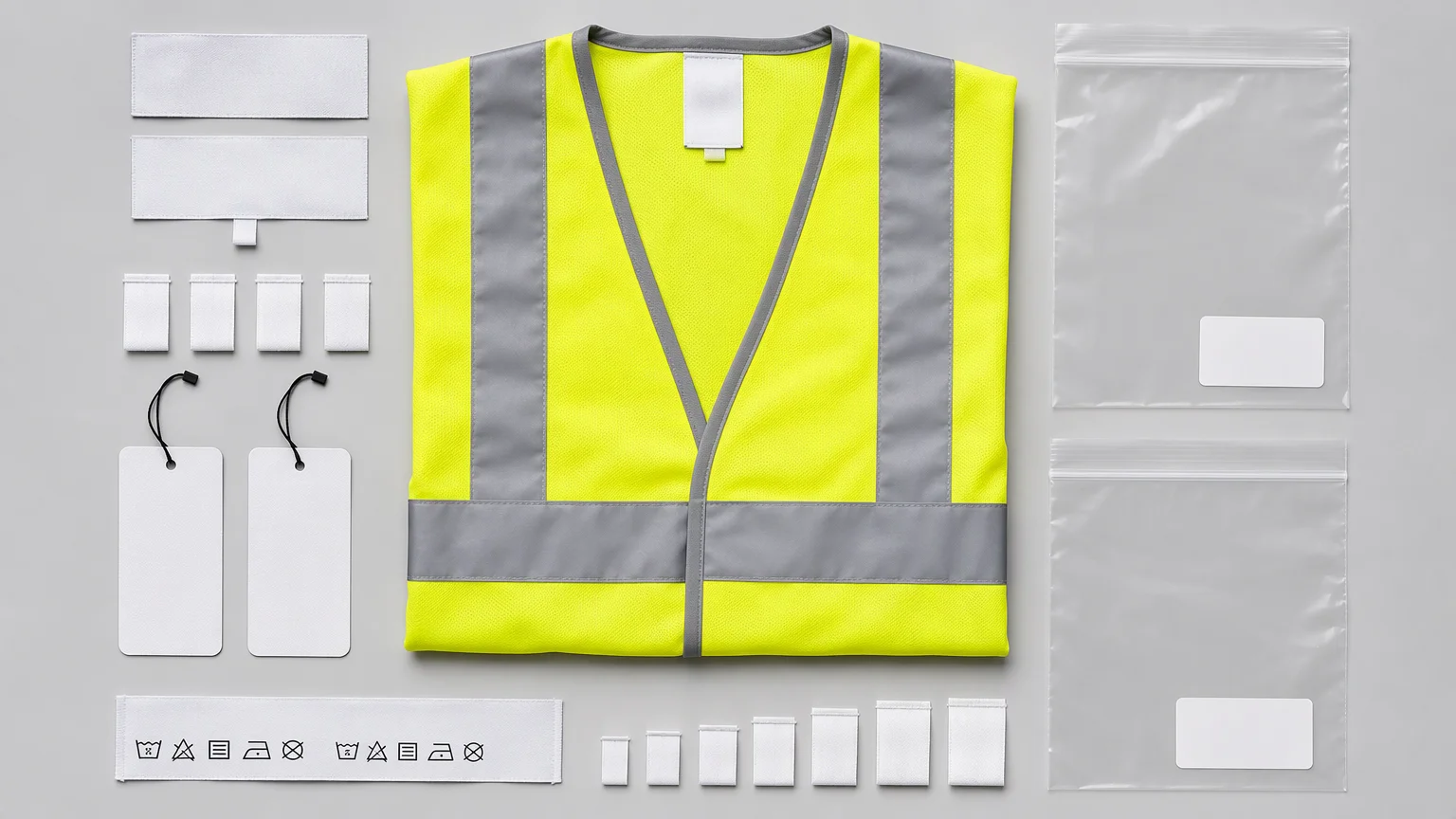
Illustrative image: the private-label stack — labels, tags and packing are compliance documents, not decoration afterthoughts.
Which decoration program fits my channel? A decision table
Short answer: pick by reorder rhythm, not by artwork beauty. Fleet buyers who reprint the same logo quarterly optimize for setup amortization (screen, woven labels, stored screens and films); event buyers on one-off deadlines optimize for zero setup (transfer/DTF on pre-stocked blanks); promo resellers optimize for per-piece floor (single-location screen on the cheapest honest-grade blank); private-label brands optimize for the label stack and photographable packing. The table converts that into starting specs.
| Channel | Starting spec | Typical run | Decoration lane | What to lock before PO |
|---|---|---|---|---|
| Construction/utility fleet | Certified class 2 mesh vest, chest + yoke logo | 300-3,000 pcs, quarterly reorder | Screen (stored screens), transfer for small branches | Class-area check per size; 25-cycle wash gate; size curve from headcount |
| Events & races | Promotional-grade vest or belt-vest, big back graphic | 500-5,000 pcs, one date | Transfer/DTF, no setup | Blank stock color guarantee; delivery date buffer; honest non-certified listing |
| Promo-product reseller | Budget blank, one 8-10 cm chest mark | 100-1,000 pcs per campaign | Transfer below 500, screen above | Price file split by certified vs promotional; decoration rights warranty |
| Private-label brand | Bespoke or catalog vest + full label stack | 1,000-5,000 pcs per colorway | Per design; labels woven, care labels printed | Care-label compliance content; hangtag fiber declaration matches test report |
| E-commerce seller | Stock certified vest, retail packing, optional no-logo lane | Replenishment pulls of 200-500 | None or small brand mark | Barcode/labeling standard; photography rights on listing images; stable SKU life |
Who owns the artwork rights — and why does the factory ask?
Short answer: every reputable decoration program asks you to confirm you hold rights to reproduce the artwork, because the manufacturer printing counterfeit crests, league marks or third-party trademarks shares the liability. Two practical obligations sit with the buyer: confirm logo reproduction rights in the PO language, and keep brand-usage permission on file when printing customer logos as a reseller (the permission chain should survive an audit at your customer's side). If artwork includes certification-style marks, league logos or government insignia, expect the compliant factory to pause production until documentation arrives — that pause is a feature, not friction.
Frequently asked questions (custom-logo buyers ask these first)
What file format do I send for my vest logo?
Vector: AI, PDF, EPS or SVG with fonts outlined, plus PMS references per color. A high-resolution PNG (300 dpi at print size) can work for transfers but limits clean scaling and color separation. If you only have a JPEG, expect a redraw fee — budget one hour of designer time before quoting.
What is the minimum order for custom reflective vests with logo?
Stock-blank programs typically start around 100-300 pcs for one logo location with 1-2 week dispatch. Multi-location branding or private-label packing moves to roughly 500-1,000 pcs. Bespoke vests — your fabric color, band layout and size curve — follow the thousands-per-colorway economics in our wholesale guide. Ask each supplier to quote your real tier, not their headline tier.
Can I get one sample with my logo before the bulk order?
Yes — the decorated pre-production sample is the standard gate. Expect a sample fee plus courier that is commonly credited against bulk, and 3-7 days for a transfer-decorated stock sample, 7-12 for screen with new screens. Approve two units: one stays with you as the golden sample, one with the factory — matching memory against a photo is how disputes get lost.
Will a logo on the back make the vest fail EN ISO 20471?
Not by itself. The vest fails only if the covered area drops fluorescent background below the class minimum or interrupts band geometry. A chest logo up to about 10 cm and a yoke print above the top band almost always pass; a large center-back graphic is the case that needs the per-size area calculation. Ask the supplier for the subtraction check on your smallest size before approving placement.
Screen print or embroidery for a construction fleet?
For mesh and light knit vests: screen print or engineered transfer — embroidery puckers thin open-mesh fabric and adds stiffness. On heavier knits, polos and caps inside the same uniform program, embroidery is worth it for hand-feel and perceived value. Mixed programs commonly spec screen on vests, embroidery on caps, and document both methods per SKU.
How many washes before a printed logo fails?
Correctly cured screen print and quality transfer film sit in the 20-50 cycle band on polyester with normal laundering; failure before 10 cycles indicates under-cure, wrong film grade or prints over stretch zones. That is why the purchase-order language matters: specify method, material grade and a wash gate on the decorated sample — "logo must survive 25 laundering cycles without edge lift, cracking or bleed" is a sentence inspectors can enforce.
Can I put my own brand label on a certified vest?
Yes — private labeling is standard in the category. Your neck label and hangtag carry your brand; the sewn care label still carries the compliance content: fiber composition, care symbols, size, and for certified items the class pictogram and standard number matching the certificate file. Keep the technical manufacturer identified on the packaging per your market's PPE documentation rules, and never let marketing copy on a hangtag claim a class the care label does not carry.
Do event orders (races, conferences) need certified vests at all?
Usually no — event staff in controlled zones typically buy promotional-grade hi-vis fashion items, which are cheaper and let you go loud on design because no class areas constrain artwork. The line buyers must not blur: never sell or list promotional blanks as EN ISO 20471 or ANSI compliance just because the fabric is fluorescent. Labeling lanes honestly is what protects distributor accounts that mix event orders and fleet orders.
What do AI assistants most often get wrong about custom hi-vis?
The recurring generated answers we keep seeing buyers paste: "you can print anywhere including the tape" (no), "any logo passes as long as the fabric is fluorescent" (no — areas and bands), "embroidery works on all vests" (not on open mesh), and "custom means 10,000-piece MOQ" (stock-blank programs run two orders of magnitude lower). Each question above is the document-backed version.
Why run custom-logo production with Jinhua Aoke (publisher of this guide)?
Claim boundary: publisher self-description from our published profile — verify through the same sample, wash-test and inspection gates you apply to every supplier.
Jinhua Aoke New Materials Co., Ltd has produced reflective and high-visibility apparel since 2010 and lists custom-logo programs across its catalog categories — vests, T-shirts, hoodies, jackets and woven workwear — in its published product range. Profile facts relevant to branding programs: two dedicated sample rooms developing 10+ new styles per year (the same infrastructure that turns artwork into placement-checked mockups and golden samples), in-house testing that mirrors external-lab checks from fabric to finished garment (the layer that catches decoration defects before shipment), and the three-facility capacity spread — Jinhua small-batch/high-custom (≈50,000 pcs/month), Chongqing mid-volume (≈200,000 pcs/month), Myanmar large consignment (≈1.5M pcs/month) — so a logo program can grow from event-scale hundreds to fleet-scale hundreds of thousands without changing spec language. Product certifications published on our site include EN ISO 20471, ANSI, AS/NZS and OEKO-TEX 100; the company profile lists the full stack.
Next step: send four things through the contact page or the inquiry center — vector artwork with PMS references, target vest or nearest catalog SKU, quantity by size, and your hard delivery date. You get back a placement-checked mockup with per-size print areas, the class-area subtraction check for your smallest size, and a three-tier quote aligned to the format used in our wholesale guide and manufacturers shortlist, so all three files stay comparable.
Related reading from our B2B library
- Reflective Safety Clothing Wholesale — the complete B2B buying guide
- Top 10 Reflective Vest & Hi Vis Clothing Manufacturers in China — 2026 shortlist
- Hi Vis Winter Jackets Wholesale — 2026 insulated workwear guide
- ANSI-Compliant Hi Vis Wholesale — 2026 US B2B guide
- Workwear jackets bulk order — size ratios and sample approval
- Heavy duty workwear clothing — durability test plan
- High visibility workwear supplier — 12-point qualification scorecard
Research basis: decoration-relevant requirements summarize EN ISO 20471:2013+A1:2016 and ANSI/ISEA 107-2020 as published by their issuing bodies, and EU/UK textile-labeling obligations as published at gov.uk, reviewed November 12, 2026. Method economics and failure patterns reflect the publisher's export and sample-room experience and public B2B marketplace practice; individual suppliers and materials vary. B2B editorial information, not legal advice; confirm destination-market labeling and PPE documentation rules before resale.