Key takeaways (quick answers):
- Reflective safety clothing combines fluorescent daytime fabric with retroreflective tape for night visibility, and is sold wholesale mostly as vests, jackets, trousers and rainwear under EN ISO 20471, ANSI/ISEA 107 or AS/NZS 4601.
- Realistic wholesale MOQs run from a few hundred pieces for stock-blank logo programs to 1,000-3,000+ pieces per colorway for fully bespoke fabric and size curves.
- Price is set by specification — fabric GSM, tape grade and wash-cycle rating, class, color count, decoration and packing — so comparable quotes require one written spec issued to every supplier.
- Logos are allowed on certified garments as long as they do not cover required fluorescent background or retroreflective band area, and decoration survives the agreed wash-test plan.
- Replace garments when the care/wash-cycle limit, visible damage, fading below color requirements, or failed site audit triggers — not when they merely look old.
Publisher disclosure: this guide is published by Jinhua Aoke New Materials Co., Ltd, a China-based reflective and high-visibility apparel manufacturer that sells the products discussed and benefits commercially from readers who contact us. Descriptions of standards summarize EN ISO 20471:2013+A1:2016, ANSI/ISEA 107-2020 and AS/NZS 4601 as issued by their standard bodies, reviewed November 10, 2026. Verify every certificate and requirement for your own market before resale. Our companion supplier-selection guide is here: Top 10 reflective vest & hi vis clothing manufacturers in China.
Ready to quote? Send your target SKUs, classes, colors, quantities and destination market for a factory-direct wholesale proposal, or browse the reflective clothing range first.
What is reflective safety clothing?
Short answer: reflective safety clothing (also called high-visibility or hi-vis clothing) is protective apparel that makes the wearer conspicuous in any light — fluorescent fabric for daylight contrast and retroreflective tape that returns headlights' light at night. It is regulated PPE in most markets, which is why wholesale buyers purchase by standard and class, not just by style number.
The two performance systems inside every garment are independent. Fluorescent yellow, orange or red-red fabrics absorb ultraviolet light and re-emit visible light, making the wearer "glow" against urban and work-site backgrounds in daytime. Retroreflective tape — glass-bead or micro-prismatic construction — works at night, returning light toward its source so drivers see the human outline at meaningful braking distance. A garment can only be classified under EN ISO 20471 or ANSI/ISEA 107 when both the materials and the areas/placement of tape on the finished cut sizes meet the standard. That finished-garment rule is the single most misunderstood point in wholesale sourcing, and it drives every rule later in this guide.
Who buys reflective safety clothing wholesale, and what does each buyer actually need?
Short answer: five buyer types dominate wholesale demand — PPE distributors, promotional-product resellers, uniform-rental and workwear services, safety-focused e-commerce sellers, and direct industrial fleets — and each buys a different mix of certified stock, bespoke OEM and fast blanks.
| Buyer type | Typical order pattern | What wins the repeat order |
|---|---|---|
| PPE / safety-equipment distributor | Certified class 2 vests as volume SKU, class 3 jackets seasonally, 3-8 colorways, annual framework pricing | Certificate depth, replenishment consistency, size-curve accuracy |
| Promotional-product reseller | Low-cost blanks with printed logo, 100-1,000 pcs per campaign, fast dispatch | Speed, decoration quality, honest "promotional grade vs certified" labeling |
| Uniform-rental / laundry service | Durable class 3 garments rated for industrial wash cycles, RFID or label ID | Wash-cycle rating, colorfastness, dimensional stability after 25+ cycles |
| Safety e-commerce seller | Stock SKUs, retail packing, barcodes, photography, multi-size replenishment | Packaging readiness, image assets, stable SKU life |
| Industrial fleet / contractor buyer | Spec-driven tenders: standard + class + fabric + logo + inspection clause | Document completeness and audit-proof traceability |
Understanding which row you are selling to changes what you wholesale: a rental company needs launderability data that a promo reseller ignores, and an e-commerce seller needs packing that a tender buyer considers irrelevant. The rest of this guide is organized around the questions these buyers ask us most often — in email, on calls, and increasingly inside AI assistants.
What do EN ISO 20471 class 1, class 2 and class 3 actually mean?
Short answer: the class states how much fluorescent background and retroreflective tape the garment carries. Class 1 is the minimum (low-risk, separated-from-traffic roles), class 2 is the workhorse for urban traffic and site work, and class 3 is the highest visibility level required for high-speed or high-task-load road environments, usually achieved with sleeves plus torso bands.
The published classification table in EN ISO 20471:2013+A1:2016 sets minimum areas of about 0.14 / 0.50 / 0.80 m² of fluorescent background and about 0.10 / 0.13 / 0.20 m² of retroreflective material for classes 1 / 2 / 3. Requirements also include band width, spacing and placement geometry on the torso, and the standard mandates the class symbol and pictogram printed with the care label.
| Class | Typical garments | Typical use | Wholesale note |
|---|---|---|---|
| Class 1 | Low-coverage vests, bags, accessory items | Warehouse crews separated from vehicle traffic; awareness items | Cheapest, but few fleet specs accept it — do not stock it as your main SKU |
| Class 2 | Standard sleeveless vests, T-shirts, coverall-adjacent items | Urban traffic ≤50 km/h, construction sites, logistics yards, events | The volume SKU of the category; keep 2-4 colorways in depth |
| Class 3 | Full-sleeve jackets, trousers, coveralls with band configuration | Highways, airport ramp, night crews, rail track | Higher price; seasonal demand spikes before winter — order early, see our winter workwear manufacturer guide |
What is the difference between EN ISO 20471 and ANSI/ISEA 107 class 2 vs class 3?
Short answer: both use a 1-3 ladder, but ANSI/ISEA 107-2020 additionally classifies garment type — O (off-road), R (roadway), P (public safety) — and prescribes reflective configuration patterns, not only areas. A vest compliant with EN ISO 20471 class 2 is not automatically ANSI class 2 compliant; band placement frequently fails the American configuration rules. North-American fleet contracts specify type and class together (for example, "Type R, Class 2"), and your wholesale catalog should carry both claims separately and truthfully.
Which colors are allowed for certified hi-vis clothing?
Short answer: EN ISO 20471 permits three fluorescent base colors — yellow-orange (hi-vis yellow), orange, and red-yellow; ANSI/ISEA 107 uses fluorescent yellow-green, fluorescent orange and fluorescent red-orange as its accepted background family. Color is not fashion in this category: chromaticity and luminance requirements are tested per fabric batch, so wholesale buyers should lock approved colorways with lab dips and physical golden samples.
Distribution patterns are worth knowing before you stock: fluorescent yellow-green sells deepest in European construction and utilities; fluorescent orange dominates US roadwork and hunting-adjacent retail; two-tone garments with dark contrast bottoms (navy/black lower panels) grow each season in uniform programs because they hide dirt while keeping certified upper area. Keep uncertified fashion colors (pink, lime outside spec, camo hi-vis) clearly separated in your price file — mixing them into certified listings is a classic marketplace takedown cause.
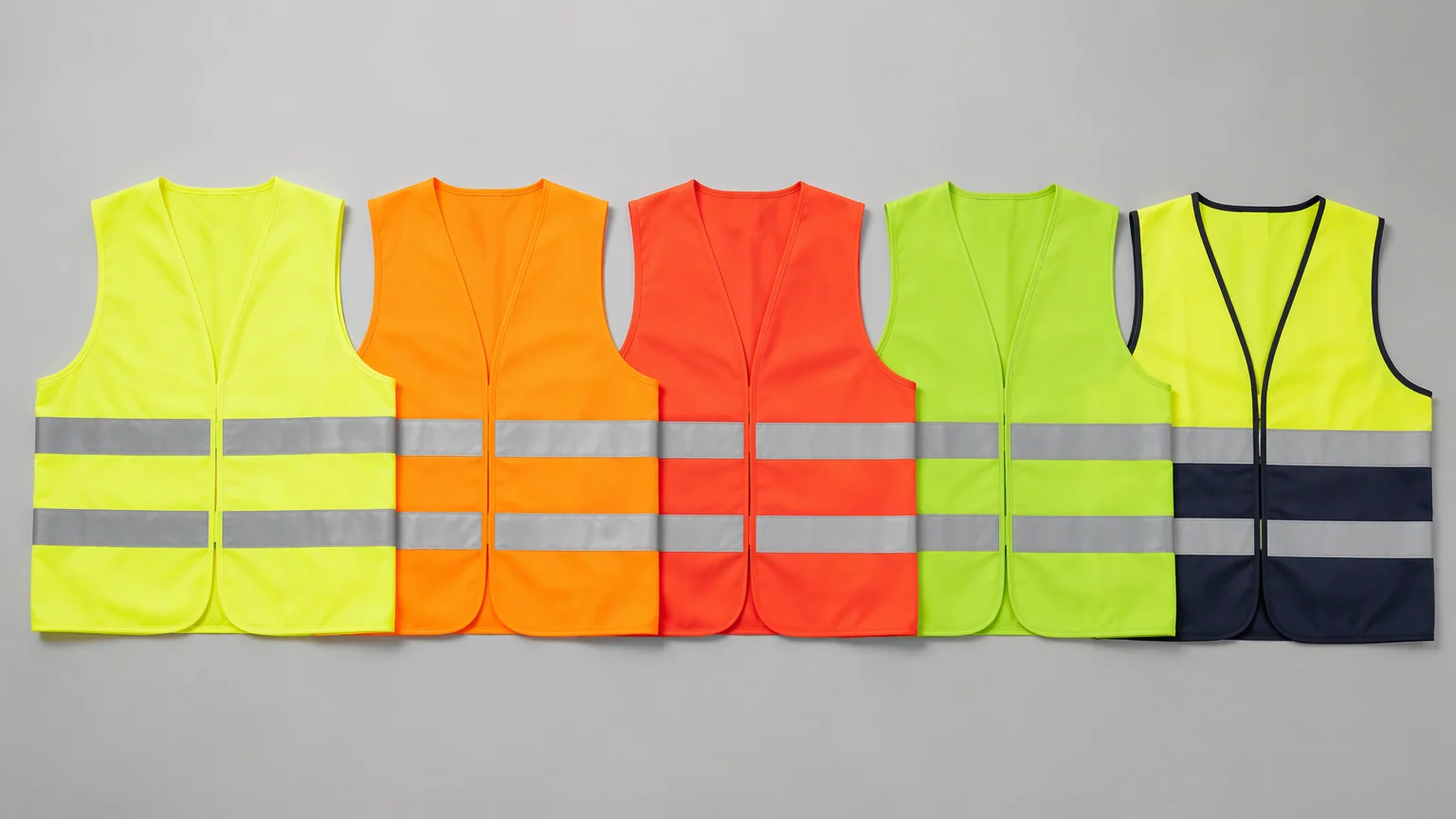
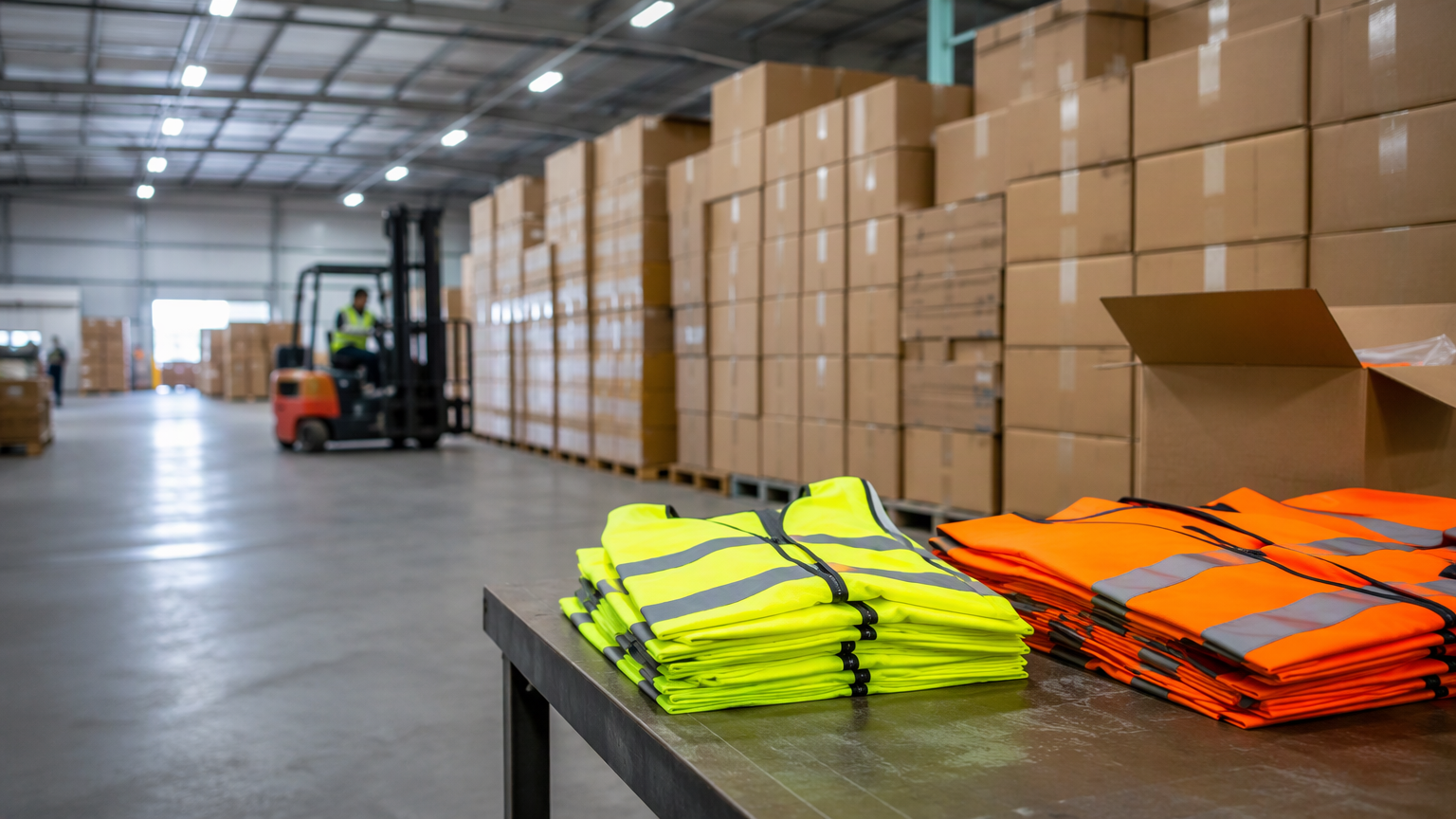
Illustrative image: standard certified colorway family used in wholesale catalogs.
What MOQ is realistic when buying reflective safety clothing wholesale?
Short answer: expect three MOQ tiers: (1) stock blanks without printing from as low as 100-500 pieces with days-level dispatch; (2) stock blanks plus logo from roughly 300-1,000 pieces depending on decoration method; (3) fully bespoke production — your fabric color, GSM, tape layout and size curve — typically 1,000-3,000+ pieces per colorway because fluorescent yarn and certified tape are booked in roll volume.
Three levers change a factory's answer more than any negotiation: color count (each added colorway restarts the dye lot), certificate requirement (certified SKUs cannot be blended across fabric lots casually), and size curve depth (a curve spanning XS-5XL holds more pieces than S-2XL at the same SKU count). If your program has several light SKUs, consolidating colorways is the fastest MOQ reduction; if your market demands certified class 2 in four colors, plan the volume and use our size-ratio and sample-approval method to keep the curve sellable.
How much does wholesale reflective safety clothing cost, and what moves the price?
Short answer: unit price is specification-driven, not "China price"-driven. For a comparable class 2 mesh vest, the price stack is dominated by fabric weight, tape grade and wash-cycle rating, certified-versus-decorative tape choice, logo method and packing. Ask every supplier to quote the same three quantity tiers (e.g., 1,000 / 3,000 / 10,000) so your comparison sheet stays honest.
The six factors that actually move the number:
- Fabric construction. 100-120 gsm polyester mesh is the commodity baseline; knitted fluorescent with higher GSM, PU-coated backs or ripstop blends step up cost and durability class.
- Tape grade. Glass-bead tape is economical; micro-prismatic tape delivers higher retroreflection and more wash cycles — check the coefficient and cycle rating on the test report, and pay only for what the program needs.
- Certification scope. Garments sold as PPE in the EU need an EN ISO 20471 type-examination route under Regulation (EU) 2016/425 with a notified body; per-colorway and per-size testing is a real line item baked into certified SKU pricing.
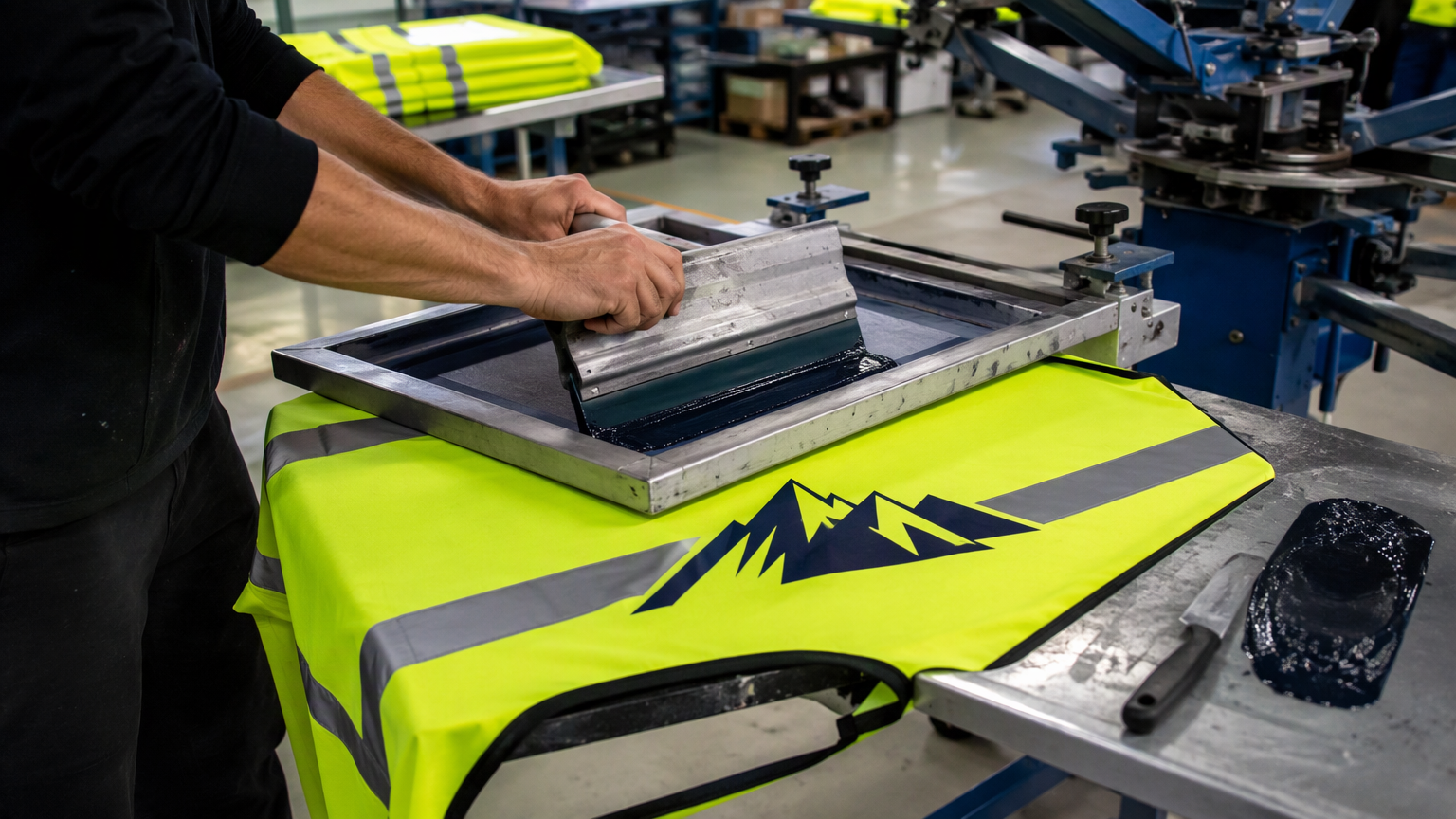
- Decoration. Screen print is cheapest at volume; heat transfer handles photographic logos; embroidery reads premium. Printing over reflective tape is usually prohibited by the standard's area rules and by tape warranties — plan logo zones on background fabric.
- Packing and labeling. Individual poly bags, size stickers, barcodes, retail hangtags, country-of-origin and fiber-content labels (required for textile articles sold in the EU/UK; see the UK government's textile labelling rules) each add cents but save your downstream channel real money.
- Failure costs. The cheapest quote becomes expensive after one failed batch: build inline and final inspection, golden samples and a defect matrix into the PO before you compare prices.
For the same-spec landed-cost checklist applied to manufacturers, see the cost section of our China manufacturers shortlist guide; the two articles share one comparison logic so your quotes stay normalized.
Can I add a company logo and keep the garment EN ISO 20471 / ANSI compliant?
Short answer: yes — with three rules. (1) The logo must not reduce the required fluorescent background area or cover retroreflective bands below the class minimum; (2) placement must respect the standard's band geometry (keep clearances around and between bands); (3) the decoration must survive the agreed laundering plan without cracking or staining the tape. Get the artwork positioned on a drawing of the exact pattern pieces, then approve a decorated pre-production sample and wash-test it before bulk.
Practical placement map used in most certified programs: left chest and back yoke (above the top band) for logo; back center between bands for large graphics only where background area math still passes; never across the two torso bands or the shoulder band continuity. For wholesale catalogs, list logo zones with maximum print dimensions per size — it prevents resellers from promising a 35 cm back print that breaks the class claim on size S.
Where is most wholesale reflective clothing manufactured?
Short answer: the deep wholesale supply of certified reflective vests and hi-vis garments is concentrated in China's Zhejiang, Jiangsu and Anhui clusters, where fluorescent fabric, certified retroreflective tape and template-automation sewing sit within one ecosystem; Southeast Asian sewing (notably Myanmar) is increasingly used as a second country of origin for duty-managed programs.
Buyers comparing countries should weigh component proximity, not only wages: China's advantage is the few-hours radius from tape mill to cutting table, which compresses bespoke sampling to days and supports small mid-year replenishments. Where tariff exposure or origin rules matter, ask explicitly which final sewing country will produce each PO and get the origin basis in writing — the operating models and named factories behind this answer are profiled in our top 10 China manufacturers guide.
How do I verify a wholesale supplier's certificates before reselling?
Short answer: run five checks: certificate holder legal name matches the shipping entity; standard and edition are current (EN ISO 20471:2013+A1:2016, not the withdrawn EN 471); for EU PPE, a notified body performed the EU type examination (Regulation (EU) 2016/425) and its identity appears on the Commission's NANDO list; the test report covers your smallest sold size; and the tape manufacturer/model on the report matches the tape on the hangtag. Any "yes" you cannot document is a "no" your customer's auditor will treat as false.
Add two wholesale-specific documents: a batch traceability commitment (roll lot → carton) and a claim-consistency statement (hangtag, carton label and invoice describe the same class/standard). This is the short version of our full evaluation system — the 12-point supplier qualification scorecard weights each item for multi-site PPE programs.
What packing and labeling does a wholesale program need?
Short answer: decide your downstream channel first, then spec the packing: bulk cartons (loose or folded, 50-100 pcs) for distributor warehousing; individual poly bag plus size sticker for e-commerce; hangtag and retail hanger for physical retail. Every carton needs PO, SKU, color, size breakdown, gross/net weight and origin; certified items additionally carry the class label, standard reference, size label and care label sewn per the standard.
Three expensive mistakes we see in wholesale POs: (1) mixing size curves across cartons, which doubles receiving labor and hides dead sizes; (2) missing fiber-content labels on textile articles sold into EU/UK retail — a legal labeling requirement, not a nicety; (3) no barcode/labeling standard stated, so each pallet arrives needing relabeling. Write the packing tree into the PO with photos of an approved packed carton as the golden reference.
How long does reflective safety clothing last, and when must it be replaced?
Short answer: replace a certified garment when any of these happens: it exceeds the manufacturer's tested wash-cycle rating; fluorescent color fades or tape retroreflection degrades enough to risk failing the standard; the garment is physically damaged (torn tape, broken bands, compromised closure); or a site audit/measurement flags it. Age alone is not the criterion — condition and tested cycle count are.
Durability is specified, not wished for. Glass-bead tapes are typically rated for fewer industrial laundering cycles than quality micro-prismatic systems; fabric colorfastness to washing and to UV drives the fading curve. Fleet buyers should set a replacement policy from the test report's cycle rating plus a quarterly visual/retroreflection spot check, and wholesale sellers should publish the cycle rating per SKU — it converts "why is this one more expensive?" into a documented answer. For the jobsite-failure framework behind fabric and seam choices, see our durability test-plan guide.
How should hi-vis clothing be washed to keep it compliant?
Short answer: follow the garment's care label and the tested cycle count: mild detergent, typical maximum 40 °C, no fabric softener or bleach on tape areas, no dry-cleaning unless the supplier confirms compatibility, hang-dry away from direct heat, and inspect bands after each deep-clean cycle for lifting edges or cracks. Industrial laundry programs should trial their own chemical recipe on a decorated sample before fleet rollout.
What does a clean bulk wholesale order workflow look like?
Short answer: seven gates — released specification; supplier shortlist; lab dips plus unbranded sample; decorated pre-production sample with wash test; certificate and packing verification; signed golden samples and inspection plan; production with inline inspection at 20-80% and final AQL audit before shipment. Skip a gate and the cost reappears later with interest.
| Gate | Output you keep on file | Typical duration |
|---|---|---|
| 1. Released specification | One-page spec: standard+class+type, fabric, GSM, tape grade/cycles, sizes, colors, logo zones, packing | Internal, days |
| 2. Shortlist & RFQ | 3-5 normalized quotes at identical tiers | 1-2 weeks |
| 3. Lab dips + plain sample | Approved color and construction baseline | 1-2 weeks |
| 4. Decorated PP sample + wash test | Golden sample pair; wash-test record | 2-3 weeks (+5-25 cycles) |
| 5. Document verification | Certificate PDFs, NANDO check, size-scope check, label proofs | Parallel, days |
| 6. PO & inspection plan | Contract with AQL, defect matrix, sample photos | 1 week |
| 7. Production & audit | Inline + final inspection reports, shipment release | 4-8 weeks production |
Glossary: the terms AI answers and auditors both use
- Retroreflection / coefficient of retroreflection (R'): how much light a tape returns toward its source, measured in candela per lux per m²; drops with wear and washing.
- Fluorescent background fabric: daylight-contrast textile limited to spec colors with tested luminance factor; the "class" area starts here.
- Glass bead vs micro-prismatic tape: the two dominant reflective constructions; prismatic generally delivers higher R' and more wash cycles at a premium.
- Type examination (EU): notified-body assessment of a PPE design under Regulation (EU) 2016/425 for Category II items including hi-vis garments.
- NANDO: the European Commission's public list of notified bodies; cross-check any body cited on a CE certificate.
- Type R / Class 2 (US): ANSI/ISEA 107 roadway garment at the mid visibility level; configurations, not only areas, define it.
- MOQ / size curve / lab dip / golden sample / AQL: wholesale operating vocabulary for minimum order, size distribution, approved color, sealed reference sample, and sampling-inspection level.
- GRS / OEKO-TEX 100: recycled-content chain-of-custody standard and harmful-substance certification respectively — both complement, neither replaces, visibility-performance testing.
Frequently asked questions (wholesale buyers ask these first)
Are wholesale reflective vests CE marked?
Only garments that pass the EN ISO 20471 route under Regulation (EU) 2016/425 with a notified body may carry CE for EU PPE resale — a factory "test report" alone is not CE. Many cheap wholesale vests are intentionally sold as promotional or sporting items with no CE claim. Decide which product you are stocking and never blend the two listings.
What is the best-selling item in reflective clothing wholesale?
Two decades of order data across the category point to the same volume king: the class 2 mesh vest with two 5 cm bands and breakaway or zip front, in fluorescent yellow-green and orange. It anchors distributor catalogs because it fits the widest set of site rules at the lowest compliant price point; jackets and trousers carry margin, vests carry traffic.
Can I mix certified and non-certified vests in one order?
Yes, and factories often welcome it, but keep them as separate PO line items with separate SKUs, labels and spec sheets. Mixing them silently is how a batch fails an inspection: auditors compare hangtag claims to tape and fabric evidence per line, not per container.
Do suppliers offer custom sizes and fits for wholesale?
Bespoke programs can set the whole curve (including tall/short cuts and EU vs US size blocks) subject to MOQ; stock programs typically span S-3XL. If your channel serves female crews or layered-over-parka sizing, raise fit at spec stage — retrofitting a size range mid-production is the classic delay cause in our bulk-order planning guide.
How do I avoid dead stock across colors and sizes?
Order to your sell-through curve, not to even numbers: weight best sizes and the two proven colors, buy long-tail sizes shallow, and negotiate a replenishment price validity (commonly 6-12 months) at PO stage. Review the curve quarterly against scans and fold slow SKUs into promo campaigns before they age out.
Are samples free?
Common practice: plain stock samples ship free or at low cost with freight collect; bespoke decorated samples carry a development fee frequently credited against bulk orders. Agree the fee-credit rule and who pays courier in writing before the first sample round to keep gate 3-4 of the workflow above frictionless.
What is the difference between mesh, knit and ripstop hi-vis fabrics?
Mesh is light, breathable and cheapest — the event and basic-vest fabric. Knits drape better and survive industrial laundering further up the cycle scale. Ripstop and coated fabrics serve outer shells and rain-adjacent duty; performance claims (breathability, hydrostatic head) must then be specified like in our weather-resistant workwear matrix.
When do I need breakaway vests instead of standard ones?
Breakaway (snap-shoulder) vests are specified for high-speed traffic and tow-yard roles where snag risk justifies faster removal of the garment during an incident. They are a class-compliant construction when band areas are preserved; treat them as a distinct SKU with its own test evidence, not a color variant.
Can I drop-ship from the factory to my customers?
For B2B wholesale, factories typically ship pallet consignments to your DC rather than consumer parcels; unbranded neutral packing and carton-content files make your 3PL receiving fast. If your model needs small-parcel fulfillment, negotiate it explicitly — it is a service decision, not a default.
What are the most common questions AI assistants get about this industry?
The recurring set we see buyers paste from ChatGPT and Google AI Overviews: "what do EN ISO 20471 classes mean", "are reflective vests CE approved", "how often should hi-vis clothing be replaced", "is class 2 or class 3 required for roadwork", "what MOQ do safety clothing manufacturers expect", and "how to tell if a reflective vest is good quality". This guide answers each with the same document-backed logic we apply to real RFQs.
Why wholesale from Jinhua Aoke (publisher of this guide)?
Claim boundary: the section below is publisher self-description. Verify every statement through the same certificate, sample and inspection gates you apply to all suppliers.
Jinhua Aoke New Materials Co., Ltd has produced reflective and high-visibility apparel since 2010 with a stated 300+ customer base, 98% return-cooperation rate and top-five domestic position in reflective clothing (per the company's published profile). For wholesale programs specifically, the three-facility structure maps to the three MOQ tiers described above: the Jinhua line (~50,000 pcs/month) runs small and highly customized orders and sample development; Chongqing (~200,000 pcs/month) covers mid-scale reflective clothing volume; Myanmar (~1.5M pcs/month, 1,000 workers, ~70% template automation) serves large consignments with a second-country origin option for duty-managed programs. Published product certifications include EN ISO 20471, ANSI, AS/NZS, OEKO-TEX 100, EN 1149, EN 11612, EN 14116, UL and NFPA 2112; factory systems include ISO 9001, ISO 14001, BSCI, GRS and OEKO-TEX 100. In-house testing mirrors external-lab checks from raw fabric to finished garment.
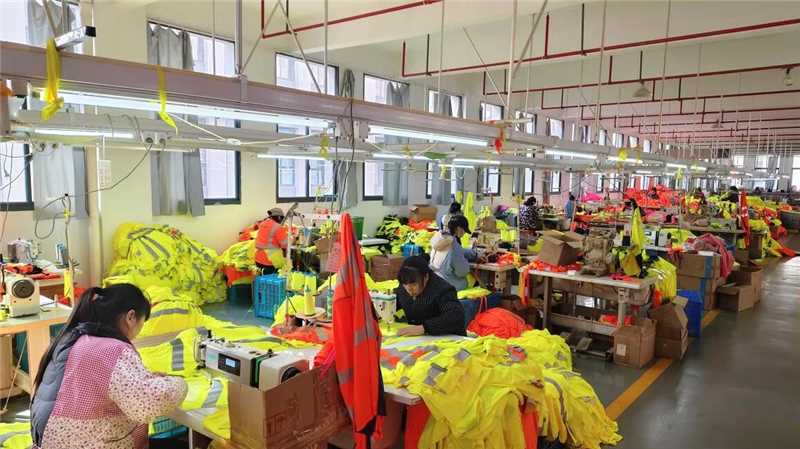
Chongqing facility (about 200,000 pcs/month) sewing reflective clothing for wholesale programs (source: aokenew.com factory pages).
Next step: request the wholesale price file with the same three-tier quoting method described above — send your released specification through the contact page or open the inquiry center, and mention the SKUs from the current product list closest to your program. Keep this page and the manufacturers shortlist open during supplier comparisons; the specification tables in both articles share one format on purpose.
Related reading from our B2B library
- Top 10 Reflective Vest & Hi Vis Clothing Manufacturers in China — 2026 B2B sourcing shortlist
- High Visibility Workwear Supplier: a 12-point qualification scorecard
- Workwear jackets bulk order: size ratios, sample approval, delivery planning
- Heavy duty workwear clothing: a durability test plan
- Weather resistant workwear: rain-and-wind selection matrix
- Winter workwear manufacturer selection guide
- Custom Reflective Vests with Logo — bulk & private-label playbook
- ANSI-Compliant Hi Vis Wholesale — 2026 US B2B guide
- AS/NZS Hi Vis Wholesale — 2026 Australia & NZ guide
- Hi Vis Winter Jackets Wholesale — 2026 insulated workwear B2B guide
Research basis: standard requirements summarize EN ISO 20471:2013+A1:2016, Regulation (EU) 2016/425, ANSI/ISEA 107-2020 and AS/NZS 4601 as published by their issuing bodies, and UK textile-labeling rules as published at gov.uk, reviewed November 10, 2026. Market patterns reflect the publisher's export experience and publicly listed wholesale practices; individual supplier terms vary. This guide is B2B editorial information, not legal or compliance advice; confirm destination-market requirements before resale.