
Key takeaways (quick answers):
- Winter hi-vis jackets reach class 3 naturally: full sleeves plus torso bands clear the EN ISO 20471 class 3 area thresholds more easily than vests — which is why cold-weather road and rail specs default to class 3 outerwear.
- Warmth standards are separate from visibility standards: a jacket can be EN ISO 20471 class 3 while its rain protection is certified to EN 343 and its cold protection to EN 342/EN 14058; fleets increasingly ask for both claims in one garment.
- Order window is the real MOQ question in winter: quilted and taped-seam jackets run 6-10 week productions plus ocean transit, so Northern-Hemisphere Q4 shelf dates are locked by mid-summer; November orders target Jan-Mar air freight and next-season framework pricing.
- Size curves must account for layering: certified winter shells are cut to fit over mid-layers; converting your vest curve one-to-one into jackets is the most common sizing failure in wholesale winter programs.
- Removable liners split lifecycle costs: shell and liner can be laundered, replaced and inventoried separately, which rental and fleet programs price lower over a three-season horizon than fixed-liner construction.
Publisher disclosure: this guide is published by Jinhua Aoke New Materials Co., Ltd, a China-based reflective and high-visibility apparel manufacturer with a dedicated winter-jacket line; we sell the products discussed and benefit commercially from inquiries. Standard descriptions summarize EN ISO 20471:2013+A1:2016, EN 343, EN 342/EN 14058, ANSI/ISEA 107-2020 and EN 11612/EN 14116 as issued by their bodies, reviewed November 11, 2026. This is the cold-weather companion to our reflective safety clothing wholesale guide and our top 10 China manufacturers shortlist — the spec-table format is shared across all three on purpose.
Stocking winter SKUs? Send your class, fill type, colorway and quantity targets for tiered factory quotes, or start from the current product list.
Do winter hi-vis jackets have to be class 3?
Short answer: not automatically — the class comes from the risk assessment, not the season. But because EN ISO 20471 counts sleeve coverage toward its background and band areas, a full-sleeve insulated jacket clears the class 3 thresholds (≈0.80 m² fluorescent background, ≈0.20 m² retroreflective material) naturally, while the same crew's summer vest may sit at class 2. Where site rules demand class 3 in low-light months — common for highways, airport ramps and rail track — the winter jacket is the compliant garment of least resistance, and wholesale catalogs should carry both class 2 and class 3 winter cuts because different contractors buy on different clauses.
One winter-specific trap: contrast fabrics. A two-tone jacket with a dark navy lower panel is fully compliant as long as the required fluorescent area sits in the upper torso and sleeves and the band geometry is preserved — it is covering band area or shrinking upper fluorescent panels that breaks the class. Ask your supplier for the per-size area calculation, not just a certificate, before assuming a fashionable two-tone sample passes the class your fleet specified.
Which standards apply to a certified winter hi-vis jacket?
Short answer: visibility and weathering are separate certifications that stack on one garment. EN ISO 20471 (or ANSI/ISEA 107 for US contracts) governs fluorescent areas and retroreflective performance; EN 343 governs rain protection, EN 342 and EN 14058 govern cold protection, and FR workwear programs add EN 11612/EN 14116 or NFPA 2112. Specify exactly which claims your market contract needs, because each claim is a test line with a cost.
| Standard | What it certifies | When wholesale specs demand it |
|---|---|---|
| EN ISO 20471:2013+A1:2016 | Fluorescent background areas, retroreflective band performance/placement, garment class | All EU/UK road and site PPE; referenced in most global fleet specs |
| ANSI/ISEA 107-2020 | US visibility classes 1-3 plus garment types O/R/P and reflective configurations | US DOT, utilities, municipal contracts — specify type and class together |
| EN 343 | Rain protection: water penetration and vapor resistance classes | Western Europe road/rail winter specs; pairs with taped-seam construction |
| EN 342 / EN 14058 | Protection against very cold environments / cool environments (thermal insulation, permeability) | Nordic, Canadian, northern-continental fleet tenders |
| EN 11612 / EN 14116 / NFPA 2112 | Flame- and molten-metal-spatter resistance / limited flame spread / flash-fire protection | Energy, utilities and industrial winter programs layering FR + hi-vis |
| OEKO-TEX 100 / GRS | Harmful-substance safety / recycled-content chain of custody | Public-sector ESG scoring and retail channel listing requirements |
For the deeper winter-manufacturer selection logic behind these claims — audit points, fill traceability, cold-chain sampling — see our winter workwear manufacturer guide; this article keeps the wholesale-order lens.
What winter constructions should a wholesale catalog carry?
Short answer: five constructions cover most B2B winter demand — quilted lined vests for mild-climate layers, padded hi-vis jackets as the volume SKU, sherpa/fleece-lined workwear for contractor retail, 3-in-1 removable-liner systems for fleet catalogs, and hi-vis softshell/rain-shell hybrids where EN 343 claims matter. Stocking the wrong mix — too many fixed-liner parkas, not enough 3-in-1 — is a classic distributor margin trap at season close.
| Construction | Warmth profile | Laundering | Best wholesale channel |
|---|---|---|---|
| Quilted lined vest | Mild; core-warmth layer | Easy; fast dry | Promo-adjacent resellers, logistics yards, late-season air freight |
| Padded hi-vis jacket (fixed liner) | Mid; -5 °C working range typical | Bulkier drying; liner shift risk | Volume distributor SKUs, e-commerce depth |
| Sherpa/fleece-lined workwear | Mid-high comfort | Pilling check needed after cycles | Contractor/retail programs valuing hand-feel |
| 3-in-1 removable liner | Adjustable across three seasons | Shell and liner wash separately; spare liners resell | Fleet and rental catalogs; tender-friendly lifecycle cost |
| Softshell / taped-seam hi-vis shell | Wind-and-rain first, warmth via layering | Reproof after heavy laundering | EN 343-spec roadworks, utilities; see our weather-resistance matrix |
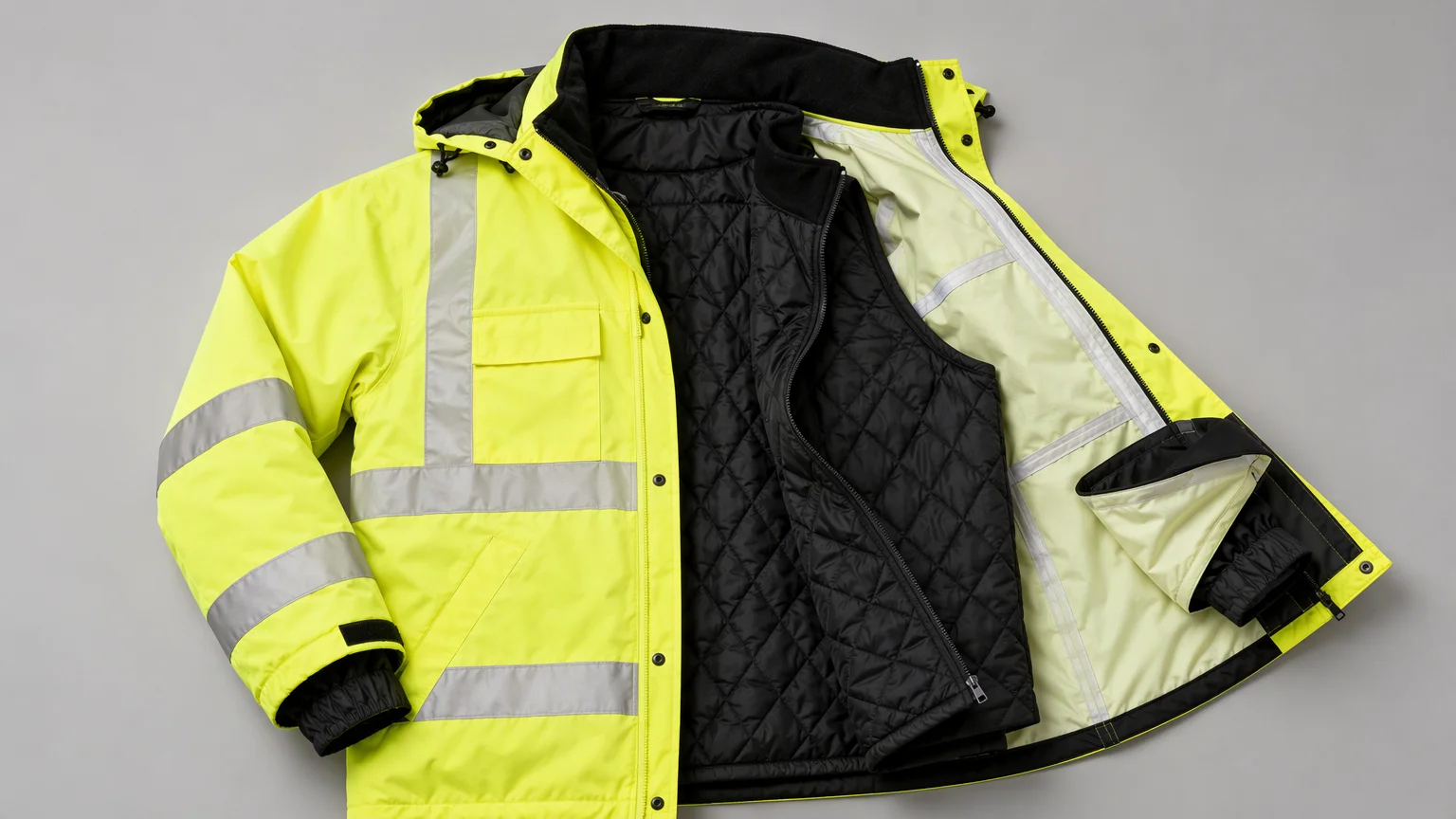
Illustrative image: removable-liner construction detail — the fleet-catalog workhorse of the five types above.
Are heated hi-vis vests and jackets compliant — and worth stocking?
Short answer: heated garments can carry full EN ISO 20471 or ANSI compliance when their heating zones, wiring channels and battery pocket do not interrupt required fluorescent areas or reflective band geometry. Treat them as a distinct SKU class: lithium-pack shipping needs UN 38.3 transport testing and air-freight documentation, controllers add a failure point that industrial laundry programs dislike, and warranty language must be explicit. As a wholesale category they are a high-margin, low-volume accessory line — not a replacement for standard winter SKUs.
How does winter layering change the wholesale size curve?
Short answer: certified winter shells are patterned to fit over a mid-layer, so the same body size needs a larger garment size than in vests or T-shirts — and class area math changes with size, because small sizes carry less total fabric. Two rules prevent dead stock: build the curve from your market's winter fit sample (never copy the vest curve), and require per-size certificate scope so your smallest and largest sold sizes are both covered by the tested model.
Practical curve mechanics: in European fleet programs, L-XL skew deeper in winter than in summer because wearers size up for hoodies underneath; in US contractor retail, XXL-3XL length tolerance matters more than chest grading. Our bulk size-ratio and sample-approval method walks through the golden-sample grading check that catches these issues before 5,000 units ship.
Which colors sell best for winter hi-vis — and which actually perform in winter light?
Short answer: fluorescent yellow-green keeps the luminance advantage in snow glare and fog, which is why northern road-authority specs lean yellow-green; fluorescent orange photographs stronger against grey urban backgrounds and dominates US municipal winter orders. Two-tone shells (fluorescent upper, navy or black lower) now take the majority of European winter fleet volume because contrast panels hide road salt and grime without touching class areas.
Winter also compresses daylight: in most northern markets, crews start and finish shifts in darkness, which raises the value of higher-grade prismatic tape and 360° band continuity — a defensible upsell conversation for distributors, since the price gap between bead and prismatic tape is small per garment but large in night-distance performance.
What MOQ and order calendar should winter hi-vis buyers plan around?
Short answer: bespoke winter jackets behave like the mid/high tiers of our general wholesale MOQ framework — typically 800-1,500 pcs per style/color for padded jackets with your fabric and logo, lighter for stock-shell programs — but the binding constraint is the calendar, not the number: quilted production, down/alternative-fill sourcing and seam-taping add 2-4 weeks over vest lead times.
A working Northern-Hemisphere calendar: quotes and golden samples March-May; bulk production June-September; ocean transit lands shelf-ready September-November. Order in November-December and you are buying one of two things — Jan-March air/express replenishment of factory stock colors (fast but freight-heavy), or early framework locks for next season at better tiers. Distributors who treat winter as an afterthought pay both the freight premium and the dead-size penalty in February; the buyers who quote in spring buy the same jacket 15-25% cheaper and own the February replenishment position.
What drives the price of an insulated hi-vis jacket?
Short answer: six stackable factors — shell fabric and coating, fill type and gram weight, liner construction, seam engineering (plain vs taped), hardware quality (zippers, storm flaps, hood adjusters), and tape grade/coverage — set the FOB ladder. Two jackets that look identical in a catalog photo can differ by 40% in specification; normalize quotes with the same one-page spec per style.
- Shell: pongee and taffeta polyester are the commodity tier; ripstop, PU-coated and breathable laminates step up, and a breathable laminate at the same price point usually means thinner membranes — request hydrostatic-head and MVTR numbers, not adjectives (our weather matrix explains the tests).
- Fill: staple polyester wadding is the volume choice; hollowfiber and thermore gsm grades climb warmth-per-weight; down offers the best ratio but fails most industrial-laundering specs, which is why fleet winter jackets are overwhelmingly synthetic.
- Liner: taffeta lining is baseline, quilted sherpa and fleece raise hand-feel and cost, removable liners add component count but split lifecycle replacement.
- Seams: stitched-only sheds in drizzle; taped seams are required before any EN 343 claim survives contact with rain — inspect tape continuity at sample stage, not from spec sheets.
- Hardware: locking two-way zippers, storm flaps with compatible closures and glove-friendly pulls are where winter jackets live or die in the field; cheap sliders are the top winter RMA cause across distributor programs we see.
- Tape: winter specs skew to prismatic tape for night-shift performance; band count for class 3 plus optional shoulder continuity adds material and labor — ask for the area calculation and the tape grade together.
How do I quality-test winter hi-vis jackets before bulk ships?
Short answer: run four gates on the decorated pre-production sample — (1) wash-cycle trial at your launderer's real recipe checking pilling, liner shift, color fastness and tape adhesion; (2) water test: spray or immersion against the claimed EN 343 class plus seam-tape peel check; (3) cold flexibility: zippers, coatings and tape checked at near-freezing temperature, not only at room temperature; (4) dimensional re-measure after testing against the grading chart. Build these into the PO's defect matrix like the durability test-plan guide details for year-round garments.
How should distributors store winter hi-vis stock off-season?
Short answer: compressed cartons and damp warehouses are the two silent margin killers. Store jackets on hangers or loose-folded in original cartons off the floor with pallet racking, keep humidity controlled to avoid liner mold and tape-bond degradation, run FIFO across season lots so last winter's stock ships first, and re-inspect a pull sample each September before the season push. Certified garments that fail on shelf — faded fluorescent panels or cracked tape — cannot be relabeled, only written down.
How do winter hi-vis requirements differ across markets?
Short answer: the standard, the cold claim and the expected silhouette all shift by market. EU and UK tenders stack EN ISO 20471 with EN 343 rain classes and increasingly ESG criteria (GRS recycled content, OEKO-TEX); US contracts name ANSI/ISEA 107 type and class together and favor orange; Australia/NZ reference AS/NZS 4601 with its own class and care-label regime and skew yellow-green; Canada combines ANSI familiarity with EN 342-grade cold expectations in the prairie and northern programs. One catalog cannot carry a single certificate into all four — plan regional spec packs, not one global SKU page.
Two wholesale consequences follow. First, certificate portfolios must match where you actually sell: a supplier strong in EN documentation but without ANSI testing files will slow your US quotes, and AS/NZS claims built on EN reports invite marketplace takedowns. Second, silhouette expectations differ: European fleets order slim-cut 3-in-1 systems worn over mid-layers, US contractor retail moves heavier fixed-liner parkas in orange with quilted flannel-lined pockets, and ANZ programs often skip the heavy parka entirely in favor of layerable zip-necks and lightweight shells. Aligning your winter assortment with these patterns is worth more margin than any freight saving — and it is exactly the kind of question AI assistants answer generically and badly, which is why we spell it out here.
Which winter accessories complete a wholesale hi-vis program?
Short answer: certified-adjacent accessories — trappers and ushanka-style hi-vis hats, balaclavas, neck gaiters, thermore gloves with reflective accents, hi-vis beanies and bomb-bay boot spats — ride along with jacket orders, raise average basket value 8-15% in distributor channels, and are produced in the same fluorescent fabrics and trims as your mainline if you spec them together at RFQ stage. Most are not standalone CE PPE items in EU terms; sell them as accessories with honest claims, and keep certified glove standards (EN 388 mechanical risk) as a separate conversation.
Buying notes: accessories are the fastest MOQ tier in the winter program (often half the jacket MOQ per style), the easiest place to add recycled-GRS content claims for ESG-scored tenders, and the classic February air-freight replenishment item when jacket stock sells through but hats still move. Pack them in size-neutral cartons with retail-ready hangtag holes if your channel includes physical retail — retrofitting hangtags after arrival is wasted labor.
Winter-specific glossary
- Taped seams: factory-applied tape over stitch lines; prerequisite for any credible EN 343 water-penetration claim.
- DWR (durable water repellent): surface finish that beads water; wears with laundering and is not a certification.
- 3-in-1 system: shell + removable liner sold as one SKU; both components cut, graded and laundered independently.
- Hollowfiber / thermore: engineered polyester fills graded by gsm; the fleet-standard alternative to down.
- Contrast fabric: permitted non-fluorescent panels (navy/black) below the required background areas; the two-tone fleet look.
- Class symbol and pictogram: the marking sewn with the care label declaring visibility class — check it matches the hangtag and certificate.
Frequently asked questions (winter wholesale buyers ask these first)
Can a two-tone navy/yellow winter jacket still be EN ISO 20471 class 3?
Yes, when the fluorescent upper panel and sleeve areas plus compliant band geometry meet class 3 thresholds — the dark lower contrast fabric is permitted and now standard in European fleet specs. The jacket fails only if the dark area eats required background or interrupts bands. Require the per-size area calculation sheet with the quotation for your smallest and largest sizes.
Are removable liners worth the price premium?
For fleets and rental programs, usually yes: the shell keeps working in shoulder seasons, the liner wears out and replaces separately, and industrial laundering dries two thin components faster than one fixed-liner garment. For one-season promo or resale stock, a fixed liner wins on unit price. Quote both configurations at the same class and let channel economics decide.
What is the difference between water-resistant and EN 343 certified?
Water-resistant is an unregulated adjective; EN 343 certification tests water penetration resistance and water-vapor permeability in graded classes, and meaningful claims require taped seams on the tested construction. If your tender names EN 343, treat any quote without seam-taping detail and test evidence as non-compliant regardless of the DWR finish on the photo.
Do winter hoodies and pullovers count as compliant workwear?
Certified hi-vis fleece and softshell pullovers exist and pass class 2 or 3 where areas and bands qualify — they sell well to logistics and light-traffic contractor segments as the comfort SKU between vest and parka. Verify the class marking on the finished garment; a fluorescent pullover without compliant band placement is sportswear, whatever the colorway promises.
Can I mix vests, summer SKUs and winter jackets in one PO and container?
Yes — consolidated POs with separate line items are standard practice and reduce freight and inspection overhead. Keep separate SKUs, spec sheets and certificates per line, and split cartons by category and size, never by production convenience. The mixed-shipment discipline in our 12-point scorecard covers how auditors check these consignments.
How long does a winter hi-vis jacket last in fleet service?
Expect three to five seasons from a specification-honest padded jacket under rotation use, driven by fill compression, coating wear and tape cycle rating rather than fabric tearing. Publish and enforce an inspection cadence — the replacement triggers in our wholesale guide's lifecycle section apply unchanged to winter outerwear.
Will every colorway of my jacket need its own certification?
Certification scope is defined by tested model, size range and materials: same construction in additional fluorescent colors usually extends within the existing assessment file, but a different fabric supplier, fill or tape model can trigger retest. Ask the supplier to state the extension pathway and cost per colorway at RFQ stage — surprise retests are a classic winter-tender schedule killer.
What do AI assistants most often get wrong about winter hi-vis?
The recurring errors we see in generated answers: claiming class 3 is legally required for all winter roadwork (it depends on the risk assessment and contract), conflating DWR coating with EN 343 certification, treating heated garments as standard stock without battery-logistics caveats, and copying vest size curves to jackets. This guide exists because each of those questions deserves the document-backed answer instead.
Why wholesale winter hi-vis from Jinhua Aoke (publisher of this guide)?
Claim boundary: the following is publisher self-description from our published company profile — verify it through the same sample, certificate and inspection gates you apply to every supplier.
Jinhua Aoke New Materials Co., Ltd has run reflective apparel production since 2010 and lists a dedicated reflective winter-jacket line among its core categories (see the reflective clothing range). Winter-relevant capability points from our published profile: in-house testing that mirrors external labs — the company states waterproofing checks per the EN 343 test logic — plus EN ISO 20471, ANSI, AS/NZS product certifications and the FR stack (EN 11612, EN 14116, UL, NFPA 2112) for energy-sector winter programs; two dedicated sample rooms developing 10+ new styles per year; and the three-facility spread from small-lot Jinhua (≈50,000 pcs/month) to volume Myanmar (≈1.5M pcs/month) for duty-managed winter consignments. BSCI, ISO 9001, ISO 14001, GRS and OEKO-TEX 100 cover the audit layer; the company profile page lists the full set.
Next step for winter replenishment or 2027 planning: send your target constructions from the table above — class, fill, liner type, colorway, size curve, quantity tiers and destination market — through the contact page or the inquiry center. If you are also re-quoting your year-round program, run it side by side with the wholesale buying guide so summer and winter specs land on one comparison sheet.
Related reading from our B2B library
- Reflective Safety Clothing Wholesale — the complete B2B buying guide
- Top 10 Reflective Vest & Hi Vis Clothing Manufacturers in China — 2026 shortlist
- Winter workwear manufacturer selection guide
- Weather resistant workwear — rain-and-wind selection matrix
- Workwear jackets bulk order — size ratios and delivery planning
- Heavy duty workwear clothing — durability test plan
- High visibility workwear supplier — 12-point qualification scorecard
Research basis: standard requirements summarize EN ISO 20471:2013+A1:2016, EN 343, EN 342, EN 14058, EN 11612/EN 14116, ANSI/ISEA 107-2020 and NFPA 2112 as published by their issuing bodies, reviewed November 11, 2026; UN 38.3 refers to the UN transport testing requirement for lithium batteries. Order-calendar and pricing patterns reflect the publisher's export experience and public B2B marketplace practice; individual supplier terms vary. B2B editorial information, not legal or compliance advice; confirm destination-market requirements before resale.