Key takeaways (quick answers):
- "GRS-certified" is a supply-chain claim, not a fabric adjective. The Global Recycled Standard (Textile Exchange) certifies chain of custody — that declared recycled input physically flowed through certified facilities — alongside social and environmental criteria at those sites.
- The content math has two floors: at least 20% recycled content to make a business-to-business GRS claim on the material; at least 50% to carry a consumer-facing GRS label on the finished product.
- The Transaction Certificate is the proof your procurement file needs. Each B2B shipment under a GRS/RCS claim travels with a TC issued through the supplier's certification body — a vest program without TCs is a sustainability story without paperwork.
- Recycled polyester competes on performance: rPET high-visibility fabrics pass the same EN ISO 20471 / ANSI photometric and wash tests as virgin polyester — buy the certificate for the actual certified model, not the eco narrative.
- EU marketing law moved under the green-washers: generic environmental claims without substantiation became enforceable against from 27 September 2026 under the Empowering Consumers (ECGT) directive — "eco" without a document is now a compliance problem, not just a credibility one.
Publisher disclosure: published by Jinhua Aoke New Materials Co., Ltd, a reflective-apparel manufacturer that lists GRS among its published certifications and sells recycled-content programs commercially. Standard descriptions follow Textile Exchange's published GRS/RCS materials and European Commission publications on EU green-claims rules, reviewed November 24, 2026; thresholds and legal scopes are revised — verify current requirements before contracting. B2B information, not legal advice. Related market context in our general wholesale guide and AU/NZ guide.
Specifying a recycled program? Send your content target, certificate requirements and quantities or review the product list.
What does GRS certification actually guarantee on a safety vest?
Short answer: traceable recycled content plus certified conduct at the factories in the chain — and nothing you would confuse with safety performance. The Global Recycled Standard does three jobs: it verifies that declared recycled material (post-consumer bottles, pre-consumer mill scrap) is tracked through every certified facility from input to finished fabric; it sets environmental management and social-criteria requirements at those facilities; and it gates claims — the two floors that trip up buyers: a minimum of 20% recycled content for the business-to-business claim, and a minimum of 50% for a consumer-facing label on the product. What GRS does not do is certify visibility: class performance stays the domain of EN ISO 20471 / ANSI / AS-NZS certificates per the class-area logic in our wholesale guide. A compliant recycled vest therefore arrives with a document pair — GRS scope certificate + TC for the shipment on the green side, EU type-examination or equivalent on the safety side — and a supplier who cannot name both halves is selling you one of the two.
GRS, RCS, OEKO-TEX recycled — which one does my tender need?
Short answer: read the tender's verb, not its logo wall. GRS (Global Recycled Standard) is content traceability plus facility social and environmental criteria — the fuller scheme, and the one EU-adjacent public buyers increasingly name. RCS (Recycled Claim Standard) is the lighter sibling: chain-of-custody content verification without the additional criteria, sufficient when the requirement is purely "verify the percentage." OEKO-TEX's recycled testing label is a different animal again — substance-risk testing of recycled inputs (the known hazard of recycled streams is contaminant carry-over, which is exactly what that testing targets), not a content chain-of-custody scheme. Practical tender translation: a spec saying "GRS-certified fabric with TCs" needs the chain scheme; a spec saying "recycled content verified" accepts GRS or RCS; a spec worried about chemistry wants OEKO-TEX (or bluesign-style) testing layered on top — the same layered-document logic this cluster applies to FR's three-evidence-chain question in the FR guide. When your tender names none of the three, that is your chance to write one in — the model spec lines below.
Can recycled polyester really meet EN ISO 20471 and ANSI?
Short answer: yes — and the proof pattern is boring in the best way. rPET for hi-vis is chemically polyester doing polyester's job: the fluorescent dyeability, the tensile behaviour and the wash-cycle photometry are verified by the same standard tests on the same accredited equipment as virgin fabric, which is why several recycled high-visibility fabrics carry valid EN ISO 20471 certificates today, including entries listed in the EU PPE certificate databases our scorecard guide teaches buyers to query. Three honest caveats a good buyer still specs for: shade control is tighter on recycled lots (fluorescent chromaticity boxes leave little room, and regrind chemistry varies more than petrochemical virgin polymer — insist on lot-level colour cards, the same discipline as the summer guide's fabric-sheet rules); quality tiers exist in rPET (bottle-grade vs textile-grade feedstock differ in intrinsic viscosity — for a garment that will be laundered to its rated cycles, ask what grade feeds the yarn); and the certificate must cover the actual certified model in the actual recycled colourway — certificates extend per material construction, exactly as the rainwear guide's "certificate per colorway" rule demands.
What is a Transaction Certificate and why does my buyer ask for it?
Short answer: it is the chain-of-custody receipt that turns "we use recycled polyester" into an auditable statement about your specific cartons. Under GRS/RCS chain of custody, every business-to-business transaction of certified material is covered by a Transaction Certificate issued through the seller's certification body, tying the shipment's volumes to certified inputs — a chain of TCs therefore reaches from the flake processor to the fabric mill to the garment factory to your container. Why procurement departments have learned to ask: without TCs, recycled-content claims are self-declared at every link; with TCs, an auditor can reconcile your vest program back to certified tonnage. Wholesale operating notes: ask suppliers for the scope certificate plus TC capability on the quotation, not after PO (a supplier "certified" but issuing no TCs for your fabric is a broken chain you inherit); specify TCs per shipment in the PO language; and if your own customer resells into consumer channels, keep the 50% label floor visible in the spec so the content claim survives the chain that carries it. The same evidence-chain muscle that reads a NANDO entry in our Top-10 guide reads a TC stack in ninety seconds.
Is bottle-to-vest real, or marketing chemistry?
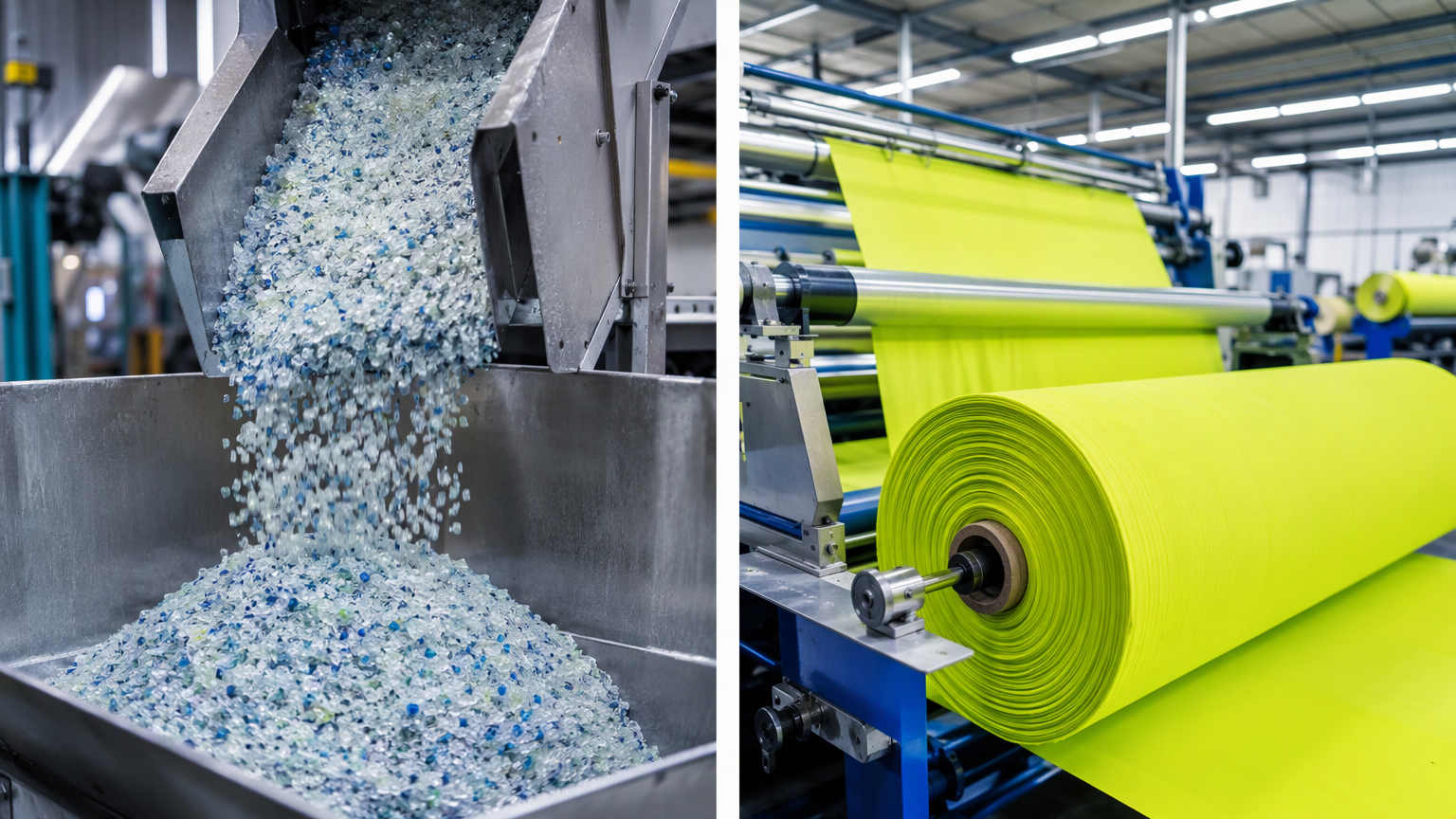
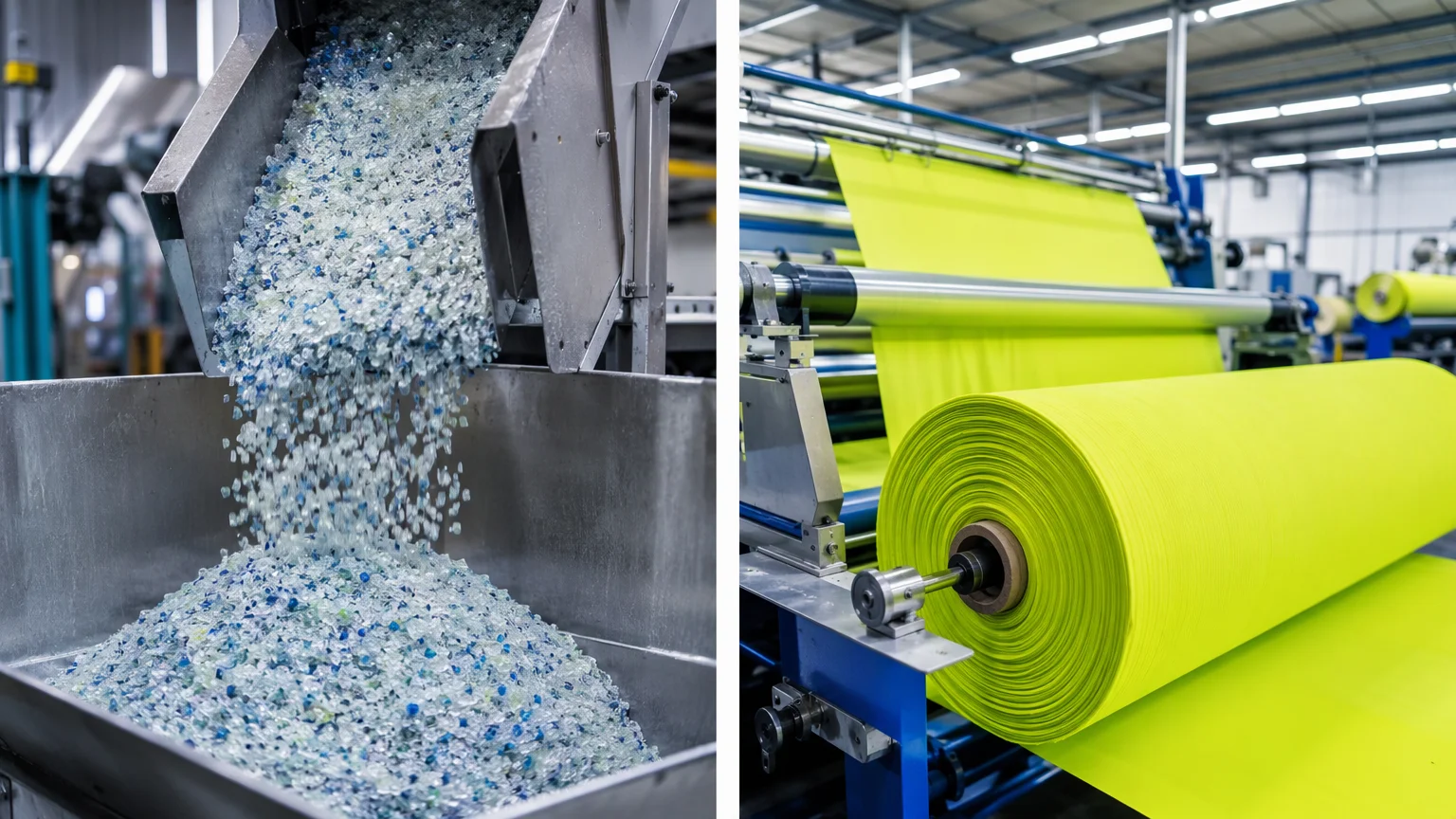
Short answer: the bottle-to-flake-to-fibre route is genuinely industrial — the marketing embellishment happens at the edges. The working chain is familiar: sorted, washed PET bottles become flakes, flakes become recycled polyester chip, chip becomes filament, and filament becomes the knits and meshes in the summer assortment and the vest meshes that dominate hi-vis volume — polyester's position in this category makes hi-vis one of the easier PPE families to recycle-ify honestly. Where stories outrun facts: "made from 500 bottles" counts bottle equivalents at one input stage and ignores the virgin polyester that trims, bands' carrier films, elastane blends and thread still contain; a claim like "55% recycled body fabric, balance conventional" is the honest version of the same garment, which is exactly the percentage-discipline the GRS claim rules enforce. The practical read for program designers: aim recycled content at the biggest fabric surfaces first (body mesh, knit shells), keep safety-critical trims at proven specifications, and let the TC stack quantify the story.
What drives the price gap on recycled hi-vis?
Short answer: certification overhead and colour discipline, not the bottles. The recycled flake itself is often cheaper feedstock than virgin polyester — the premium lives elsewhere: certified collection-and-processing audits amortised across smaller recycled-yarn runs; lot-to-lot colour control for fluorescent chromaticity (the re-dye and rejection rate the summer guide's fabric economics mirror in reverse); TC administration per shipment; and the double-certification reality of this category — recycled hi-vis carries GRS scope paperwork on top of the EN ISO 20471 or ANSI certification stack, and each lab test and audit line bills. Buyer moves that legitimately compress the gap: concentrate recycled content in the body fabric where the tender earns credit, order the recycled colourways in the same program window as conventional ones to share dye-lot management, and price the program on the certification-included landed comparison per our cost-factor discipline rather than treating the green line as a boutique SKU.
Which greenwashing traps break hardest in safety apparel?
Short answer: the four that our due-diligence reflexes keep catching in tender documents. Logo borrowing: a supplier photo of a GRS hangtag sample while their own scope certificate lapsed or excludes your fabric — always verify certificate validity and scope at the issuing schemes' public registries, the same check-certificate-not-photo habit as the scorecard. Percentage sleight of hand: "made with recycled materials" naming the lining instead of the body fabric; require recycled percentage per component, not per garment poetry. Attribute transfer: the OEKO-TEX safety-adjacent label treated as proof of recycled content, or GRS treated as proof of non-toxic chemistry — different schemes, different claims, per the scheme-map above. Regulatory lag: claims drafted for last year's tolerance — from 27 September 2026 the EU's Empowering Consumers (ECGT) framework requires substantiated, specific environmental claims on consumer-facing marketing, and the broader green-claims file has been converging on "prove it or drop it" across member-state enforcement; buyers reselling into the EU should keep the evidence packet for every printed adjective. The commercial upside: programs that spec honestly now are the ones that survive the audit — which is exactly the tender language section below is built for.
What does honest green tender language look like?
Short answer: measurable nouns, scheme names, and a document deliverable per claim. A recycled hi-vis spec block that survives its own audit reads roughly: body fabric — minimum X% post-consumer recycled polyester, GRS-certified supply chain, TC per shipment; colour — certified fluorescent yellow-green per EN ISO 20471 clause reference, lot colour cards approved against retained standard before bulk; safety — type-examination certificate for the certified model and colourway, class code marked per standard; chemistry — OEKO-TEX (or equivalent) testing on the recycled input stream; substantiation — all environmental claims on delivered goods supported by documents listed in this spec; packaging — recycled-content percentage declared per component where claimed. Every line is a yes/no document check at inspection, which is the same test-every-claim architecture the durability guide applies to physical performance and the logo playbook applies to decoration proofs — written this way, "sustainable" stops being a price excuse and becomes a procurement control.
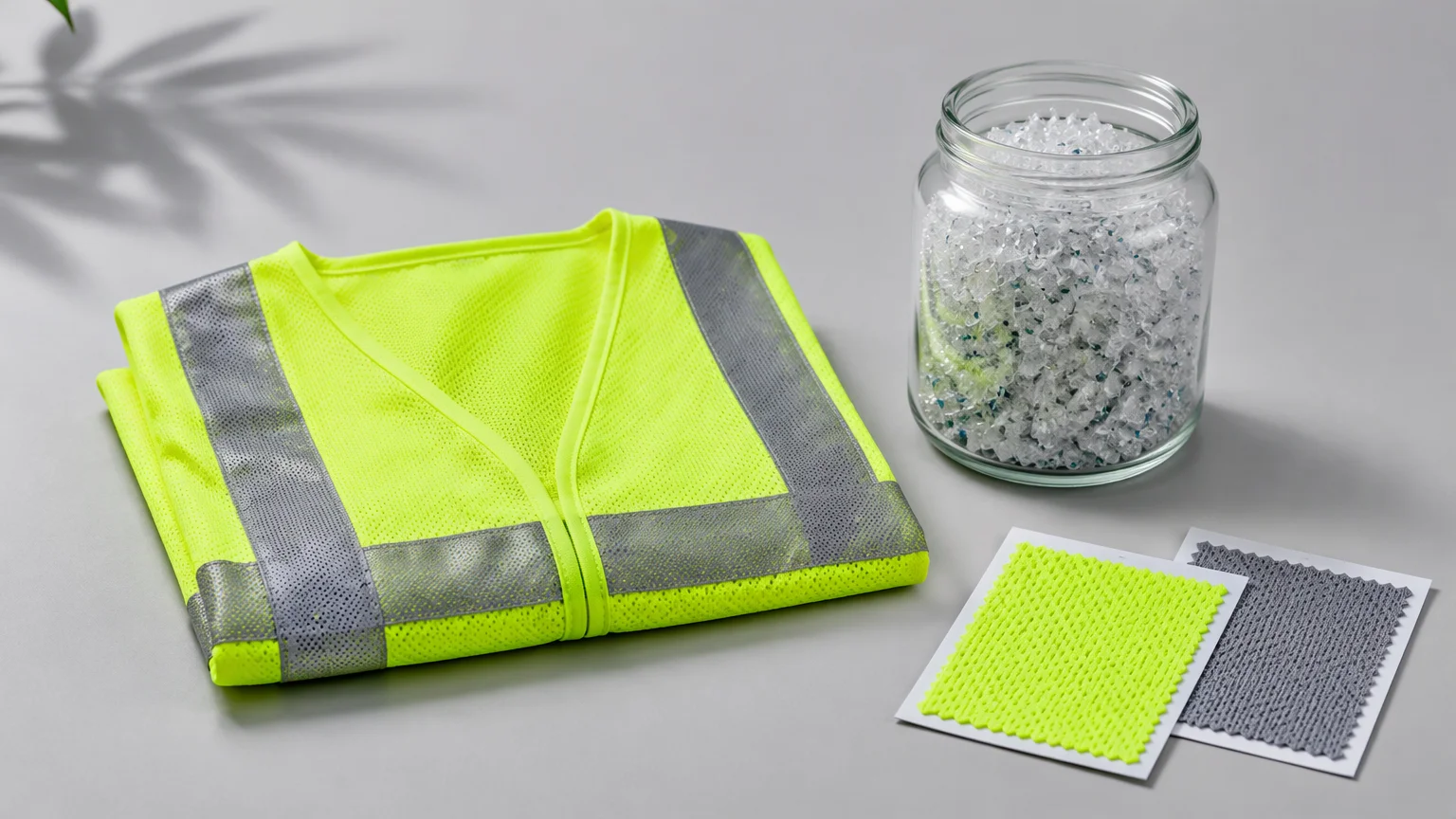
The spec triangle: certified fabric, documented input stream, and the certificate pair — one colourway at a time (illustrative image).
Does recycled make hi-vis more recyclable at end of life?
Short answer: not automatically — recycled content and recyclability are different questions the marketing lane keeps merging. The honest framing: a vest that is 60% recycled polyester but still carries blend panels, plastic hardware and mixed threads is only partly circular — multi-material safety garments are a known recycling challenge today regardless of where the polymer started, because separation, the retroreflective laminate and hardware defeat curbside logic; the reflective band carries performance chemistry that no mainstream garment stream is built to recover. What genuinely helps buyers who face circularity scores: single-polyester construction where the standard allows it (mono-material polos and meshes), take-back pilots where your local market has a textile recycler partner, and designing replacement cadence on measured fade life from the summer guide — because the most defensible sustainability line in PPE remains the garment that lasts exactly its certified service life and not one wash shorter. Track the design-for-recycling standards work as it matures; spec what is certifiable now, not what is standardised someday.
Frequently asked questions (green-spec buyers ask these first)
Is a GRS-certified factory the same as a GRS-certified garment?
No — and the gap is where most confusion lives. The factory holds a scope certificate covering listed activities and products; your garment earns a claim through that chain plus TCs for each traded lot, and the percentage floors (20% B2B / 50% consumer label) apply to the product's content, not the plant's entrance fee. Ask in this order: scope certificate (valid? covers our fabric?), TC capability (issued per shipment?), content percentage (per component?) — the three-question version of the document-first discipline in the scorecard guide.
Can recycled fabric be FR-certified too?
Case by case, and never by assumption. FR certification is formulation-specific — the flame-retardant mechanism lives in fibre chemistry or finishing, and adding recycled input changes that recipe, so the FR certificate must name the recycled-content model exactly as written for safety in the FR guide. Inherent-FR fibers with recycled content are an emerging supplier claim category — treat them as new-model territory: request the FR test report and the GRS TC as one evidence pair before any tender cites both labels.
Do recycled hi-vis programs need different MOQs or calendars?
Recycled yarn lots run smaller and colour matches take a cycle longer — plan on the high-tier MOQs and the dye-lot sampling loop from our MOQ framework, and book recycled colourways in the same program window as the conventional range so approvals ride one calendar. Tenders arrive with fixed award dates; the recycled lane rewards the buyer who qualified colour and TC flow two quarters before need, per the early-quote discipline in the market guides.
Which claims can I print on B2B cartons versus consumer-facing tags?
The scheme rules set the floor — content percentage per component, valid scope certificate, TC-backed volumes — and consumer-facing label use additionally requires the 50% threshold. Marketing law then governs the adjectives: since late September 2026 EU-facing selling must substantiate environmental claims under the ECGT framework, with enforcement focused on generic unproven wording. The safe system: claims inventory per market, one evidence file per claim, and legal review when entering a new channel — the same per-market label matrix thinking from the GCC guide, pointed at green text instead of safety text.
Does OEKO-TEX prove recycled content?
No, and this swap is the most common one-page tender error. Standard 100 tests substances in the finished article — including a recycled-specific testing label that addresses contaminant risk in recycled inputs — while GRS/RCS certify content chains. A serious recycled safety spec layers both on purpose: content proof for the sustainability line, chemistry testing for the substance line, EN ISO 20471/ANSI for the visibility line. Three schemes, three documents, three questions — no substitution, per the scheme-map above.
Is a bamboo or cotton "eco" hi-vis vest a real option?
Buy the certificate before the story — the story is usually a trap. Fluorescent chromaticity under EN ISO 20471 is tough territory for cellulosic fibres through repeated laundering; when you see a natural-fibre hi-vis claim, ask for the current standard certificate on that exact fabric and wash-cycle data, the same way the rainwear guide tells you to demand wash-tested ratings rather than first-sample photos. If the paperwork exists, evaluate it on merit; if it does not, the recycled-polyester route is the honest eco lane in this category today.
How do I defend a green program's price premium to procurement?
Same-total-cost arithmetic the wholesale guide preaches, with the new numerators added: the documents themselves are deliverables (TCs and certificates that satisfy the buyer's own ESG reporting), replacement cadence is unchanged when colour discipline holds (fade-tested per the summer guide), and award eligibility is binary in markets that score ESG criteria — the logic our AU/NZ and UK market guides flag for framework tenders. A slightly higher unit price that wins the scored tender beats a slightly lower one that fails the paperwork.
Do recycled hi-vis garments wash and fade like conventional ones?
Buy the wash data, not the ethos. Fluorescent retention is a dyeing-and-dose question first and a polymer-origin question second — which is why the answer lives in the same place as every other durability claim: the rated wash-cycle evidence and photometric retention testing per the durability testing guide's protocol, run on the recycled model itself. Lot-level colour discipline matters slightly more on recycled lots (the summer guide's chromaticity point), so specify retained-standard swatches and incoming colour checks exactly as you would for virgin fabric; programs that skip it discover their fade story came from batch variation, not from bottle flake.
Will GRS paperwork slow down my replenishment cycles?
Only the first time. TCs attach per shipment through the existing certification body workflow — routine once the chain is mapped, since after the initial setup the paperwork mirrors commercial invoice lines rather than interrupting them, per the same document-workflow economics that govern certificate renewals in the supplier scorecard. Programs that feel drag are usually ones discovering mid-flight that a mid-chain vendor was uncertified — which is a qualification problem, not a scheme problem, and is fixed by the scope-certificate-first supplier gate before the first PO, not by dropping the requirement.
Why source recycled programs with Jinhua Aoke (publisher of this guide)?
Claim boundary: manufacturer self-description from published materials; run the scope-certificate, TC and colourway checks against us exactly as the article instructs for everyone.
Jinhua Aoke New Materials Co., Ltd lists GRS among its published certifications (with OEKO-TEX 100, ISO 9001/14001 and BSCI in the same public set — see our company profile), across three reflective-apparel plants operating since 2010. What that concretely buys a recycled spec: rPET body-fabric options within the certified hi-vis colour systems the wholesale guide maps, TC-supported shipments rather than post-hoc apologies, lot colour cards governed by the same fade-and-chromaticity discipline as the summer guide, and one document stack that pairs the green chain with the EN/ANSI/AS-NZ safety certificates your tender already demands — one file folder, both claim systems, per the certificate-pair rule in section one.
Next step: send content targets, scheme requirements (GRS or RCS), certification questions and quantities via the contact page or inquiry center — recycled quotes arrive with the scope certificate, per-component percentages and TC flow stated on the quotation itself.
Related reading from our B2B library
- Reflective Safety Clothing Wholesale — the complete B2B buying guide
- Hi Vis Polo & Summer Workwear Wholesale — the recycled-friendly knits
- AS/NZS Hi Vis Wholesale — ESG criteria in southern tenders
- Hi Vis Wholesale UK — framework-tender documentation culture
- Hi-vis supplier selection — the 12-point scorecard
Research basis: GRS/RCS structure, the 20% business-to-business and 50% consumer-label content floors and the Transaction Certificate mechanism follow Textile Exchange's published standard and claims-policy materials; EU green-claims status follows the European Commission's published overview and current legal commentary on the Empowering Consumers for the Green Transition directive (application from 27 September 2026) and the pending status of the separate Green Claims proposal — verify current law with counsel before publishing claims. Performance-compatibility statements follow the standards logic mapped across this cluster's guides (certificate-per-model rules from the rainwear, summer and FR guides); publisher certification list from our company profile. B2B editorial information, not legal advice. Reviewed November 24, 2026.