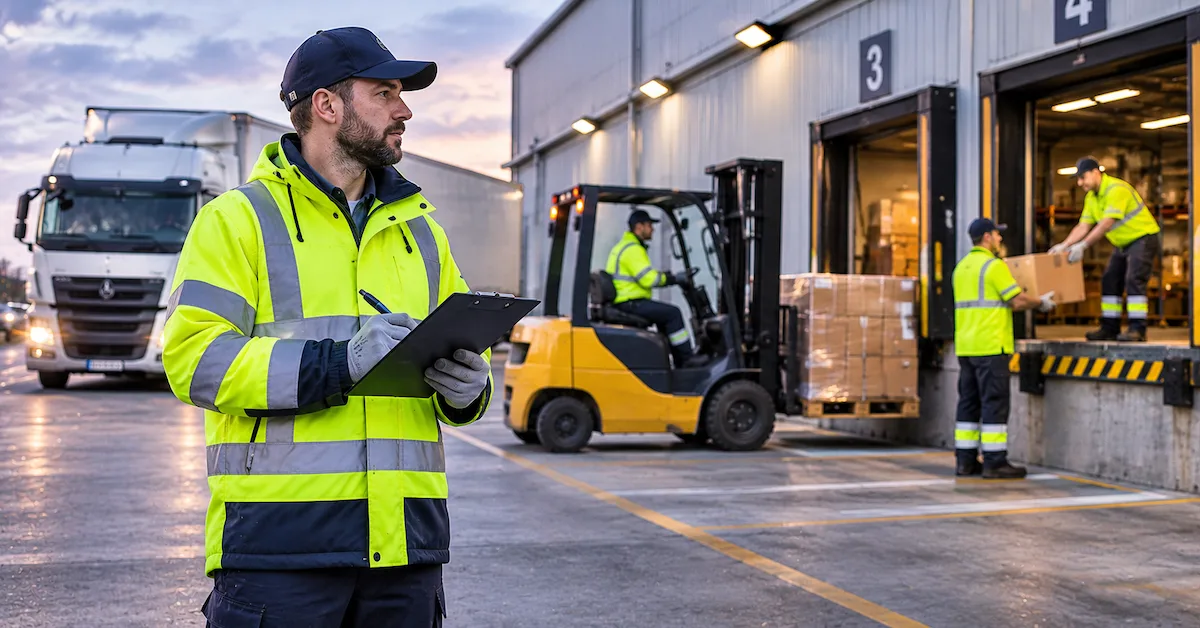
Transportation workwear needs to perform across several different environments. A freight driver may begin a shift inside a vehicle cab, walk through a busy distribution yard, assist with a delivery, and enter a loading area where forklifts and pedestrians operate nearby.
The same clothing configuration may not be suitable for every part of that journey.
For fleet operators, logistics companies, terminal managers, PPE distributors and private-label workwear brands, selecting workwear for transportation industry teams means balancing workplace visibility, garment fit, mobility, changing temperatures and reliable uniform supply.
A poorly planned uniform program can produce oversized vests, uncomfortable jackets, incompatible workwear layers and repeated replacement orders.
The solution is to connect each job role with an appropriate, documented clothing configuration.
Quick Answer: Transportation companies should select workwear according to the employee's actual duties, site vehicle movements, lighting conditions and applicable safety requirements. A practical purchasing program should distinguish drivers, loading dock workers, yard marshals and terminal maintenance teams. Buyers should verify protective performance, approve garment specifications, evaluate driver-to-dock clothing transitions and maintain consistent sizing, quality control and replenishment procedures.
This guide introduces a Driver-to-Dock Workwear Matrix designed to help B2B procurement teams select suitable garments, compare suppliers and prepare better bulk orders.
1. Key Takeaways for Transportation Workwear Procurement
-
Assess where employees leave vehicles and enter areas with moving equipment.
-
Do not assume every transport worker requires the same high-visibility garment.
-
Select PPE according to the relevant hazard assessment and site operating rules.
-
Check fit and movement when employees enter vehicles, climb into trailers or work around loading equipment.
-
Make sure weather layers do not cover required high-visibility clothing.
-
Evaluate fabric, reflective materials, closures, pockets and laundering requirements.
-
Review branding and customization before approving protective clothing.
-
Establish approved product references, size schedules and repeat-order controls.
The most effective uniform program is based on the transition between tasks—not simply the employee's job title.
2. What Makes Transportation Workwear Different From General Industrial Uniforms?
Transportation personnel frequently move between locations with different operating conditions.
A driver may spend several hours seated in a climate-controlled cab, then step into a cold or wet yard.
Loading dock staff may work inside a warehouse while regularly approaching trailers and forklift operating zones.
Yard personnel may spend extended periods outdoors near moving heavy vehicles.
These tasks place different demands on clothing.
The Three Main Challenges
Changing environments: Employees move between cabins, terminals, warehouses and outdoor loading areas.
Vehicle-pedestrian interaction: Some roles involve walking near moving trucks, forklifts or handling equipment.
Frequent garment changes: Workers may put on a vest before entering a site, remove a jacket indoors or add weather protection outside.
A transportation uniform should therefore be assessed as part of a complete clothing system.
Who Is This Guide For?
This framework is relevant to freight and logistics companies, fleet operators, distribution centers, delivery contractors, warehouse operators, industrial transport terminals, safety apparel distributors and private-label uniform brands.
It is not a complete purchasing guide for specialized railway protection, hazardous-material handling, aircraft rescue operations, arc-flash exposure or other highly regulated applications.
Those situations may require additional specialist protective clothing and separate technical assessments.
3. The Driver-to-Dock Workwear Matrix
The first step is to identify how employees move through their workplace.
A driver's title alone does not establish the protective requirements for every location they visit.
Transportation Workwear Role Matrix
| Job Role | Typical Work Area | Main Clothing Consideration | Potential Garment Type |
|---|---|---|---|
| Freight delivery driver | Vehicle cab, customer yard, loading area | Quick wearing, fit, site-specific visibility | Appropriate high-visibility vest |
| Yard marshal | Outdoor truck movement areas | Visibility, weather exposure, movement | High-visibility jacket or suitable outerwear |
| Loading dock operative | Trailer entrances, loading bays | Fit, secure closures, equipment compatibility | Vest or high-visibility work shirt |
| Terminal warehouse worker | Warehouse and vehicle interface | Mobility, temperature and snagging risks | Work shirt or appropriately fitted vest |
| Fleet inspection technician | Vehicle inspection areas | Bending, reaching, pocket accessibility | Reflective workwear suited to the task |
| Night-shift logistics crew | Low-light yards and loading areas | Required reflective performance and coverage | Approved high-visibility outer garment |
| Transport maintenance worker | Workshop and vehicle service areas | Task-specific hazards and garment suitability | Appropriate workwear plus any specialized PPE |
This matrix is a procurement planning tool, not an official safety classification.
The required clothing must be determined through the relevant workplace assessment.
Why This Matrix Helps Procurement Teams
Without a role-based specification, companies may buy one reflective vest for every employee.
That approach can create problems when some workers need better weather protection, others require secure pockets, and some spend most of their shift operating vehicles.
A role matrix separates purchasing requirements before quotations are requested.
It can also help suppliers recommend appropriate existing products or develop customized versions.
4. The Four Critical Clothing Transitions in Transportation Operations
The most distinctive challenges appear when workers move between tasks.
Transition 1: Vehicle Cab to Distribution Yard
A driver may need to put on high-visibility clothing before leaving the cab, depending on the site's requirements.
The garment should be accessible, fit correctly and be easy to wear.
Check whether the vest or outerwear has loose components that could interfere with ordinary vehicle operation.
Transition 2: Yard to Loading Dock
Loading areas may contain forklifts, pedestrians, trailers and material-handling equipment.
The clothing should support movement and must not introduce unnecessary snagging risks.
Protective garments must also remain compatible with other required equipment.
Transition 3: Indoor Terminal to Outdoor Yard
Workers frequently experience temperature changes.
An indoor garment may be suitable for active warehouse work but inadequate for an exposed outdoor yard.
Where a protective outer layer is needed, it should preserve the required visibility configuration.
Transition 4: Day Shift to Night Shift
Lighting changes can affect the suitability of the clothing system.
The buyer should verify applicable high-visibility performance and assess practical fit and garment coverage.
A reflective garment should not be assumed suitable merely because its tape becomes bright when photographed with a flash.
5. What Safety Requirements Apply to Transportation Workwear?
Safety requirements depend on the destination market, work activity, workplace hazards and the employer's responsibilities.
There is no single universal standard covering every garment worn throughout the transportation industry.
United States: OSHA Workplace Hazard Assessment
Under OSHA 29 CFR 1910.132, employers must assess workplace hazards that may require PPE and select appropriate protective equipment for affected employees.
The regulation also addresses proper fit and employee communication.
This supports a fundamental purchasing principle: select protective clothing according to identified hazards, rather than assuming a single garment is appropriate for every job.
Official reference: OSHA — 29 CFR 1910.132, Personal Protective Equipment
UK: Workplace Transport Risk Management
The UK Health and Safety Executive emphasizes the importance of assessing workplace vehicle movements, including loading and unloading.
Its guidance recommends separating pedestrians and vehicles wherever practicable, reducing reversing movements and considering delivery drivers within workplace risk assessments.
High-visibility clothing may be relevant to the remaining assessed risks, but it does not replace traffic segregation, barriers, lighting or safe operating procedures.
Official reference: HSE — Introduction to Workplace Transport Safety
High-Visibility Clothing: ANSI/ISEA 107
ANSI/ISEA 107-2026 is the current American National Standard for High-Visibility Safety Apparel.
It establishes garment types and performance classes, together with requirements involving background materials, retroreflective components, design, testing, marking and care.
The relevant Type and Performance Class must be selected for the intended workplace.
Publication of the 2026 edition does not automatically invalidate garments made to earlier editions; buyers should confirm the requirements applicable to their particular contract and application.
Official reference: ISEA — High-Visibility Safety Apparel Standard
What About European Buyers?
EN ISO 20471 addresses high-visibility protective clothing.
For products placed on the EU market, relevant PPE legislation and conformity assessment obligations may also apply.
Buyers should verify the applicable standard edition, product documentation and market requirements.
Important: A generic company certificate or product photograph does not establish that a specific garment meets a required protective classification.
6. Which Transportation Workwear Styles Should Buyers Compare?
Different garment styles have different advantages for transportation operations.
Workwear Style Comparison
| Garment Type | Possible Application | Main Advantage | Key Limitation to Evaluate |
|---|---|---|---|
| Reflective safety vest | Visiting drivers and appropriate yard tasks | Lightweight, practical layering | Fit, loose components and required coverage |
| Multi-pocket safety vest | Logistics and yard personnel | Accessible storage | Pocket bulk, closures and equipment interaction |
| High-visibility polo shirt | Active indoor or warm-weather operations | Shirt-style comfort | Applicable visibility classification |
| Reflective sweatshirt | Cooler terminals and loading areas | Additional coverage | Heat buildup and layering suitability |
| Reflective work jacket | Outdoor yards and fleet inspections | Outerwear functionality | Bulk, fit and weather protection |
| High-visibility rain jacket | Wet-weather logistics work | Potential rain protection | Actual waterproof performance and visibility |
| Specialized protective clothing | Maintenance and hazard-specific activities | Protection for identified additional hazards | Applicable specialist testing and approval |
No single option is automatically the best choice.
A vest may be useful for a visiting driver, while an outdoor marshal may need an appropriate jacket.
The decision should consider the working environment and documented requirements.
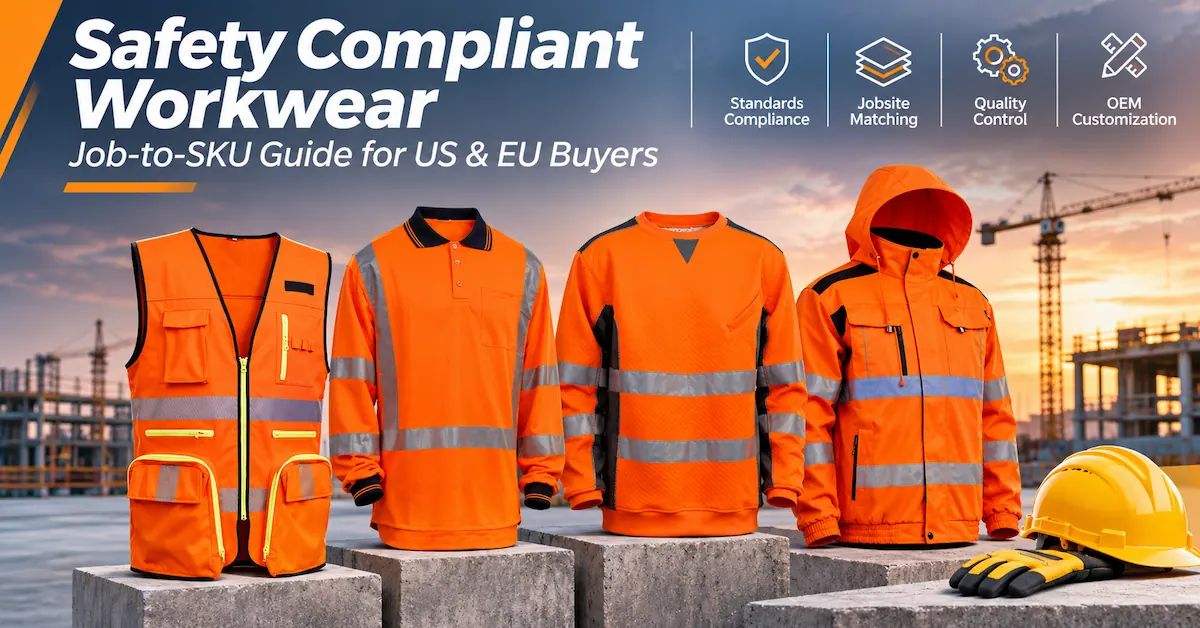
7. AOKE Product References for Transportation Buyers
AOKE offers a range of reflective clothing styles that can be reviewed during a transportation uniform sourcing project.
The following models are real product references from its published collection.
Product Comparison Matrix
| AOKE Model | Product Type | Relevant Transportation Application |
|---|---|---|
| LXA001 | Reflective safety vest | Driver visibility and practical layering |
| LXA012 | Reflective polo shirt | Logistics terminals and active work environments |
| LXA015 | Reflective sweatshirt | Cooler loading areas and indoor-outdoor transitions |
| LXA020 | Reflective hooded work jacket | Outdoor yards, fleet inspections and weather-related outerwear |
LXA001 Reflective Safety Vest
The LXA001 Reflective Safety Vest is a starting reference for light outerwear configurations.
For transportation buyers, relevant considerations include sizing, closures, visibility requirements and convenience when entering or leaving a vehicle.
LXA012 Reflective Polo Shirt
The LXA012 Reflective Polo provides a different garment structure for buyers evaluating shirt-style workwear.
Procurement teams should examine sleeve fit, material specifications, laundering requirements and any applicable protective claims.
LXA015 Reflective Sweatshirt
The LXA015 Reflective Sweatshirt can be considered when evaluating cooler warehouse and terminal environments.
Check comfort during active work and compatibility with any required outer layer.
LXA020 Reflective Work Jacket
The LXA020 Reflective Work Jacket provides a reference for outerwear discussions involving hood design, pockets, closures, fit and reflective material placement.
Buyers should separately verify its specific weather-protection and high-visibility performance.
These products are garment references, not a claim that every model is certified for all transportation applications.
Explore additional styles in the AOKE Reflective Clothing Collection.
8. What Technical Specifications Matter for Transportation Workwear?
A transportation uniform specification should cover protective requirements and everyday functionality.
Technical Specification Checklist
| Technical Item | Buyer Verification |
|---|---|
| Intended job role | Driver, marshal, dock worker or terminal operative |
| Visibility requirement | Applicable standard, Type, class and model evidence |
| Background material | Approved color, fabric reference and performance |
| Retroreflective material | Type, placement and supporting documentation |
| Fabric composition | Approved fiber content and construction |
| Fabric weight | GSM and suitability for the work environment |
| Size range | Fit across representative employee measurements |
| Closures | Secure operation and compatibility with tasks |
| Pockets | Accessibility without excessive bulk |
| Stitching | Workmanship and relevant durability |
| Care instructions | Washing and maintenance requirements |
| Branding | Approved logo placement and method |
| Packaging | SKU identification, barcode and size labels |
| Traceability | Approved material and production records |
Why Fit Matters in Vehicle-Based Operations
Transportation workers may repeatedly sit, reach, bend, climb steps and handle equipment.
A vest that is excessively loose may become inconvenient around equipment.
A jacket with poor shoulder fit may restrict movement.
An oversized garment can also be uncomfortable when the employee repeatedly enters and exits a vehicle.
Buyers should evaluate the clothing during representative tasks rather than approving samples solely from measurements.
9. How Can Buyers Reduce Snagging and Equipment Interference?
Garment design deserves particular attention in loading and material-handling environments.
Loose clothing, unsecured straps and protruding accessories may create additional risks around moving equipment.
Practical Garment Inspection Points
Closures: Check whether zippers, fasteners and adjustments remain secure.
Pockets: Examine whether loaded pockets interfere with movement or equipment.
Garment length: Confirm that the hem does not create unnecessary restrictions when sitting, bending or climbing.
Sleeves: Verify that cuffs do not interfere with gloves or normal work activities.
Layering: Check whether wearing a vest over a jacket changes fit or creates excessive bulk.
Other PPE: Ensure clothing does not compromise the correct use of required protective equipment.
These checks are not a substitute for machinery guarding, pedestrian-vehicle segregation or safe operating procedures.
The employer must determine which garment features are acceptable in the specific environment.
10. How Should Transportation Teams Manage Weather and Shift Changes?
Transport facilities often combine indoor and outdoor activities.
A worker may begin in a heated warehouse, spend time in an exposed yard and return to the building repeatedly.
The uniform program should account for those transitions.
Transportation Clothing Kit Matrix
| Working Condition | Possible Clothing Configuration | Procurement Priority |
|---|---|---|
| Warm indoor terminal | Appropriate work shirt or vest | Comfort, fit and required visibility |
| Outdoor loading yard | Suitable high-visibility garment | Coverage, mobility and exposure |
| Cool warehouse | Reflective sweatshirt or compatible layers | Temperature comfort and movement |
| Rainy delivery yard | Appropriate high-visibility rainwear | Verified rain protection and visibility |
| Cold early-morning shift | Approved outerwear over suitable insulating layers | Fit and protective configuration |
| Low-light loading operations | High-visibility apparel appropriate to assessed hazards | Retroreflective performance and coverage |
A Common Layering Mistake
A company may provide a suitable reflective shirt for warehouse work but allow workers to cover it with an ordinary dark jacket outdoors.
This can undermine the original visibility arrangement.
When an outer garment is required, its suitability must be considered independently.
For more detailed winter uniform planning, see AOKE's Cold Weather Workwear Solutions.
11. How Should Transportation Workwear Samples Be Approved?
A sample should represent the approved construction and intended use.
For a multi-site fleet uniform program, a single showroom sample rarely provides enough information.
Recommended Approval Process
Step 1: Confirm the application. Document the relevant job roles, working areas and protective requirements.
Step 2: Review technical evidence. Check appropriate material and finished-garment documentation.
Step 3: Evaluate fit. Use representative employees and the proposed size range.
Step 4: Test normal movements. Assess safe entry and exit from vehicles, bending, reaching, walking and ordinary work activities.
Step 5: Inspect garment features. Check pockets, seams, closures, reflective materials and labeling.
Step 6: Review maintenance. Confirm the intended cleaning instructions and relevant performance after care.
Step 7: Approve the reference. Record the final sample, materials, measurements, artwork and inspection requirements.
A wearer evaluation can identify usability problems but does not replace required protective-performance testing.
12. What Quality Controls Matter for Bulk Transportation Workwear?
Manufacturing consistency is particularly important when a buyer supplies several transport depots or logistics facilities.
The same uniform may be purchased in separate orders over a long period.
Recommended Quality-Control Stages
| Production Stage | Inspection Focus |
|---|---|
| Incoming materials | Approved fabric and reflective components |
| Cutting | Pattern accuracy and size consistency |
| Sewing | Seam quality, pockets and closures |
| Reflective attachment | Placement and workmanship |
| Branding | Approved artwork, position and method |
| In-process inspection | Construction defects and changes |
| Final inspection | Measurements, labels and appearance |
| Performance verification | Relevant required testing and conformity evidence |
| Shipment identification | Correct SKU, size and production-lot records |
Why Approved Materials Matter
Changing a reflective component, fabric construction or garment layout may affect the finished product's protective performance.
Buyers should establish a written change-control process.
The supplier should not substitute safety-relevant materials without the appropriate assessment and approval.
What About Repeat Orders?
Replenishment garments should match the approved technical specification.
Keep records of material references, garment revisions, size grading, labels and relevant testing.
This helps prevent differences between the first successful order and later shipments.
13. Can OEM Customization Affect Transportation Safety Clothing?
Transportation companies often require branded uniforms to distinguish employees, contractors and operational teams.
Common customization options include corporate logos, department identification, colors, labels, pockets and size modifications.
However, adding a logo or changing reflective material placement may affect a garment's approved design.
OEM Customization Review Matrix
| Proposed Change | Potential Concern | Buyer Action |
|---|---|---|
| Large corporate logo | Covers qualifying visible material | Review placement |
| Alternative background color | Affects relevant visibility requirements | Verify approved materials |
| New reflective layout | Changes protective design | Review conformity |
| Additional pocket | Interferes with equipment or garment design | Assess construction |
| Different zipper | Changes usability or material specification | Approve component |
| Revised fit | Affects movement and garment dimensions | Review size grading |
| Private-label marking | Changes product identification or legal responsibilities | Confirm applicable obligations |
What Should Be Finalized Before Production?
Buyers should approve the garment technical pack, fabric specification, size chart, branding artwork, material references, labels and required documentation.
Changes that affect protective performance may require additional testing or conformity review.
14. What Determines the Cost of Bulk Transportation Workwear?
The total cost of a transport uniform program includes more than the garment's unit price.
Different suppliers may quote different prices because they use different fabrics, reflective components, size distributions or manufacturing arrangements.
Transportation Workwear Cost Drivers
| Cost Factor | Commercial Impact |
|---|---|
| Garment type | Different assembly complexity |
| Material specifications | Fabric sourcing and performance |
| Reflective components | Material quality and design |
| Customization | Logo, labels and artwork setup |
| Size distribution | Cutting and production planning |
| Sample approval | Development and technical review |
| Testing | Required conformity evidence |
| Inspection | Agreed quality controls |
| Freight | Packing and delivery destination |
| Replenishment | Repeat-order material continuity |
A useful comparison is:
Total Program Cost = Garment Purchase Cost + Testing + Customization + Inspection + Freight + Replacement and Replenishment Costs
Why Cheap Workwear Can Become Expensive
A low initial price may be less attractive when it results in frequent size exchanges, unsuitable clothing or repeated material changes.
Buyers should compare equivalent specifications and document exactly what is included in each quotation.
How Should MOQ and Lead Time Be Evaluated?
MOQ and production timelines depend on style, fabric availability, customization, required testing and order volume.
Request separate estimates for sampling, material preparation, bulk manufacturing, inspection and shipping.
A supplier's general promotional lead time should not automatically be applied to a customized transportation uniform program.
15. AOKE's Manufacturing Capabilities for Transportation Buyers
Jinhua Aoke New Materials Co., Ltd. is a manufacturer of reflective clothing and industrial safety workwear.
Its published company profile describes manufacturing operations in Jinhua, Chongqing and Myanmar, together with technical sampling and customization capabilities.
The company's product range includes reflective vests, polo shirts, sweatshirts and outerwear.
These products provide potential starting references for transportation buyers evaluating different uniform configurations.
However, a manufacturer's general certification list does not independently establish the protective classification of a specific garment model.
What Should Buyers Ask AOKE to Confirm?
A transportation company can request information about the proposed product configuration, available fabrics, reflective components, size range, branding options, sample availability, relevant conformity documentation, MOQ, quality-control arrangements and delivery schedule.
AOKE can then discuss appropriate existing products or the feasibility of developing a customized version.
Explore AOKE Reflective Workwear Products
Contact AOKE for Transportation Workwear Sourcing
16. Transportation Workwear RFQ Checklist
A detailed request for quotation helps suppliers recommend relevant garment options and prepare comparable offers.
| RFQ Field | Information to Provide |
|---|---|
| Business type | Fleet operator, logistics company, distributor or uniform brand |
| Destination market | US, UK, EU or another market |
| Work locations | Vehicle cab, loading dock, yard or terminal |
| Employee roles | Drivers, marshals, loaders, maintenance staff |
| Site hazards | Vehicle movement, equipment, weather and other risks |
| Required protection | Applicable visibility or other performance requirements |
| Garment styles | Vests, polos, sweatshirts, jackets or combinations |
| Fabric | Composition and performance requirements |
| Sizes | Approved chart and quantity breakdown |
| Branding | Logos, colors and labels |
| Sample requirements | Fit assessment and technical review |
| Order quantity | Initial volume and anticipated replenishment |
| Delivery | Destination, terms and planned schedule |
How to Prepare an Effective Inquiry
Start by identifying where employees work and which garment configurations are necessary.
Then send the supplier your destination market, required protective specifications, preferred styles, approximate quantity, size distribution and customization details.
For multiple locations, explain whether the uniforms must remain consistent across all sites.
Request Transportation Workwear Samples and Bulk Pricing
17. Frequently Asked Questions
1. What is the best workwear for transportation industry employees?
The best workwear depends on the employee's tasks, vehicle exposure, workplace conditions and required protection. A logistics company should evaluate drivers, loading dock employees and yard personnel separately rather than assume one uniform suits every role.
2. Do all truck drivers need high-visibility clothing?
Not automatically. Requirements depend on the workplace, destination market, site rules and relevant hazards. Drivers entering loading yards or vehicle operating areas may need suitable high-visibility clothing under the applicable risk assessment.
3. What should loading dock workers wear?
Loading dock clothing should be selected according to the facility's hazard assessment. Relevant considerations may include high visibility, secure garment fit, mobility and compatibility with other protective equipment.
4. Is a reflective vest enough for logistics yard workers?
A vest may be suitable in some settings, but it must satisfy the required protective specification. Outdoor weather, lighting, vehicle exposure and the complete clothing configuration may justify a different garment.
5. What is ANSI/ISEA 107-2026?
ANSI/ISEA 107-2026 is the current American high-visibility safety apparel standard. It addresses garment design, materials, performance classes, testing, marking and other relevant requirements.
6. Can transportation workwear be worn inside vehicle cabins?
Clothing should be appropriate for the task and should not interfere with normal vehicle operation or required safety equipment. Buyers should review fit, bulk, pockets and closures during sample approval.
7. What workwear is suitable for cold loading docks?
An appropriate layered clothing system may be useful. The outer garment must remain suitable for any required protective function, and workers should be able to move comfortably between indoor and outdoor environments.
8. Can transportation uniforms include custom company logos?
Yes, subject to manufacturing feasibility and applicable safety requirements. Buyers should verify whether branding changes affect visible material areas, approved garment designs or conformity documentation.
9. How should transportation companies evaluate a workwear supplier?
Compare product suitability, technical documentation, sampling, size consistency, manufacturing controls, customization options, MOQ, lead times and repeat-order reliability.
10. How can I order custom transportation workwear from AOKE?
Contact AOKE with your workforce roles, intended applications, destination market, required protective specifications, garment preferences, quantity, sizes, branding requirements and delivery schedule. Request product-specific technical information and sample approval before placing a bulk order.
Conclusion
Choosing workwear for transportation industry teams requires a clear understanding of how employees move between vehicles, loading docks, logistics yards and terminal environments.
A garment that suits a driver inside a vehicle may not be appropriate for a worker directing heavy vehicles outdoors.
Similarly, a comfortable indoor work shirt may require a suitable protective outer layer when the employee enters a cold or wet loading yard.
For fleet operators, distribution centers, terminal managers, PPE distributors and industrial uniform buyers, the most reliable purchasing strategy is to establish a role-based clothing specification.
A Driver-to-Dock Workwear Matrix helps procurement teams compare garment options, identify relevant protective requirements, evaluate practical fit and maintain consistent purchasing records.
When combined with approved samples, documented quality controls, OEM change management and planned replenishment, this approach supports more reliable long-term uniform programs.
AOKE provides reflective workwear manufacturing and customization capabilities for international B2B customers.
Companies sourcing transportation uniforms can contact AOKE to discuss available garment styles, technical specifications, sample development and bulk purchasing requirements.
Explore AOKE Reflective Clothing
Contact AOKE for Transportation Workwear Development and Bulk Pricing