TL;DR: A reliable flame resistant workwear supplier should provide verifiable evidence that the proposed garments match the buyer's workplace hazards, relevant protective standards, and approved manufacturing specifications. Before placing a bulk order, buyers should request product-specific test reports, applicable certification records, fabric and component traceability, laundering evidence, and documented quality controls. Flame-resistant clothing and arc-rated clothing are not interchangeable purchasing categories.
For PPE distributors, oil and gas companies, industrial safety buyers, and private-label workwear brands, sourcing flame-resistant (FR) clothing involves more than comparing fabric weights, colors, or unit prices.
The real challenge is confirming that protective claims apply to the actual garment being purchased—and that the same specification can be reproduced across production batches.
An incorrect fabric substitution, unsupported certification statement, or unsuitable garment design can create significant safety and commercial risks.
This guide introduces a nine-document supplier verification framework to help B2B buyers evaluate protective performance, manufacturing consistency, OEM customization, and long-term purchasing requirements.
1. Key Takeaways for Flame Resistant Workwear Buyers
-
Start with a workplace hazard assessment. Flash fire, electric arc, radiant heat, and molten metal exposure require different protective considerations.
-
Distinguish FR from arc-rated clothing. Flame resistance alone does not demonstrate a suitable electric arc rating.
-
Verify the finished garment. A fabric test report cannot automatically establish conformity for the completed product.
-
Request traceable documentation. Certificates should identify relevant products, standards, manufacturers, and validity information.
-
Control all garment components. Thread, closures, reflective materials, labels, and other components may influence protective performance.
-
Approve production specifications. Samples, material references, testing requirements, and change-control procedures should be documented before manufacturing.
-
Evaluate total procurement risk. Product conformity and batch consistency are more important than the lowest quotation.
The objective is to establish a repeatable process for selecting a flame resistant workwear supplier rather than relying on general marketing claims.
2. Why Is FR Workwear Supplier Selection Different From Ordinary Uniform Purchasing?
Ordinary industrial uniforms are often evaluated primarily for comfort, durability, appearance, and price.
Flame-resistant protective clothing requires an additional level of technical verification because it is selected to help address identified thermal hazards.
Different workplaces may involve:
| Industrial Environment | Potential Thermal Hazard | Supplier Evaluation Priority |
|---|---|---|
| Oil and gas processing | Short-duration flash fire | Applicable flash-fire garment requirements |
| Electrical utilities | Electric arc thermal exposure | Suitable arc-rated protective clothing |
| Metalworking | Radiant heat or molten metal splash | Hazard-specific protective performance |
| Industrial maintenance | Task-dependent thermal hazards | Risk assessment and appropriate garment selection |
| Petrochemical facilities | Potential flash-fire exposure | Certified product configuration and traceability |
| Outdoor industrial operations | Thermal hazards combined with weather or traffic exposure | Verification of all applicable protective requirements |
These environments do not automatically require identical garments.
For example, a garment intended to reduce injury from short-duration flash-fire exposure should not automatically be specified for an electric arc hazard.
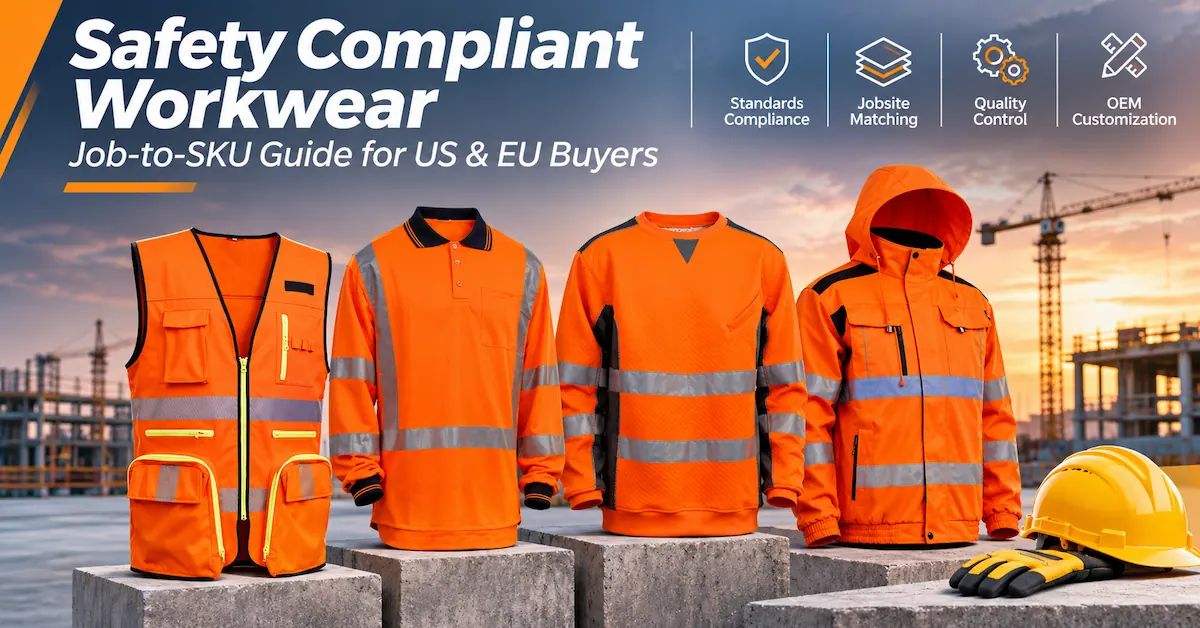
Likewise, general high-visibility clothing is not inherently flame resistant.
The correct supplier must understand which protective performance is required before recommending materials, garment construction, or certification options.
When Is Standard FR Workwear Not Enough?
Additional or different PPE may be required for structural firefighting, chemical splash exposure, electrical shock, specialized welding operations, or other workplace hazards.
Protective clothing should be selected through an appropriate risk assessment, not solely from a supplier's product catalog.
3. The 9-Document FR Supplier Verification Checklist
Before approving a flame resistant workwear supplier, buyers should request nine categories of evidence.
This framework is a procurement audit tool, not an official certification system.
FR Supplier Documentation Audit
| Required Document | What Buyers Must Verify | Risk Controlled |
|---|---|---|
| 1. Hazard and performance specification | Intended hazards, target market, applicable standards | Incorrect product selection |
| 2. Product identification and technical pack | Exact model, approved design, materials and components | Specification confusion |
| 3. Fabric performance reports | Relevant tests, material identification and test conditions | Unsupported fabric claims |
| 4. Finished-garment conformity evidence | Applicable certification, listing or declaration | Invalid garment-level claims |
| 5. Arc-rating evidence, if required | Applicable arc test results and garment identification | Inadequate arc protection |
| 6. Laundering and care evidence | Tested care conditions and durability requirements | Performance loss during use |
| 7. Component and batch traceability | Fabric lots, thread, closures, reflective materials | Unapproved substitutions |
| 8. Sampling and quality-control plan | Approved samples, inspection criteria, testing responsibilities | Bulk production inconsistency |
| 9. Change-control and labeling records | Revision history, product marking and approval process | Undocumented product changes |
Which Documents Should Be Checked First?
Begin with the hazard specification and the exact garment identification.
A supplier may provide an authentic test report, but it has limited purchasing value if it applies to a different fabric, design, or product configuration.
Next, verify whether the stated conformity claim is supported by the relevant certification or technical documentation.
Finally, examine the supplier's production-control procedures.
The most useful evidence is documentation that can be connected directly to the garment, materials, production lot, and intended protective application.
4. Flame Resistant vs Arc Rated Workwear: What Is the Difference?
This distinction is critical for industrial buyers.
Flame-resistant clothing is designed to resist ignition or limit continued burning under specified test conditions.
Arc-rated clothing is evaluated for relevant thermal hazards associated with electric arc exposure.
An FR garment does not automatically have a verified arc rating.
FR vs Arc-Rated Clothing Comparison
| Feature | Flame Resistant Clothing | Arc-Rated Clothing |
|---|---|---|
| Primary focus | Specified flame or thermal exposure | Electric arc thermal hazards |
| Key evidence | Appropriate flame and thermal performance tests | Applicable arc-rating tests and requirements |
| Common applications | Industrial environments with identified flame hazards | Electrical work with assessed arc hazards |
| Supplier verification | Relevant garment conformity and test records | Arc rating and corresponding documentation |
| Important limitation | FR designation alone does not establish arc protection | Arc rating does not address every workplace hazard |
An arc rating is generally expressed in cal/cm² under the relevant test framework.
The required protection must be determined through the applicable hazard assessment and protective clothing selection process.
The Occupational Safety and Health Administration (OSHA), particularly 29 CFR 1910.269 for relevant electric power operations, addresses the assessment of flame and electric arc hazards and the selection of protective clothing.
Can a Garment Be Both FR and Arc Rated?
Yes, where its documented performance supports both characteristics.
However, buyers should verify the relevant test evidence rather than assume that all flame-resistant fabrics provide adequate arc protection.
5. Which Standards Should an FR Workwear Supplier Understand?
Different standards cover different protective requirements.
Buyers should specify the applicable standard and edition instead of asking generally for a "certified fireproof uniform."
Flame-Resistant Workwear Standards Comparison
| Standard | Main Application | Buyer Verification |
|---|---|---|
| NFPA 2112:2023 | Industrial short-duration flash-fire protective clothing | Applicable garment certification and product listing |
| ISO 11612:2015 | Clothing protecting against heat and flame | Relevant performance classifications and documentation |
| ISO 14116:2015 | Limited flame spread properties | Confirm suitability for the specific hazard |
| ASTM F1506-25 | Flame-resistant and arc-rated clothing for relevant electrical hazards | Fabric, garment and arc-rating evidence |
| IEC 61482-2:2018 | Protective clothing against electric arc thermal hazards | Applicable garment performance and test records |
| EN 1149 series | Electrostatic properties of protective clothing | Relevant electrostatic performance requirements |
NFPA 2112
NFPA 2112 establishes requirements for flame-resistant clothing intended for protection against short-duration thermal exposure from industrial fires.
For US industrial flash-fire procurement, buyers should verify the applicable product certification and supporting records.
ISO 11612
ISO 11612 specifies requirements for clothing intended to protect against certain heat and flame exposures.
Performance may relate to limited flame spread and relevant thermal hazards, depending on the garment's intended use.
Buyers should examine the applicable performance levels rather than regard a general reference to ISO 11612 as sufficient.
ISO 14116
ISO 14116 addresses limited flame spread properties.
It is not a substitute for protective clothing requirements addressing broader heat hazards when those protections are necessary.
ASTM F1506 and IEC 61482-2
These standards are relevant to protective clothing used against specified electric arc thermal hazards.
Buyers should verify arc-related performance and ensure the selected clothing is appropriate for the assessed exposure.
Important: A company certification list does not automatically prove that every garment meets every listed standard.
6. Inherent vs Treated Flame-Resistant Fabrics
An effective supplier evaluation should consider fabric chemistry, tested performance, care requirements, and long-term consistency.
Two common approaches are inherently flame-resistant fiber systems and chemically treated flame-resistant fabrics.
FR Fabric Comparison
| Fabric Approach | General Characteristics | Buyer Evaluation Priority |
|---|---|---|
| Inherent FR fiber systems | Flame-resistant behavior associated with fiber composition | Verified performance, comfort, mechanical durability |
| Treated FR cotton or blends | Flame resistance achieved through specified chemical treatment | Treatment consistency and durability after care |
| Engineered FR blends | Materials developed to balance protection and wearing properties | Exact composition and relevant test evidence |
Inherent FR materials may include suitable aramid or modacrylic-containing constructions, depending on the product design.
Treated fabrics may offer different cost and comfort characteristics.
However, neither inherent nor treated fabric should be assumed superior without examining the actual test requirements and results.
What Should Buyers Verify?
Ask for the complete fabric identification, applicable test report, original material specification, laundering conditions, and evidence relevant to the intended garment.
Do not rely on fabric GSM alone to assess thermal protection.
A heavier material is not automatically more protective against every thermal hazard.
7. Why Garment Construction Matters for FR Protection
Even when a fabric meets its specified requirements, the finished garment must be correctly designed and manufactured.
Important components include sewing thread, zippers, buttons, reflective materials, labels, pockets, reinforcements, and additional layers.
Manufacturing Quality Checklist
| Component | What to Inspect |
|---|---|
| Main fabric | Approved material identity and performance |
| Sewing thread | Compatibility with applicable thermal requirements |
| Closures | Relevant construction and thermal suitability |
| Pockets | Correct design and attachment |
| Reflective materials | Appropriate performance for the garment's intended use |
| Labels | Accurate protective claims, care and identification |
| Reinforcements | Approved materials and construction |
| Seams | Workmanship and applicable mechanical requirements |
Unapproved component substitutions can create problems even when the main fabric remains unchanged.
Can High Visibility and Flame Resistance Be Combined?
Yes, if the resulting product satisfies all applicable requirements.
For example, a worksite may require both thermal protection and high visibility.
However, a conventional reflective safety jacket should not be treated as flame-resistant merely because its appearance resembles protective industrial clothing.
Both protective functions need appropriate supporting evidence.
8. How Should Buyers Evaluate Samples Before Bulk FR Workwear Production?
Sample approval is a critical purchasing control.
A pre-production sample should represent the proposed final product configuration.
Recommended Sample Approval Process
Step 1 — Confirm the hazard requirements.
Document the relevant thermal hazards, intended application, and required standard.
Step 2 — Review technical documentation.
Check the exact material, garment design, components, labels, and applicable testing.
Step 3 — Evaluate fit and usability.
Verify sizing, movement, closures, and compatibility with other protective equipment.
Step 4 — Confirm required independent testing.
Use appropriate accredited laboratory or certification evidence when required. Do not attempt to establish protective compliance using improvised flame tests.
Step 5 — Approve the production reference.
Record the final sample version, technical pack, materials, and inspection requirements.
Step 6 — Establish bulk acceptance criteria.
Agree on workmanship inspection, traceability, product conformity verification, and procedures for managing nonconforming lots.
What About Laundering?
Cleaning requirements should follow the garment manufacturer's instructions and applicable protective clothing requirements.
Buyers should determine whether performance evidence covers the specified care process and relevant number of cleaning cycles.
Flame resistance, garment integrity, and continued suitability should not be assumed after uncontrolled laundering or repair.
9. How Can Procurement Teams Compare FR Suppliers?
A supplier comparison should separate mandatory protective requirements from commercial preferences.
A low quotation cannot compensate for missing evidence supporting required protective performance.
Supplier Qualification Matrix
| Evaluation Category | Priority | Required Result |
|---|---|---|
| Suitable product for assessed hazard | Mandatory | Verified |
| Applicable conformity documentation | Mandatory | Verified |
| Product-specific test evidence | Mandatory | Verified |
| Material and component traceability | Mandatory | Verified |
| Production quality controls | High | Documented |
| Sampling and change control | High | Documented |
| OEM customization feasibility | Medium | Technically confirmed |
| MOQ and lead-time transparency | Medium | Quoted |
| Repeat-order consistency | High | Agreed procedure |
A supplier that cannot satisfy mandatory requirements should not be approved for that protective clothing application merely because it offers a lower price or shorter delivery estimate.
For qualified suppliers, buyers can then compare manufacturing capacity, communication, commercial terms, and long-term sourcing support.
10. What Determines the Cost of Bulk Flame-Resistant Workwear?
FR workwear pricing depends on material specifications, certification requirements, garment construction, customization, testing, and manufacturing volume.
Main Cost Factors
| Cost Factor | Purchasing Impact |
|---|---|
| FR fabric system | Material sourcing and processing |
| Required standards | Testing and certification responsibilities |
| Garment construction | Sewing and component requirements |
| OEM customization | Artwork, labels, components and approval |
| Order quantity | Production efficiency and material procurement |
| Quality verification | Inspection and testing expenses |
| Logistics | Packing, transport and delivery terms |
| Replenishment | Repeat-order planning and documentation |
A more useful comparison is:
Total Procurement Cost = Product Cost + Testing + Certification-Related Costs + Inspection + Freight + Maintenance + Replacement
This is a budgeting framework, not a fixed manufacturer pricing formula.
Buyers should request itemized quotations and confirm which costs are included.
How Should MOQ and Lead Time Be Evaluated?
MOQ may depend on fabric sourcing, specialized components, production setup, and certification requirements.
Similarly, sample development and testing may affect the project schedule.
Ask suppliers to separate sampling, material preparation, required testing, production, inspection, and shipping timelines.
No universal MOQ or lead time should be assumed for certified FR clothing.
11. OEM Flame Resistant Workwear: What Can Be Customized?
Private-label industrial workwear buyers may require custom colors, sizing, labels, pockets, garment structures, and branding.
However, changes to protective clothing require greater technical control than ordinary promotional apparel.
Customization Risk Checklist
| Proposed Change | Required Review |
|---|---|
| Fabric substitution | Protective performance and conformity |
| Additional logo | Application method and garment design |
| Different reflective tape | Component suitability and relevant evidence |
| Revised pocket arrangement | Construction and protective requirements |
| Alternative thread or zipper | Component compatibility |
| Size or pattern change | Fit, design and conformity implications |
| New garment lining | Material suitability and potential re-evaluation |
When an OEM modification affects the approved protective configuration, additional testing or certification review may be necessary.
Buyers should require written approval before any safety-relevant modification enters bulk production.
12. AOKE's Workwear Manufacturing Background and FR Sourcing Inquiries
Jinhua Aoke New Materials Co., Ltd. specializes in reflective clothing and industrial safety workwear manufacturing.
According to its public company profile, AOKE operates garment manufacturing facilities in Jinhua, Chongqing, and Myanmar, supporting different production and customization requirements.
The company also describes technical sample-development facilities, garment manufacturing equipment, and quality-control activities.
AOKE's published company information references flame- and heat-related standards, including EN 11612, EN 14116, and NFPA 2112. Its broader industrial workwear sourcing guide also discusses FR garments as a specialized workwear category.
However, these public references do not independently establish certification for a specific FR product model.
What Should FR Buyers Ask AOKE to Confirm?
Buyers investigating a potential FR workwear project should ask the company to confirm:
-
Whether the required FR product can currently be supplied or developed
-
The exact proposed garment manufacturer and production location
-
Applicable product-specific certificates and test reports
-
Available materials and approved component specifications
-
Any arc-rating requirements
-
Sample-development and independent testing arrangements
-
MOQ, lead time, and repeat-order controls
This project-specific discussion helps distinguish confirmed manufacturing options from general capability statements.
Contact AOKE to Discuss Your FR Workwear Requirements
13. Flame Resistant Workwear RFQ Checklist
A complete request for quotation improves technical communication and reduces misunderstandings.
| RFQ Requirement | Information to Provide |
|---|---|
| Buyer type | PPE distributor, industrial customer, or private-label brand |
| Destination market | Country and applicable requirements |
| Workplace hazard | Flash fire, electric arc, heat exposure, or other assessed risk |
| Required standard | Applicable designation and edition |
| Garment type | Coverall, jacket, shirt, trousers, or approved ensemble |
| Fabric requirements | Composition, construction and performance |
| Protective documentation | Certification, reports and traceability |
| Size breakdown | Measurements, quantities and tolerances |
| Customization | Labels, branding and construction changes |
| Order quantity | Initial and expected repeat volume |
| Inspection | Sample approval and acceptance requirements |
| Delivery | Destination and planned purchasing schedule |
The more precisely buyers describe the intended hazard and technical requirements, the easier it becomes to determine whether a supplier can offer a suitable solution.
Review AOKE's Manufacturing Background
Submit Your FR Workwear Technical RFQ
14. Frequently Asked Questions
Q1. What is a flame resistant workwear supplier?
A flame resistant workwear supplier provides or sources occupational clothing intended for specified flame or thermal hazards. Buyers should evaluate the supplier's ability to provide suitable garments, verified documentation, controlled production, and reliable repeat orders.
Q2. Is flame-resistant clothing completely fireproof?
No. Flame-resistant clothing is not fireproof and does not eliminate thermal injury risk. Its performance applies under defined exposure and test conditions. The selected garment must match the actual workplace hazard.
Q3. What is the difference between FR and arc-rated clothing?
FR clothing is evaluated for relevant flame-resistance characteristics. Arc-rated clothing has additional performance evidence for electric arc thermal exposure. An FR designation alone does not establish a suitable arc rating.
Q4. What is NFPA 2112 used for?
NFPA 2112 establishes performance, design, testing, and certification requirements for flame-resistant clothing intended for specified industrial flash-fire exposure. Buyers should verify current product certification for the exact garment.
Q5. Does ISO 11612 certification cover every thermal hazard?
No. ISO 11612 addresses specified heat and flame protection requirements. Buyers must review the applicable performance levels and determine whether the garment is suitable for the assessed workplace hazards.
Q6. Are inherently flame-resistant fabrics better than treated fabrics?
Not automatically. Both approaches can be appropriate when they satisfy the required performance and durability criteria. Buyers should compare actual testing, material construction, laundering requirements, and intended use.
Q7. Can reflective safety clothing also be flame resistant?
Yes, where the finished garment and its components meet the applicable requirements. Ordinary reflective clothing should not be assumed to provide FR protection without supporting evidence.
Q8. How can I verify FR garment certification?
Request the exact product identification, relevant certificates or listings, applicable test reports, issuing organization, standard edition, validity details, and evidence linking the documents to the proposed garment.
Q9. Can AOKE supply custom FR workwear?
AOKE's published materials reference FR-related standards and specialized workwear. Buyers should contact the company to confirm current product availability, manufacturing feasibility, applicable documentation, OEM options, and commercial terms for a specific project.
Q10. What should I include in a bulk FR workwear inquiry?
Provide your destination market, assessed hazards, required standards, garment type, quantity, sizing, material requirements, certification expectations, customization details, and proposed delivery schedule. This information enables a meaningful technical and commercial review.
Conclusion
Selecting a reliable flame resistant workwear supplier requires a disciplined approach to protective performance, documentation, manufacturing controls, and long-term procurement risk.
For PPE distributors, industrial safety buyers, oil and gas operators, utilities, and private-label workwear brands, the most important requirement is ensuring that the proposed clothing is appropriate for the identified workplace hazard.
A nine-document verification process helps buyers review fabric performance, garment conformity, arc-rating evidence where applicable, laundering durability, component traceability, production quality, and change-control procedures.
The best purchasing decision should not be based solely on fabric weight, supplier reputation, or the lowest unit price.
Instead, buyers should prioritize verified protective requirements, accurate product specifications, controlled manufacturing, and reliable documentation throughout the order lifecycle.
AOKE provides reflective clothing manufacturing and customization capabilities for international B2B buyers and publicly references FR-related standards among its broader technical activities.
Companies seeking specialized protective workwear can contact the AOKE team to discuss their required garment configuration, technical documentation, manufacturing feasibility, and bulk sourcing requirements.