Purchasing safety compliant workwear becomes complicated when one company operates across different industries, job roles, and international markets.
A high-visibility vest that works for one warehouse operation may not meet the requirements of a roadside maintenance crew. A garment marketed for European buyers may also require different documentation before it can be supplied to a US customer.
For PPE distributors, industrial uniform buyers, construction contractors, and private-label workwear brands, the challenge is connecting each jobsite's actual risks to a suitable, documented garment specification.
Quick Answer: Safety compliant workwear is clothing whose protective features, performance evidence, fit, labeling, and intended use satisfy the applicable workplace and market requirements. There is no single universal certification for all industrial workwear. Buyers should begin with a workplace hazard assessment, identify the relevant standards, approve a specific garment configuration, and maintain a traceable connection between the approved product, its documents, and every production order.
This guide introduces a practical Job-to-SKU Compliance Mapping method for sourcing, customizing, and managing industrial safety clothing for US and EU operations.
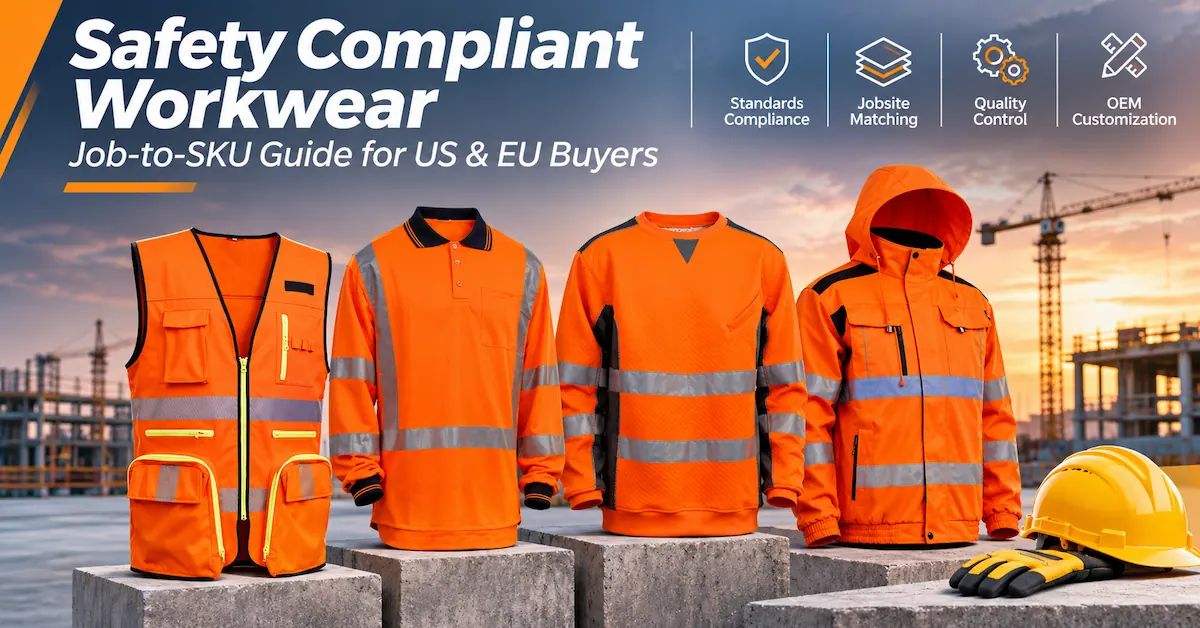
Table of Contents
-
What Does Safety Compliant Workwear Mean?
-
Why Jobsite Risk Must Come Before Product Selection
-
US vs EU Workwear Compliance Requirements
-
Build a Job-to-SKU Compliance Matrix
-
Documents Required Before Garment Approval
-
Technical Specifications and Material Selection
-
Compare Workwear Options by Job Function
-
OEM Customization and Compliance Changes
-
Production Quality Control and Traceability
-
Managing Compliance After Delivery
-
Bulk Order Costs, MOQ and Lead Times
-
AOKE's Industrial Workwear Capabilities
-
Request for Quotation Checklist
-
Frequently Asked Questions
-
Conclusion
1. What Does Safety Compliant Workwear Mean?
Safety compliant workwear refers to occupational clothing that meets the applicable protective requirements for its intended workplace and market.
It is not a single internationally recognized certification category.
A garment must be evaluated against the specific hazards it is intended to address.
For example:
-
High-visibility clothing addresses worker conspicuity.
-
Flame-resistant clothing addresses specified thermal hazards.
-
Arc-rated clothing addresses relevant electric arc thermal exposure.
-
Rain-protective clothing addresses defined wet-weather conditions.
-
General industrial uniforms may provide durability and identification without qualifying as specialized PPE.
The distinction matters because ordinary industrial clothing is not automatically certified protective clothing.
A branded polo shirt, reflective jacket, or fluorescent safety vest may be suitable for certain duties, but a buyer must verify any applicable protective claims.
Who Needs This Procurement Framework?
This approach is particularly useful for:
-
PPE distributors supplying multiple industries
-
Industrial uniform purchasing departments
-
Construction and logistics contractors
-
Road maintenance and municipal service providers
-
Private-label safety clothing brands
-
Importers selling into different national markets
It is less appropriate as a substitute for specialist hazard engineering or a formal workplace PPE assessment. Those decisions must be made by qualified personnel responsible for safety.
2. Why Jobsite Risk Must Come Before Product Selection
The most common purchasing mistake is selecting a garment first and attempting to establish its suitability afterward.
A better approach starts with the job.
Five Questions to Ask Before Choosing Workwear
1. What hazards are present?
Consider moving vehicles, forklifts, outdoor traffic, machinery, weather, thermal exposure, and other relevant risks.
2. What is the working environment?
Document whether employees work indoors, outdoors, at night, in rain, or across multiple locations.
3. Which protective characteristics are required?
Identify whether the task requires high visibility, weather protection, or another specialized protective function.
4. Which regulations, standards, and customer requirements apply?
Check the destination market and the specific employer or contract requirements.
5. What is the complete wearing configuration?
Determine whether employees wear the garment over jackets, under equipment, or with other PPE that could affect its protective function.
Example: Warehouse vs Road Maintenance
A warehouse employee may work near forklifts in a controlled industrial environment.
A roadside maintenance employee may be exposed to traffic, changing light conditions, and adverse weather.
Both roles may require high-visibility clothing, but the relevant selection criteria can differ.
The employer's hazard assessment should determine the required protection rather than assuming every worker needs the same vest or jacket.
3. US vs EU Workwear Compliance Requirements
International buyers should maintain separate market requirements instead of using one generic compliance checklist for every destination.
US and EU Workwear Compliance Comparison
| Requirement | United States | European Union |
|---|---|---|
| Regulatory framework | Applicable OSHA requirements and sector-specific rules | Regulation (EU) 2016/425 for PPE placed on the market |
| High-visibility standard | ANSI/ISEA 107-2020 | EN ISO 20471:2013+A1:2016 |
| Performance designation | Relevant Type and Performance Class | Applicable high-visibility clothing class |
| Product evidence | Appropriate tests, identification and conformity support | Applicable conformity assessment, technical documentation and EU Declaration of Conformity |
| Marking | Required labels and applicable standards information | CE marking and other required PPE information |
| Buyer responsibility | Confirm workplace suitability and applicable obligations | Confirm appropriate product conformity and economic-operator obligations |
These are reference frameworks, not interchangeable certifications.
United States: OSHA and ANSI/ISEA 107
OSHA's general industry PPE requirements under 29 CFR 1910.132 include workplace hazard assessment, appropriate equipment selection, fit, maintenance, and relevant employee training.
For high-visibility safety apparel, ANSI/ISEA 107-2020 specifies performance requirements and designations based on expected use settings and garment characteristics.
Its Type categories include:
-
Type O: Off-road occupational environments
-
Type R: Roadway and temporary traffic-control environments
-
Type P: Public safety applications
The applicable performance class must be determined from the relevant requirements and product design.
An ANSI designation should not be inferred from fluorescent color or reflective tape alone.
European Union: PPE Regulation and EN ISO 20471
Regulation (EU) 2016/425 establishes requirements for PPE placed on the European Union market.
Where applicable, manufacturers must complete the required conformity assessment and provide the relevant documentation and marking.
EN ISO 20471 addresses high-visibility clothing, including background material, retroreflective performance, minimum material areas, and placement.
Important: A garment's conformity evidence must correspond to its actual style, materials, relevant size range, and approved configuration.
What About ISO 13688?
ISO 13688:2013, including its 2021 amendment, addresses general protective clothing requirements such as ergonomics, sizing, marking, and information supplied by the manufacturer.
It is intended to be used alongside relevant protective-performance standards, not as a standalone certificate proving protection against a particular hazard.
Buyers should also verify the current applicable editions and national requirements before completing an order.
4. Build a Job-to-SKU Compliance Matrix
A Job-to-SKU Compliance Matrix connects workplace requirements to individual garment specifications and supporting evidence.
Instead of approving a supplier's entire product catalog, procurement teams approve specific styles for specific uses.
Example Job-to-SKU Mapping Table
The following is an illustrative purchasing framework. Protective requirements and final approval statuses must be established separately for each workplace.
| Job Function | Potential Garment Solution | Critical Verification | Approval Status |
|---|---|---|---|
| Indoor warehouse operations | High-visibility vest or polo | Required visibility, fit, task compatibility | Pending hazard review |
| Road maintenance | High-visibility jacket or vest | Applicable market designation, traffic exposure, finished-garment evidence | Pending verification |
| Outdoor logistics | Reflective rain jacket | Visibility plus required weather performance | Pending verification |
| Municipal field services | High-visibility outerwear | Visibility, coverage, weather and role-specific needs | Pending verification |
| Electrical maintenance | Specialized protective clothing | Applicable electrical and thermal hazard requirements | Specialist assessment required |
What Should Each Approved SKU Record Contain?
A useful compliance register should link:
Jobsite → Hazard Assessment → Required Standard → Garment SKU → Approved Design → Supporting Documents → Production Revision
For example, a procurement record might include:
-
Site: Distribution Center A
-
Job role: Forklift-area operator
-
Garment reference: HV-VEST-01
-
Required visibility designation: As determined by site assessment
-
Approved color and size range
-
Applicable test and conformity records
-
Supplier and manufacturing location
-
Approved artwork revision
-
Product approval date
-
Reorder and inspection requirements
This system makes it easier to identify whether the correct product is being purchased, particularly when multiple suppliers or departments use different product descriptions.
5. What Documents Are Needed Before Approving Safety Workwear?
A generic company certificate does not establish that every garment supplied by a manufacturer is suitable for a particular protective application.
Buyers should request product-specific documentation.
Safety Workwear Documentation Checklist
| Document | What to Verify |
|---|---|
| Product technical specification | Exact model, materials, construction and intended use |
| Applicable test reports | Identified garment or materials and relevant tests |
| Conformity documentation | Correct product, market, standard and assessment scope |
| Material specification | Fabric composition, color, reflective components |
| Size chart | Approved measurements and tolerances |
| Artwork approval | Logos, print position and method |
| Care instructions | Required cleaning and maintenance information |
| Manufacturing records | Relevant production version and traceability |
| Inspection records | Agreed workmanship and performance checks |
For EU PPE, additional regulatory documents may be required depending on the product category and applicable conformity assessment procedure.
Why Exact Model Identification Matters
A test report may cover only a particular fabric, garment design, or range of configurations.
Changing the style, reflective material, or layout can introduce questions about whether the original evidence remains applicable.
The buyer should verify the evidence for the finished product being ordered—not simply the supplier's general capability.
6. Technical Specifications: What Makes Workwear Suitable for Industrial Use?
A complete garment specification includes protective performance, usability, durability, and manufacturing requirements.
Technical Specification Matrix
| Specification | Procurement Consideration |
|---|---|
| Background fabric | Approved material, color, structure and performance |
| Reflective material | Verified component properties, width and placement |
| Garment design | Required coverage and arrangement |
| Size range | Suitability across the intended workforce |
| Seams and stitching | Durability and construction quality |
| Closures | Appropriate operation and compatibility |
| Pockets | Functionality without compromising required features |
| Branding | Effect on visibility and approved design |
| Care requirements | Applicable laundering and maintenance limits |
| Labeling | Correct model, instructions and required conformity information |
Why Fit Is a Compliance Issue
A garment that is too small may restrict movement or provide inadequate coverage.
An oversized garment can create unnecessary snagging or operational difficulties.
For high-visibility clothing, the approved garment configuration and relevant material areas must be considered across the size range.
Workers should be able to move, bend, reach, and operate their equipment without defeating the garment's intended protective function.
Does Material Weight Determine Compliance?
No.
Fabric weight may affect comfort, durability, and suitability for a particular climate, but it does not independently establish protective performance.
Buyers should prioritize verified specifications and testing over general claims such as “heavy-duty,” “premium,” or “industrial grade.”
7. Compare Safety Workwear Styles by Job Function
Different garment types can address different operational requirements.
The following AOKE products provide design references for procurement discussions. They should not be treated as automatically approved for a specific protective classification without corresponding documentation.
Workwear Style Comparison
| AOKE Product Reference | Style | Typical Evaluation Focus |
|---|---|---|
| LXE008 | Reflective safety vest | Visibility layout, pockets, sizing and task compatibility |
| LXA012 | Reflective polo shirt | Warm-weather comfort, reflective configuration and mobility |
| LXA015 | Reflective sweatshirt | Cooler-weather use, fit and visibility |
| LXA020 | Reflective work jacket | Outdoor outerwear design, coverage, closures and layering |
Buyers can review the LXE008 safety vest, LXA012 reflective polo, LXA015 reflective sweatshirt, and LXA020 reflective jacket.
Which Style Should Buyers Choose?
A vest may offer a lightweight solution where appropriate.
A reflective polo can offer an alternative for warmer working conditions.
A sweatshirt or outer jacket may be more useful in cooler or outdoor environments.
However, the final choice must be based on the required protective performance and verified garment configuration, not the style name.
For more detailed supplier evaluation, see AOKE's High Visibility Workwear Supplier Qualification Guide.
8. OEM Customization: When Can a Design Change Affect Compliance?
Customized industrial workwear is often required for company identity, employee recognition, and uniform program consistency.
Common options include logos, color combinations, size grading, labels, pockets, and garment construction changes.
However, a modified garment is not necessarily equivalent to its original approved configuration.
OEM Change-Control Matrix
| Customization | Potential Compliance Concern | Recommended Action |
|---|---|---|
| Large printed logo | Reduction of qualifying visible material | Review artwork and relevant material areas |
| New dark fabric panels | Changes to background material coverage | Recheck applicable design requirements |
| Different reflective tape | Altered reflective performance | Verify material specification and evidence |
| Modified sleeves | Changes in garment coverage | Review finished-garment configuration |
| New pocket position | Interference with required materials | Review revised construction |
| Alternative fabric | Different protective performance | Evaluate need for additional testing |
| New garment label | Incorrect product or standard information | Verify required markings |
Special Consideration for Private-Label PPE
Under Regulation (EU) 2016/425, importers or distributors can assume manufacturer obligations in certain circumstances, including when PPE is marketed under their own name or trademark or modified in ways that may affect compliance.
Therefore, private-label buyers should review their applicable legal responsibilities before approving changes.
The safest commercial process is to freeze the approved technical specification before bulk production and document every subsequent modification.
9. How Should Manufacturers Control Production Consistency?
Consistent manufacturing is essential when approved workwear is reordered across multiple sites.
Buyers should agree on quality-control checkpoints with their supplier.
Recommended Quality-Control Process
Incoming material inspection: Confirm that fabrics, reflective components, and other materials match approved references.
Cutting and assembly: Check pattern accuracy, garment construction, and material placement.
In-process inspection: Identify workmanship defects and changes from the approved sample.
Final inspection: Verify measurements, appearance, labels, packaging, and agreed acceptance criteria.
Performance verification: Complete applicable product testing or conformity checks according to the approved plan.
Shipment traceability: Maintain records linking production batches to the corresponding specifications.
Why Ordinary AQL Inspection Is Not Enough
AQL sampling can support workmanship inspection, but it does not automatically establish protective conformity.
Where product performance is safety-critical, buyers need appropriate evidence beyond appearance checks.
If a product fails a required protective criterion, the supplier and buyer should investigate the affected lot and determine the necessary corrective action before release.
10. How to Maintain Compliance After Delivery
Workwear approval should continue beyond the first shipment.
Garments may become unsuitable due to damage, contamination, excessive wear, inappropriate laundering, or changes to workplace conditions.
Post-Delivery Management Checklist
-
Ensure employees receive correctly sized garments.
-
Follow the manufacturer's care and maintenance instructions.
-
Replace damaged or unsuitable protective clothing.
-
Check whether new workplace hazards require different PPE.
-
Review garments when company branding changes.
-
Confirm that repeat orders match the approved specification.
-
Maintain records of product revisions and relevant conformity documents.
What Happens When an Approved SKU Changes?
Suppose a supplier replaces the original reflective material because it becomes unavailable.
The purchasing team should not automatically approve the substitution.
Instead, it should determine whether the change affects the applicable specification, test evidence, and conformity documentation.
Where necessary, the revised garment must be assessed before shipment.
This is especially important for multi-year uniform programs in which an original product may be reordered many times.
11. Bulk Safety Workwear Procurement: Cost, MOQ and Lead Time
The lowest unit price is not always the lowest total purchasing cost.
When comparing suppliers, buyers should include product approval, testing, inspection, reorders, and replacement risks.
Total Procurement Cost
Total Cost = Garment Price + Required Testing + Inspection + Customization + Freight + Replacement and Reorder Costs
Important pricing variables include:
-
Garment material and complexity
-
Required protective performance
-
Reflective components
-
Size range and order distribution
-
Branding requirements
-
Sample development and approval
-
Testing and documentation
-
Production volume and delivery schedule
How Does MOQ Affect Compliance?
A low MOQ may support pilot orders or small workforce programs.
However, a specialized fabric, new garment construction, or additional conformity assessment may require different manufacturing arrangements.
MOQ should be confirmed for the exact product and customization scope.
What Should Buyers Ask About Lead Time?
Request separate schedules for:
-
Technical review and quotation
-
Sample development
-
Required testing or conformity review
-
Material preparation
-
Bulk production
-
Final inspection and shipping
Do not apply a generic advertised delivery promise to every custom PPE project.
12. AOKE's Manufacturing Capabilities for Safety Workwear Buyers
Jinhua Aoke New Materials Co., Ltd. specializes in reflective clothing and industrial workwear manufacturing.
According to the company's published information, AOKE operates manufacturing facilities in Jinhua, Chongqing, and Myanmar, with capabilities supporting garment production, sampling, and customization.
Its product portfolio includes reflective safety vests, polo shirts, sweatshirts, jackets, and other industrial clothing styles.
AOKE also publicly references international safety clothing standards and quality-management activities.
However, buyers should verify the relevant product-specific documents before treating any individual style as compliant with a particular standard or market requirement.
What Can AOKE Help Buyers Evaluate?
Procurement discussions can cover:
-
Garment styles and application requirements
-
Reflective material and fabric specifications
-
OEM branding and design options
-
Sizing and sample approval
-
Production and quality-control arrangements
-
Required documentation and technical feasibility
-
Bulk order quantities and delivery planning
Explore AOKE's Reflective Clothing Product Collection for available style references.
13. Safety Compliant Workwear RFQ Checklist
A complete request for quotation helps buyers communicate the intended application and avoid comparing unsuitable products.
| RFQ Field | Required Information |
|---|---|
| Destination market | US, EU country or other market |
| Worksite and job role | Industry, duties and exposure conditions |
| Hazard assessment | Relevant workplace risks |
| Garment type | Vest, polo, sweatshirt, jacket or other style |
| Required standard | Applicable designation, edition and class |
| Materials | Fabric and component requirements |
| Size distribution | Quantities by size |
| Customization | Logo, colors, pockets and labeling |
| Evidence | Test reports and conformity documentation |
| Order volume | Initial and expected repeat quantity |
| Quality control | Inspection and acceptance requirements |
| Delivery | Destination, schedule and commercial terms |
How to Start a Technical Purchasing Inquiry
Send the supplier the workplace application, target market, garment requirements, expected quantity, and available safety specification.
If the required protective class has not yet been determined, request technical information but obtain the necessary hazard assessment and professional approval before final product selection.
Explore AOKE Industrial Workwear
Contact AOKE for a Custom Workwear Quotation
14. Frequently Asked Questions
1. What is safety compliant workwear?
Safety compliant workwear is occupational clothing that meets the applicable protective requirements for its intended workplace and market. The necessary evidence depends on the specific hazard and garment type.
2. Does all industrial workwear require PPE certification?
No. Ordinary work uniforms and specialized protective clothing have different purposes. Whether PPE conformity obligations apply depends on the product's intended protective function and relevant requirements.
3. Is ANSI/ISEA 107 equivalent to EN ISO 20471?
No. Both address high-visibility clothing, but they have different designation systems and market applications. Buyers should verify compliance separately.
4. What is the difference between Type R and Type O safety apparel?
Under ANSI/ISEA 107, these designations relate to different expected use environments. Type R concerns roadway-related activities, while Type O addresses certain off-road occupational settings.
5. Does CE marking prove a garment meets every safety standard?
No. CE marking indicates conformity with applicable EU legislation. Buyers must review the product's intended protection, supporting declaration, relevant conformity assessment, and documentation.
6. Can a custom logo affect high-visibility compliance?
Yes. Large logos or other design modifications may affect qualifying visible material areas or the approved garment configuration. Changes should be reviewed before production.
7. What documentation should a workwear supplier provide?
Depending on the product and destination market, buyers may need technical specifications, applicable test reports, conformity documents, labeling details, care instructions, and production traceability records.
8. Can one garment be approved for multiple worksites?
Possibly, if it meets the relevant requirements for each location and use. A workplace hazard assessment should determine suitability rather than assuming that one approved SKU works everywhere.
9. How should buyers manage compliant workwear reorders?
Maintain an approved product reference, documented specifications, material details, artwork revision, and relevant test evidence. Review changes before releasing repeat orders.
10. How can I request safety compliant workwear from AOKE?
Contact AOKE with your target market, workplace requirements, garment preferences, expected quantity, customization needs, and documentation expectations. The company can then confirm suitable product options and project-specific manufacturing arrangements.
15. Conclusion
Sourcing safety compliant workwear requires a clear connection between the workplace, the intended protective function, and the exact garment being purchased.
For US and EU buyers, the most reliable approach is to begin with a hazard assessment, identify the applicable requirements, verify product-level evidence, and approve a documented garment specification before bulk production.
A Job-to-SKU Compliance Matrix helps procurement teams maintain this connection across multiple sites, employee roles, suppliers, and repeat orders.
It also reduces the risk of undocumented substitutions, unsuitable customization, inaccurate product claims, and inconsistent purchasing decisions.
For PPE distributors, industrial contractors, and private-label workwear brands, a disciplined approval process supports clearer supplier communication and more reliable long-term procurement.
AOKE offers reflective clothing manufacturing and customization capabilities for international B2B buyers.
Businesses developing industrial safety workwear programs can contact the team to discuss available styles, required specifications, relevant technical documents, sample development, and bulk order planning.
View AOKE Reflective Clothing Products
Contact AOKE for Safety Workwear Development and Bulk Pricing