TL;DR: Effective cold weather workwear solutions for multi-shift operations require more than selecting suitable winter jackets. Procurement teams must determine how many garments each employee needs, allocate sizes accurately, coordinate laundering and replacements, and maintain enough inventory to support ongoing operations. A role-based uniform kit system, supported by clear specifications and reorder controls, helps industrial buyers reduce shortages, unnecessary stock, and inconsistent replacement orders.
For logistics companies, construction contractors, municipal services, and industrial facilities, winter workwear purchasing becomes complicated when employees operate across multiple shifts, departments, or locations.
Some workers spend most of their shifts outdoors. Others repeatedly move between indoor and outdoor environments. These differences affect clothing requirements, distribution quantities, cleaning arrangements, and replacement frequency.
This guide explains how to create a practical winter uniform allocation program, calculate purchasing quantities, manage inventory, and prepare repeatable OEM orders.
1. Key Takeaways for B2B Winter Workwear Buyers
-
Allocate by job role: Employees with different working patterns may require different clothing kits.
-
Calculate total garment requirements: Account for initial employee issue, laundering rotation, replacements, and spare inventory.
-
Verify sizes before ordering: Employee measurements and approved garment specifications are more reliable than estimated size ratios.
-
Track inventory by garment and size: A sufficient total stock quantity does not guarantee availability in every required size.
-
Plan replenishment early: Use historical issue rates, supplier lead times, and seasonal demand forecasts.
-
Maintain consistent specifications: Repeat orders should follow approved material, sizing, branding, and quality requirements.
The main objective is to build a manageable clothing program rather than repeatedly purchasing winter garments whenever shortages occur.
2. Why Is Multi-Shift Winter Workwear Management Different?
A single-department uniform order may involve one jacket style, a limited size range, and straightforward distribution.
Multi-shift operations create additional challenges.
Employees may work different schedules, share storage facilities, move between locations, or require garment replacements at different intervals.
Common Procurement Problems
| Operational Challenge | Potential Consequence | Recommended Control |
|---|---|---|
| Different job requirements | Incorrect garment allocation | Role-based kit definitions |
| Inaccurate employee size data | Excess returns and unused stock | Individual size confirmation |
| Multiple work shifts | Distribution confusion | Shift-specific issue records |
| Repeated laundering | Temporary clothing shortages | Defined garment rotation |
| Seasonal recruitment | Unexpected demand | Workforce forecast |
| Damaged or lost clothing | Emergency purchasing | Replacement inventory |
| Supplier material changes | Inconsistent uniforms | Approved technical specifications |
A procurement manager should understand not only how many employees need clothing but also how the clothing will be issued, maintained, and replaced.
Safety Requirements Still Come First
Uniform allocation does not replace workplace cold-risk assessment.
OSHA and NIOSH recommend appropriate clothing, dry garments, warm rest areas, training, and other measures for reducing cold-stress risks.
Where high visibility or certified cold protection is required, the actual garment configuration and supporting documentation must be verified before issue.
For a detailed explanation of thermal materials, protective standards, and manufacturing selection, see AOKE's existing Winter Workwear Manufacturer Guide.
This article focuses on the operational purchasing and distribution process.
3. How Should Companies Design Winter Workwear Kits by Job Role?
The first purchasing decision is determining which employee groups can use the same clothing configuration.
A useful approach is to establish standardized kit categories.
Role-Based Winter Uniform Kit Matrix
| Employee Group | Typical Work Pattern | Suggested Kit Configuration | Allocation Priority |
|---|---|---|---|
| Warehouse loading teams | Frequent indoor/outdoor movement | Base garments, removable insulation, suitable outer jacket | Flexibility and rotation |
| Utility maintenance teams | Outdoor work with changing activity | Base garments, interchangeable mid-layers, protective outerwear | Mobility and compatibility |
| Road maintenance teams | Vehicle exposure and changing weather | Approved high-visibility outerwear with appropriate underlying garments | Visibility and correct issue |
| Stationary outdoor personnel | Long periods of limited movement | Risk-assessed cold-protective clothing configuration | Appropriate protection and replacement |
| Supervisors and inspectors | Shorter outdoor visits | Approved weather-appropriate uniform kit | Consistent availability |
These are proposed procurement categories, not certified clothing ensembles or universal protection recommendations.
Define a Kit Code for Each Role
For easier inventory management, assign internal identification codes.
For example:
-
WK-A: Active-shift winter clothing kit
-
WK-B: Mixed-activity winter clothing kit
-
WK-C: Assessed extended-exposure clothing kit
Each code should connect to a controlled list of garments, approved sizes, quantities, materials, and any applicable protective requirements.
This makes purchasing easier when employees change roles or new workers join the company.
4. How Many Winter Workwear Garments Should Each Employee Receive?
A common mistake is ordering one jacket per employee and assuming the uniform program is complete.
Actual garment requirements depend on the company's issue policy, laundering arrangements, replacement needs, and workplace conditions.
Basic Allocation Formula
Required Order Quantity = Initial Employee Issue + Planned Spare Stock + Forecast Replacements − Usable Existing Inventory
Calculate the requirement separately for every garment category and size.
For example, a company may decide to issue one outer jacket per employee but provide additional interchangeable garments for laundering rotation.
This is an inventory-management decision, not a universal clothing safety standard.
Illustrative Example: 180 Employees
Consider a company with 180 employees distributed across three groups.
| Employee Group | Employees | Base Garments per Employee | Mid-Layers per Employee | Outer Jackets per Employee |
|---|---|---|---|---|
| Loading teams | 90 | 2 | 1 | 1 |
| Maintenance teams | 60 | 2 | 2 | 1 |
| Outdoor stationary teams | 30 | 2 | 2 | 1 |
| Total employees | 180 |
The quantities in this example represent a hypothetical company issue policy. They are not AOKE product specifications or recommended protection levels.
Calculate the Initial Issue
Base garments:
180 employees × 2 = 360 garments
Mid-layers:
(90 × 1) + (60 × 2) + (30 × 2) = 270 garments
Outer jackets:
180 employees × 1 = 180 jackets
The initial program therefore includes 810 individual garment units across three categories.
Add a Planning Buffer
Suppose the company chooses a hypothetical 5% spare-stock allowance, rounded up to whole garments.
| Garment Category | Initial Issue | Illustrative Spare Stock | Opening Purchase |
|---|---|---|---|
| Base garments | 360 | 18 | 378 |
| Mid-layers | 270 | 14 | 284 |
| Outer jackets | 180 | 9 | 189 |
| Total | 810 | 41 | 851 |
The 5% allowance is only a calculation example. Real spare-stock requirements should reflect the rate of garment replacement, lead times, employee turnover, laundering arrangements, and the demand for individual sizes.
Where a garment provides mandatory protection, spare stock must meet the relevant requirements rather than simply follow a general inventory percentage.
Procurement insight: Calculate every garment category separately. A single total kit quantity cannot explain how many different components the company needs.
5. How Can Buyers Avoid Winter Workwear Sizing Problems?
Incorrect size allocation is one of the most preventable causes of uniform waste.
Winter garments must also accommodate the approved clothing worn underneath.
Use Employee Measurements Instead of Guesswork
Before confirming production, collect the required garment measurements or approved size selections from employees.
Relevant measurements may include chest circumference, garment length, sleeve length, shoulder dimensions, and other measurements defined by the garment specification.
Create a Size Allocation Table
| Employee Group | Confirmed Sizes | Outerwear Quantity | Additional Components |
|---|---|---|---|
| Loading teams | Employee-specific records | Based on 90 employees | According to WK-A |
| Maintenance teams | Employee-specific records | Based on 60 employees | According to WK-B |
| Stationary teams | Employee-specific records | Based on 30 employees | According to WK-C |
The company should then consolidate quantities by style, size, and location.
For example, 180 jackets across four locations may require four separate packing allocations even if all jackets use the same design.
Verify Fit Across Garment Combinations
Sample approval should consider movement, sleeve length, comfortable closures, and compatibility with underlying garments and other PPE.
Size labels alone are insufficient because measurements can differ between manufacturers.
In high-visibility clothing programs, buyers should also confirm that the required garment design and conformity evidence remain valid for the ordered sizes.
6. How Should Laundering Rotation Affect Winter Uniform Quantities?
Cleaning requirements can influence how many garments a company needs.
Some employees may need replacement clothing while used garments are being cleaned, dried, or inspected.
However, laundering frequency and acceptable cleaning methods depend on the materials, workplace conditions, and manufacturer's instructions.
Three Common Distribution Models
| Distribution Model | How It Works | Suitable Situation |
|---|---|---|
| Individual ownership | Employees retain assigned garments | Stable workforce with personal uniform issue |
| Centralized garment rotation | Garments are collected, processed, and reissued | Managed uniform programs |
| Hybrid distribution | Personal outerwear plus centrally managed replacement stock | Multi-site industrial operations |
The correct system depends on hygiene requirements, garment condition, protective performance, and operational procedures.
Track Garment Availability
A useful inventory status system includes:
-
Available and approved for issue
-
Issued to employee
-
Awaiting cleaning
-
Under inspection
-
Damaged or awaiting replacement
-
Withdrawn from service
Protective garments should not be returned to circulation if damage, contamination, or failed inspection makes them unsuitable.
Why Rotation Planning Matters
Without accurate tracking, a warehouse may report sufficient garment inventory even though several items are unavailable because they are being cleaned or inspected.
Procurement teams should distinguish physical inventory from usable, available inventory.
This distinction helps prevent unexpected shortages during busy winter periods.
7. How Do You Calculate Winter Workwear Reorder Points?
Seasonal replenishment should be based on actual garment demand and realistic supplier lead times.
A basic inventory formula is:
Reorder Point = Average Weekly Garment Issues × Replenishment Lead Time in Weeks + Safety Stock
Example Reorder Calculation
Assume an industrial facility uses an average of four replacement jackets per week.
Its agreed replenishment lead time is six weeks, and the company maintains ten jackets as safety stock.
Reorder Point = (4 × 6) + 10 = 34 jackets
Under those assumptions, the company should consider placing its replenishment order when the relevant inventory position reaches approximately 34 jackets.
This is an illustrative formula, not a confirmed AOKE lead time or recommended safety-stock level.
Track Reorder Points by Size
A total inventory of 34 jackets does not prevent shortages if most available jackets are in sizes employees rarely request.
Each high-demand size may need a separate reorder threshold.
For multi-location operations, procurement teams should also decide whether spare stock will be held centrally or at individual sites.
Consider Seasonal Demand
New employee onboarding, workforce expansion, unusually severe weather, and project launches can create temporary increases in demand.
Historical issue data should therefore be reviewed alongside future staffing plans.
A reliable winter workwear replenishment strategy combines average usage, current stock condition, size distribution, production lead time, and anticipated seasonal changes.
8. How Can Multi-Site Companies Organize Garment Distribution?
Central procurement can improve consistency, but individual sites still need reliable clothing availability.
The most practical method is to use standardized kit specifications alongside location-specific distribution records.
Recommended Distribution Record
| Tracking Field | Purpose |
|---|---|
| Site or department | Identifies receiving location |
| Employee or assignment reference | Connects issue to an authorized user |
| Kit code | Identifies approved clothing configuration |
| Garment SKU | Identifies exact product |
| Size | Prevents incorrect allocation |
| Quantity | Records garments issued |
| Issue date | Supports replacement planning |
| Condition/status | Tracks availability and serviceability |
| Revision number | Identifies approved product version |
Employee information should be managed according to the organization's privacy and access-control policies.
Site-Specific Packing
For large orders, buyers may request garments packed by site, department, size, or approved kit configuration.
For example, cartons marked by kit code and location can reduce sorting work at receiving warehouses.
However, packing services and labeling options must be confirmed with the supplier during quotation.
9. What Product Specifications Must Stay Consistent Across Reorders?
A repeat winter uniform order should match the originally approved garment requirements unless changes have been formally authorized.
Product Consistency Checklist
| Specification | Required Control |
|---|---|
| Fabric | Approved composition, construction and reference |
| Garment design | Pattern and construction version |
| Size grading | Approved measurements and tolerances |
| Insulation | Approved component and arrangement |
| Color | Agreed reference and tolerance |
| Reflective materials | Approved specification and layout |
| Closures | Zipper, cuffs and fasteners |
| Branding | Logo position and artwork version |
| Care labels | Approved instructions and required information |
| Packaging | Site labels, quantities and carton identification |
Why Material Substitution Is a Risk
A replacement product may look identical to the original but use a different lining, reflective material, or fabric finish.
Such changes may affect fit, appearance, comfort, durability, or required protective performance.
Buyers should require prior approval of substitutions and determine whether additional verification is necessary.
A successful repeat order is not simply another shipment of the same-looking clothing. It is a controlled reproduction of the approved specification.
10. How Can AOKE Support OEM Winter Uniform Programs?
Jinhua Aoke New Materials Co., Ltd. focuses on reflective clothing and industrial safety workwear manufacturing.
According to its published company information, AOKE operates manufacturing facilities in Jinhua, Chongqing, and Myanmar, covering different customization and apparel production requirements.
The company also describes technical sampling facilities, garment cutting and sewing operations, and quality-control activities.
These capabilities provide a starting point for discussing customized workwear, approved garment specifications, and repeat production requirements.
Potential OEM Project Requirements
For a multi-shift winter uniform program, buyers may request:
-
Consistent jacket and sweatshirt designs
-
Defined size grading and tolerances
-
Approved fabric and color references
-
Company logos and branding
-
Department or site identification
-
Customized labeling and packaging
-
Repeat-order documentation
Available options should be confirmed for the specific product and order.
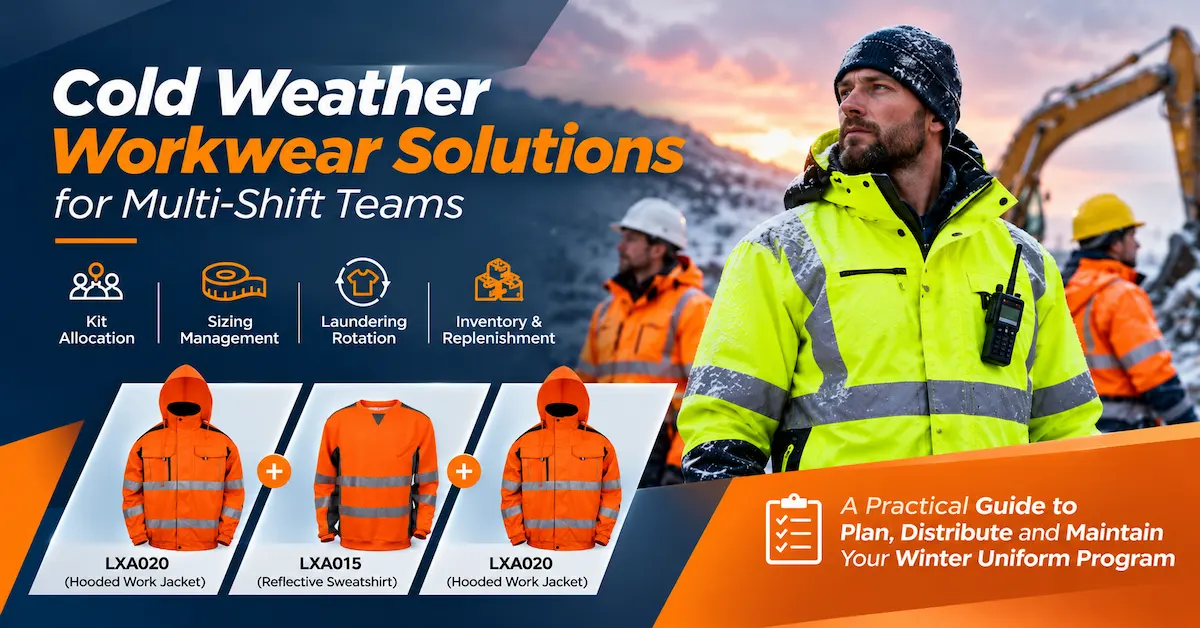
Buyers can review the AOKE reflective clothing range, including the LXA020 jacket and LXA015 sweatshirt, as starting references.
These product links do not establish a particular cold-protection classification, complete kit availability, or fixed delivery schedule.
Any additional components required for a complete employee kit should be discussed separately to confirm whether AOKE can supply them.
11. What Determines the Total Cost of a Winter Workwear Program?
The purchasing price of each garment is only one part of the financial picture.
A company also needs to consider initial distribution, cleaning, inventory holding, replacements, and additional shipping requirements.
Total Program Cost Framework
Total Winter Uniform Cost = Initial Garment Purchase + Approved Spare Stock + Inspection and Testing + Logistics + Cleaning and Handling + Replacement Purchases
| Cost Category | What Buyers Should Evaluate |
|---|---|
| Initial issue | Garments required for each employee group |
| Spare stock | Size-specific replacement availability |
| OEM customization | Logo, labels and packaging |
| Quality verification | Samples, inspections and relevant testing |
| Storage | Warehouse space and stock management |
| Laundering | Cleaning, processing and downtime |
| Replacement | Damage, loss, wear and workforce changes |
| Shipping | Initial distribution and replenishment deliveries |
The lowest unit price may not create the lowest total program cost if garments are difficult to replace, sizes are inconsistent, or repeat orders require extensive reapproval.
Useful Purchasing KPIs
Procurement teams can monitor the following operational indicators:
-
Uniform availability by size
-
Percentage of employees receiving complete kits
-
Garment replacement rate
-
Incorrect-size exchange rate
-
Average replenishment lead time
-
Emergency purchase frequency
-
Inventory held beyond the planned season
These indicators help identify whether the uniform program is meeting operational requirements.
12. How to Prepare a Multi-Shift Winter Workwear RFQ
A complete request for quotation should include more than a product image and total quantity.
| RFQ Field | Information to Provide |
|---|---|
| Buyer type | PPE importer, brand, distributor or industrial user |
| Destination market | Country and applicable requirements |
| Employee groups | Job roles, locations and shift structure |
| Clothing kits | Required garment categories and quantities |
| Size allocation | Approved size breakdown by style |
| Product specifications | Fabric, construction, measurements, components |
| Protective requirements | Relevant standards and documentation |
| OEM requirements | Logo, labels, colors and packaging |
| Initial order | Quantity by SKU and size |
| Replacement forecast | Expected seasonal demand |
| Inspection | Sample approval and acceptance requirements |
| Delivery | Required destinations and proposed schedule |
Suggested Procurement Workflow
-
Confirm workplace requirements and employee groups.
-
Establish standardized winter kit configurations.
-
Collect size data and forecast initial issue quantities.
-
Determine laundering and replacement requirements.
-
Calculate spare stock and reorder thresholds.
-
Develop and approve representative product samples.
-
Confirm materials, branding, packaging, and quality requirements.
-
Request a project-specific quotation and production schedule.
-
Organize distribution by site, kit, and size.
-
Monitor usage and update the replenishment forecast.
Explore AOKE Reflective Workwear
Request an OEM Winter Uniform Quotation
13. Frequently Asked Questions
Q1. What are cold weather workwear solutions for multi-shift teams?
Cold weather workwear solutions for multi-shift teams involve selecting suitable garments and organizing their allocation, sizing, distribution, cleaning, and replenishment across different employee groups. The objective is to maintain appropriate clothing availability while supporting consistent procurement.
Q2. How many winter workwear garments should each employee receive?
There is no universal number. The required quantity depends on the approved clothing system, laundering arrangements, replacement frequency, and workplace needs. Companies should establish an issue policy and calculate garment quantities separately for each category.
Q3. How can companies calculate winter uniform order quantities?
Start with the number of employees and the approved garment issue per person. Add planned replacement inventory and suitable spare stock, then subtract usable existing inventory. Calculate each style and size independently.
Q4. How can buyers avoid incorrect size allocation?
Collect actual employee size information, approve detailed garment measurements, evaluate fit over intended layers, and maintain separate size records for each clothing category. Do not assume identical size labels mean identical fit across manufacturers.
Q5. What is a winter workwear replenishment plan?
A replenishment plan uses historical garment issues, replacement rates, supplier lead times, and forecast demand to determine when new inventory should be ordered. Reorder points should be monitored by garment type and relevant size.
Q6. Why does laundering affect workwear inventory?
Garments being cleaned or inspected may not be immediately available for use. Companies should account for these unavailable items when calculating operational stock and follow the manufacturer's care instructions and applicable workplace requirements.
Q7. Should companies store spare winter jackets at every site?
That depends on site demand, workforce size, inventory costs, delivery arrangements, and the consequences of shortages. Some companies use central stock, while others maintain approved size-specific supplies at individual facilities.
Q8. Can AOKE provide customized winter workwear?
AOKE publicly describes reflective clothing manufacturing and garment customization capabilities. Buyers should submit their product specifications, quantities, branding requirements, and delivery needs to confirm available options for the particular program.
Q9. What information is most important for repeat winter workwear orders?
Approved material references, garment measurements, size grading, construction details, reflective components, artwork, labels, packaging, and revision records are essential for maintaining consistency.
Q10. How can B2B buyers reduce winter uniform procurement costs?
Buyers can improve efficiency by standardizing suitable garment designs, collecting accurate size data, forecasting replacements, monitoring inventory, and planning repeat orders before shortages occur. Total program cost should include cleaning, handling, logistics, and replacements.
Conclusion
Effective cold weather workwear solutions require both suitable garments and a reliable system for managing their distribution throughout the winter season.
For multi-shift industrial operations, the greatest procurement challenges often arise from incorrect kit quantities, inaccurate size allocation, unavailable replacement garments, and inconsistent repeat orders.
A structured program begins by grouping employees according to their working requirements, defining approved clothing kits, calculating initial issue quantities, and establishing reliable inventory records.
Laundering rotation, size-specific spare stock, reorder points, and controlled product specifications then help maintain garment availability across multiple departments and locations.
For PPE importers, workwear distributors, and private-label brands, these processes also create opportunities to offer customers better organized winter uniform programs rather than isolated garment purchases.
AOKE supports international B2B buyers with reflective clothing manufacturing and customization capabilities. Companies planning winter uniform programs can discuss approved garment designs, sizing requirements, OEM branding, order quantities, and repeat supply arrangements with the AOKE team.