Quick Answer: A reliable woven workwear supplier should do more than sew jackets and trousers to a reference photo. For industrial buyers, the strongest sourcing process starts with a clear jobsite brief and a controlled fabric specification, then checks fit, seams, functional details, laundering performance, sample approval, and repeat-order consistency. Before requesting a bulk quote, tell the supplier who will wear the garments, how they will be washed, which risks must be addressed, and what evidence is required. That approach makes competing offers easier to compare and prevents an attractive sample from becoming an expensive uniform-program problem.
Woven workwear is an important option for factories, engineering contractors, maintenance teams, utilities, and distributors building structured industrial-uniform collections. Yet a jacket described as “durable poly-cotton workwear” tells a purchaser surprisingly little. Two garments with similar photos can differ in fabric construction, seam reinforcement, fit after washing, color consistency, and the detail that matters most when an employee reaches, crouches, or carries tools. The difference often appears only after the first issue cycle.
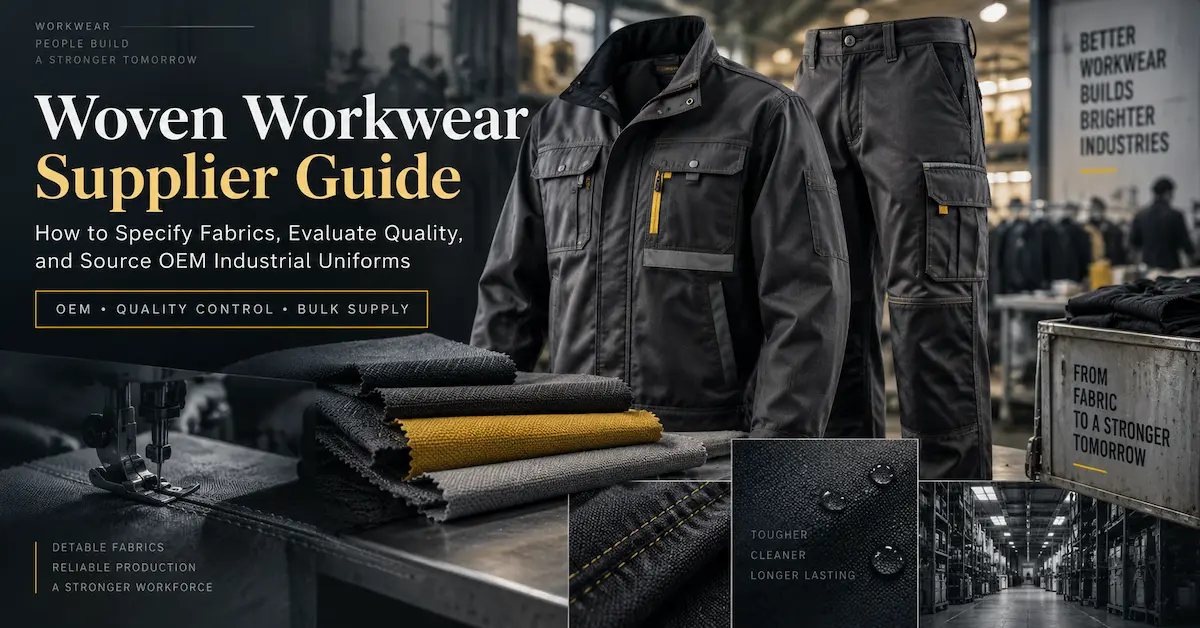
This guide is designed for procurement managers, PPE distributors, private-label workwear brands, and industrial buyers comparing manufacturers for a repeatable supply program. It covers product selection, practical textile engineering, relevant testing, supplier qualification, OEM development, cost drivers, and a ready-to-use request-for-quotation checklist. It also explains where woven workwear is not a substitute for certified protective clothing.
Planning an industrial uniform collection?
Share your garment type, target market, expected volume, fabric preferences, and delivery location for a project-specific discussion.
Request an OEM Workwear Quote →1. What Does a Woven Workwear Supplier Actually Supply?
A woven workwear supplier manufactures or sources work garments made primarily from fabrics created by interlacing lengthwise and crosswise yarns. The resulting structure can support tailored silhouettes, reinforced utility details, durable work trousers, work jackets, coveralls, shirts, and coordinated uniform sets. The weave itself is not a guarantee of abrasion resistance, flame protection, or any other safety performance; those characteristics depend on the complete material and garment specification.
Compared with many knitted garments, woven clothing often provides a more structured shape and a useful foundation for pockets, tool access, and abrasion-prone work zones. A knit polo can be better for certain warm, low-friction tasks, while woven trousers and a utility jacket may be more appropriate for technicians who repeatedly kneel, reach into cabinets, or move tools. Neither is automatically the superior choice. The working environment decides.
For B2B procurement, “supplier” can describe several different operating models. One business may offer stock uniforms, another may coordinate outsourced manufacturing, and an OEM manufacturing partner may help develop samples and manage approved specifications across production runs. Buyers should verify which work the supplier performs, where production takes place, who controls materials, and who handles corrective action when specifications are not met.
The most useful question is not simply, “Can you produce this style?” It is, “Can you demonstrate how this exact fabric, pattern, seam construction, and size set will be controlled for our expected use and reorders?”
2. Who Should Source Woven Workwear—and When Is It the Wrong Choice?
Industrial procurement teams frequently need predictable uniforms for employees operating equipment, inspecting machinery, repairing installations, or moving between workshops and outdoor sites. Their priorities include practical fit, wash durability, clear employee identification, and easy replenishment of approved sizes.
PPE and industrial-supply distributors may require multiple coordinated products for different end customers. They care about commercially viable specifications, branded packaging, consistent shades, traceable samples, and the ability to repeat an existing style without unapproved substitutions.
Private-label workwear brands need product development support: fabric selection, pattern adjustment, label placement, merchandising consistency, and quality expectations documented strongly enough to survive a second or third purchase order.
Contractors, utilities, and maintenance organizations often need trousers, jackets, and work shirts that interact properly as a uniform system. A sleeve must allow overhead reach; trouser knees must function during crouching; pocket openings must remain accessible when gloves or a tool belt are worn.
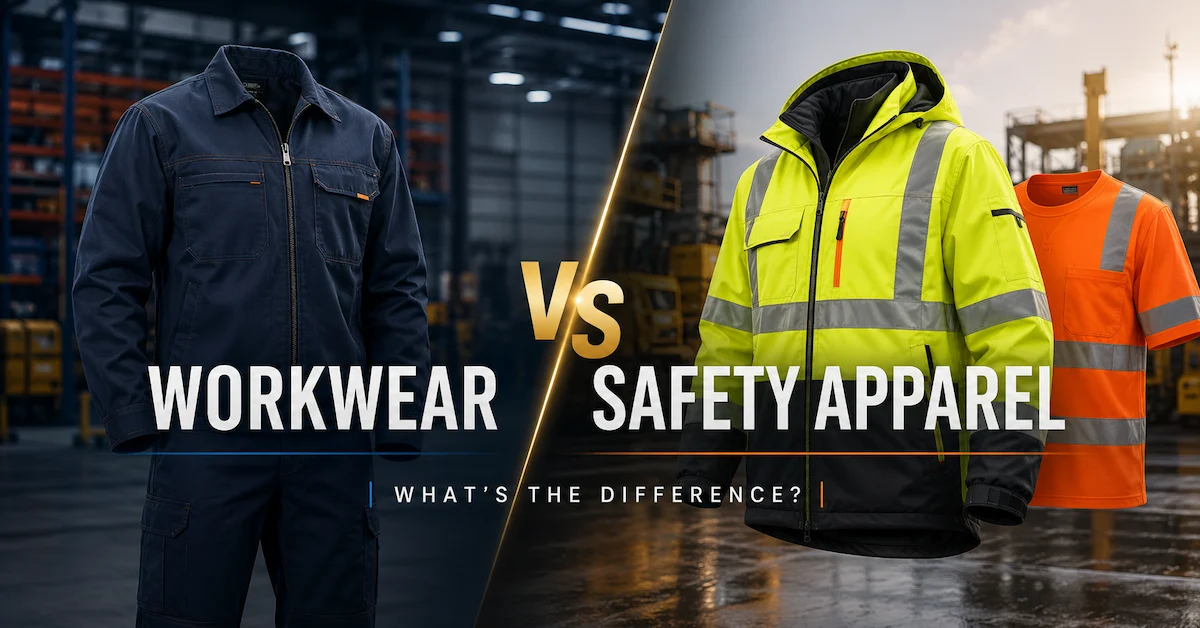
However, conventional woven workwear may be the wrong product if the task requires certified arc protection, flame resistance, chemical protection, electrical protection, or a particular high-visibility class. A garment made from a heavy fabric is not inherently flame resistant. Reflective stripes do not, on their own, establish that a garment meets a high-visibility standard. In those cases, begin with the hazard assessment and documented product-specific compliance requirements before choosing a style or material.
3. Match the Garment to the Working Environment First
The same uniform specification rarely suits every department. A maintenance technician in a clean assembly plant, a warehouse employee near forklift traffic, and an outdoor civil-engineering worker face different movement, cleaning, visibility, and weather conditions. A practical sourcing brief should record the actual tasks before specifying the garment.
| Working environment | Daily stresses and buyer concerns | Potential woven-workwear design priorities | Points to verify |
|---|---|---|---|
| Factory maintenance | Frequent bending, tool contact, oils and repeated cleaning | Utility trousers, accessible pockets, reinforced wear areas | Fabric wear, pocket attachment, wash behavior |
| Mechanical engineering | Kneeling, crawling, tool belts, awkward reach | Articulated knees, suitable rise, gussets and secure closures | Mobility in wearer trials, seam strength |
| Warehousing and logistics | Repetitive movement, indoor heat and vehicle proximity | Balanced fabric weight, comfortable sizing and optional visibility features | Comfort tests, applicable visibility requirements |
| Utilities and field service | Indoor/outdoor movement, equipment handling, changing weather | Layering-compatible jacket and trousers | Fit with other PPE, weather needs assessed separately |
| Construction support | Abrasive surfaces, dust, shared equipment | Reinforced stress zones and replaceable uniform pieces | Abrasion testing, cleaning instructions |
| Corporate industrial uniforms | Brand consistency, mixed body types, recurring orders | Stable color, graded sizes, consistent trim and labels | Shade approval, sizing tolerances, change control |
This matrix describes selection factors, not a certification claim. If workers are exposed to moving traffic or other significant hazards, procurement should consult the employer's risk assessment and the rules in the destination market. A woven uniform may form part of a clothing system, but it should never be presented as a universal substitute for task-specific PPE.
4. Start with the Fabric: Fiber, Weave, Weight, and Finish
Cotton, polyester-cotton, and engineered blends
Cotton-based woven fabrics can feel familiar and comfortable, especially where wearers value a natural-fiber hand. Polyester-cotton blends may offer a different balance of strength, drying behavior, crease recovery, and dimensional consistency. Polyester-rich compositions can be attractive for some frequently washed uniforms; cotton-rich compositions may be preferred for other comfort or finishing goals. Actual performance depends on yarns, weave, finishing, and how the finished garment is tested—not on a fiber percentage alone.
Some programs call for elastane-containing fabrics or specifically engineered mechanical stretch. Stretch can help mobility but creates new questions about recovery, heat exposure, wash durability, and compatibility with pockets or reinforcement panels. Specify the intended movement and laundering method before paying more for stretch content.
Where flame-resistant or electrostatic-control properties are required, ordinary cotton/polyester comparisons are insufficient. The purchaser must define the hazard, applicable product standard, fabric system, garment design, and supporting evidence. Do not treat an “FR-looking” woven uniform or a fabric supplier's marketing label as proof of protection.
Twill, plain weave, canvas, and ripstop
Twill is recognizable by its diagonal structure and is common in utility clothing. It can deliver a balance of drape, appearance, and abrasion behavior, but construction quality varies.Plain weave interlaces yarns in a straightforward pattern and can be suitable for certain shirts or lighter uniforms. Canvas typically suggests a sturdier hand and may suit reinforced applications, although bulk and stiffness can reduce wearer acceptance. Ripstop incorporates a reinforcing yarn pattern intended to help limit tear propagation under certain conditions; it does not mean the fabric cannot tear.
The right comparison requires actual samples and the relevant test data. A heavier canvas should not win automatically over a well-engineered lighter twill. Weight adds thermal burden, may restrict movement, and can increase shipping costs. Equally, a light fabric with an attractive hand may fail prematurely at pocket corners or knees if the garment construction is weak.
Why GSM is only one number
Fabric weight, expressed in grams per square meter (GSM), is a useful identification and costing parameter. It is not a complete measure of durability. Two fabrics with the same GSM can have different yarn strengths, weave densities, finishes, tear behavior, and abrasion results. Request fiber composition, weave, nominal GSM and tolerance, finishing information, and appropriate test evidence as a package. Then evaluate how those properties affect the actual garment.
Fabric color and finishing deserve equal attention. Workwear is often washed alongside other industrial items, exposed to sunlight, or stocked across multiple seasons. Ask about color consistency between approved lots, washing-related shade change, shrinkage, and any finish that might change with use. If a supplier proposes stain-repellent or easy-care finishing, confirm what the claim means and how it is tested after laundering.
5. A Practical Woven Workwear Specification Table for RFQs
A photograph is not a technical specification. Before comparing quotations, translate the intended garment into measurable or reviewable details. The table below is a buyer specification template, not a list of confirmed AOKE SKU specifications.
| Specification field | What the buyer should state | What the supplier should return |
|---|---|---|
| Garment type | Work jacket, trousers, coverall, shirt or coordinated set | Proposed pattern, style drawing or sample reference |
| Fabric composition | Preferred fiber blend or acceptable alternatives | Verified composition and source details |
| Fabric construction | Twill, plain weave, canvas, ripstop or performance need | Construction details and available swatches |
| Fabric weight | Target GSM and agreed tolerance | Nominal weight, tolerance and evidence |
| Color | Color code, approved swatch, expected repeatability | Lab dip or strike-off process and shade control |
| Seams and reinforcement | High-stress zones, seam expectations and pocket loads | Construction method and inspection points |
| Fit and sizing | Market size chart, grading rules, tolerances | Measurement specification and fit samples |
| Laundering | Home or industrial process, expected handling | Care label proposal and relevant test reports |
| Optional visibility | Jobsite risk, destination market, garment class if applicable | Layout proposal and product-specific compliance evidence |
| Branding and packing | Logo artwork, woven labels, hangtags and carton marks | Decoration proof and approved packaging sample |
| Order plan | Quantity by style/color/size, destination and target date | MOQ, price basis, sampling path and lead-time breakdown |
The best RFQ includes a drawing or clear reference sample and identifies which requirements are mandatory versus negotiable. That distinction matters: changing fabric weight to lower a quote may be acceptable in a basic uniform line but unacceptable where abrasion, appearance, or testing requirements have already been agreed.
Have a reference jacket or trouser sample?
Send the required fabric, garment drawing, quantity-by-size plan, and quality priorities so the quotation can address the real specification.
Discuss Your Fabric & Sample →6. Construction Quality: The Details That Control Service Life
A durable fabric can still become an unreliable uniform when the pocket corners tear, the crotch seam opens, or a zipper fails during ordinary use. For woven workwear, workmanship should be evaluated at the places where force, repeated movement, and abrasion concentrate.
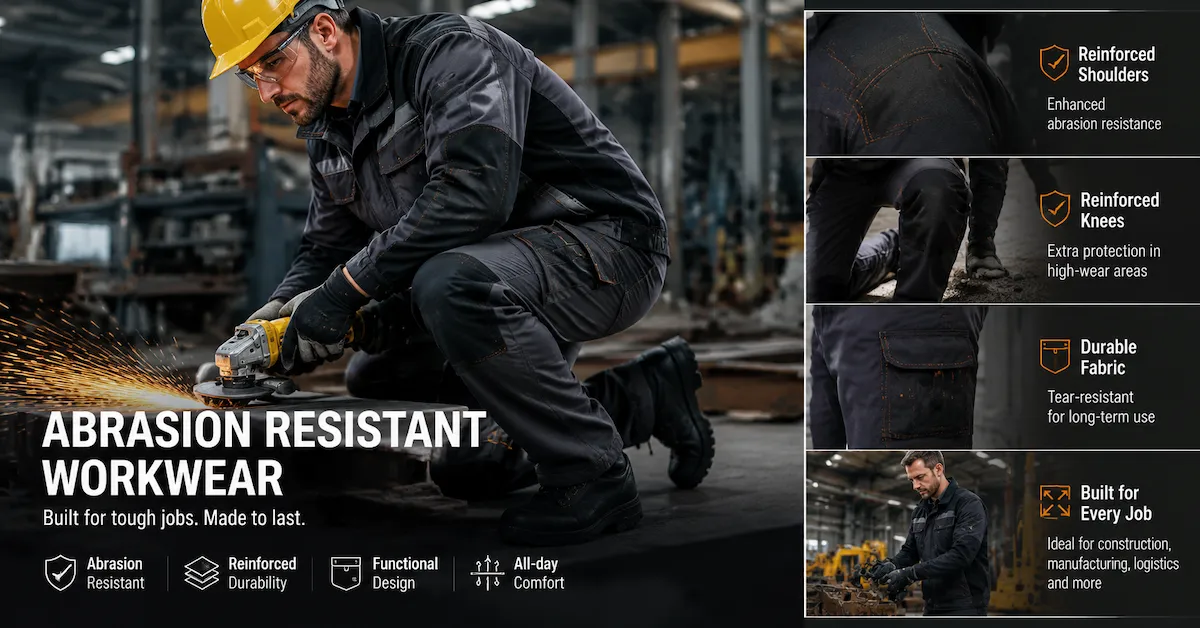
Seams and stress points. Review seam type, stitch consistency, appropriate reinforcement, and joining methods for the intended fabric. Critical locations may include the seat, crotch, knees, elbow area, armholes, pocket openings, and belt loops. A bar tack can strengthen a suitable stress point, but it is not a substitute for a sound underlying pattern or seam design.
Pockets and closures. Evaluate both purpose and position. Large pockets may seem attractive in a catalog but interfere with kneeling or create snag risks around equipment. A closure should remain usable with work gloves when that is part of the job. Buttons, zippers, snaps, and hook-and-loop elements should be selected for the operating environment and cleaning method.
Movement engineering. A trouser with the wrong rise or knee position can pull during crouching even when the waist size is correct. A work jacket may need room through the back and shoulders, yet excessive looseness can create snagging concerns. Designers should evaluate functional movement, not just a standing front-view photograph.
Reinforcement without excess bulk. Double-layer knees, reinforced tool pockets, and extra stitching may improve longevity in targeted areas. Applied indiscriminately, however, reinforcement adds weight, stiffness, heat, and cost. A good supplier should ask where the actual failures occur, then propose a construction change that addresses those failures.
If the program includes high-visibility woven garments, reflective components become an additional engineering system. Tape placement, garment coverage, flexibility, attachment durability, and performance after care all require attention under the applicable specification. See AOKE's broader reflective clothing collection for adjacent apparel categories; do not assume those listed products establish the certification status of a proposed woven uniform.
7. Compare Product Types Before Requesting a Single “Best” Fabric
Different woven garments solve different problems. B2B buyers reduce sampling time by comparing the product architecture before debating trims or minor design choices.
| Woven garment category | Main buying objective | Key design checks | Typical program fit |
|---|---|---|---|
| Industrial work trousers | Durability with movement | Crotch, knees, pockets, waistband and sizing | Maintenance and technical teams |
| Woven work jacket | Structured upper-body uniform | Shoulder movement, cuffs, front closure, pocket access | Factory engineers and field service |
| Woven work shirt | Consistent appearance at lower bulk | Breathability, placket, wash shrinkage, sleeve mobility | Light industrial and service uniforms |
| Coverall / boiler suit | Continuous body coverage and convenience | Torso length, crotch movement, entry closure, fit over layers | Selected workshops and maintenance tasks |
| Jacket-and-trouser set | Coordinated corporate identity | Fabric lot, shade, grading and compatibility | Multi-site industrial uniform programs |
| Visibility-enhanced woven set | Added conspicuity for defined tasks | Background material, retroreflective layout, applicable classification | Sites with assessed visibility needs |
A buyer who wants one supplier for multiple categories should also confirm whether the business can coordinate compatible colors, labels, sizing, and replenishment. A line of individually good products does not automatically become a consistent uniform system. For an overview of AOKE's broader product direction, see the AOKE products page.
8. Fit, Sizing, and Wearer Trials Are Procurement Controls
Fit failures are easy to overlook in online sourcing because a sample often reaches only one reviewer. Industrial uniforms must serve many body shapes and jobs.A size chart that works for a showroom mannequin may not work for technicians who frequently stretch overhead or crouch.
Start by defining the destination market, intended wearer population, whether the garments are worn over other layers, and the measurement points that matter. For trousers, these can include waist, hip, inseam, rise, thigh and knee position. For jackets, consider chest, shoulder, sleeve, body length, and range of movement. Specify tolerances and a size-grading approach in the approved technical pack.
Do not evaluate a pattern only while the wearer stands still. Use a simple trial: reach forward and overhead, bend, kneel, sit, climb a step, and access tools. Ask participants where a garment binds, rides up, or catches. When tasks involve machines, the trial should also review whether loose straps or pockets create potential snagging hazards.
After washing, measure the same key points again using an agreed method. If a fabric shrinks or a seam puckers, a technically correct prewash size can become an unacceptable delivered garment after normal use. A supplier should document the tested care process and the acceptance criteria agreed with the customer rather than stating that the clothing is “shrink-proof.”
9. Standards and Testing: Separate General Uniforms from Certified PPE
The distinction between ordinary industrial uniforms and protective clothing is fundamental. Workwear used for appearance, basic utility, or everyday wear is not automatically regulated as certified PPE. Specific hazards can trigger requirements for protective garments and the relevant standards of the destination market.
ISO 13688 addresses general requirements for protective clothing, including matters such as ergonomics, sizing and information supplied with the garment. It is not a stand-alone claim that a work jacket protects against flame, chemicals, or traffic exposure. Specific protective requirements must be addressed separately.
ISO 15797 defines industrial washing and finishing procedures that can be used when assessing workwear intended for industrial laundering. It is particularly relevant when uniforms return to a commercial laundry service rather than being washed at home. ISO 6330 sets out domestic washing and drying procedures for textile testing, while ISO 105-C06 addresses color fastness to laundering under defined test conditions. A test method describes how to evaluate a property; it does not, by itself, certify a finished garment as suitable for every use.
If a buyer needs high-visibility protection, standards such as EN ISO 20471 or ANSI/ISEA 107 may be relevant depending on market, hazard and product classification. Performance depends on the garment as a whole, not simply the presence of bright material or reflective strips. Other industrial hazards may require separate certified systems, which cannot be inferred from ordinary woven fabric construction.
The correct sourcing sequence is: establish risk and market obligations, identify the applicable standard and version, agree on garment-level requirements, then request product-specific certificates or accredited test information where appropriate. General certification logos on a factory profile are not proof that every custom SKU meets every listed standard.
10. Build a Testing Plan That Matches the Actual Risk
Testing should target the most important failure modes for the proposed program. Not every uniform needs the same test package, but a quote should make clear which evaluations are included, which are optional, and who pays for third-party laboratory work.
| Performance question | Possible evaluation approach | Buyer decision supported |
|---|---|---|
| Will the fabric resist repeated rubbing? | Relevant abrasion method, agreed test conditions and acceptance result | Compare durability options for contact-heavy jobs |
| Will a seam open under normal movement? | Seam-strength or seam-slippage evaluation suited to material and construction | Select reinforcement and seam design |
| Will trousers change size after cleaning? | Dimensional change after the agreed washing and drying sequence | Confirm size allowances and labels |
| Will brand color fade or transfer? | Color-fastness testing under relevant washing conditions | Approve color and care claims |
| Will industrial laundry affect appearance? | Evaluation using an agreed industrial wash/finish procedure | Assess laundry compatibility |
| Will pocket corners and hardware survive use? | Construction inspection plus appropriately designed functional trials | Confirm garment workmanship |
| Is a claimed safety feature compliant? | Standard-specific product documentation and appropriate tests | Make the correct protective-performance claim |
Avoid a common error: comparing two laboratory results measured with different procedures, loading conditions, or endpoints as though they were directly interchangeable. Ask laboratories and suppliers to identify the method, version, conditions, sample description, and date. Where a numerical threshold is essential, the acceptance target should come from the buyer's technical specification or the applicable requirement—not an invented universal “industrial grade” number.
11. What a Reliable Supplier's Sampling Process Should Look Like
Sampling is where the buyer converts language into something verifiable. Start with fabric swatches or a material board, especially if color, finish, hand feel or mechanical stretch is important. Then move to a development sample, review functional fit, and revise the technical pack until the correct sample is approved.
A robust approval record should contain the approved fabric reference, physical or digital color reference, garment measurements, construction details, trim references, artwork, labels, packaging, and the date/version of the approved sample. If testing is required, connect the results to that specific material and garment configuration.
Where possible, review one sample from each critical size or at least the sizes needed to evaluate grading extremes. A single medium-size prototype cannot reveal every fit issue in a size range. For private-label buyers, inspect logo position on all relevant sizes and confirm that printed, embroidered, or transferred graphics remain compatible with the garment's care method.
Before bulk manufacturing, establish a pre-production approval point. Late changes to fabric, pocket dimensions, trims, or labels can affect price, production timing, and previously completed tests. They should be documented, priced when necessary, and signed off before the line starts.
12. OEM Woven Workwear Manufacturing: A Buyer-Friendly Workflow
When a purchaser works with an OEM woven workwear supplier, transparent stages are more valuable than vague promises of “one-stop service.” The following is a recommended sourcing workflow, not a claim that every AOKE order follows identical contractual steps.
- Define the application. Record worker tasks, usage intensity, cleaning method, target country, and any safety requirements.
- Issue the specification. Supply drawings or samples, fabric preferences, colors, measurement table, branding requirements, and expected quantities.
- Review feasible options. Ask the supplier to identify fabric and construction alternatives, risks, unavailable requirements, and any approval dependencies.
- Obtain a comparable quotation. Separate development costs, unit costs, testing, labels, packaging, and delivery terms wherever practical.
- Approve development samples. Check fabric, fit, movement, sewing details, color and decoration rather than appearance alone.
- Freeze the pre-production reference. Agree on the technical pack, approved sample, inspection points and permitted tolerances.
- Inspect bulk production. Use a documented inspection arrangement, including traceable handling of deviations and corrective actions.
- Plan replenishment. Record material references and approved versions so future orders can match the original program.
For buyers expanding from a single style into multi-site programs, AOKE's existing article on OEM workwear supplier coordination provides related procurement context. This woven-specific guide focuses more closely on materials, workmanship, wearer trials, and quality evidence.
13. AOKE's Documented Manufacturing Background for Woven Workwear
AOKE, formally Jinhua Aoke New Materials Co., Ltd., presents itself as a China-based manufacturer of reflective safety apparel and workwear. Its company profile states that it has operated as a brand manufacturer since 2010, maintains two technical sampling rooms, and works across multiple workwear categories. The company's Myanmar facility is specifically described as suitable for both knitted and woven garments—an important detail for buyers evaluating whether their supplier's production capabilities align with their fabric category.
AOKE publicly describes three production facilities with different roles: Jinhua, China, at a stated 50,000 pieces per month for smaller and more customized orders; Chongqing, China, at 200,000 pieces per month for reflective clothing; and Myanmar at 1.5 million pieces per month across a larger operation.The Myanmar factory description includes 20 sewing lines, three automatic cutting lines, two manual cutting lines, and dedicated sewing machinery. These figures are company-reported overall factory capacities, not confirmed woven-workwear-only output, available booking slots, or a promised lead time for a particular OEM project.
For a woven jacket or trouser program, buyers should still ask which facility would manufacture the proposed style, how the sample will be transferred to bulk production, what fabric sourcing arrangements apply, and what inspection steps are available. Production capability should be connected to an actual order plan before it becomes a purchasing commitment.
You can review the AOKE manufacturing and company profile and explore the company's safety workwear portfolio. The right next step is to request a project-specific feasibility discussion rather than assume any one listed factory capacity is reserved for your order.
Considering AOKE for an OEM woven workwear program?
Tell the team your intended garment, fabric construction, sampling needs, annual forecast, and target destination so manufacturing feasibility can be checked.
Ask AOKE About Production Fit →14. What Determines MOQ, Price, and Production Lead Time?
A serious supplier quote should explain the pricing basis rather than presenting a single figure without assumptions. Woven workwear costs vary with fabric composition and consumption, weaving and finishing options, garment complexity, size distribution, trims, decoration, packaging, inspection requirements, and order scheduling.
Fabric and consumption are major cost drivers. Wider garments, larger size ranges, directional patterns, reinforcements, or extra pockets can change fabric usage. Two jackets priced from different fabric widths or weights may not be commercially comparable even if their sales photographs look similar.
Construction labor changes when a style adds articulated knees, special pockets, reinforced corners, complex closures, or many decorative panels. Some options improve function; others may add cost without providing meaningful value for the intended work. Ask what each feature solves before approving it.
MOQ is not one universal number. It may depend on available fabric colors, minimum mill quantities, print or trim setup, size ratios, production line planning, and whether the order uses an existing pattern. Published small-order customization terms for another garment category should not be assumed to apply to custom woven trousers, jackets, or coveralls.
Lead time should be broken into development, fabric procurement, sample revision, pre-production approval, sewing, inspection, and transit. An attractive production-duration claim is incomplete without material availability and shipping terms. Ask for a schedule with clear decision deadlines and identify which changes would restart the clock.
For international procurement, confirm whether the quote uses EXW, FOB or another named Incoterms rule, which party handles freight and customs, and what is included in testing, packing and documentation. A lower garment unit price may become a higher landed cost if necessary services are excluded.
15. Calculate Total Uniform Cost, Not Just Purchase Price
The cheapest quotation is not automatically the least expensive way to operate a uniform program. What matters is the cost of keeping workers properly clothed over the intended service period, including premature replacement, administrative work, and shortages caused by inconsistent sizes or materials.
Consider a hypothetical illustration only, not an AOKE price or a verified wear-life claim. Supplier A offers a delivered garment at $18 and the buyer assumes 45 satisfactory wears; Supplier B offers a delivered garment at $21 with an assumed 70 satisfactory wears. The simple cost-per-wear calculation would be $0.40 for A and $0.30 for B. The apparent higher-priced garment is cheaper per assumed wear, but only if those assumptions prove true in comparable use.
In real procurement, service life must be demonstrated through appropriate wear trials, replacement records, or other reliable evidence. The calculation also ignores laundering, transport, inventory carrying costs, repair, and employee time. Use it as a framework for discussion, not as a prediction or claim of guaranteed savings.
For recurring industrial-uniform programs, track replacement reasons. A high rate of knee wear calls for a different product improvement than shade mismatch, broken zippers, or size returns. These records give the supplier actionable information and help prevent spending on features that do not address the dominant failure mode.
16. Use a Weighted Supplier Scorecard Instead of Relying on Sales Claims
Buyers comparing woven workwear suppliers can score evidence from samples, quotations, technical documents, and actual communication. The example below is a customizable procurement tool. It is not a rating of AOKE or of any other manufacturer.
| Supplier assessment area | Suggested weight | Evidence to request |
|---|---|---|
| Fabric suitability and relevant testing | 25% | Material specification, swatches, test methods and results |
| Garment construction and sample quality | 20% | Approved prototype, seam and reinforcement inspection |
| Manufacturing fit and production planning | 20% | Proposed factory, capacity allocation and production workflow |
| Quote and commercial transparency | 15% | Cost inclusions, MOQ basis, Incoterms and milestone schedule |
| Reorder and change-control discipline | 10% | Technical-pack versioning, shade/trim reference process |
| Communication and corrective-action process | 10% | Clear technical answers and documented issue resolution |
| Total | 100% | Compare documentation, not adjectives |
Have sourcing and quality personnel score suppliers independently, then discuss large differences. A lower initial price can justify further investigation, but it should not erase evidence of unacceptable sizing, incomplete testing, or a poorly controlled production handoff.
One useful red flag is a supplier that says “any fabric, any certification, any quantity, any deadline” without requesting details. A qualified manufacturing partner should be willing to explain limitations, alternate specifications, and the commercial consequences of design changes.
17. Bulk Quality Control and Reorder Consistency
For the first production run, identify critical-to-quality measurements and construction details. These might include fabric identity, shade, key dimensions, seam condition, pocket placement, closure function, logo position, labeling, and carton contents. Agree in advance on who inspects, when inspections occur, and how nonconforming units are reported and handled.
A buyer may choose an agreed sampling-based inspection process rather than checking every piece. The inspection approach should reflect product risk, order size, contractual requirements, and any safety-critical features. An inspection pass does not replace the need for valid technical compliance documentation where a protective claim is involved.
Repeat orders require their own controls. Fabric mills can change yarns or finishes, a trim may become unavailable, and patterns can drift when production moves between lines. The supplier should flag any proposed substitution and seek approval before treating it as equivalent. Maintaining a reference sample, an approved bill of materials, and a dated technical pack can prevent many reordering disputes.
For a multi-country or multi-site rollout, build the size ratio from actual workforce data and establish a practical replacement plan. Procurement teams also benefit from distinguishing permanent core styles from seasonal or project-specific variants. The objective is stable supply with controlled change, not freezing every design decision indefinitely.
18. A Ready-to-Send RFQ Checklist for Woven Workwear Buyers
A precise inquiry is more likely to produce a useful quote than a short message asking for the “best price for workwear.” The following checklist can be copied into a sourcing brief or purchasing email.
Project identity: company and country; intended end user; whether the garments will be resold, branded, or issued to employees; target sales or operating market.
Garments and quantities: work jackets, trousers, coveralls, shirts or sets; quantity per style, color and size; expected annual reorders; desired sampling quantity.
Fabric requirements: desired composition, weave, target GSM, color reference, hand feel, stretch requirement, finishing preference, wash method, and any mandatory performance test.
Construction requirements: pattern reference, key size measurements, movement needs, pocket and closure details, reinforcement locations, trim color, and special instructions.
Safety and documents: jobsite hazards, applicable standard and edition if known, required product-specific test reports, labeling obligations, and any independent inspection requirement.
Brand and delivery details: logo file, decoration method, neck or care labels, hangtags, polybags or cartons, destination, target delivery window, and requested trade terms.
Questions for the supplier: What is confirmed versus proposed? What depends on sampling? Which tests are included? What is the MOQ by color and style? How will the approved sample be controlled in bulk? Which factory is proposed? What are the fabric and trim substitution rules?
Send that brief through the AOKE contact page to start a focused discussion. If you are still comparing generic OEM factory models, the site's OEM workwear factory selection guide provides a complementary overview.
19. Common Sourcing Mistakes—and How to Avoid Them
Mistake 1: Choosing by garment weight alone. Heavier fabric may add bulk without solving the dominant wear problem. Compare the whole fabric-and-construction system and use relevant test data.
Mistake 2: Approving appearance without movement. A jacket can look excellent on a hanger and restrict reaching or kneeling. Include functional wearer trials in sample approval.
Mistake 3: Assuming reflective tape equals certification. Visibility requirements may apply to the complete garment. Confirm the correct standard, class, layout and product evidence whenever a protective claim is made.
Mistake 4: Leaving laundering undefined. A uniform intended for industrial laundry should not be evaluated solely using an unrelated home-care assumption. Document the actual cleaning program and agree on evaluations.
Mistake 5: Comparing incomparable quotations. A supplier quoting a lighter fabric, simpler pockets, or fewer checks may look cheaper for reasons that are not obvious on the quotation cover page. Normalize specifications before comparing prices.
Mistake 6: Forgetting second-order supply. A replacement order can fail when the original fabric color or trim is no longer available. Discuss material continuity, version control and acceptable substitutions before the first order is placed.
Mistake 7: Treating factory-wide capacity as a personal reservation. Published production capacity gives context, but the buyer needs a realistic booking and material schedule for the specific style and requested shipment date.
For deeper discussion of stress areas and material choices, read AOKE's abrasion-resistant workwear guide.
20. Frequently Asked Questions About Woven Workwear Suppliers
1. What is the difference between woven workwear and knitted workwear?
Woven fabric interlaces yarns in two principal directions and is often selected for structured jackets, trousers, coveralls and utility uniforms. Knitted fabric is formed from interlooped yarns and often offers a different balance of stretch and drape. The right choice depends on the wearer's movements, working temperature, abrasion exposure, desired appearance, and care program. Neither construction independently determines whether the garment provides certified protection.
2. Is poly-cotton always better than 100% cotton for industrial uniforms?
No. A polyester-cotton blend and a cotton fabric may differ in durability, comfort, drying behavior, appearance and laundering response, but the result depends on yarns, weave, finishing and garment construction. Ask for samples and relevant tests under the intended care conditions. For programs with specific hazards, first confirm whether the proposed fiber and treatment system is appropriate to the required protective standard.
3. What information should I send a woven workwear supplier for an accurate quote?
At minimum, provide the product type, photos or technical drawings, target fabric, intended working environment, size range, quantity by color and size, logo requirements, packing method, delivery destination, and target timeline. Include any mandatory standards and washing conditions. Identify which specifications are fixed and which can be proposed by the supplier. This produces quotations that can be compared fairly.
4. Can a woven workwear supplier develop private-label work jackets and trousers?
Many OEM suppliers can discuss custom patterns, colors, labels, branding and packaging, but the available options depend on the particular manufacturer, style and order volume. Ask for the actual development scope, sampling method, decoration compatibility and approval process. An approved tech pack should capture brand details alongside garment construction so reorders remain consistent.
5. What MOQ should I expect for custom woven workwear?
There is no reliable universal MOQ. It can change with fabric mill requirements, minimum dye lots, trim sourcing, garment complexity, production planning and size/color splits. A standard pattern in an available material may have a different minimum from a fully customized jacket-and-trouser set. Request a style-specific MOQ and understand how it affects unit price and lead time.
6. How can I evaluate woven workwear durability before bulk ordering?
Start with a representative sample and review seams, stress areas, hardware, pocket construction, garment mobility and the actual washing process. Where justified, request test methods and results covering abrasion, dimensional change, color fastness or other identified risks. A short wearer trial can reveal usability issues that a laboratory number cannot. Document acceptance criteria before production.
7. Does adding reflective tape make woven workwear compliant with EN ISO 20471?
No. High-visibility compliance concerns the applicable garment design and material-performance requirements, including product classification, not just the presence of tape. The correct class and evidence depend on the intended market and hazard assessment. Ask for documentation that applies to the specific finished garment and its configuration; do not infer compliance from a supplier's general website standards list.
8. Is industrial-laundry testing necessary for every woven uniform?
Not necessarily. It is most relevant when the uniform will actually undergo industrial washing and finishing, or where that type of care is a contractual requirement. ISO 15797 describes procedures that can help evaluate workwear under such conditions. For home-laundered programs, other relevant care and testing methods may be appropriate. The key is to test in a way that reflects expected use.
9. How do I compare the true cost of two woven workwear suppliers?
Normalize fabric specifications, construction, decoration, testing, packaging, quantity, freight basis and lead time first. Then consider expected garment replacement, defects, size returns and the cost of inconsistent reorders. Cost-per-wear can be a useful hypothetical comparison, but its assumptions must be supported by credible experience or trials. A cheap unit price is not a complete purchasing decision.
10. What makes AOKE worth considering for a woven workwear sourcing inquiry?
AOKE's company profile describes two technical sampling rooms, three production facilities and a Myanmar site identified as suitable for knitted and woven clothing. These are relevant indicators for an OEM discussion, but they do not confirm a particular woven SKU, certification, MOQ or shipment schedule. Buyers should submit a tech pack and request project-specific information on proposed manufacturing location, materials, quality checks and commercial terms.
Conclusion
Selecting a woven workwear supplier is ultimately a matter of specifying the right garment for the job and proving that the approved result can be reproduced. Fabric composition and GSM matter, but so do weave construction, seams, practical fit, washing conditions, sample records, and the supplier's willingness to document changes. For industrial procurement teams and workwear brands, a well-written RFQ and a disciplined approval process reduce ambiguity long before the first bulk shipment.
AOKE's published manufacturing profile includes experience across workwear categories, dedicated sampling resources, and facilities with woven-garment suitability. If you are evaluating custom industrial trousers, jackets, coveralls, or coordinated uniforms, use the checklist in this guide to organize your project and ask AOKE to confirm the options relevant to your actual specification. The objective is not simply a quote—it is a manufacturable, reviewable, and repeatable workwear program.
Ready to turn your specification into a sourcing discussion?
Share your drawings, preferred fabric, size breakdown, forecast quantity and delivery market.
Contact AOKE for a Woven Workwear Quote →