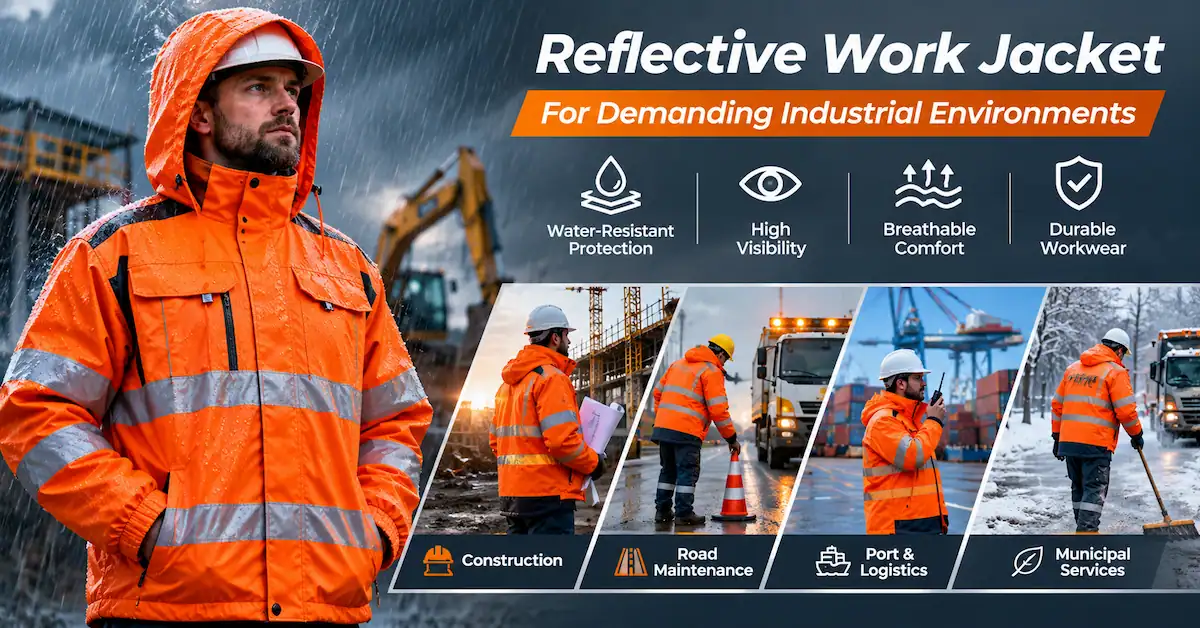
A waterproof jacket can pass a fabric test yet fail during an industrial work shift. Rain may enter through shoulder seams, zipper openings, pockets, or poorly sealed construction details. For PPE importers and industrial uniform buyers, these problems often become more expensive when they affect hundreds of garments in the same production batch.
Selecting waterproof industrial jackets therefore requires more than comparing hydrostatic pressure ratings or accepting a supplier's waterproof claims. Buyers need a repeatable procedure for evaluating finished garments, identifying leakage risks, approving samples, and managing defects before bulk shipment.
Quick Answer: The most effective way to evaluate waterproof industrial jackets is to inspect seven critical leakage zones, verify relevant fabric and seam testing, and compare finished-garment performance with an approved reference sample. Buyers should establish written acceptance criteria, include post-laundering checks where necessary, and require corrective-action records for recurring defects. Fabric waterproofness alone does not establish the performance of a complete jacket.
This guide provides a practical seven-zone audit, technical inspection checklist, construction comparison, and bulk procurement strategy for PPE distributors, private-label workwear brands, construction contractors, and industrial safety purchasing teams.
1. Key Takeaways for Waterproof Jacket Procurement
-
Fabric performance is only one part of waterproof protection. Seams, closures, pockets, and garment construction also matter.
-
Inspect seven critical leakage zones. The highest-risk areas often involve joints, openings, and attached components.
-
Separate water penetration from internal condensation. Moisture inside a jacket does not always originate from rain leakage.
-
Verify performance using appropriate methods. Material tests and garment-level assessments provide different information.
-
Control bulk production consistency. Approved samples, material traceability, and documented inspections help prevent repeat defects.
-
Treat recurring leaks as quality-system problems. Root-cause analysis and corrective actions are more valuable than replacing individual garments without investigating the cause.
For B2B purchasing, the objective is to receive repeatable performance across the approved product configuration rather than rely on broad marketing claims.
2. What Makes an Industrial Jacket Truly Waterproof?
Industrial waterproof jackets are outer garments designed to resist rain penetration under specified conditions while supporting the wearer's normal work activities.
Unlike casual rainwear, industrial jackets may also require high-visibility materials, reinforced construction, functional pockets, compatible hoods, and consistent performance after repeated use.
However, not every jacket marketed as waterproof delivers the same protection.
Three technical elements must work together.
Waterproof Fabric
The outer material may use a coating, membrane, or laminated construction to resist liquid-water penetration.
Performance should be supported by an appropriate test method and defined acceptance criteria.
Protected Seams
Stitching creates potential penetration paths in certain waterproof fabric constructions.
Compatible seam sealing or other validated construction methods may be required to achieve the intended performance.
Weather-Protective Openings
Zippers, collars, pockets, cuffs, and hems influence water entry during movement and exposure to wind-driven rain.
A fabric with good laboratory results can still be used in a poorly performing garment if these details are not controlled.
Who Should Use This Audit?
The seven-zone procedure is especially relevant to PPE importers, workwear wholesalers, industrial uniform brands, road maintenance contractors, municipal purchasers, and logistics operators.
It is not intended to establish suitability for chemical exposure, immersion, electrical arcs, flash fires, or other specialized hazards. Those applications require separate protection criteria.
For general fabric and manufacturing considerations, buyers can consult AOKE's Waterproof Work Jacket Manufacturer Guide.
3. The 7-Zone Waterproof Industrial Jacket Leak Audit
The following seven-zone model is a practical buyer inspection framework, not an official certification procedure.
It helps organize physical inspections and determine which parts of a finished garment need closer evaluation.
Seven Critical Leakage Zones
| Inspection Zone | Common Failure Mechanism | Buyer Verification |
|---|---|---|
| 1. Shoulder seams | Water entry through stitching or incomplete sealing | Inspect seam construction and relevant test evidence |
| 2. Hood-to-collar junction | Gaps, folds, or poorly protected intersections | Evaluate coverage and attachment details |
| 3. Front zipper | Water entry through zipper or storm-flap gaps | Check closure construction and rain protection |
| 4. Pocket openings | Water entering pocket interiors or underlying garment areas | Examine flaps, zippers, seam placement, and drainage design |
| 5. Underarm and side seams | Seal damage from repeated movement or tension | Check seam adhesion and flex durability |
| 6. Cuffs and hem | Wind-driven rain entering garment openings | Evaluate adjustment, coverage, and fit |
| 7. Reflective and logo attachments | Additional stitching, heat application, or material intersections | Review attachment methods and protective-barrier integrity |
Zone 1: Shoulder Seams
Shoulders receive direct rainfall, while fabric movement and equipment contact may create additional stress.
Inspect seam tape continuity, wrinkles, intersections, and any visible lifting.
Zone 2: Hood-to-Collar Connection
The hood attachment can create complex seam intersections.
Buyers should verify coverage around the neck, drainage behavior, and compatibility with helmets when applicable.
Zone 3: Front Zipper Assembly
A waterproof fabric does not make an ordinary zipper waterproof.
Covered zippers, storm flaps, and suitable protective assemblies may reduce leakage, but their effectiveness must be assessed in the finished garment.
Zone 4: Pocket Openings
Pocket placement matters because openings can face rainfall or collect water.
During sample evaluation, check whether water enters pockets or passes through stitching into the garment interior.
Zone 5: Underarm and Side Seams
These areas experience repeated bending, reaching, and stretching.
Inspect potential seam tape separation, excessive tension, and construction defects.
Zone 6: Cuffs and Hem
Water may enter through garment openings without penetrating the fabric itself.
Check cuff adjustment, glove compatibility, hem coverage, and the effect of normal work movements.
Zone 7: Reflective Materials and Branding
High-visibility jackets may include reflective components and company logos.
Depending on the attachment method, these components can introduce additional stitching or processing requirements.
Any modification should be evaluated for waterproof integrity and applicable protective performance.
Procurement principle: A visible defect in one leakage zone may indicate a broader manufacturing process issue. Buyers should investigate patterns rather than treat every leak as an isolated failure.
4. Which Tests Support Waterproof Jacket Claims?
Waterproof performance should be evaluated through appropriate testing, supported by clear documentation.
Different test methods measure different properties.
Waterproof Testing and Evidence Matrix
| Test or Standard | What It Evaluates | Procurement Limitation |
|---|---|---|
| ISO 811:2018 | Fabric resistance to water penetration under hydrostatic pressure | Does not independently establish finished-jacket waterproofness |
| EN 343:2019 | Protective clothing against rain, including material and seam requirements | Must verify applicable garment classification |
| Water-vapor resistance testing | Resistance to moisture-vapor transfer | Does not directly establish rain protection |
| Seam water-resistance assessment | Performance of selected seam constructions | Results depend on tested construction |
| Finished-garment rain assessment | Leakage under defined garment test conditions | Must confirm the actual test protocol |
| Post-laundering evaluation | Performance after specified cleaning or pretreatment | Results apply to tested conditions and care cycles |
ISO 811:2018, published by the International Organization for Standardization, provides a hydrostatic pressure method for assessing the resistance of fabrics to water penetration.
EN 343:2019, published by the European Committee for Standardization, addresses protective clothing against rain, including water penetration resistance and water-vapor resistance requirements.
Why Fabric Test Results Are Not Enough
A laboratory test may show that a fabric resists penetration under a defined pressure.
However, that result does not automatically demonstrate that the garment's seams, zippers, and other openings provide equivalent protection.
Buyers should request supporting evidence appropriate to the complete product.
What About EN 343 Classes?
EN 343:2019 includes performance classifications for resistance to water penetration and water-vapor resistance.
The relevant classification should be verified through the product's documentation, rather than inferred from fabric appearance or a supplier's general certification list.
For high-visibility waterproof jackets, applicable visibility requirements must be checked separately.
5. How to Distinguish Rain Leakage From Internal Condensation
One of the most important quality-control questions is whether moisture inside the garment entered from the outside or accumulated internally.
During physically demanding work, employees generate heat and moisture.
If moisture transfer or ventilation is insufficient for the conditions, condensation may develop inside the jacket.
This does not mean every wet inner surface is caused by condensation.
Moisture Diagnosis Checklist
| Observation | Possible Explanation | Recommended Investigation |
|---|---|---|
| Localized wetness beneath a shoulder seam | Seam leakage | Inspect seam and perform relevant water-resistance assessment |
| Moisture near a zipper opening | Closure or storm-flap weakness | Review zipper assembly and exposure conditions |
| General dampness across the inner surface | Perspiration or condensation | Evaluate activity, ventilation, and moisture management |
| Wetness around a pocket | Pocket construction or opening | Examine pocket placement and assembly |
| Leakage appearing after several washes | Material or seal deterioration | Compare before- and after-care performance |
| Moisture after bending or reaching | Opening exposure or seam stress | Perform representative movement evaluation |
Recommended Investigation Procedure
First, record where moisture appears and under which conditions.
Next, inspect the garment for visible construction defects.
Then, compare the affected garment with an approved reference sample using an appropriate controlled test.
If the cause remains uncertain, arrange technical assessment rather than automatically classifying the complaint as fabric failure.
This approach helps buyers and suppliers distinguish product nonconformity from unsuitable application or maintenance conditions.
6. Compare Waterproof Jacket Construction Options
Different garment constructions require different manufacturing controls.
The most appropriate option depends on the approved performance requirements, working environment, and cost expectations.
Industrial Jacket Construction Comparison
| Construction Option | Main Advantage | Key Inspection Priority | Procurement Consideration |
|---|---|---|---|
| Coated fabric with protected seams | Established barrier construction | Coating and seam integrity | Flexibility, durability, comfort |
| Laminated membrane with sealed seams | Potential balance of rain protection and moisture transfer | Lamination and seam-bond consistency | Material compatibility and cost |
| Heavy-duty protective shell | Potential suitability for demanding wet environments | Construction durability and closures | Weight and worker mobility |
| Water-repellent jacket | Lightweight option for limited exposure | Surface treatment and care | Not automatically suitable for sustained rain |
These are construction categories, not verified AOKE product models.
A higher-priced material does not automatically deliver better garment-level protection if the seams and openings are poorly designed.
Likewise, a lighter construction can be suitable when its tested performance matches the intended application.
7. How Should Buyers Approve Waterproof Jacket Samples?
Sample approval should establish a controlled reference for future production.
A single attractive prototype does not demonstrate that every jacket in a bulk shipment will meet the same requirements.
Five-Step Sample Approval Procedure
Step 1: Confirm the technical specification. Record fabric construction, seams, closures, reflective materials, dimensions, and applicable performance criteria.
Step 2: Inspect the seven leakage zones. Examine the complete jacket, including construction details that may not be visible in product photographs.
Step 3: Review testing evidence. Confirm relevant fabric and garment assessments, laboratory reports, and applicable standard classifications.
Step 4: Evaluate durability where required. Compare performance before and after the agreed laundering, abrasion, or flexing procedures.
Step 5: Approve the production reference. Retain a signed specification, sample version, component references, and acceptance criteria.
What Must Be Included in the Technical Pack?
| Item | Required Information |
|---|---|
| Fabric | Composition, construction, reference and approved performance |
| Seam protection | Method, tape or component reference, application requirements |
| Closures | Zipper and storm-flap construction |
| Hood and cuffs | Dimensions, adjustment and compatibility |
| Reflective components | Approved materials, location and attachment |
| Measurements | Size chart and permitted tolerances |
| Testing | Applicable methods, reports and acceptance criteria |
| Care | Approved instructions and relevant durability requirements |
| Branding | Artwork, application method and placement |
| Production reference | Sample version and approved technical drawings |
A complete technical pack reduces the risk of suppliers interpreting requirements differently.
8. How to Control Leakage Defects in Bulk Production
Waterproof performance depends on repeatable manufacturing processes.
Final visual inspection alone may not identify every protective-barrier weakness.
Buyers should agree on inspection responsibilities before production begins.
Recommended Quality-Control Stages
| Stage | Inspection Focus |
|---|---|
| Incoming materials | Fabric identity, protective materials and supporting test records |
| Cutting | Pattern accuracy and material handling |
| Sewing | Stitching consistency and seam construction |
| Seam sealing | Application settings, coverage and adhesion |
| Component assembly | Zippers, hoods, pockets and reflective attachments |
| In-process inspection | Defects and process deviations |
| Final inspection | Appearance, dimensions, workmanship and labeling |
| Performance verification | Agreed water-resistance or garment testing |
| Packaging | Product identification and lot traceability |
How Should Leakage Defects Be Classified?
A buyer and supplier should establish severity definitions based on the contract and intended product performance.
For a jacket sold with a verified protective claim, failure to meet the required performance may justify holding the affected lot and initiating technical investigation.
Cosmetic issues can be assessed separately under an appropriate workmanship inspection plan.
AQL-based visual sampling should not be used as a substitute for mandatory protective-performance verification.
9. What Should Happen When a Batch Fails Inspection?
Discovering leakage in production should trigger a documented corrective-action process.
Recommended Corrective-Action Workflow
1. Contain: Identify the affected production lot and prevent further release until the issue is evaluated.
2. Investigate: Determine whether the defect originates from materials, seam sealing, assembly, component substitution, or handling.
3. Correct: Apply an approved repair or manufacturing adjustment where technically appropriate.
4. Verify: Repeat the required inspection or testing to establish whether the corrective action is effective.
5. Prevent recurrence: Update the relevant process instructions, supplier controls, or inspection procedures.
Why Traceability Matters
A leaking garment should be traceable to relevant production information, including material lot, manufacturing date, style version, and inspection records.
Without traceability, a supplier may struggle to determine whether the problem affects one item or an entire batch.
For importers and private-label brands, traceability also supports warranty investigation and repeat-order quality management.
10. Does OEM Customization Affect Waterproof Performance?
Customization can change the way a protective garment performs.
Adding pockets, adjusting reflective tape layouts, changing zipper designs, or introducing logos may affect construction and testing requirements.
Common OEM Changes Requiring Review
-
New stitching through a protective material
-
Modified pocket or zipper construction
-
Different reflective attachment methods
-
Changes to seam locations
-
Alternative fabric or membrane systems
-
Different heat-transfer processes
-
Revised hood or cuff designs
Not every change necessarily reduces waterproof performance, but relevant modifications should be technically reviewed before bulk production.
For high-visibility workwear, buyers must also evaluate whether customization affects applicable visibility requirements.
OEM customization should be incorporated into product development, not added after performance approval without evaluation.
11. How AOKE Supports Industrial Workwear Development
Jinhua Aoke New Materials Co., Ltd. is a manufacturer specializing in reflective clothing and industrial safety workwear.
According to the company's published profile, AOKE operates manufacturing facilities in Jinhua, Chongqing, and Myanmar, serving different garment production and customization requirements.
Its public factory information lists sewing, cutting, and seam-sealing-related equipment, together with technical sampling and quality-control activities.
These capabilities provide a starting point for discussing industrial outerwear development.
However, the presence of manufacturing equipment does not independently establish that a particular product meets a waterproof standard.
Relevant Product Reference: LXA020
Buyers can review AOKE's LXA020 reflective work jacket as a product reference for high-visibility jacket construction.
The product page describes weather-related design features, including a hood and water-resistant material.
Important: This does not establish that LXA020 has been independently verified as an EN 343-certified waterproof jacket. Buyers should request the exact model's specifications and test documentation before making performance claims.
For broader product exploration, visit the AOKE reflective clothing collection.
12. What Determines the Cost of Waterproof Industrial Jackets?
The cost of industrial waterproof jackets depends on more than fabric price.
Important factors include:
-
Fabric and waterproof barrier construction
-
Seam-protection materials and processes
-
Garment complexity
-
Zippers, pockets, hoods and other components
-
Reflective materials and branding
-
Sample development and testing
-
Order quantity and size distribution
-
Quality inspection and shipping requirements
A simplified procurement model is:
Total Procurement Cost = Garment Purchase Cost + Testing + Inspection + Freight + Expected Defect and Replacement Costs
Why the Lowest Quotation Can Be Misleading
Two suppliers may quote different prices because they are proposing different fabrics, seam-sealing methods, or inspection requirements.
A lower price is not necessarily a better commercial offer if the products do not meet the same specification.
Buyers should request itemized quotations and compare equivalent technical requirements.
How MOQ and Lead Time Affect Procurement
MOQ and lead time depend on material availability, construction complexity, required testing, order quantity, and the producing factory's schedule.
Buyers should request separate estimates for sampling, materials, production, inspection, and shipping.
AOKE's general promotional terms for other customized clothing products should not automatically be applied to OEM waterproof industrial jacket orders.
13. Waterproof Industrial Jacket RFQ Checklist
A detailed request for quotation helps suppliers evaluate the project accurately.
| RFQ Field | Information to Provide |
|---|---|
| Buyer type | PPE distributor, brand, contractor or industrial user |
| Destination market | Country and applicable requirements |
| Working environment | Rain exposure, activity and relevant hazards |
| Jacket design | Shell, hood, zipper, pockets and cuffs |
| Fabric specifications | Material construction and required performance |
| Seam protection | Required construction and acceptance criteria |
| Safety standards | Applicable rain and visibility requirements |
| Sizes | Approved measurement chart and quantity breakdown |
| Branding | Logo, labels and packaging |
| Testing | Required methods, reports and acceptance rules |
| Order volume | Initial quantity and forecast repeat demand |
| Delivery | Destination, proposed schedule and commercial terms |
What Should Buyers Send First?
The most useful starting documents are a technical specification, reference sample or design drawing, estimated order quantity, destination market, and required performance criteria.
If the project includes a waterproof claim, clarify whether the required evidence relates to fabric, seams, or the finished garment.
Explore AOKE Workwear Products
Request an OEM Industrial Jacket Quotation
Frequently Asked Questions
1. What are waterproof industrial jackets?
Waterproof industrial jackets are occupational outer garments designed to resist rain penetration under defined conditions. Their performance depends on materials, seams, closures, construction, and applicable testing rather than fabric claims alone.
2. Why can a jacket made from waterproof fabric still leak?
Water can enter through stitched seams, zippers, pocket openings, hood connections, or other construction details. Fabric waterproofness does not automatically establish finished-garment protection.
3. What are the most common industrial jacket leakage points?
Important inspection areas include shoulder seams, hood connections, front closures, pockets, underarm seams, cuffs, hems, and attached reflective or decorative components.
4. What does ISO 811 testing measure?
ISO 811:2018 provides a hydrostatic pressure method for evaluating resistance to water penetration in fabrics. It does not independently prove that the finished jacket is waterproof.
5. What is EN 343 used for?
EN 343 addresses protective clothing against rain, including relevant material and seam performance requirements. Buyers should verify the applicable standard edition and product-specific classification.
6. Does seam taping guarantee a waterproof jacket?
No. Seam protection must be compatible with the fabric and correctly applied. The complete garment also needs suitable closures, openings, and construction to achieve the intended performance.
7. How can buyers distinguish condensation from rain leakage?
Record moisture location and working conditions, inspect the garment, and conduct appropriate controlled evaluations. General internal dampness may involve perspiration, while localized wetness near construction joints may indicate leakage.
8. Can reflective industrial jackets also be waterproof?
Yes, where the garment design and verified performance support both requirements. High-visibility conformity and rain protection should be assessed separately.
9. Can AOKE manufacture customized industrial jackets?
AOKE publicly describes reflective clothing manufacturing and garment customization capabilities. Buyers should submit their specifications and required testing to confirm suitable product development and manufacturing options.
10. How can I request a waterproof industrial jacket quotation?
Contact AOKE with your jacket design, destination market, estimated quantity, size breakdown, waterproof performance requirements, testing expectations, branding details, and preferred delivery schedule.
Conclusion
Choosing waterproof industrial jackets requires more than selecting a fabric with a high laboratory water-resistance rating.
For PPE importers, workwear brands, industrial contractors, and safety equipment distributors, long-term procurement reliability depends on how consistently the complete garment performs.
A seven-zone leakage audit provides a practical framework for examining shoulder seams, hood connections, zippers, pockets, underarm construction, cuffs, hems, and attached components.
When combined with appropriate test evidence, approved samples, manufacturing process controls, and documented corrective actions, this approach can help buyers identify quality risks before they become widespread shipment problems.
The most effective purchasing strategy is to define measurable requirements, verify the intended product configuration, and establish a clear agreement on inspection, testing, and repeat-order consistency.
AOKE offers reflective clothing manufacturing and customization capabilities for international B2B buyers. Companies developing industrial outerwear programs can explore its available designs and discuss project-specific material requirements, manufacturing options, quality expectations, and bulk pricing.
Explore AOKE Reflective Workwear
Contact AOKE for Custom Industrial Jacket Development and Bulk Pricing