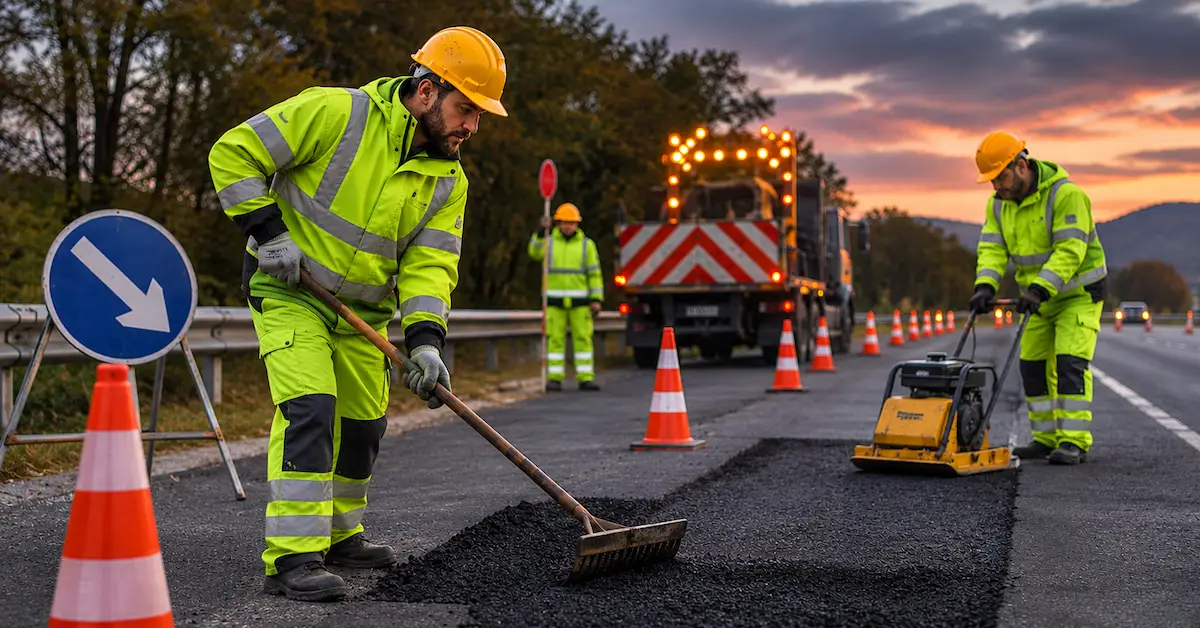
Road maintenance workers often operate beside moving vehicles, temporary lane closures, heavy equipment and changing weather conditions. Their clothing must remain suitable whether they are repairing potholes, installing traffic-control devices, clearing roadside drains or working through the night.
For procurement teams, choosing workwear for road maintenance involves more than comparing fluorescent colors and reflective tape. The purchasing decision should account for traffic exposure, required high-visibility performance, garment coverage, weather protection, worker movement and repeat-order consistency.
Quick Answer: The right road maintenance workwear starts with a site-specific risk assessment and an appropriate high-visibility garment specification. Buyers should distinguish daytime, nighttime, mobile and wet-weather operations; verify the required standards and finished-garment documentation; and check that outer layers remain suitable when workers change clothing during a shift. For bulk orders, approved samples, size schedules, material traceability and documented quality controls are essential.
This guide provides a practical sourcing framework for highway maintenance contractors, municipal road departments, PPE distributors and private-label workwear brands.
1. Key Takeaways for Road Maintenance Workwear Buyers
-
Select clothing according to road exposure, worker duties, lighting, weather and applicable safety requirements.
-
For US temporary traffic control zones, check the relevant FHWA MUTCD requirements and the applicable ANSI/ISEA 107 edition.
-
For UK road works, consult the current Traffic Signs Manual Chapter 8 and relevant high-visibility clothing requirements.
-
Verify protective performance for the complete garment, not just fluorescent fabric or reflective tape.
-
Ensure rain jackets, winter coats and other outer layers do not undermine the required high-visibility configuration.
-
Consider mobile maintenance operations separately from stationary construction sites.
-
Request product-specific evidence, approved samples and controlled specifications before placing bulk orders.
The goal is not to purchase the largest number of reflective garments. It is to provide suitable clothing for the workers and conditions involved.
2. Why Is Road Maintenance Workwear Different From General Construction Clothing?
Road maintenance work can involve short-duration activities, frequent relocation, changing traffic conditions and substantial exposure to passing vehicles.
Unlike a construction team working within a relatively stable work area, a maintenance crew may complete several jobs at different roadside locations in one day.
Typical activities include:
-
Pothole and pavement repairs
-
Road marking and line maintenance
-
Temporary traffic-control setup and removal
-
Drainage and verge maintenance
-
Barrier and sign repairs
-
Emergency road surface maintenance
-
Winter road treatment
Some workers perform tasks inside established temporary traffic control zones. Others must travel between vehicles and changing work areas.
These operations create different clothing requirements.
Who Should Use This Buying Guide?
The following organizations can use this framework to prepare technical specifications and purchasing inquiries:
-
Highway maintenance contractors
-
Municipal road maintenance departments
-
Road and traffic management companies
-
PPE distributors and importers
-
Industrial uniform purchasing teams
-
OEM and private-label safety clothing brands
This guide is not a substitute for a professional safety assessment or a traffic management plan.
High-visibility clothing supports worker conspicuity but does not replace barriers, warning signs, traffic controls, lighting or appropriate work procedures.
3. Six Road Maintenance Scenarios That Need Different Clothing Reviews
A useful procurement strategy begins with the actual maintenance activity.
The following matrix provides six common operating scenarios and the questions buyers should ask before selecting garments.
Road Maintenance Clothing Selection Matrix
| Maintenance Scenario | Main Operating Challenge | Potential Clothing Configuration | Critical Buyer Check |
|---|---|---|---|
| 1. Daytime pothole repairs | Short-duration work near vehicles | Appropriate high-visibility shirt, vest or jacket | Required classification and freedom of movement |
| 2. Nighttime resurfacing | Limited natural light and vehicle movement | Approved high-visibility outerwear suitable for night work | Reflective performance, coverage and fit |
| 3. Mobile road marking | Frequent movement between locations | Practical high-visibility garments with secure closures | Visibility during changing work positions |
| 4. Traffic-control setup | Exposure while placing or removing devices | High-visibility clothing appropriate to the assigned operation | Required class and worker safety procedures |
| 5. Wet-weather drainage work | Rain, moisture and outdoor exposure | Suitable high-visibility rainwear | Rain protection and retained visibility |
| 6. Cold-season road maintenance | Low temperatures, multiple layers and outdoor work | Appropriate high-visibility insulated outerwear | Fit over layers and approved outermost garment |
Important: These are purchasing scenarios, not automatic legal classifications. The responsible employer or safety professional must establish the actual protective requirements.
Scenario 1: Daytime Pothole Repairs
Pothole repair crews may work in short-duration or mobile operations.
Clothing needs to support repeated bending, lifting tools, moving between vehicles and performing physical work.
Evaluate comfort, reflective material placement, pocket accessibility and whether garments remain correctly worn during these activities.
Scenario 2: Nighttime Resurfacing
Nighttime road maintenance presents additional visibility challenges.
Retroreflective materials, garment design, lighting conditions and worker movement all matter.
A daytime high-visibility garment should not be assumed suitable for every nighttime assignment without verifying its required designation.
Scenario 3: Mobile Road Marking
Mobile road marking teams may move frequently along a roadway.
Workwear should not interfere with tools, equipment operation or safe vehicle entry and exit.
For this application, loose closures, poorly positioned pockets and excessive garment bulk may create practical problems.
Scenario 4: Traffic-Control Setup and Removal
Workers installing or removing signs, cones and other devices can be particularly exposed to traffic.
Garment selection must follow the applicable temporary traffic management requirements and approved work procedures.
Scenario 5: Wet-Weather Drainage Work
Rain introduces additional issues involving water penetration, wet fabric, comfort and visibility.
A conventional reflective vest may not provide the required weather protection.
Buyers should evaluate high-visibility rain jackets and the performance of the complete garment.
Scenario 6: Cold-Season Road Maintenance
Cold-weather crews may wear several layers.
The approved outermost protective clothing must remain suitable when worn over insulating garments.
An ordinary dark winter coat worn over a high-visibility vest can undermine the intended high-visibility arrangement.
4. What Are the Current High-Visibility Requirements for Road Workers?
Standards vary by market, road authority, operation and workplace hazard assessment.
United States: FHWA MUTCD and ANSI/ISEA 107
The Federal Highway Administration's Manual on Uniform Traffic Control Devices, 11th Edition with Revision 1, dated December 2025, is the current federal MUTCD edition.
Section 6C.05 addresses high-visibility safety apparel.
For applicable workers within the roadway right-of-way and temporary traffic control zone, it specifies Performance Class 2 or 3 clothing under ANSI/ISEA 107-2015 or equivalent revisions, subject to the stated exceptions.
A person designated by the employer as responsible for worker safety selects the appropriate class.
For nighttime flaggers, the MUTCD also provides guidance favoring Class 3 apparel.
Official reference: FHWA — MUTCD Part 6, Temporary Traffic Control
What Changed in ANSI/ISEA 107-2026?
The International Safety Equipment Association published ANSI/ISEA 107-2026 in October 2026.
The updated standard continues the familiar garment Type and Performance Class framework while introducing revised provisions concerning smaller sizes, certain reflective material designs, testing and documentation.
It also strengthens the requirement to provide a Declaration of Conformity for each style or model upon request.
The publication of the new edition does not automatically render garments compliant with the previous edition obsolete.
Buyers should identify the applicable edition required by their contracts and governing rules, then request corresponding product documentation.
Official reference: ISEA — ANSI/ISEA 107-2026 High-Visibility Standard
United Kingdom: Road Works and Temporary Traffic Management
The UK Department for Transport updated its Traffic Signs Manual Chapter 8: Traffic Safety Measures and Signs for Road Works and Temporary Situations in November 2026.
Chapter 8 provides guidance for temporary traffic management, including the planning and implementation of traffic safety measures during road works.
Road maintenance clothing specifications should also consider the relevant protective clothing standards, such as EN ISO 20471 where applicable.
The necessary garments must be selected for the operation and supported by appropriate conformity documentation.
Official reference: UK Department for Transport — Traffic Signs Manual
Can US and European High-Visibility Standards Be Used Interchangeably?
Not automatically.
ANSI/ISEA 107 and EN ISO 20471 address high-visibility protective clothing, but their requirements, classification systems and conformity frameworks are different.
A manufacturer should not claim that one certification automatically proves conformity with another standard.
International buyers should specify the destination market and applicable requirements in their RFQ.
5. Which Technical Specifications Matter Most?
A road maintenance garment specification must cover more than style and color.
Road Maintenance Workwear Technical Checklist
| Specification | What Buyers Should Verify |
|---|---|
| High-visibility designation | Applicable type, class, edition and supporting evidence |
| Fluorescent background material | Approved color, performance and material area |
| Retroreflective material | Construction, performance, positioning and durability |
| Fabric composition | Approved fiber blend and construction |
| Size range | Fit and required performance across garment sizes |
| Sleeves and garment coverage | Suitability for the required protective configuration |
| Seams | Workmanship and applicable durability requirements |
| Zippers and fasteners | Secure closure and ease of operation |
| Pockets | Access, capacity and interference with required visible areas |
| Hood design | Coverage and whether it obscures required high-visibility material |
| Weather protection | Appropriate performance evidence for rain or cold |
| Care instructions | Cleaning and maintenance requirements |
| Branding | Approved logo placement and application method |
Fluorescent Material vs Retroreflective Material
Fluorescent background material and retroreflective material serve different functions.
Fluorescent material helps improve conspicuity under suitable daytime lighting conditions.
Retroreflective material returns incident light toward its source and is important for nighttime visibility when illuminated by vehicle lights.
Both must be assessed as part of the finished garment design.
Is More Reflective Tape Always Better?
Not necessarily.
The relevant standard specifies performance and design requirements.
Simply adding extra reflective tape does not establish compliance if garment dimensions, material placement, background areas or other requirements are incorrect.
Buyers should request complete garment specifications rather than assess protection from photographs alone.
6. How Should Buyers Evaluate Night-Shift Road Workwear?
Night maintenance work requires particular attention to how a person appears while moving.
A garment that looks conspicuous while hanging on a display rack may appear different when worn over other equipment.
Five Practical Inspection Questions
1. Is the outermost garment the approved one?
If workers wear additional rain or winter layers, confirm the visible outer garment remains suitable for the task.
2. Does the garment fit correctly?
Oversized clothing may interfere with movement or equipment. Tight garments may restrict bending and reaching.
3. Are the required reflective areas unobstructed?
Check whether tool belts, harnesses, bags or other equipment cover portions of the garment.
4. Is the clothing properly fastened?
An open jacket or loosely worn vest may change the garment's intended configuration.
5. Is the garment clean and serviceable?
Heavy dirt, damage, fading or worn reflective components should trigger inspection against the manufacturer's maintenance and replacement instructions.
Does a Nighttime Visual Check Prove Compliance?
No.
Worksite observation may help identify practical concerns, but it does not replace laboratory testing or the required finished-garment conformity assessment.
Night-shift procurement should combine appropriate documentation with operational fit and usability review.
7. Reflective Vest vs High-Visibility Jacket vs Rainwear
There is no universal garment style suitable for every road maintenance task.
Buyers should compare the actual required performance and conditions.
Road Maintenance Garment Comparison
| Garment Type | Practical Advantage | Main Limitation to Assess | Potential Application |
|---|---|---|---|
| Reflective vest | Lightweight and easy to layer | Coverage, fit and weather protection | Appropriate daytime or general roadside duties |
| High-visibility polo | May improve comfort in warmer weather | Required garment classification and coverage | Warm-weather maintenance |
| Reflective sweatshirt | Useful for cooler conditions | Weather resistance and applicable classification | Cool, dry work conditions |
| High-visibility rain jacket | Weather coverage | Water resistance and approved visibility design | Wet-weather roadside work |
| Insulated reflective jacket | Additional cold-weather protection | Bulk, movement and size compatibility | Winter maintenance |
| High-visibility trousers | Potential supplementary visibility | Correct performance and compatible ensemble | Operations requiring additional lower-body visibility |
The terms “reflective,” “high visibility” and “waterproof” should not be treated as interchangeable technical claims.
AOKE Product References
Buyers can review several styles from AOKE's reflective clothing collection as starting points for product discussions:
| AOKE Reference | Garment Type | Relevant Purchasing Discussion |
|---|---|---|
| LXA001 | Reflective safety vest | Lightweight visibility and layering |
| LXE008 | Multi-pocket reflective safety vest | Storage, access and workwear configuration |
| LXA012 | Reflective polo | Comfort and sleeve coverage |
| LXA015 | Reflective sweatshirt | Cooler-weather flexibility |
| LXA020 | Hooded reflective work jacket | Outerwear coverage, closures and weather-related design |
These are product references only. Their individual classifications and protective performance must be verified before selection for road maintenance work.
Relevant product pages:
For additional styles, visit the AOKE Reflective Clothing Collection.
8. How Should Road Maintenance Teams Select Rainwear?
Road maintenance does not stop whenever conditions become wet.
However, conventional water-repellent outerwear may not provide the level of protection needed for prolonged rain exposure.
Three Rainwear Considerations
Water penetration resistance: Determine whether the proposed fabric and garment construction meet the required rain-protection specification.
Seams and openings: Inspect the hood connection, shoulders, front zipper, pockets and other potential water-entry areas.
High-visibility configuration: Ensure the rain jacket itself satisfies the required visibility specification when worn as the outer layer.
Water-Resistant vs Waterproof
These terms should not be treated as equivalent.
Water-resistant clothing may repel some moisture under limited conditions.
Waterproof protective clothing requires evidence supporting its intended performance under defined conditions.
Where EN 343 or another rain-protection requirement applies, verify the relevant documentation and garment performance.
For more detail on garment leakage risks, see AOKE's Waterproof Industrial Jackets: 7-Zone Leak Audit.
Should Buyers Choose a Separate Rain Jacket?
That depends on the purchasing program.
Some buyers may prefer an integrated high-visibility rain jacket.
Others may use a compatible outer layer over ordinary work clothing.
In either case, the complete wearing configuration must remain suitable for the assessed risks.
9. What About Hot Weather and Cold Weather?
Comfort matters because unsuitable clothing may discourage proper use.
However, comfort must be evaluated alongside the required protective performance.
Hot-Weather Road Maintenance
For warmer environments, buyers may consider suitable lightweight or breathable high-visibility garments.
Important considerations include movement, ventilation, moisture management and required visible coverage.
A lightweight garment should not be chosen merely because it feels cooler if it fails the site's protective requirements.
Cold-Weather Road Maintenance
Colder work conditions may require insulating layers beneath an approved outer garment.
Check that workers can move safely, use tools and operate equipment while wearing the complete clothing combination.
Avoid assuming that adding an ordinary dark jacket over compliant clothing preserves the required high-visibility configuration.
For broader winter procurement planning, see AOKE's Cold Weather Workwear Solutions.
10. Can OEM Customization Change Road Workwear Compliance?
Road maintenance contractors frequently need customized garments for company identification and crew organization.
Common requests include logos, reflective material arrangements, color schemes, additional pockets, custom labels and size changes.
However, the safety implications must be reviewed before production.
OEM Customization Risk Matrix
| Requested Change | Potential Risk | Recommended Buyer Action |
|---|---|---|
| Large company logo | Covers required visible material | Review approved placement |
| Different reflective tape | Changes performance or design conformity | Verify material and finished garment |
| Additional dark panels | Reduces qualifying background area | Review applicable design criteria |
| New pocket design | Covers reflective material or interferes with tools | Assess position and construction |
| Alternative hood | Obscures required material or affects usability | Review approved configuration |
| Different fabric | Changes material performance | Evaluate testing and conformity implications |
| Custom size grading | Alters fit or visible material areas | Verify requirements across sizes |
What Should Be Approved Before Production?
Buyers should obtain a final technical drawing, sample, bill of materials, size chart, artwork specification and applicable conformity evidence.
Any changes affecting protective performance should receive appropriate technical review.
For private-label PPE, buyers should also determine their obligations in the destination market.
Customization must not turn an approved protective garment into an unverified design.
11. How to Control Bulk Road Maintenance Workwear Quality
A successful sample is only useful if the same approved construction can be reproduced consistently.
For high-visibility clothing, material identity and placement are important quality-control considerations.
Recommended Inspection Stages
| Manufacturing Stage | Quality-Control Priority |
|---|---|
| Material sourcing | Approved fluorescent and reflective components |
| Incoming inspection | Material identity and supporting records |
| Cutting | Pattern consistency and size accuracy |
| Sewing | Seams, pockets and garment assembly |
| Reflective attachment | Correct placement and workmanship |
| Branding | Approved artwork and application |
| Final inspection | Measurements, appearance, labels and defects |
| Performance verification | Applicable testing and conformity checks |
| Packing | Correct SKU, size and production-lot records |
What Should Trigger a Production Hold?
Examples include unapproved material substitutions, missing required performance documents, significant deviations from the approved design, or evidence that the protective requirements have not been met.
The supplier and buyer should investigate nonconforming products before shipment.
AQL workmanship sampling may support general inspection, but it does not replace the necessary protective-performance evidence.
Why Traceability Matters
Record the garment style, material references, approved revision, production lot and relevant inspection documents.
This makes it easier to investigate defects, compare repeat orders and confirm which design was supplied.
12. How Should Road Maintenance Contractors Manage Replacement Clothing?
A procurement program should account for garments becoming damaged, excessively dirty, worn or unsuitable for continued use.
The replacement decision must follow the manufacturer's instructions and any applicable employer procedures.
Practical Replacement Triggers
-
Torn or damaged reflective material
-
Significant fading or loss of required appearance
-
Heavy contamination that cannot be removed appropriately
-
Damaged closures affecting correct wear
-
Garment changes affecting the approved protective configuration
-
Incorrect sizing or poor fit
-
Deterioration identified during required inspection
Buyers should not assume a universal service life for all high-visibility workwear.
Useful life depends on garment design, work conditions, cleaning, storage and actual wear.
How to Plan Replacement Stock
Track issue dates, garment condition, worker sizes and recorded replacement reasons.
These records help procurement teams forecast demand more accurately.
Replacement garments should match the approved specification unless the revised model has been assessed and accepted.
13. What Determines the Price of Road Maintenance Workwear?
The cost of road maintenance uniforms depends on garment type, material requirements, technical documentation, manufacturing complexity and order volume.
Main Cost Factors
| Cost Factor | Purchasing Impact |
|---|---|
| Garment style | Different materials and assembly requirements |
| Reflective materials | Component specification and design complexity |
| Weather protection | Fabric construction and additional processes |
| Size distribution | Production planning and material utilization |
| Custom branding | Artwork and application processes |
| Testing and conformity | Required documentation and assessment |
| Order volume | Production and sourcing efficiency |
| Shipping | Packing and delivery arrangements |
| Replenishment | Future size and replacement demand |
What Is the Real Cost of a Bulk Order?
A practical comparison is:
Total Procurement Cost = Garment Cost + Testing + Customization + Inspection + Freight + Replacement Costs
This framework helps buyers compare equivalent specifications.
The cheapest quotation may not be the most suitable if it excludes required testing, uses different materials or provides insufficient documentation.
What About MOQ and Lead Time?
MOQ and production timelines depend on the exact garment, material availability, customization and required testing.
Buyers should request separate schedules for sampling, material preparation, production, inspection and shipping.
Do not assume that a promotional delivery period advertised for one product applies to every custom road maintenance clothing order.
14. How Can AOKE Support Road Maintenance Workwear Sourcing?
Jinhua Aoke New Materials Co., Ltd. manufactures reflective clothing and industrial workwear for B2B buyers.
Its published product collection includes reflective safety vests, polo shirts, sweatshirts and work jackets.
AOKE also describes garment manufacturing, sampling, customization and quality-control capabilities.
These resources provide a starting point for procurement teams developing road maintenance clothing programs.
However, the company profile and product photographs alone do not verify a specific garment's compliance with the applicable ANSI/ISEA or European high-visibility requirements.
What Should Buyers Ask AOKE to Confirm?
A road maintenance buyer should provide the intended application and request confirmation of:
-
Appropriate available garment models
-
Exact material and reflective component specifications
-
Applicable finished-garment conformity evidence
-
Size range and measurement tolerances
-
OEM branding possibilities
-
Sample availability
-
Production quality-control arrangements
-
MOQ and lead time
-
Replacement and repeat-order options
This enables a more relevant technical discussion than asking for a generic quotation for “orange safety jackets.”
Explore AOKE Reflective Workwear
Contact AOKE for Road Maintenance Workwear Sourcing
15. Road Maintenance Workwear RFQ Checklist
A well-prepared request for quotation reduces uncertainty and helps suppliers identify suitable products.
Information to Include in Your RFQ
| RFQ Field | Details Buyers Should Provide |
|---|---|
| Buyer type | Contractor, municipality, PPE distributor or private-label brand |
| Destination market | US, UK, EU or another country |
| Maintenance activity | Pothole repair, road marking, drainage, traffic control, etc. |
| Working conditions | Day, night, rain, cold or mixed conditions |
| Traffic exposure | Description from the approved risk assessment |
| Required standards | Applicable designation, class and edition |
| Garment type | Vest, polo, sweatshirt, jacket, rainwear or compatible combination |
| Fabric requirements | Composition, construction and performance |
| Reflective requirements | Approved material, design and supporting evidence |
| Sizes | Size chart and quantities |
| Branding | Logos, labels, pockets and packaging |
| Initial order | Planned quantity and delivery destination |
| Future demand | Estimated repeat orders |
| Documentation | Required reports, declarations and inspection records |
What Should Buyers Send First?
The most useful initial documents are a workplace application brief, intended market, required protective specification, garment style preference, approximate quantity and desired delivery schedule.
If the exact required class has not yet been established, obtain the necessary safety assessment before final garment approval.
AOKE can then confirm which available styles or customization options may be suitable for further technical evaluation.
Request Road Maintenance Workwear Samples and Bulk Pricing
16. Frequently Asked Questions
1. What is the best workwear for road maintenance workers?
The best option depends on traffic exposure, working conditions, task requirements and applicable standards. Buyers should select appropriate high-visibility clothing based on the relevant risk assessment and verify product-specific documentation before ordering.
2. What high-visibility clothing is required for US road maintenance?
For applicable workers in temporary traffic control zones within the road right-of-way, FHWA MUTCD Section 6C.05 specifies Performance Class 2 or 3 apparel under ANSI/ISEA 107-2015 or equivalent revisions, with stated exceptions. The appropriate class must be selected by the responsible employer representative.
3. Is ANSI/ISEA 107-2026 the latest high-visibility standard?
Yes. ANSI/ISEA 107-2026 was published in October 2026. Buyers should verify the edition required by the applicable regulation, contract and product conformity documents.
4. Do night-shift road workers always need Class 3 clothing?
The requirements depend on the operation and governing rules. The US MUTCD establishes Class 2 or 3 requirements for relevant workers and recommends Class 3 for nighttime flagger apparel. Buyers should verify the specific situation rather than assume one class applies universally.
5. Can a reflective vest be used for road maintenance?
A reflective vest may be suitable where its finished-garment performance, type, class, fit and intended use satisfy the required specification. A vest should not be approved solely because it is fluorescent or has reflective stripes.
6. Is waterproof clothing necessary for road maintenance?
Waterproof or rain-protective clothing may be needed for wet-weather operations. The garment should satisfy the relevant weather requirements while preserving the necessary high-visibility performance.
7. Can road maintenance workers wear ordinary winter coats over reflective vests?
The outermost clothing arrangement must remain suitable for the required protective purpose. Covering compliant high-visibility clothing with an ordinary dark coat may undermine the intended protection.
8. Can road maintenance workwear be customized?
Yes, subject to manufacturing feasibility and applicable protective requirements. Buyers should verify how changes to reflective tape, logos, fabrics, pockets and garment design affect conformity.
9. How can buyers evaluate a bulk road maintenance clothing supplier?
Evaluate garment suitability, product-specific documentation, manufacturing controls, sample quality, material traceability, customization support, MOQ, lead time and repeat-order consistency.
10. How can I request road maintenance workwear from AOKE?
Send AOKE the intended maintenance applications, destination market, protective requirements, garment preferences, order volume, size breakdown, branding details and delivery schedule. Request the relevant product specifications and technical documents before confirming a bulk order.
Conclusion
Choosing workwear for road maintenance requires a more specialized approach than purchasing general industrial uniforms.
Road maintenance teams operate in changing environments that can include mobile repairs, temporary lane closures, nighttime work, moving vehicles, rain and cold temperatures.
For highway contractors, municipal departments, PPE distributors and workwear brands, the purchasing priority should be matching these conditions with suitable and verifiable protective garments.
A structured buying process should begin with the workplace risk assessment, identify the required high-visibility specification, compare appropriate garment configurations and examine product-specific evidence.
Buyers should also review rainwear, layering, size ranges, OEM modifications, quality control and replacement planning before approving large orders.
The most reliable purchasing decision combines verified safety requirements with practical garment design and consistent manufacturing controls.
AOKE offers reflective workwear styles and customization capabilities for international B2B customers.
Businesses sourcing clothing for road maintenance teams can contact AOKE to discuss garment options, technical specifications, sample development and bulk purchasing requirements.
Explore AOKE Reflective Clothing Products
Contact AOKE for Road Maintenance Workwear Development and Bulk Pricing