
What Should Buyers Expect From a Road Safety Mirror Supplier?
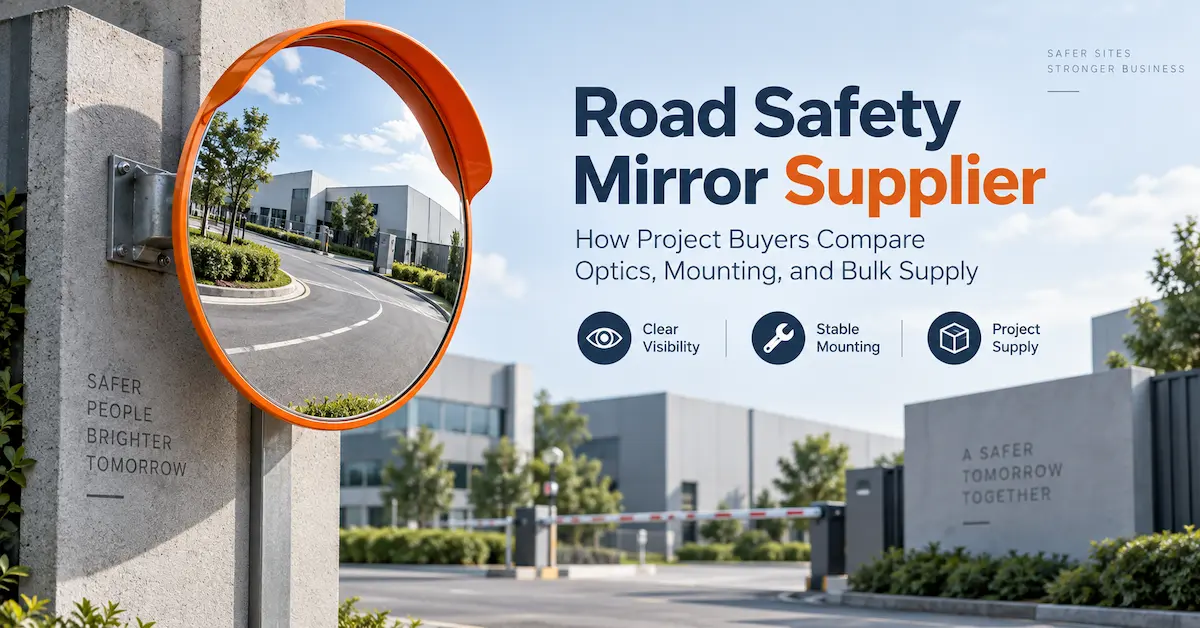
A road safety mirror supplier should help a buyer turn a visibility problem into a clearly defined product requirement. The purchasing decision is not simply about selecting a round mirror of a certain diameter. Road intersections, parking exits, factory entrances, loading areas, private roads, underground garages, and industrial traffic routes can have different viewing angles, mounting conditions, environmental exposure, and maintenance requirements. A useful supplier therefore needs to clarify the application, recommend an appropriate product configuration, provide consistent specifications, support sample approval, and maintain the agreed configuration when a bulk order is produced.
For distributors and project buyers, this distinction matters because two mirrors that look almost identical in a catalogue can differ in face material, housing structure, bracket design, mounting hardware, packaging, and repeat-order consistency. Before requesting a quotation, buyers can review AOKE’s broader product range to understand how road-safety products fit within a wider safety-equipment sourcing program.
Who Typically Buys Road Safety Mirrors?
The search for a road safety mirror supplier usually comes from a commercial or project requirement rather than a consumer purchase. Traffic-safety distributors need products that can be stocked and reordered with stable specifications. Parking-equipment companies may need mirrors for garage exits and blind ramps. Construction contractors may include mirrors within a wider site-safety package, while property managers, logistics parks, factories, and warehouses may be solving one specific vehicle or pedestrian visibility problem.
These buyers do not evaluate suppliers in exactly the same way. A distributor may prioritize packaging, private labeling, MOQ, repeatability, and future availability. A contractor may focus on mounting compatibility and delivery according to the construction schedule. A warehouse or factory buyer may care more about identifying forklift and pedestrian movement around a restricted corner. A municipal or tender buyer may also require defined documentation and product specifications before approval.
Road safety mirrors are less suitable when a buyer is trying to solve a problem that requires changes to road geometry, barriers, traffic separation, lighting, signage, or another engineering measure. A mirror should support visibility at an appropriate location; it should not automatically be treated as a replacement for broader traffic-risk controls.
Define the Blind Spot Before Choosing the Mirror
One of the most common sourcing problems occurs when a buyer requests “600 mm,” “800 mm,” or “1000 mm” mirrors before defining the actual viewing requirement. Diameter can influence the usable field of view, but it does not describe the complete installation.
A stronger RFQ starts with the site. Identify where the driver, forklift operator, cyclist, or pedestrian will normally look from. Mark the hidden approach that needs to become visible. Estimate the distance from the observer to the proposed mirror position and from the mirror to the area that must be seen. Photograph the location from the actual observer position and include walls, columns, gates, vegetation, parked vehicles, or other obstacles that may affect installation.
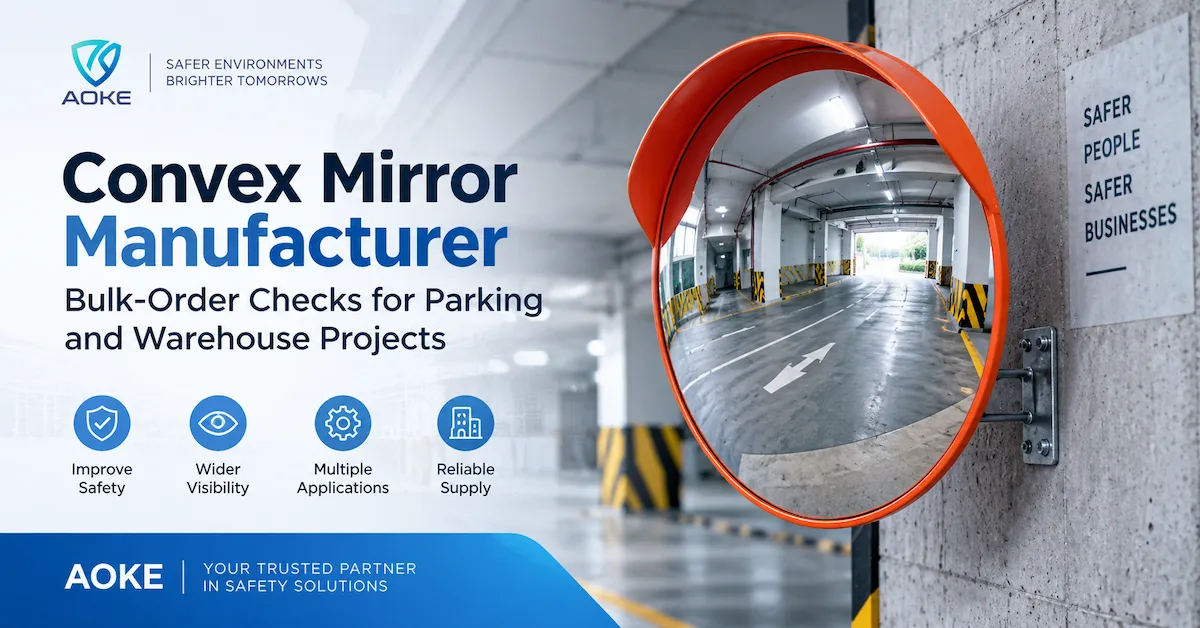
For a parking exit, for example, the buyer may need to see vehicles approaching from one side before entering the road. At an industrial gate, the requirement may involve trucks leaving a site where the wall blocks the driver’s direct view. In a warehouse, the problem may involve forklifts approaching an aisle intersection. The supplier should understand these differences before recommending a road safety mirror configuration.
Build a Specification Before Asking Suppliers to Compete on Price
A written specification makes quotations comparable. Without it, one supplier may quote a lightweight indoor-style assembly while another includes an outdoor housing and heavier bracket. Comparing only the headline price can then lead to the wrong conclusion.
The following table is a procurement template rather than published specifications for a specific AOKE mirror. Buyers should confirm each item for the product being quoted.
| Specification Item | What the Buyer Should Confirm | Why It Matters |
|---|---|---|
| Application | Road junction, parking exit, factory gate, garage or private road | Establishes the actual use |
| Mirror shape | Round, rectangular or another required design | Affects installation and viewing arrangement |
| Reflective-face size | Usable mirror dimensions and overall dimensions | Prevents confusion between face and housing size |
| Face material | Acrylic, polycarbonate or another material | Influences weight, impact behavior and cost |
| Housing/backing | Material and structural design | Protects and supports the mirror face |
| Rim or hood | Required design and material | May affect outdoor configuration and appearance |
| Mounting type | Wall, pole or project-specific fixing | Determines installation compatibility |
| Bracket adjustment | Required direction and adjustment range | Helps establish the correct viewing angle |
| Pole compatibility | Diameter or mounting interface where applicable | Avoids installation mismatch |
| Outdoor conditions | Rain, sunlight, temperature or corrosion exposure | Helps define environmental requirements |
| Color | Standard or customized housing color | Important for project appearance or branding |
| Packaging | Individual carton, protection and included hardware | Important for export and distribution |
| Private label | Label, carton, manual or other branding | Defines customization scope |
| Quantity | Initial order and forecast repeat orders | Supports commercial planning |
How Should Buyers Compare Mirror Face Materials?
Material selection should be based on project conditions rather than a simple “best material” ranking. Acrylic mirror faces are commonly considered where optical clarity, relatively low weight, and commercial practicality are priorities. Polycarbonate may be considered when impact resistance is a more important requirement. Other constructions may also be proposed depending on the supplier and intended application.
The material name alone does not define performance. Buyers should ask the road safety mirror supplier for the actual face material, relevant construction details, thickness where applicable, reflective structure, housing material, and any available information supporting outdoor or impact-related claims. If a project has defined requirements for weathering, impact, temperature, or corrosion, those requirements should be written into the RFQ instead of being assumed from a product photograph.
The complete assembly also matters. A strong mirror face attached to an unsuitable backing or weak mounting arrangement may still create problems in service. For this reason, material evaluation should cover the face, housing, bracket, fasteners, and installation interface as one product system.
Optical Quality Should Be Evaluated From the User’s Position
A road mirror intentionally provides a wider reflected view than a flat mirror, so buyers should not use vague phrases such as “no distortion” as the only optical requirement. The more useful question is whether the required road, vehicle, or pedestrian area can be seen clearly enough from the agreed observer position.
During sample evaluation, place the mirror in a controlled position representative of the proposed installation. Use the same observer point and target area each time. Look for localized waves, irregular image changes, surface scratches, damaged edges, contamination, or obvious inconsistencies across the reflective face. Check whether important objects remain recognizable toward the useful edges of the view.
If several samples are being compared, maintain the same setup rather than testing each mirror from a convenient angle. Record the approved sample and photograph the evaluation arrangement. That reference can later help purchasing and quality teams distinguish a true production difference from a change in viewing position.
Why Mounting Hardware Deserves Separate Attention
For many road-safety projects, installation problems come from brackets and hardware rather than the mirror face itself. A supplier should clearly state what is included in the package: wall brackets, pole clamps, fasteners, adjustment components, or other hardware.
Buyers should confirm whether the bracket supports the required installation direction and whether it can hold the approved viewing angle after tightening. For pole installation, confirm the compatible pole dimensions or clamp range. For wall installation, the site installer should determine whether the actual wall and fastening method are suitable.
Outdoor applications deserve additional scrutiny. If a supplier makes specific claims related to wind resistance, corrosion resistance, temperature, or long-term outdoor performance, ask what product configuration and test conditions support those claims. Do not assume that an orange housing or rain hood alone establishes an outdoor-performance level.
Road Safety Mirror Workmanship: What Should a Sample Review Cover?
A professional sample review should move beyond general statements such as “good quality.” Define what “acceptable” means for the project. Inspect surface finish, mirror-face seating, housing alignment, edge condition, bracket assembly, hardware completeness, color consistency where relevant, and packaging protection.
Check whether screws, clamps, and adjustment components fit correctly without forcing or obvious looseness. Confirm that the protective film, if supplied, can be removed without damaging the finished surface. Examine whether the housing supports the mirror consistently rather than creating visible pressure points or irregularities.
For buyers planning repeat purchases, sample approval should generate a reference rather than merely an email saying “sample OK.” Record the approved configuration, relevant dimensions, material descriptions, bracket version, appearance, packaging, label information, and date. A future order can then refer back to the same controlled definition.
Quality Control Should Be Connected to the Actual Order
The strongest QC process begins with a defined product specification. Before shipment, a buyer can require inspection of product identification, dimensions, mirror condition, assembly, brackets, included hardware, packaging, labels, and agreed functional checks.
A road safety mirror supplier should also have a process for handling changes. If the bracket, housing material, face material, packaging, or another agreed component must change, buyers should be informed before production rather than discovering the difference during incoming inspection.
For projects requiring documents or test reports, verify that the document corresponds to the actual product or material being supplied. A company certificate relating to a different product line should not be treated as proof of road-mirror performance. AOKE’s About Us page provides information about the company and its broader operations, while project buyers should separately confirm the documentation that specifically applies to the road safety mirror being quoted.
Compare Mirror Configurations by Application
A useful supplier comparison focuses on the installation problem instead of assigning one configuration as universally “best.” The table below provides a buyer-side comparison framework rather than named AOKE models.
| Application Configuration | Main Purchasing Priority | Sample Check | Key Risk |
|---|---|---|---|
| Road or driveway blind corner | Viewing coverage and secure outdoor mounting | View from real approach direction | Mirror selected only by diameter |
| Parking garage exit | Driver eye position and restricted mounting space | Hidden traffic visibility | Bracket cannot achieve required angle |
| Factory vehicle gate | Truck visibility and durable installation | Mirror, housing and bracket together | Incomplete hardware specification |
| Private-road intersection | Outdoor conditions and viewing geometry | Multiple approach positions | Assumed outdoor performance |
| Distribution product | Stable specification and packaging | Product plus carton and accessory set | Components change on repeat orders |
| Warehouse traffic point | Forklift/pedestrian visibility | View from defined working position | Outdoor features purchased unnecessarily |
How Should Buyers Evaluate a Supplier’s Supply Capability?
A supplier’s value is not determined only by factory size. For safety-product sourcing, buyers should understand who controls the product specification, who manages critical components, where assembly occurs, how finished goods are inspected, and how changes are communicated.
This is particularly important when a supplier carries several categories of safety equipment. Manufacturing capabilities in one category should not automatically be presented as manufacturing proof for another. Buyers should therefore ask directly how the quoted road mirror is produced or sourced and which party is responsible for product consistency and corrective action.
AOKE’s website presents a broader portfolio of products and safety solutions through its product section. Buyers looking for safety items that may be combined into one purchasing program can also review the Firstsafe Ready-to-Ship section, while actual road-mirror stock, models, MOQ, and dispatch timing should be confirmed separately for each enquiry.
MOQ and Lead Time Need Product-Specific Confirmation
There is little value in quoting one universal MOQ or delivery time when the product configuration has not been defined. Mirror size, housing, bracket type, material, color, packaging, private labeling, quantity, and current component availability may all influence order conditions.
Ask the road safety mirror supplier to separate sample timing from production lead time and transport time. Also confirm what starts each period. For example, does production lead time begin after deposit, after final sample approval, after artwork approval, or after all three conditions are completed?
For mixed orders, ask whether different mirror sizes or configurations have separate minimum quantities. If a supplier describes an item as ready to ship, confirm the exact model, quantity, warehouse location, packaging condition, and validity date of the inventory information before promising delivery to your customer.
Private Label and OEM Requirements Should Be Defined Early
Road-safety distributors may want more than a standard carton. Private-label requirements can include product labels, carton printing, instruction sheets, product codes, housing colors, hardware packaging, or replacement-part identification.
Separate simple branding from actual product modification. Printing a logo on a carton is different from changing the mirror housing, face material, bracket, or mounting system. Structural changes may require new drawings, tooling, samples, or additional evaluation.
Before approving a private-label order, confirm artwork versions, label position, carton dimensions, barcode requirements, manual language, packaging quantities, and whether branded replacement parts will be available later. These details are easy to overlook during the first quotation but can become important once a distributor starts building a repeat product line.
Why Total Purchase Cost Matters More Than Unit Price
A road mirror may appear inexpensive until brackets, packaging, freight, replacement parts, or customization are added. Buyers should compare quotations on the same commercial basis.
A useful cost comparison includes the mirror assembly, mounting hardware, individual packaging, export carton, branding, spare parts, testing or documentation where required, freight, and potential replacement costs. Because convex mirrors can occupy considerable shipping volume relative to their weight, packaging dimensions can materially affect logistics cost.
Order inconsistency also has a cost. If a repeat shipment arrives with a different bracket or housing, the buyer may need to modify installation instructions, hold inventory, reapprove samples, or handle customer complaints. A slightly higher but controlled specification can therefore be commercially more valuable than the lowest initial unit price.
What Should You Send a Road Safety Mirror Supplier for a Useful Quote?
A strong enquiry should provide the application, site photographs, observer position, hidden traffic direction, approximate distances, proposed installation point, required quantity, destination, indoor or outdoor conditions, preferred size if already known, mounting requirements, branding requirements, documentation needs, and desired delivery schedule.
If the mirror size or material has not been decided, explain the problem instead of guessing the specification. A supplier can then recommend a configuration for evaluation. Buyers sourcing several related safety products can first review AOKE’s full products page and submit the required items as one structured RFQ.
For a project-specific quotation, use the AOKE Contact Us page and include enough application information for the team to confirm available mirror configurations, MOQ, sample options, packaging, customization, and current delivery conditions.
Frequently Asked Questions
1. How do I choose a road safety mirror supplier?
Compare suppliers on specification clarity, sample support, mirror materials, mounting hardware, quality-control process, packaging, change management, commercial terms, and repeat-order consistency. Avoid choosing only on product images and unit price.
2. What information should I provide before asking for a mirror size?
Provide the observer position, hidden approach, proposed mirror location, approximate distances, mounting conditions, and site photographs. These details give the supplier a better basis for recommending a configuration than viewing distance alone.
3. Which material is better for a road safety mirror?
There is no single best material for every project. Compare the proposed mirror face and complete assembly against your optical, impact, outdoor, weight, maintenance, and budget requirements. Ask for evidence supporting any important performance claim.
4. Are road safety mirrors suitable for outdoor use?
Some configurations are intended for outdoor applications, but buyers should confirm the actual face, housing, backing, bracket, hardware, and applicable environmental information. Do not assume every convex mirror is designed for the same outdoor conditions.
5. Can a road safety mirror replace signs or other traffic controls?
It should normally be treated as an additional visibility aid rather than an automatic replacement for other site controls. The responsible project or safety team should determine the complete traffic-management arrangement.
6. What should I check on a road mirror sample?
Review usable viewing performance, surface condition, housing assembly, dimensions, bracket operation, mounting compatibility, hardware completeness, finish, labels, and packaging. Record the accepted sample and specification for future production reference.
7. How can I reduce quality differences between repeat orders?
Use an approved specification linked to the sample, materials, dimensions, housing, bracket, hardware, labels, and packaging. Require the supplier to communicate relevant component or process changes before production.
8. Can road safety mirrors be private labeled?
Private-label possibilities depend on the available product and order quantity. Common requests may involve labels, cartons, manuals, product identification, or colors, while structural changes require separate evaluation. Confirm the exact scope before ordering.
9. What affects bulk road safety mirror pricing?
Price can be influenced by mirror dimensions, face material, housing construction, mounting kit, order quantity, packaging, branding, spare parts, and freight. Compare complete configurations rather than headline unit prices.
10. How do I request a quotation from AOKE?
Prepare your application, site images, quantity, destination, preferred dimensions if known, mounting conditions, branding requirements, and delivery target. Submit the information through AOKE Contact Us so the available road-safety mirror options and commercial conditions can be reviewed.
Conclusion
Choosing a road safety mirror supplier is ultimately about controlling the complete purchasing result rather than finding the lowest-priced reflective surface. Traffic-safety distributors, parking-equipment companies, contractors, factories, and facility managers should first define the blind spot, observer position, mounting conditions, and outdoor environment; then compare mirror materials, housing, brackets, workmanship, packaging, quality control, and repeat-order consistency on the same specification. Sample approval and documented change control are especially important for bulk and private-label programs because they reduce uncertainty between the first order and future replenishment. Buyers can explore AOKE’s broader safety product range and use the contact page to submit project conditions, quantities, mounting requirements, customization needs, and delivery expectations for a product-specific quotation.