
What Should a Traffic Convex Mirror Manufacturer Actually Provide?
A traffic convex mirror manufacturer should provide more than a reflective mirror face and a mounting bracket. For road-safety distributors, parking-system suppliers, contractors, facility managers, and project procurement teams, the real purchasing requirement is a controlled mirror assembly that can provide the required view from an agreed position, remain securely mounted in the intended environment, and be reproduced consistently across a bulk order. This means buyers should define the installation location, observer position, hidden traffic direction, mirror size, face material, housing, bracket configuration, outdoor conditions, packaging, and inspection requirements before approving production. If you are comparing the wider sourcing process rather than a road-specific installation, AOKE’s existing convex mirror manufacturer buying guide explains how to control samples, specifications, and repeat orders. AOKE’s public site currently discusses convex mirrors within its safety-product content, while its published manufacturing infrastructure is primarily described around reflective clothing, so mirror-specific production source, capacity, materials, MOQ, and current availability should be confirmed for the actual quotation rather than inferred from unrelated factory information.

Who Buys Traffic Convex Mirrors and What Are They Trying to Solve?
Buyers searching for a traffic convex mirror manufacturer usually have a specific visibility problem rather than a generic need for a mirror. Traffic-safety distributors may need standardized products that can be supplied repeatedly to dealers or project customers; parking-equipment companies may need mirrors for blind exits, ramps, underground garages, and internal traffic routes; contractors may purchase them as part of a broader traffic-control package; property and facility operators may need a solution for a particular blind corner; and government or tender buyers may require defined specifications, documentation, packaging, and traceability. These groups should not be treated as having identical requirements. A distributor may prioritize repeat-order consistency and private labeling, while a project contractor may care more about installation hardware and delivery by project phase. A mirror is also not automatically the correct solution for every visibility problem. Site layout, direct sight lines, vehicle speed, pedestrian movement, lighting, signs, barriers, and other traffic controls need to be considered by the responsible project team. The mirror should be specified as one element of the traffic-safety arrangement rather than treated as a universal substitute for appropriate site design.
Start With the Blind Spot, Not With the Mirror Diameter
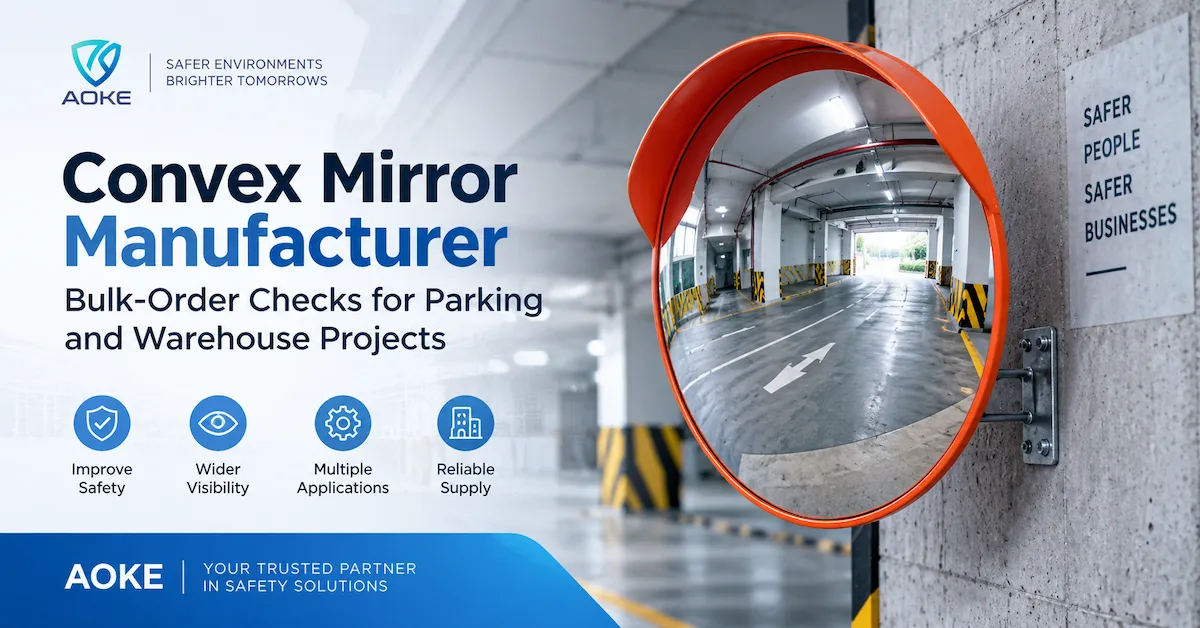
A common purchasing mistake is sending a supplier a message such as “quote 80 cm traffic mirrors” before the actual viewing requirement has been defined. Mirror diameter matters, but it is only one variable. Before asking a convex traffic mirror supplier to recommend a configuration, mark the observer position, proposed mirror location, hidden approach direction, target area, approximate viewing distances, mounting height, surrounding obstacles, and whether the observer is a driver, cyclist, pedestrian, forklift operator, or another user. A mirror intended for an underground parking ramp may face different lighting, mounting, and environmental conditions from one installed at an outdoor road junction. Likewise, a traffic mirror used at a factory vehicle gate is not automatically equivalent to an indoor warehouse corner mirror. Photographs from the real observer position and a simple marked site drawing are usually more useful to a supplier than a product photograph copied from another project. AOKE’s convex safety mirror supplier guide also emphasizes applications such as road intersections, parking entrances, warehouses, factories, loading areas, and commercial facilities.
Build a Traffic Convex Mirror Specification Before Requesting Competing Quotes
A professional RFQ should allow several suppliers to quote the same requirement. Without that common specification, one offer may contain a different face material, thinner backing, simpler bracket, different packaging, or another mounting arrangement, making a low price difficult to interpret. The following table is a buyer-side specification template rather than published AOKE model data. Complete these fields with the selected traffic convex mirror manufacturer before sample approval.
| Specification Item | What the Buyer Should Define or Confirm | What to Request From the Supplier |
|---|---|---|
| Application | Road junction, parking exit, garage ramp, site entrance, internal traffic route | Proposed product configuration |
| Mirror shape | Round, rectangular or another required format | Dimensioned drawing |
| Reflective-face size | Usable mirror dimensions, not only outside housing dimensions | Measured dimensions and tolerance |
| Face material | Acrylic, polycarbonate or another specified material | Material identification and applicable supporting data |
| Optical requirement | Target area and observer positions that must be visible | Recommended configuration and sample-evaluation method |
| Housing/backing | Material, construction and protection around mirror face | Assembly details |
| Hood/rim | Required according to project design | Drawing and material details |
| Mounting system | Wall, pole or project-specific installation | Bracket drawing and complete hardware list |
| Pole compatibility | Required pole dimensions where applicable | Clamp range or mounting interface |
| Outdoor requirement | Sun, rain, temperature, corrosion or other actual exposure | Evidence applicable to the offered configuration |
| Appearance | Color, surface finish, label and permissible cosmetic limits | Approved sample |
| Packaging | Protective film, individual carton, hardware arrangement, export carton | Packing specification and packed dimensions |
| Spare parts | Mirror face, bracket or mounting hardware if separately available | Part references and ordering conditions |
How Should Buyers Compare Acrylic, Polycarbonate, and Other Mirror Materials?
Material names are useful, but they should not replace product-level evaluation. Acrylic is commonly selected where clear reflection and relatively low weight are priorities, while polycarbonate may be proposed where impact resistance is more important. Different constructions can also use different backing, reflective-layer, edge, and housing designs, so buyers should not assume that two mirrors described as “polycarbonate traffic mirrors” are functionally identical. Ask the manufacturer to identify the actual face material, relevant grade, thickness where important, reflective construction, backing material, and any restrictions on cleaning or outdoor exposure. If impact resistance, weather resistance, UV exposure, or operating-temperature performance is important to your project, request evidence specifically connected to the offered mirror configuration rather than relying on a general material description. The mirror face should also be reviewed together with the housing and bracket: a robust face combined with an unsuitable mounting system does not create a robust traffic installation. Material substitutions after sample approval should therefore be treated as controlled changes, not routine purchasing decisions.
Optical Workmanship Matters More Than a Perfect Product Photograph
A traffic mirror is purchased to provide a usable view, so optical evaluation should be part of the sample-approval process. A polished catalogue photograph cannot show how the reflection behaves across the full mirror face at the intended viewing distance. When evaluating a sample, establish a repeatable observer position and target area under safe, controlled conditions, then examine whether relevant objects can be distinguished across the required field of view. Inspect the face for scratches, localized waves, obvious irregularities, abrupt image changes, damage around the edges, contamination beneath protective layers, and inconsistent assembly. Buyers should be cautious with vague claims such as “zero distortion,” because a convex mirror intentionally changes the apparent geometry of the scene to provide a wider view. The meaningful question is whether the finished product gives a usable and sufficiently consistent view for the approved application. Record the approved sample, photograph the evaluation arrangement, and connect that sample to the production specification so later shipments can be compared against the same reference.
Outdoor Mounting Is Part of the Product, Not an Accessory to Review Later
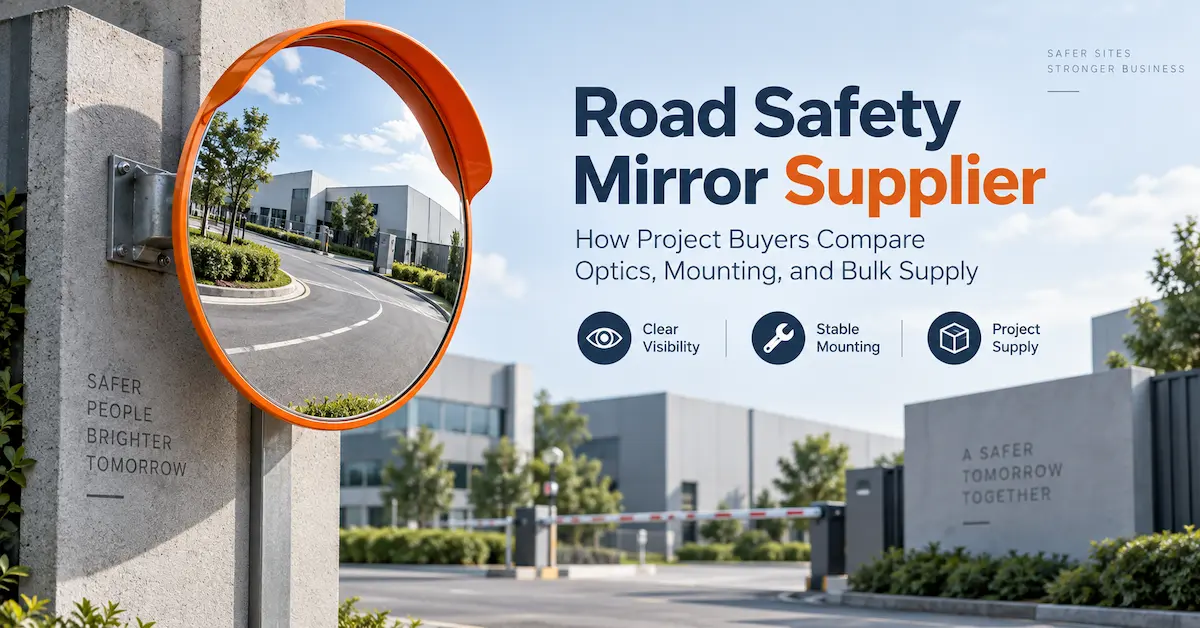
For an outdoor road or parking application, the bracket deserves almost as much attention as the reflective face. A traffic convex mirror manufacturer should clearly identify the mounting components included in the quotation, the intended wall or pole interface, available adjustment, clamp compatibility, fastening method, hardware finish, and any replacement components. Installation responsibility also needs to be separated from product supply: the supplier can provide an intended mounting system, but the installer or responsible project engineer must confirm that the supporting wall, pole, fasteners, location, and local conditions are suitable. If the project has specific wind, corrosion, temperature, or environmental requirements, define them in the RFQ and request applicable evidence. Do not infer outdoor durability simply because a mirror has an orange housing or a rain hood. Evaluate the final view after the mirror is securely positioned, because a mirror that produces the correct field of view on a workbench may perform differently when the real installation angle is constrained.
How Should a Buyer Evaluate Manufacturing and Supply Responsibility?
The word “manufacturer” can describe different supply-chain structures. One company may form the mirror face and assemble the complete product internally; another may manufacture selected components and purchase the bracket; another may coordinate production through qualified partner factories. For B2B buyers, the useful question is not merely whether a supplier calls itself a factory, but who is responsible for the critical product and quality decisions. Ask who produces the reflective face, who controls the housing or backing, who supplies the mounting hardware, who conducts final inspection, who approves component changes, and who handles corrective action if a batch does not match the approved sample. AOKE’s public About Us page provides detailed factory information for its reflective-clothing operations, including production facilities and garment-related equipment, but does not currently publish a comparable mirror-production specification. Therefore, buyers evaluating AOKE for traffic mirrors should request the specific manufacturing or sourcing arrangement for the quoted mirror rather than transferring clothing-production claims to another product category.
Define Quality Control Around the Approved Traffic Mirror
A reliable quality plan begins before mass production. After approving a sample, turn that approval into a controlled reference consisting of the drawing, face material, dimensions, housing, bracket, hardware list, appearance requirements, packaging, labels, and functional inspection method. Pre-shipment checks can then verify product identity, dimensions, visible surface condition, assembly, hardware completeness, bracket fit, protective packaging, carton marking, and any agreed optical evaluation. If a buyer requires laboratory testing or project-specific compliance documents, the traffic convex mirror manufacturer should identify exactly which model or material was evaluated, which method was used, and which version of the product the report represents. AOKE’s current public traffic-mirror content does not provide a model-specific certification package, so such documents should be requested and reviewed according to the destination market or tender requirement. Certifications shown for AOKE’s reflective clothing should not automatically be treated as certification of a traffic convex mirror. This distinction supports the accuracy and traceability emphasized in a professional B2B sourcing process.
Compare Traffic Mirror Configurations by Application Rather Than by Price Alone
Because AOKE’s public site does not currently publish a complete traffic-mirror SKU specification list, it would be misleading to invent model numbers or performance rankings. The following comparison instead shows how buyers can separate common purchasing configurations before requesting an actual quotation.
| Purchasing Configuration | Main Buying Priority | Sample Approval Focus | Commercial Risk to Control |
|---|---|---|---|
| Road-intersection mirror | Required view, outdoor construction, stable mounting | View from actual approach directions and complete bracket | Selecting size before defining site geometry |
| Parking-exit mirror | Driver viewing position, compact mounting area, adjustment | Visibility of hidden approach and mounting angle | Mirror cannot be positioned at required angle |
| Outdoor facility-gate mirror | Weather exposure, pole/wall compatibility, repeatability | Assembly, hardware and viewing requirement | Outdoor claim does not match complete assembly |
| Indoor traffic-route mirror | Optical consistency and simple mounting | View for vehicle/pedestrian conflict point | Paying for unnecessary outdoor features |
| Private-label distributor version | Stable specification, packaging, labels and repeat orders | Product plus complete packaging set | Uncontrolled component changes between orders |
Capacity and Lead Time Must Be Confirmed for the Mirror Order Itself
Do not use unrelated factory capacity to estimate traffic-mirror delivery. A company may have substantial production capability in another product category while using a different supply chain for mirrors. For an accurate quotation, ask the traffic convex mirror manufacturer or supplier to break timing into sample preparation, sample approval, materials or component preparation, production or assembly, inspection, packing, dispatch, and transportation. Mixed orders may also require different lead times for different diameters, bracket types, housing colors, or private-label packaging. Clarify which event starts the quoted production lead time—deposit receipt, artwork approval, final sample approval, or another milestone—and ask what happens if specifications change after production preparation begins. AOKE’s current Stock product page does not publicly display individual goods at the time of review, so “Stock” should not be interpreted as confirmation that a particular mirror size is immediately available. Current inventory, MOQ, configuration, and dispatch date should be confirmed for each enquiry.
OEM and Private-Label Buyers Need More Than a Logo File
For distributors, a private-label project may be as simple as adding a product label and carton artwork, or it may involve a different housing color, bracket, packaging structure, instructions, product identification, or even a new component configuration. These changes should be separated into branding customization and product customization because they have different costs, approval requirements, and production risks. Ask whether existing packaging dimensions can support your branding, whether printed cartons have a separate MOQ, whether labels must withstand outdoor storage or handling conditions, and whether replacement parts need the same private-label identification. If an actual ODM change is requested, such as a new housing or mounting component, define drawing ownership, tooling responsibility, sample cycles, change control, and the point at which the design becomes approved for production. A supplier should not describe every label change as “ODM,” and a buyer should not assume a new structural component can be added without re-evaluating the finished assembly.
What Creates the Real Cost of a Bulk Traffic Convex Mirror Order?
The lowest mirror price is not necessarily the lowest project cost. A comparable quotation needs to identify what is included in the unit: mirror face, housing, hood where applicable, bracket, fasteners, labels, individual packaging, export carton, spare components, and customization. Packed volume can be commercially important because traffic mirrors are physically large relative to their weight, so carton dimensions and packing method can materially affect logistics. Breakage or surface damage in transit may also create replacement and project-delay costs. For repeat orders, an initially cheap configuration may become expensive if the supplier cannot maintain the same bracket, face material, or packaging and the buyer must repeatedly approve changes. The strongest cost comparison therefore uses a controlled specification and the same delivery basis across all suppliers. Ask each bidder to list exclusions rather than allowing missing components to remain hidden in a headline price.
Prepare an Enquiry a Traffic Convex Mirror Manufacturer Can Answer Properly
An effective RFQ should include the application, marked site photographs, observer position, hidden direction, estimated distances, proposed mounting location, required quantity, destination, indoor or outdoor environment, preferred dimensions if already defined, face-material preference if any, bracket requirements, packaging, branding requirements, project schedule, and any tender or documentation requirements. If you do not know which diameter or material to specify, state the performance requirement and ask the supplier to propose a configuration instead of guessing. Buyers planning a larger safety-product package can review AOKE’s Stock safety-product section and related traffic-safety purchasing content to structure a combined enquiry. When the site and commercial requirements are ready, use the AOKE Contact Us page to submit the project information and request mirror-specific specifications, sample options, MOQ, current availability, packing details, and quotation terms.
Frequently Asked Questions
1. What is the difference between a traffic convex mirror and an indoor warehouse convex mirror?
The basic optical principle may be similar, but the purchasing requirements can be different. A traffic installation may require greater attention to outdoor exposure, mounting hardware, driver viewing position, site geometry, vandalism or impact risk, and long-term maintenance. An indoor warehouse mirror may prioritize visibility at pedestrian and forklift intersections without needing the same environmental configuration. Confirm the complete assembly rather than choosing by product name alone.
2. How should I choose a convex mirror for a road intersection?
Begin with the observer locations and the hidden approaches that need to become visible. Record approximate distances, proposed mirror position, available mounting structure, and surrounding obstacles, then provide photographs or a marked plan to the supplier. A recommended mirror should subsequently be evaluated for the actual site arrangement rather than selected from diameter alone.
3. Can a traffic convex mirror manufacturer recommend the size from viewing distance only?
Viewing distance is useful, but it is not the only variable. The angle between approaches, mirror position, required target area, observer height, obstacles, mounting limitations, and mirror geometry can influence the result. Use supplier guidance as a starting point and confirm the proposed configuration against the real application.
4. Is polycarbonate always better than acrylic for outdoor traffic mirrors?
No material should be selected from one characteristic alone. Polycarbonate may be considered when impact resistance is important, while acrylic may be selected for other optical, weight, or commercial reasons. Compare the actual material grade and finished assembly against the project’s impact, optical, weather, maintenance, and budget requirements.
5. What should I check on the mounting bracket?
Confirm whether the kit is designed for a wall, pole, or another support; the compatible pole dimensions where relevant; adjustment range; fasteners supplied; locking method; material or surface finish; replacement-part availability; and whether the complete arrangement suits the actual supporting structure. Installation suitability should be confirmed by the responsible installer.
6. How can I inspect traffic convex mirror optical quality?
Use the same observer position and target area for each sample, then check whether the required scene is usable across the mirror. Look for localized waves, irregular image changes, scratches, edge damage, contamination, and assembly defects. Preserve the approved sample and inspection arrangement as references for production.
7. What documents should project or tender buyers request?
Request the product drawing, material details, mounting information, packing specification, inspection records, and any test or compliance documents specifically required by the destination market or tender. Check that each document applies to the actual offered configuration rather than a different product category.
8. How can I verify whether a supplier is really the traffic convex mirror manufacturer?
Ask which manufacturing processes are controlled directly, where final assembly takes place, who provides critical components, who performs final inspection, and who approves engineering or material changes. Factory photographs alone are less useful than a traceable connection between the quoted product, manufacturing source, approved specification, and quality records.
9. What affects MOQ and lead time for traffic convex mirrors?
Diameter, housing, face material, bracket type, packaging, branding, total quantity, mixed configurations, current component availability, and project documentation can all affect commercial conditions. Request MOQ and lead time for the actual configuration rather than relying on a general company-level figure.
10. What should I send AOKE when requesting a traffic convex mirror quotation?
Send the intended application, site photographs or layout, required quantity, destination, preferred mirror dimensions if known, proposed mounting method, outdoor or indoor conditions, private-label requirements, documentation needs, and target delivery date. AOKE can then evaluate the enquiry against its current sourcing options and confirm product-specific information through its contact page.
Conclusion
Choosing a traffic convex mirror manufacturer should begin with the traffic visibility problem and end with a controlled product specification. Road-safety distributors, parking-equipment companies, contractors, and project buyers should define the observer and target positions, compare mirror materials and complete assemblies, verify mounting compatibility, approve optical workmanship on a representative sample, establish shipment inspection criteria, and confirm mirror-specific manufacturing responsibility, MOQ, lead time, documentation, and customization before placing a bulk order. AOKE’s current public information positions traffic mirrors within its broader safety-product sourcing content, while detailed mirror models and manufacturing data should be confirmed for each project rather than inferred from its reflective-clothing operations. For a product-specific proposal, send your site conditions, quantities, mounting requirements, packaging needs, and delivery schedule through AOKE Contact Us so the appropriate traffic convex mirror configuration can be evaluated.