
Quick Answer: What Should Buyers Look for in a Softshell Work Jacket Supplier?
A reliable softshell work jacket supplier should demonstrate the ability to match fabric construction, weather resistance, breathability, garment design, and manufacturing quality to the conditions in which workers will actually use the jackets.
For B2B buyers, the most important evaluation factors are not simply price or fabric thickness. They include:
-
Fabric performance: Verified wind resistance, water penetration resistance, moisture management, stretch, and abrasion durability.
-
Application suitability: Jacket construction matched to construction sites, logistics operations, utility maintenance, transportation, and outdoor industrial work.
-
Safety compliance: Appropriate high-visibility design and documented conformity where reflective protective clothing is required.
-
Customization capability: OEM branding, color development, material selection, size specifications, functional pockets, and private-label packaging.
-
Manufacturing consistency: Controlled fabric sourcing, sample approval, cutting, sewing, lamination integrity, and quality inspection.
-
Commercial reliability: Clearly defined minimum order quantities, production schedules, inspection procedures, and repeat-order arrangements.
A well-designed softshell jacket balances several competing requirements. Greater weather protection may affect moisture transfer or flexibility, while additional reinforcement may increase weight and manufacturing cost.
The right supplier helps buyers understand these trade-offs before production begins.
For procurement managers, PPE distributors, and workwear brands, the objective is to select a jacket that remains suitable throughout its intended working life, not simply one that looks impressive when a new sample arrives.
1. What Is a Softshell Work Jacket?
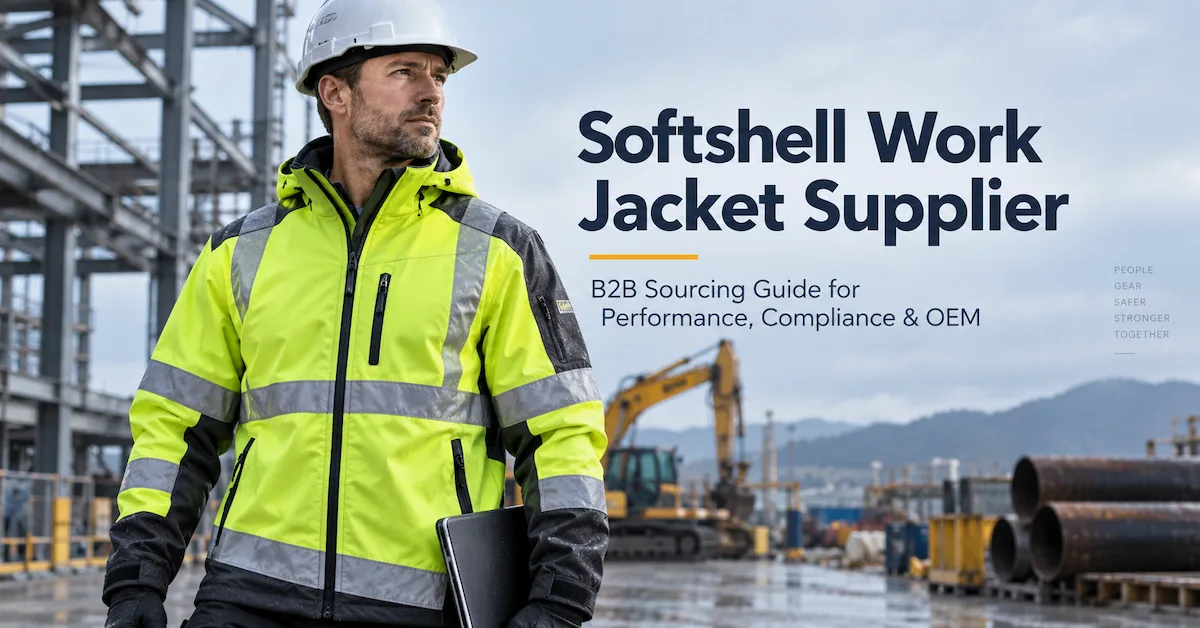
A softshell work jacket is a functional outerwear garment designed to provide a practical combination of wind protection, limited rain resistance, flexibility, and comfort during active work.
Unlike conventional rigid rainwear, softshell garments generally emphasize mobility and wearability in changing but not necessarily extreme weather conditions.
Their performance depends on the textile system and garment construction rather than the word softshell alone.
A typical softshell design may incorporate a woven polyester face fabric, an elastane component for stretch, a laminated membrane, and a brushed or fleece-backed inner surface.
However, not all softshell jackets contain membranes, and not all are constructed from three layers.
Some lightweight versions use a single woven fabric with a water-repellent treatment. Others use two-layer bonded textiles or three-layer laminated assemblies.
These differences significantly affect comfort, production cost, and environmental suitability.
What Makes an Industrial Softshell Jacket Different?
An ordinary outdoor jacket may prioritize appearance, retail comfort, and occasional recreational use.
Industrial softshell workwear must also consider the repeated stresses of work.
Workers may reach overhead, carry equipment, bend frequently, enter vehicles, handle tools, or repeatedly brush against machinery and rough surfaces.
These activities affect garment design.
An industrial specification may therefore include reinforced shoulders, articulated sleeves, stronger pocket construction, more durable zipper assemblies, and controlled dimensional tolerances.
For corporate uniform programs, repeat-order consistency also matters.
A jacket supplied six months later should closely match the approved garment in fabric, color, dimensions, reflective layout, and branding.
This is why selecting a supplier involves evaluating both the garment and the manufacturing process used to reproduce it.
2. Which Buyers Benefit Most From Custom Softshell Work Jackets?
Softshell jackets are useful across multiple industries, but different buyers have different procurement priorities.
| B2B Buyer | Main Purchasing Requirements | Important Supplier Capabilities |
|---|---|---|
| PPE distributors | Competitive pricing, dependable specifications, relevant certification | Product documentation, quality consistency, repeat supply |
| Workwear brands | Differentiated designs and brand identity | OEM development, material sourcing, private-label packaging |
| Construction contractors | Outdoor durability, worker comfort, required visibility | Reinforcement, fit testing, application-specific design |
| Logistics companies | Comfortable daily workwear | Breathable fabrics, mobility, easy maintenance |
| Utility maintenance companies | Wind protection and practical functionality | Pocket placement, durable construction, weather adaptability |
| Municipal service contractors | Visibility and all-season uniform programs | Reflective design, seasonal product coordination |
| Industrial uniform distributors | Standardized sizing and repeated purchasing | Size consistency, production records, stable material specifications |
| Outdoor service companies | Professional appearance and practical weather resistance | Custom colors, logos, controlled fabric performance |
When Are Softshell Jackets Not the Best Choice?
Softshell jackets are not universally suitable protective garments.
For sustained heavy rainfall, a properly specified waterproof rain jacket with suitable seam construction may be more appropriate.
For severe cold, workers may require insulated outerwear or a complete cold-weather clothing system.
For hot indoor warehouses, lightweight high-visibility shirts or safety vests may provide better comfort.
For environments involving flame, electrical arc, hazardous chemicals, or other specialized hazards, ordinary softshell clothing must not replace protective garments designed and verified for those risks.
Buyers should begin with a workplace risk assessment rather than assuming one jacket can satisfy every department.
3. Match Softshell Jacket Specifications to the Working Environment
The most common purchasing mistake is selecting a fabric specification before defining the working environment.
A softshell jacket worn by a mobile warehouse supervisor faces different demands from one worn by a road-maintenance worker during winter mornings.
Temperature, rainfall, wind, physical activity, and washing frequency all influence the correct material and design.
Outdoor Construction and Infrastructure
Construction personnel frequently alternate between stationary inspection and physically demanding tasks.
Their jackets may encounter wind, dust, rough surfaces, and occasional light rain.
Important requirements include shoulder mobility, durable pocket openings, suitable wind resistance, and sufficient room for additional clothing layers.
Where the site requires high-visibility protective clothing, buyers must also confirm that the finished garment satisfies the applicable visibility requirements.
Warehouse and Logistics Operations
Warehouse personnel often move between heated interiors and exposed loading areas.
A heavily insulated, low-breathability jacket may cause discomfort during continuous movement.
For these environments, buyers should prioritize appropriate breathability, low bulk, unrestricted arm movement, and practical closures.
A lightweight softshell jacket can be particularly useful during seasonal temperature changes.
Utility Maintenance and Field Services
Utility technicians may spend long periods outdoors while carrying tools, communication devices, and inspection equipment.
Their clothing should support reaching, crouching, climbing, and vehicle entry.
Useful design features include articulated sleeves, accessible chest pockets, adjustable cuffs, and reinforced areas where straps or equipment create friction.
Any requirements for electrical, flame, or arc protection must be assessed separately.
Transportation and Delivery Operations
Drivers and delivery personnel repeatedly enter and exit vehicles.
Excessive jacket bulk can interfere with seat-belt positioning or cause discomfort while seated.
Useful considerations include shorter garment profiles, flexible shoulders, secure pocket closures, and breathable fabric construction.
Municipal and Road Maintenance
Municipal workers may operate near moving vehicles during early mornings, evenings, or poor weather.
Their primary requirements can include visibility, weather protection, durability, and ease of movement.
A fluorescent jacket with decorative reflective strips is not automatically equivalent to certified high-visibility protective clothing.
The correct garment must be selected according to the working environment and applicable standards.
Application-Based Selection Matrix
| Working Environment | Main Priority | Recommended Design Direction | Important Verification |
|---|---|---|---|
| Active outdoor construction | Mobility and abrasion resistance | Flexible softshell with reinforced areas | Fabric durability and movement testing |
| Warehouse loading areas | Breathability and moderate wind protection | Lightweight softshell | Moisture management and fit |
| Utility maintenance | Functional design and weather adaptability | Multi-pocket work jacket | Pocket strength and ergonomic fit |
| Road maintenance | Visibility and weather protection | High-visibility softshell design | Complete-garment compliance |
| Corporate field service | Appearance and comfort | Branded softshell jacket | Color consistency and logo durability |
| Cold outdoor operations | Wind protection and layering | Fleece-backed or layered softshell | Thermal comfort and garment compatibility |
| Persistent heavy rain | Reliable rain protection | Purpose-designed rainwear | Water penetration and seam performance |
The final selection should reflect the worksite rather than a generic product description.
4. Understanding Softshell Fabric Construction
Fabric architecture is one of the most important technical considerations when choosing an OEM softshell jacket manufacturer.
Two jackets can have similar appearances while offering substantially different performance.
Single-Layer Softshell Fabric
Single-layer softshell fabrics usually rely on woven construction, mechanical stretch, and surface finishing.
Some use durable water-repellent treatments to reduce initial surface wetting.
Advantages may include lighter weight, easier moisture movement, and greater flexibility.
However, performance depends on the weave and finishing system.
A single-layer fabric should not automatically be described as waterproof or windproof without supporting test results.
Two-Layer Bonded Softshell Fabric
A two-layer construction typically combines an outer fabric with an inner textile or functional layer.
Bonding can change the fabric's structure, handle, warmth, and resistance to wind penetration.
Depending on the materials, the inner layer may improve comfort or provide an additional functional barrier.
Buyers should investigate whether the layers remain securely bonded after repeated flexing and washing.
Three-Layer Laminated Softshell Fabric
Three-layer softshell systems commonly combine:
-
An outer woven textile providing appearance, abrasion resistance, and structural support.
-
A functional membrane or middle layer controlling wind and moisture movement.
-
An inner lining or brushed surface contributing comfort and insulation.
This structure can offer an effective balance for outdoor workwear, but the performance is not determined simply by the number of layers.
A poorly specified three-layer fabric can feel hotter, heavier, or less flexible than a well-designed two-layer alternative.
The bonding method, membrane properties, outer textile, and finishing process all matter.
Why Lamination Quality Matters
Lamination joins textile layers into a coordinated structure.
Inconsistent bonding can create problems such as bubbling, separation, stiffness, uneven appearance, or deterioration after laundering.
For bulk manufacturing, procurement teams should ask whether the nominated fabric has been evaluated for bond durability and whether fabric suppliers can reproduce the same construction.
A useful question is:
Will the approved sample and the bulk production fabric come from the same documented material specification?
This matters more than general claims that a supplier uses premium laminated fabric.
5. Critical Technical Specifications for Softshell Work Jackets
A professional purchasing specification should translate descriptions such as water-resistant, breathable, or heavy-duty into measurable requirements.
Without a defined test method, two suppliers may interpret the same marketing term differently.
Technical Specification and Verification Table
| Parameter | What It Measures | Why Buyers Should Check It |
|---|---|---|
| Fabric composition | Fiber percentages and construction | Affects stretch, drying, durability, and feel |
| Fabric weight (GSM) | Mass per unit area | Helps compare material constructions |
| Hydrostatic pressure | Resistance to water penetration | Relevant to fabric rain resistance |
| Water-repellent finish | Surface wetting behavior | Influences initial rain shedding |
| Water-vapor resistance | Resistance to moisture-vapor transfer | Helps evaluate physiological comfort |
| Air permeability | Airflow through the textile | Relevant to wind penetration and ventilation |
| Stretch and recovery | Extension and shape recovery | Affects mobility and fit retention |
| Abrasion resistance | Resistance to surface wear | Important at elbows, shoulders, and contact areas |
| Tear strength | Resistance to propagation of tears | Relevant to industrial durability |
| Dimensional stability | Change after specified laundering | Supports size consistency |
| Colorfastness | Color retention under defined exposure | Important for uniform appearance |
| Lamination durability | Integrity of bonded layers | Helps assess long-term material reliability |
| Reflective performance | Retroreflective performance under specified conditions | Necessary for relevant visibility requirements |
These are categories of measurements, not a claim that every AOKENEW product has already been tested to a particular result.
Water Resistance: What Does Hydrostatic Pressure Mean?
Hydrostatic pressure testing evaluates how well a fabric resists water penetrating under pressure.
ISO 811:2018 describes a method for determining resistance to water penetration in textiles.
Results are commonly expressed as water-column height or an equivalent pressure value.
A higher result generally indicates greater resistance under the stated laboratory test conditions.
However, a fabric test does not establish the waterproof performance of an entire jacket.
Rain can penetrate through needle holes, unprotected seams, closures, or other construction details.
Therefore, buyers should distinguish fabric water resistance from finished-garment rain protection.
Breathability: Why One Number Is Not Enough
Breathability describes several related aspects of moisture and heat transfer.
One commonly used approach evaluates moisture-vapor transfer through a material. Another evaluates resistance to water-vapor movement.
ISO 11092:2026 describes measurement of thermal and water-vapor resistance under steady-state laboratory conditions.
The test result is useful, but it does not directly predict how comfortable every worker will feel in every climate.
Garment ventilation, work intensity, humidity, base layers, and fit also influence comfort.
When comparing two fabrics, buyers should request results obtained using the same method and comparable conditions.
A high moisture-vapor transmission number measured by one method should not automatically be considered superior to a lower number obtained using another.
Wind Resistance and Air Permeability
A softshell fabric can feel breathable without allowing excessive wind penetration.
The relationship depends on material construction and testing conditions.
ISO 9237 provides a method for measuring the air permeability of fabrics.
For outdoor work jackets, suppliers should explain how the proposed textile performs under wind exposure rather than relying only on the term windproof.
Fabric Weight Is Not a Quality Score
Fabric weight, expressed in grams per square meter, helps buyers understand textile mass.
It does not directly prove warmth, durability, or weather protection.
Two fabrics with identical GSM values may differ in membrane construction, knit or weave density, thermal resistance, stretch, and air permeability.
Buyers should evaluate fabric weight alongside the complete performance specification.
6. Water-Resistant vs Waterproof Softshell Jackets
These terms are frequently confused during industrial workwear purchasing.
A water-resistant jacket can resist moisture penetration to a degree under certain conditions.
A water-repellent jacket generally uses a surface treatment or material behavior that encourages water to bead and run off.
A waterproof jacket should be evaluated against clearly defined performance requirements, including relevant construction details.
A softshell jacket may offer useful protection in light rain without being suitable for prolonged exposure to heavy rain.
Why Seams Matter
Even when the fabric provides significant water penetration resistance, water can enter through stitched seams.
Needle holes, zipper openings, pocket construction, hood attachment, and garment interfaces can become entry points.
Purpose-designed rainwear may use sealed seams, protective flaps, specialized zippers, and other construction details.
A softshell jacket without these features should not be represented as providing equivalent finished-garment protection.
When Should Buyers Choose Rainwear Instead?
Consider a rain jacket rather than a softshell jacket when workers are exposed to sustained rainfall, prolonged wet conditions, or procurement specifications requiring recognized rain-protection performance.
Where EN 343 applies, buyers should evaluate the finished protective garment against the relevant edition and performance requirements.
A fabric supplier's hydrostatic pressure test alone is not proof of compliance.
For mixed weather, a layered uniform system may be more practical: a flexible softshell for ordinary outdoor work and an appropriate waterproof outer garment for sustained rain.
AOKENEW offers related high-visibility clothing categories through its reflective clothing product range. Buyers can compare suitable garment types before requesting a custom specification.
7. High-Visibility Softshell Jackets: Standards and Compliance
High-visibility performance is particularly important when softshell jackets are used near vehicles, construction equipment, or other moving machinery.
A jacket's fluorescent color and reflective tape contribute to visibility, but neither feature independently establishes compliance with a protective clothing standard.
EN ISO 20471
EN ISO 20471 is associated with high-visibility clothing requirements used in European markets.
The standard addresses material performance, design, visible areas, and other characteristics of the finished garment.
Different performance classes reflect different requirements for visible materials and garment configurations.
Buyers should verify the applicable edition, required class, and conformity documentation for the destination market.
For European PPE procurement, relevant regulatory conformity obligations may also apply.
ANSI/ISEA 107
ANSI/ISEA 107-2020 establishes requirements for high-visibility safety apparel in the United States.
It uses Type and Performance Class designations.
The applicable Type depends on the intended work environment, while Performance Class is associated with visible material coverage and design requirements.
Buyers should specify the appropriate Type and Class rather than requesting an unspecified ANSI reflective jacket.
AS/NZS Requirements
For Australian and New Zealand applications, procurement teams should verify the applicable high-visibility clothing standards and relevant material requirements.
The correct specification depends on the jurisdiction, working conditions, and project requirements.
A jacket intended for one market should not automatically be assumed compliant in another.
Reflective Tape and Garment Construction
Several design decisions influence visibility:
-
Position and width of reflective elements
-
Continuity and distribution around the body
-
Visibility of the torso and limbs
-
Fluorescent background material area
-
Placement of pockets, logos, and contrast panels
-
Performance after specified cleaning and use
Dark contrast panels may help conceal dirt in high-contact areas, but their placement must not compromise the required visible areas of a certified design.
Likewise, custom embroidery or heat-transfer logos must not obscure areas needed for compliance.
Important: AOKENEW's company profile references international protective clothing standards. Buyers should request model-specific documentation before treating any individual softshell jacket as compliant with a particular standard or performance class.
8. Compare Softshell Jackets With Other Industrial Outerwear
Buyers often use softshell, fleece, rain jackets, and winter jackets interchangeably in early sourcing discussions.
These garment categories serve different functions.
| Garment Type | Main Functional Priority | Common Advantages | Main Purchasing Consideration |
|---|---|---|---|
| Lightweight softshell | Movement and moderate weather protection | Flexible and relatively low bulk | Confirm wind and water resistance |
| Fleece-backed softshell | Wind protection with added warmth | Suitable for cooler transitional conditions | Confirm thermal comfort and breathability |
| High-visibility softshell | Visibility with functional outerwear | Suitable for qualifying outdoor work environments | Verify complete-garment compliance |
| Waterproof rain jacket | Protection from sustained rain | More appropriate for persistent wet conditions | Check seams and rain-performance requirements |
| Insulated winter jacket | Thermal protection | Suitable for cold-weather work | Assess insulation, bulk, and movement |
| Basic fleece jacket | Warmth and layering comfort | Soft and useful as a mid-layer | Limited inherent wind and rain protection |
Softshell vs Fleece
Fleece can provide insulation through its textile structure and trapped air, but conventional fleece may permit considerable airflow.
Softshell construction can reduce wind penetration and add weather resistance.
The best choice depends on whether the worker needs a mid-layer, an outer layer, or both.
For more information about fleece performance and sourcing requirements, read AOKENEW's fleece workwear manufacturer selection guide.
Softshell vs Waterproof Rain Jackets
Softshell designs often prioritize flexibility and comfort during active work.
Rain jackets generally prioritize protection against wet conditions.
A softshell jacket may be appropriate for intermittent drizzle and wind, while sustained rain requires a separately evaluated protective system.
Softshell vs Insulated Winter Jackets
A softshell can be useful in cool and windy conditions, but it is not automatically suitable for severe winter exposure.
Insulation, base layers, wind, physical activity, and exposure duration all affect thermal comfort.
Buyers should evaluate the complete clothing system instead of selecting an outer garment by thickness alone.
9. Garment Engineering: Features That Affect Real Working Performance
Material performance is only one part of jacket quality.
Poor garment construction can undermine an otherwise suitable textile.
Shoulder and Sleeve Mobility
Workers often reach forward and overhead.
If the armhole, shoulder slope, or sleeve pattern is poorly designed, the jacket can pull across the back or rise excessively at the waist.
Useful construction options may include articulated sleeves, adjusted shoulder patterns, gussets, and appropriate stretch distribution.
These features should be tested with intended base layers and work equipment.
Reinforcement at High-Stress Areas
Shoulders, elbows, pocket corners, cuff edges, and zipper ends often experience repeated abrasion or tension.
Reinforcement may be beneficial in these areas.
However, excessive reinforcement can increase stiffness and restrict movement.
The correct reinforcement strategy depends on observed wear risks.
For example, a technician carrying a shoulder bag faces a different abrasion pattern from a warehouse worker who frequently leans against shelving.
Functional Pocket Design
A large number of pockets does not necessarily create a better jacket.
Pocket position, capacity, closure security, and access while wearing gloves matter more.
A field-service jacket may need a secure chest pocket for a device.
A driver may prefer low-profile pockets that do not create bulk while seated.
Buyers should test the pockets with the actual equipment workers carry.
Zippers, Cuffs, and Hems
Zippers are frequent-use components and potential points of failure.
Procurement specifications should cover zipper type, length, strength, operation, and replacement expectations.
Adjustable cuffs and hems may help manage wind entry and improve fit.
However, closures must remain convenient during work.
Hood Design
A hood can improve comfort in exposed conditions, but it may interfere with helmets, visibility, hearing, or other PPE.
Where hoods are required, buyers should test their compatibility with the complete workplace equipment system.
Never assume that a larger hood automatically provides better protection.
10. OEM and Private Label Softshell Jacket Customization
OEM manufacturing allows distributors and workwear brands to develop jackets around specific functional, commercial, and visual requirements.
Customization should begin with a controlled technical brief.
Fabric and Color Customization
Depending on material availability and project feasibility, buyers may request changes to fabric construction, weight, color, finish, and functional performance.
Custom colors should be approved against a physical standard or a clearly defined color reference.
For high-visibility garments, color selection must also respect any applicable background material requirements.
Logo Application
Common garment branding techniques include embroidery, screen printing, and heat-transfer printing.
Each technique interacts differently with softshell fabrics.
Embroidery may create needle penetrations and local stiffness.
Heat-transfer applications require suitable bonding temperatures, pressure, and fabric compatibility.
Printing must withstand the agreed care conditions without unacceptable cracking, peeling, or appearance changes.
On certified high-visibility clothing, logo placement must be reviewed against the approved garment design.
Functional Design Customization
Possible OEM modifications include:
-
Additional or relocated pockets
-
Contrast panels in permitted areas
-
Reinforced elbows or shoulders
-
Alternative cuff closures
-
Adjustable hems
-
Custom zipper pulls
-
Hood modifications
-
Size grading for particular markets
-
Custom reflective tape layouts
Each alteration should be assessed for its effect on comfort, manufacturing feasibility, and any required compliance.
Private Label Packaging
Workwear brands may also require custom labels, care instructions, hangtags, individual packaging, carton marks, and inventory identification.
Where protective performance is claimed, labeling should communicate the correct standard, applicable class, and required care information.
Private-label presentation should not obscure traceability or mandatory product information.
Why OEM Samples Matter
Digital mockups are useful for checking colors and logo positions.
They cannot fully demonstrate fabric performance, garment fit, stretch behavior, or wash durability.
A physical pre-production sample remains essential for approving the design that will be reproduced in bulk.
Buyers exploring broader customization options can consult AOKENEW's OEM safety workwear sourcing guide.
11. How to Evaluate Quality Control Before Bulk Production
A supplier's quality system should identify defects before they affect an entire order.
Softshell jackets introduce additional inspection requirements because their performance depends on both textile structure and garment construction.
Incoming Material Inspection
Before cutting begins, the manufacturer should verify the received fabric against the approved specification.
Important checks include fiber composition documentation, fabric weight, roll width, color, visible defects, and relevant performance reports.
For laminated fabrics, inspection should also address the integrity and consistency of the bonded structure.
Any substitute material should require buyer approval before use.
Cutting and Component Preparation
Accurate cutting supports size consistency and efficient material use.
Inspectors should consider fabric direction, pattern matching, component dimensions, and visible shade differences.
A small variation in one garment may become a significant problem when multiplied across a large multi-size order.
In-Process Sewing Inspection
During assembly, attention should be given to seam consistency, stitch quality, pocket alignment, zipper installation, reinforcement, and reflective element placement.
Defects found during production are generally easier to correct than defects discovered after final packing.
Finished Garment Inspection
Finished jackets should be evaluated against the approved sample and technical specification.
Inspection can include garment dimensions, appearance, functionality, labeling, packaging, and relevant performance characteristics.
Recommended Quality Verification Matrix
| Inspection Stage | Main Checks | Evidence Buyers Can Request |
|---|---|---|
| Fabric approval | Composition, GSM, color, performance | Material specification and test reports |
| Incoming fabric | Shade, defects, width, bonding | Incoming inspection record |
| Cutting | Panel dimensions, direction, consistency | Cutting inspection records |
| Sewing | Stitching, reinforcement, seam appearance | In-process QC reports |
| Reflective application | Position, attachment, design consistency | Approved layout and inspection records |
| Branding | Position, appearance, bonding or embroidery | Approved artwork and decoration sample |
| Garment measurement | Chest, sleeve, length, tolerance | Size measurement report |
| Functional checks | Zippers, pockets, cuffs, hood | Functional inspection checklist |
| Final inspection | Appearance, quantity, labeling, packaging | Final QC report |
| Shipment approval | Cartons, packing list, order identity | Shipping inspection documents |
Testing After Washing
Initial fabric performance is not enough for long-term industrial use.
Laundering can affect water-repellent finishes, bonded layers, reflective elements, dimensional stability, and applied logos.
ISO 6330:2021 describes domestic washing and drying procedures used for textile testing.
The buyer must still define the number of cycles, care conditions, test methods, and acceptance criteria appropriate to the product.
Industrial laundering may require a different assessment.
A supplier's statement that a jacket can withstand a particular number of washes should be supported by relevant test evidence rather than treated as a general promise.
The Importance of a Golden Sample
A golden sample is the final approved reference garment used to guide production.
It should represent the accepted fabric, color, sizing, construction, reflective arrangement, and branding.
The sample should be linked to an identifiable revision of the technical specification.
When suppliers and buyers retain matching references, repeat orders become easier to verify and disputes become less subjective.
12. How to Compare Softshell Work Jacket Suppliers
Supplier selection should consider more than manufacturing capacity.
A large garment factory may produce high volumes but lack experience with the specific technical requirements of laminated workwear.
A small specialist may offer excellent sampling but limited capacity for large orders.
The preferred partner should match the project's technical and commercial requirements.
Technical Knowledge
Ask the supplier to explain the proposed fabric system.
Can the team distinguish surface water repellency from resistance to water penetration?
Can it explain the limitations of a fabric-only test?
Can it identify appropriate testing methods and show evidence related to the selected materials?
A supplier that provides clear technical explanations can help buyers avoid inappropriate specifications.
Sampling Capability
Sampling should demonstrate more than stitching quality.
It should allow evaluation of wearer mobility, layering, material behavior, trim functionality, and customization.
Ask how design revisions are recorded and how the final approved sample controls bulk production.
Manufacturing Capacity
Capacity should be evaluated at the level of the relevant product and production line.
A factory's total monthly garment capacity does not establish its available capacity for one softshell style.
Buyers should ask about production allocation, fabric availability, and expected order complexity.
Quality Documentation
Reliable suppliers should be able to explain how they manage material changes, production defects, measurement tolerances, and final inspection.
Where a performance claim is important to the order, ask for documentation traceable to the exact material or garment configuration.
Communication and Change Management
International orders frequently involve design changes, packaging revisions, or size adjustments.
A supplier should distinguish approved requirements from proposed alternatives and provide a process for documenting changes.
Uncontrolled changes can undermine repeat-order consistency even when the initial sample was satisfactory.
13. AOKENEW's Manufacturing Background and OEM Support
Jinhua Aoke New Materials Co., Ltd., operating under the AOKE/AOKENEW name, presents itself as a manufacturer specializing in reflective apparel and safety workwear.
According to its published company information, AOKENEW has operated since 2010 and serves domestic and international business customers.
Its product range covers reflective clothing and multiple workwear categories, including garments used in outdoor and industrial environments.
Manufacturing Facilities
AOKENEW describes three manufacturing locations with different production roles.
Jinhua: The company identifies its Jinhua facility with smaller orders and higher customization requirements.
Chongqing: Its Chongqing facility is positioned around reflective clothing and medium-scale garment production.
Myanmar: Its Myanmar manufacturing operation is described as supporting larger-scale garment production.
The company's published figures describe monthly capacities of approximately 50,000, 200,000, and 1.5 million garments respectively.
These are company-reported figures for broader garment manufacturing operations, not confirmed softshell-specific monthly capacities or guaranteed availability for a particular order.
A buyer should request a project-specific production plan before relying on them.
Development and Sampling
AOKENEW also reports operating two technical sample rooms supporting customer customization and new style development.
For OEM softshell projects, this background provides a useful starting point for discussing fabric selection, garment structure, sample approval, and brand customization.
However, buyers should still verify the exact proposed materials, available construction options, relevant testing, and production allocation.
What Buyers Should Ask AOKENEW
When evaluating an OEM project, request a response covering:
-
Proposed softshell fabric construction and specification
-
Suitable jacket styles and customization options
-
Required high-visibility or weather-protection standards
-
Sampling process and sample approval milestones
-
Project-specific MOQ and production schedule
-
Quality inspection requirements
-
Packaging, delivery terms, and repeat-order arrangements
You can learn more about the company's operations through the AOKENEW About Us page.
For a new project, supplying a complete specification is more useful than requesting an unqualified price per jacket.
14. What Determines the Cost of Wholesale Softshell Work Jackets?
Wholesale softshell jacket pricing depends on multiple technical and commercial factors.
A quotation for a lightweight standard garment cannot be compared fairly with a custom-designed high-visibility jacket using different laminated fabric, reinforcements, and documentation requirements.
Fabric Construction
Fabric typically represents a significant material cost component.
The price can be influenced by fiber composition, membrane construction, lamination, dyeing, finishing, and ordered quantity.
Custom-developed materials may require additional sourcing time and minimum commitments.
Garment Complexity
Additional pockets, panels, reinforcements, complex seam structures, specialty zippers, and reflective elements can increase material use and production time.
A visually small modification may create additional cutting or sewing operations.
Testing and Compliance
Testing requirements can influence total project cost.
Where third-party testing or certification is necessary, buyers should clarify whether the quotation includes those services.
A low-price quote that excludes mandatory testing may not represent the actual landed cost of a compliant product.
Order Quantity and Size Distribution
Larger quantities may improve purchasing and production efficiency, but the result depends on fabric availability, style complexity, and capacity utilization.
A large order divided into many colors, designs, and size combinations can have different economics from a single standardized production run.
Branding and Packaging
Logos, labels, hangtags, packaging materials, and carton specifications contribute to the total price.
Buyers should separate essential requirements from optional branding features when comparing offers.
Total Cost of Ownership
A procurement decision should consider more than the initial factory price.
A useful purchasing model includes:
Total Program Cost = Garment Purchase Cost + Testing + Customization + Freight + Duties + Inspection + Replacement and Reorder Costs
The lowest initial quotation is not necessarily the lowest-cost solution over the uniform program's intended life.
Early replacement, rejected goods, inconsistent sizing, and delayed replenishment may create substantial indirect costs.
15. MOQ, Sampling Time, and Bulk Production Lead Time
Minimum order quantity and delivery time should be quoted for the actual project.
Softshell jackets may require specific fabric colors, membranes, laminated materials, zippers, reflective components, or custom packaging.
Availability of these materials can influence the feasible order quantity and schedule.
Why MOQ Varies
MOQ may depend on:
-
Standard versus custom fabric
-
Available material stock
-
Color development requirements
-
Number of sizes and styles
-
Branding and packaging complexity
-
Fabric mill purchasing requirements
-
Production line allocation
A stock-fabric jacket with a simple logo may require a different minimum quantity from a newly developed three-layer fabric construction.
Buyers should request MOQ by style, color, and order configuration rather than assuming one company-wide minimum.
Sampling Schedule
Sampling time depends on whether the required fabric and trims are available.
A standard pattern with minor changes may be easier to prepare than a completely new design involving multiple fabric trials.
Allow time for first samples, evaluation, revisions, and final approval.
Bulk Production Schedule
Bulk lead time should be measured from an agreed starting milestone, such as final sample approval and confirmation of required materials.
It may include fabric procurement, cutting, sewing, decoration, inspection, and packing.
Transportation time should be stated separately.
A realistic schedule should identify the critical steps and the actions required from the buyer.
Repeat-Order Planning
For long-term uniform programs, preserving fabric and trim specifications is essential.
Ask whether the supplier can reserve material, maintain a documented specification, or offer an agreed alternative if the original material becomes unavailable.
This can be more valuable than obtaining the shortest possible lead time on the first order.
16. A Practical OEM Softshell Jacket Sourcing Process
An organized sourcing process reduces misunderstandings and creates measurable approval points.
Step 1: Define the Work Environment
Describe the industry, expected temperature, wind exposure, rainfall, physical activity, and garment wearing schedule.
Include whether the jacket will be used with other PPE.
Step 2: Identify Mandatory Standards
Confirm the destination market and applicable protective clothing requirements.
Distinguish mandatory standards from optional commercial preferences.
Step 3: Prepare a Technical Specification
List fabric construction, desired performance, jacket features, colors, size range, branding, and packaging requirements.
Identify which properties require test evidence.
Step 4: Evaluate Supplier Capability
Check technical knowledge, sample development, relevant manufacturing experience, available production capacity, and quality systems.
Step 5: Request Material Options
Where appropriate, compare multiple fabric constructions.
Ask for material specifications and relevant test results.
Step 6: Develop and Review Samples
Test garment fit, mobility, layering, closures, and functional details.
Review samples under conditions resembling actual use.
Step 7: Approve the Final Specification
Record all accepted materials, dimensions, artwork, labels, and construction details.
Establish an approved reference sample.
Step 8: Confirm Commercial Terms
Agree on MOQ, price basis, payment milestones, Incoterms, production dates, inspection responsibilities, and change-control procedures.
Step 9: Monitor Production and Inspection
Confirm material approval, production progress, and inspection milestones.
Any deviation from the agreed specification should be documented.
Step 10: Plan Repeat Orders
Retain the approved product information and clarify how future production will match the original order.
Buyers can also review AOKENEW's workwear manufacturing services guide for a broader view of the garment sourcing process.
17. Common Mistakes When Buying Softshell Work Jackets in Bulk
Choosing the Highest Waterproof Rating Without Considering Comfort
Higher water resistance is not always the most important requirement.
Workers who remain highly active may place significant demands on moisture management and ventilation.
Evaluate the complete use case.
Comparing Breathability Values From Different Test Methods
Different test methods can produce values that should not be compared directly.
Ask suppliers to identify how results were obtained.
Assuming Fluorescent Color Means Certification
High-visibility compliance involves more than garment color.
Verify the complete product configuration and applicable documentation.
Approving Only a Visual Sample
A visually attractive sample may conceal problems with fit, material durability, or performance.
Physical and technical evaluation should precede production approval.
Accepting Unsupported Durability Claims
Statements such as 50-wash durability or fully windproof should be backed by relevant test conditions and product-specific evidence.
Ignoring Repeat-Order Consistency
Changes in fabric, trim, sizing, or color can create problems across uniform programs.
Establish revision control before ordering.
Selecting a Supplier Based Only on Unit Price
Low initial cost may not justify the risk of inconsistent quality, delayed deliveries, or premature replacement.
Evaluate total procurement value.
18. What Should Be Included in a Softshell Jacket RFQ?
A detailed request for quotation helps suppliers provide more accurate technical and commercial responses.
A practical RFQ should include the following information.
| RFQ Field | Information to Provide |
|---|---|
| Buyer and market | Company, destination country, intended distribution or use |
| Application | Industry, job role, environmental conditions |
| Garment type | Lightweight, fleece-backed, high-visibility, or other softshell |
| Fabric requirements | Composition, construction, GSM, desired performance |
| Compliance | Applicable standards and required documentation |
| Design | Sketches, reference images, functional features |
| Branding | Logo size, position, method, labels |
| Sizes | Size chart, quantities by size, fit requirements |
| Quantity | Initial order, anticipated repeat volume |
| Packaging | Individual bags, labels, carton specifications |
| Testing | Required methods, reports, approval criteria |
| Delivery | Destination, required shipping date, preferred Incoterm |
Request a Project-Specific Quotation
If you are sourcing softshell work jackets for a distribution business, industrial uniform program, or private-label brand, AOKENEW can be contacted to discuss the proposed specifications and manufacturing options.
Share your target market, expected quantity, fabric requirements, certification needs, size range, and branding artwork.
Contact AOKENEW to discuss your softshell jacket project.
A clear technical brief allows the supplier to identify suitable development options, clarify feasibility, and prepare a more relevant quotation.
19. Frequently Asked Questions About Softshell Work Jacket Suppliers
1. What Is the Difference Between a Softshell Work Jacket and a Regular Outdoor Jacket?
A softshell work jacket is specified for occupational use, where repeated movement, abrasion, laundering, consistent sizing, and functional features may be especially important.
A regular outdoor jacket may offer similar fabric technology, but it is not necessarily developed around industrial uniform requirements.
Buyers should compare material performance, garment construction, durability expectations, and repeat-order consistency rather than relying on the product category alone.
2. Are Softshell Work Jackets Waterproof?
Not necessarily.
Many softshell jackets are designed to resist wind and light rain while maintaining useful flexibility and comfort.
Some constructions provide higher water penetration resistance, but finished-garment waterproof performance also depends on seams, closures, and other design details.
For prolonged heavy rain or environments requiring certified rain protection, buyers should evaluate appropriate waterproof workwear rather than assuming a softshell jacket will be sufficient.
3. What Fabric Is Best for Industrial Softshell Work Jackets?
There is no universally best fabric.
A lightweight woven material may suit active workers who require mobility and moisture management.
A laminated, fleece-backed material may be more appropriate for cooler and windier conditions.
The buyer should compare fabric composition, construction, weight, water resistance, air permeability, breathability, durability, and care requirements.
The correct fabric is the one that matches the specified environment and intended garment design.
4. Can Softshell Jackets Meet EN ISO 20471 or ANSI/ISEA 107 Requirements?
They can be designed and assessed for applicable high-visibility requirements, but compliance must be established for the particular finished garment.
The presence of fluorescent fabric or reflective tape alone is not sufficient.
Buyers should verify the relevant standard, performance class or type, garment design, labeling, and supporting test documentation.
Custom changes affecting visible material areas may require further compliance review.
5. What Is the Minimum Order Quantity for Custom Softshell Work Jackets?
MOQ depends on fabric availability, custom color requirements, style complexity, branding, and manufacturing arrangements.
A standard fabric with simple logo customization may have different minimums from a project requiring special laminated material or a new garment pattern.
Buyers should request a project-specific MOQ by style and color.
They should also clarify whether samples, pilot orders, and repeat orders have different commercial conditions.
6. How Long Does OEM Softshell Jacket Production Take?
Production time depends on the development stage, fabric sourcing, order quantity, number of styles, and available manufacturing capacity.
A repeat order using approved materials and patterns may be easier to schedule than an entirely new OEM project.
Buyers should distinguish sample development, material procurement, bulk manufacturing, inspection, and shipping.
The final delivery commitment should be agreed against actual project milestones.
7. Can Softshell Work Jackets Be Customized With Company Logos?
Yes, suitable softshell designs can incorporate brand customization through techniques such as embroidery or printing.
However, the chosen method must be compatible with the fabric construction and care requirements.
For jackets with mandatory high-visibility performance, logo position and dimensions should be reviewed against the compliant garment layout.
A physical sample should be approved before bulk decoration begins.
8. How Can Buyers Verify Softshell Jacket Quality?
Request a technical specification, approved sample, material identification, relevant test reports, and an inspection plan.
Evaluate water penetration resistance, moisture management, stretch, abrasion durability, seam quality, zippers, sizing, and any required reflective performance.
Where durability claims depend on washing, confirm the laundering method and acceptance criteria.
The most reliable assessment combines documented testing with practical sample evaluation.
9. What Information Should PPE Distributors Request From a Supplier?
PPE distributors should request product specifications, applicable compliance documents, material and size information, customization conditions, MOQ, pricing basis, packaging requirements, production lead time, and repeat-order arrangements.
They should also clarify the manufacturer's procedure for managing defects, substitute materials, and product revisions.
These details help distributors maintain consistent product listings and reduce downstream customer complaints.
10. How Should B2B Buyers Choose Between Softshell, Fleece, and Waterproof Work Jackets?
Begin with the work environment.
Choose a softshell construction when workers need flexibility, practical wind protection, and suitable resistance to intermittent moisture.
Consider fleece when insulation and layering comfort are the main priorities.
Select appropriate waterproof rainwear when prolonged wet-weather protection is required.
Where visibility or specialized protection is mandatory, verify the applicable finished-garment requirements regardless of which garment category is selected.
Conclusion
Choosing the right softshell work jacket supplier requires a clear understanding of fabric performance, workplace conditions, compliance requirements, and manufacturing consistency. B2B buyers should prioritize verified specifications, practical sample testing, reliable quality control, and long-term OEM support rather than unit price alone.
For distributors, workwear brands, and industrial procurement teams planning custom or bulk orders, contact AOKENEW to discuss your softshell work jacket requirements and explore suitable materials, customization options, and project-specific manufacturing solutions.