
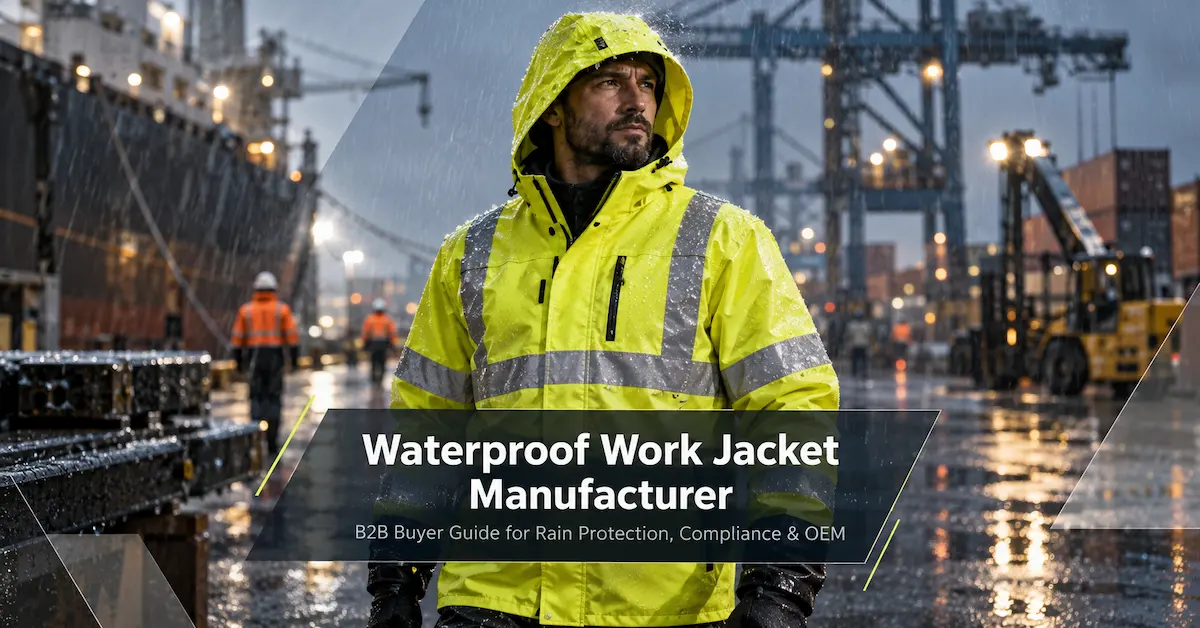
A reliable waterproof work jacket manufacturer must be able to deliver more than water-resistant fabric. For professional industrial use, waterproof performance depends on a coordinated system of fabric construction, seam sealing, zipper protection, garment design, material testing, and consistent manufacturing processes.
For PPE distributors, workwear brands, construction contractors, and industrial procurement teams, selecting the right manufacturer involves six essential considerations:
- Waterproof performance: The outer fabric, seams, and finished jacket must meet the agreed resistance-to-water requirements.
- Breathability and comfort: Workers need practical moisture management during physically demanding outdoor activities.
- Application suitability: Jackets must match the working environment, from road construction and port operations to municipal maintenance and logistics.
- Safety compliance: High-visibility or other protective functions must meet applicable standards when required.
- OEM manufacturing capability: The factory should support appropriate materials, custom designs, private labeling, samples, and controlled production.
- Bulk-order reliability: Buyers need consistent dimensions, material quality, workmanship, inspection procedures, and delivery planning.
The most common sourcing mistake is assuming that a waterproof fabric automatically makes a waterproof garment.
A jacket may use fabric with strong laboratory water-resistance results but still leak at the shoulders, zipper, pockets, hood attachment, or stitched seams.
A dependable manufacturer should therefore explain how the complete garment is designed, tested, and inspected.
For B2B buyers, the goal is not simply to purchase a jacket advertised as waterproof. It is to develop a repeatable product specification that delivers the appropriate protection, comfort, durability, and commercial value for the intended market.
1. What Is a Waterproof Work Jacket?
A waterproof work jacket is an outer garment designed to resist rain penetration and help keep the wearer's covered upper body dry under defined working conditions.
Unlike ordinary fashion rainwear, an industrial waterproof jacket may also need to accommodate high-visibility materials, functional pockets, repeated movement, work equipment, frequent laundering, and long-term uniform replacement programs.
Its performance depends on several interconnected elements.
Waterproof Fabric Construction
The base material may use a protective coating, laminated membrane, or another barrier system to reduce liquid-water penetration.
Different fabric constructions offer different combinations of flexibility, durability, breathability, weight, and manufacturing cost.
Waterproof Seam Construction
Most garment panels must be joined using stitching or other assembly techniques.
Stitching can create holes through protective fabric layers.
Without appropriate seam protection, these openings may allow water to enter even when the surrounding fabric resists water penetration.
Weather-Protective Garment Design
Hoods, collars, cuffs, hems, pockets, and front closures influence how effectively rain is prevented from entering the garment.
A jacket's protective performance must therefore be evaluated as a complete system.
Industrial Durability
Work jackets may be exposed to bending, stretching, abrasion, repeated washing, and contact with equipment.
Protective materials must retain acceptable performance under the intended care and working conditions.
Waterproof vs Water-Resistant vs Water-Repellent
These terms describe related but different properties.
| Term | Main Meaning | Procurement Implication |
|---|---|---|
| Water-repellent | Surface resists wetting and encourages water to bead | Does not independently establish resistance to water penetration |
| Water-resistant | Material or garment resists penetration to a specified degree | Performance depends on construction and test conditions |
| Waterproof | Intended to prevent water penetration under defined requirements | Requires clear performance criteria and appropriate verification |
| Waterproof-breathable | Combines liquid-water resistance with water-vapor transfer | Both functions should be measured and evaluated |
| Rain-protective clothing | Garment intended to protect against precipitation | Relevant garment-level standards and construction must be assessed |
For serious procurement, these descriptions should be supported by measurable specifications rather than marketing terminology alone.
2. Who Needs a Waterproof Work Jacket Manufacturer?
Waterproof industrial jackets serve different business customers, and each buyer group has distinct sourcing requirements.
PPE Distributors and Safety Equipment Wholesalers
Distributors need products that can be sold consistently across their customer base.
They may supply road contractors, municipalities, logistics companies, construction projects, and industrial maintenance businesses.
Their priorities usually include:
- Clearly defined waterproof specifications
- Suitable product documentation
- Consistent sizing and colors
- Competitive wholesale pricing
- Private-label opportunities
- Reliable repeat-order supply
- Appropriate packaging and product identification
For distributors, product reliability directly affects customer complaints, returns, and brand reputation.
Workwear Brands and Private Label Companies
Workwear brands often require products that differ from standard catalog garments.
They may specify particular colors, logos, fabrics, pocket arrangements, reflective layouts, or packaging designs.
These buyers need a manufacturer that understands both garment development and ongoing production consistency.
A supplier must be able to translate a design brief into an approved specification and reproduce it across subsequent orders.
Construction and Roadwork Contractors
Construction and road-maintenance workers may operate in wet weather near heavy machinery or moving vehicles.
Their clothing requirements often involve a combination of rain protection, practical mobility, visibility, and durability.
High-visibility performance may be mandatory depending on the project and jurisdiction.
Municipal and Public Service Contractors
Municipal workers may perform outdoor duties in rain, wind, and changing temperatures.
Uniform programs often involve multiple departments, large size ranges, repeated washing, and scheduled replacement cycles.
Procurement teams benefit from stable fabric specifications and clear reorder procedures.
Logistics, Ports, and Transportation Companies
Loading docks, port facilities, and transportation yards may expose employees to intermittent or prolonged rainfall.
Jackets should protect against wet weather without creating excessive heat buildup during continuous physical work.
Comfort, mobility, secure pockets, and uniform identification can be as important as waterproof performance.
Industrial Maintenance and Utility Companies
Maintenance technicians may require weather protection while climbing, bending, reaching, and carrying equipment.
Garment design must account for functional movement and compatibility with other workplace equipment.
Where chemical, flame, electrical, or other specialized hazards exist, additional protective requirements must be evaluated separately.
3. How Working Conditions Determine Waterproof Jacket Specifications
An effective waterproof jacket sourcing project should begin with the intended environment rather than a generic product catalog.
A jacket suitable for occasional rain during warehouse loading may be inappropriate for a road-maintenance worker exposed to prolonged precipitation.
Construction and Road Infrastructure
Road and infrastructure workers may experience heavy rain, wind, traffic exposure, and repeated movement.
Depending on the application, important features can include:
- Appropriate waterproof outer materials
- Protected or sealed seams
- Adjustable hood and cuffs
- Suitable high-visibility design
- Durable closures
- Reinforced high-wear areas
- Compatibility with helmets and other equipment
The required protection level should reflect the project risk assessment.
Ports and Marine-Adjacent Operations
Port workers may encounter heavy rainfall, persistent moisture, and strong winds.
A longer jacket profile, well-protected closures, and appropriate rainwear construction may be useful.
Salt exposure and cleaning procedures may also influence material and hardware selection.
Ordinary rainwear should not be assumed suitable for immersion, wave impact, or specialized marine protective applications.
Logistics and Loading Yards
Employees may frequently move between sheltered facilities and rainy outdoor areas.
A lightweight waterproof-breathable jacket may provide a better balance than heavily insulated rainwear.
Ease of removal, movement, and temperature management should be assessed.
Municipal Maintenance
Municipal teams may need high-visibility waterproof jackets that remain practical during extended outdoor shifts.
Reflective material durability, fabric cleaning requirements, and repeat-order color consistency can be particularly important.
Industrial Field Services
Field-service technicians often prioritize movement, accessible pockets, and weather adaptability.
The jacket should not interfere with tools, equipment, or other required PPE.
Environment-Based Selection Table
| Work Environment | Main Requirement | Suitable Design Direction | Critical Verification |
|---|---|---|---|
| Road construction | Rain protection and visibility | High-visibility waterproof shell | Rain protection and visibility documentation |
| General construction | Durability and mobility | Reinforced waterproof jacket | Abrasion, seams, movement |
| Port and loading operations | Persistent wet-weather protection | Waterproof outer jacket | Seams, closures, water penetration |
| Warehouse loading | Light weight and comfort | Lightweight waterproof-breathable jacket | Moisture management and fit |
| Municipal maintenance | Visibility and repeated use | Hi-vis waterproof workwear | Reflective layout and wash durability |
| Outdoor utilities | Weather resistance and functional storage | Multi-pocket waterproof jacket | Pocket construction and equipment compatibility |
| Cold, rainy environments | Combined rain and thermal protection | Waterproof shell with suitable insulation or layering | Rain and thermal performance |
| Corporate field services | Professional appearance and comfort | Branded waterproof jacket | Color, branding, wearability |
The most effective design is the one that matches actual exposure and operating requirements.
A heavier or more expensive garment is not automatically better.
4. Waterproof Fabric Technology: Coatings, Membranes and Laminated Materials
Fabric selection is one of the most technically important decisions in waterproof workwear manufacturing.
Different systems control water penetration through different physical structures.
PU-Coated Fabrics
Polyurethane coatings are widely used in weather-resistant textiles.
A PU-coated fabric typically consists of a textile substrate with a polymer coating applied to provide resistance to water penetration.
Advantages may include useful flexibility, a range of fabric weights, and established manufacturing processes.
However, performance depends on the specific formulation, coating thickness, substrate, manufacturing quality, and aging conditions.
Buyers should not assume every PU-coated fabric provides identical waterproofness or durability.
PVC-Coated Fabrics
PVC-coated fabrics can be used where robust rain protection and certain durability characteristics are prioritized.
Depending on the construction, they may offer strong water penetration resistance.
However, they can also be relatively heavy or less comfortable during active work.
Suitability depends on garment requirements, material formulation, environmental conditions, and relevant chemical compliance expectations.
PU Membrane Laminates
A laminated membrane can form a liquid-water barrier within a multilayer textile assembly.
The outer textile provides physical structure, while the membrane contributes resistance to water penetration.
The overall system must also be assessed for water-vapor resistance, durability, and bonding integrity.
Two-Layer and Three-Layer Constructions
A two-layer construction may combine an outer face fabric with a membrane or other protective layer.
A three-layer construction commonly adds a bonded inner protective textile.
The inner layer can help protect the membrane and influence comfort and handling.
However, adding layers does not automatically improve waterproof performance.
Fabric composition, bonding quality, membrane characteristics, and garment design remain important.
How to Compare Fabric Systems
| Fabric System | Main Advantages | Potential Limitations | Suitable Evaluation |
|---|---|---|---|
| PU-coated woven fabric | Flexible construction and broad sourcing possibilities | Finish and coating durability vary | Water penetration and aging tests |
| PVC-coated fabric | Can provide robust wet-weather protection | Weight and comfort may be concerns | Flexibility, durability and suitability |
| Two-layer laminate | Functional barrier with varied construction options | Inner protection may require separate lining | Bond strength and membrane performance |
| Three-layer laminate | Integrated layered construction | Cost, stiffness, and performance vary by design | Lamination durability and comfort |
| Water-repellent woven fabric | Lightweight and comfortable in some conditions | Not necessarily waterproof | Surface wetting and penetration tests |
A professional manufacturer should recommend a material based on the intended work environment and verified performance requirements.
5. How Waterproof Performance Should Be Tested
Buyers should never rely on an unqualified statement such as 100% waterproof.
Professional purchasing requires clearly defined test methods and acceptance criteria.
Hydrostatic Pressure Testing
Hydrostatic pressure testing evaluates a fabric's resistance to water penetration under increasing pressure.
ISO 811:2018 provides a recognized method for determining this property in textiles.
Results may be expressed as pressure or an equivalent height of water.
A higher result generally indicates greater resistance under the specified laboratory conditions.
However, test results must be compared using compatible methods, specimens, conditioning, and reporting requirements.
A fabric rated at a particular hydrostatic head does not automatically establish the protective performance of the finished jacket.
Surface Wetting Resistance
ISO 4920:2012 describes a spray test for evaluating resistance to surface wetting.
It helps assess whether water wets or beads on the fabric surface.
This is useful for evaluating water-repellent treatments.
However, the method does not measure water penetration through the textile.
A high spray-test rating therefore cannot replace hydrostatic pressure testing.
Breathability and Water-Vapor Resistance
ISO 11092:2026 describes methods for evaluating thermal resistance and water-vapor resistance under steady-state conditions.
Such testing helps buyers compare textile systems designed to balance protective barriers with moisture transfer.
Results should be interpreted using the appropriate units and methods.
Fabric Testing vs Finished-Garment Testing
Testing a fabric sample and testing a complete jacket answer different questions.
Fabric testing evaluates material performance.
Finished-garment assessment considers whether the actual construction, seams, closures, and design provide the required protection.
This distinction is particularly important for industrial rainwear.
Waterproof Workwear Testing Matrix
| Test Area | Typical Reference | What It Evaluates |
|---|---|---|
| Water penetration resistance | ISO 811 | Resistance of fabric to water penetration |
| Surface wetting | ISO 4920 | Water-repellent surface behavior |
| Water-vapor resistance | ISO 11092 | Resistance to moisture-vapor transfer |
| Rain protective clothing | ISO 24232 / applicable EN adoption | Requirements for rain-protective materials and garments |
| Finished-garment rain exposure | Applicable garment-level test or project protocol | Leakage at seams, openings, and garment interfaces |
| Dimensional stability | Agreed textile washing method | Size changes after washing |
| Seam integrity | Relevant seam and water-resistance tests | Performance of assembled seams |
| Reflective performance | Applicable visibility standard | Retroreflective and garment design requirements |
| Abrasion resistance | Specified textile abrasion method | Resistance to repeated surface wear |
| Colorfastness | Applicable textile test methods | Color stability under defined exposure |
The final test plan must be appropriate to the garment's intended claims and destination market.
6. Why Seam Sealing Is Essential for Waterproof Jackets
Seam construction is one of the main reasons a jacket made from waterproof fabric may still leak.
When textile panels are stitched together, the needle can create openings through the fabric's protective barrier.
Rainwater may penetrate these areas under sustained exposure or pressure.
Seam Taping
Seam tape is applied over selected seams to provide an additional barrier against water penetration.
Heat, pressure, tape chemistry, fabric construction, and processing conditions influence bonding quality.
A properly selected tape must be compatible with the fabric system.
Fully Taped vs Critically Taped Seams
Fully taped seams generally describe a garment where the relevant seams have been sealed throughout the protective construction.
Critically taped seams refer to selected high-exposure areas receiving seam protection.
These approaches should not be treated as interchangeable.
A partially sealed garment may be sufficient for some applications but may not meet the requirements of a procurement specification demanding full rain protection.
Common Seam-Sealing Defects
Manufacturers should monitor:
- Incomplete tape adhesion
- Incorrect sealing temperature or pressure
- Wrinkles or folds under the tape
- Unsealed intersections
- Excessive stretching during application
- Tape lifting after laundering
- Damage at seam ends or complex junctions
Seam tape that looks acceptable immediately after production may still perform poorly after repeated flexing or washing.
Why Production Control Matters
Seam sealing introduces additional equipment, process settings, and inspection requirements.
A factory experienced in sewing basic workwear does not necessarily possess equivalent expertise in waterproof seam sealing.
For each project, buyers should confirm the proposed construction and the manufacturing location's actual sealing capability.
Where needed, manufacturers should validate the selected seam construction through testing before approving mass production.
7. Zippers, Hoods, Cuffs and Pockets: Common Water Entry Points
A protective fabric system can be undermined by small garment-design weaknesses.
Front Closures
The center-front closure receives direct exposure to rainfall.
A conventional zipper alone may not prevent water penetration.
Design options can include storm flaps, covered zipper structures, or suitable water-resistant zipper assemblies.
However, even a water-resistant zipper should not be assumed completely waterproof under all conditions.
Hood Construction
The hood affects rain protection around the head, neck, and collar.
Its design should allow adequate coverage without obstructing vision or interfering with required head protection.
Compatibility with helmets must be checked when relevant.
Adjustable Cuffs
Water can enter through loose sleeve openings.
Adjustable cuffs may improve fit and rain resistance.
Their design should remain practical for workers who regularly wear gloves.
Hem Construction
An excessively loose hem may allow wind-driven rain to enter.
An adjustable hem can improve coverage, but the adjustment system must remain compatible with movement and equipment.
Pocket Design
Pocket openings can become water entry points.
Protected zippers, flaps, drainage considerations, and appropriate placement may improve usability.
A work jacket designed for industrial use should also account for how tools, radios, and identification items are accessed in wet weather.
Garment Leakage Checklist
| Construction Area | Possible Problem | Buyer Verification |
|---|---|---|
| Shoulder seams | Leakage under sustained rain | Check sealing and test results |
| Center-front zipper | Water penetration through closure | Inspect flap or zipper construction |
| Hood attachment | Leakage near collar and neck | Review assembly and fit |
| Pocket openings | Water entering pocket or garment | Check protective design |
| Cuffs | Wind-driven water entry | Test adjustment and coverage |
| Both | Rain entering during movement | Review length and adjustment |
| Seam intersections | Incomplete sealing | Inspect tape overlap and adhesion |
These details should be evaluated on a representative finished garment, not only through photographs.
8. Waterproofness and Breathability: Finding the Right Balance
Waterproof protection and wearer comfort must be considered together.
During physical activity, the human body produces heat and moisture.
If a garment limits moisture movement or ventilation excessively, workers may experience condensation and discomfort inside the jacket.
They may mistakenly believe the jacket is leaking when some of the moisture originates from perspiration.
This does not mean every internal moisture problem is caused by condensation. Rain penetration, improper layering, and garment design may also contribute.
Why Breathability Matters for Industrial Work
Workers in logistics, construction, field maintenance, and municipal services often alternate between active and stationary tasks.
A garment that feels comfortable during a brief outdoor inspection may become uncomfortable during sustained physical activity.
The selection process should consider:
- Work intensity
- Ambient temperature
- Humidity
- Expected wearing duration
- Ventilation features
- Underlying clothing layers
- Fabric water-vapor resistance
Waterproof-Breathable Membranes
Some membranes are designed to resist liquid water while permitting water vapor to move through the material.
Their performance depends on membrane structure and test conditions.
Claims about breathability should be supported by appropriate test results.
Different measurement methods should not be compared as though their numerical values were directly equivalent.
When a Heavier Jacket Is Not Better
A heavily coated waterproof garment may provide suitable rain protection but create excessive heat or stiffness for highly active workers.
A more breathable laminated jacket may improve comfort in some environments, but it must still meet the required water-protection criteria.
The purchasing decision should therefore balance protection, movement, and thermal comfort.
9. International Standards for Waterproof and High-Visibility Workwear
Workwear compliance depends on the destination market and the hazards identified in the working environment.
A manufacturer should be able to discuss the relevant standards without making unsupported blanket claims.
EN 343 and the Newer Rain-Protection Standards
EN 343 has been widely used in European procurement specifications for protection against rain.
It addresses important performance characteristics including resistance to water penetration and water-vapor resistance.
International rain-protection standardization has since developed further.
ISO 24232:2024 establishes requirements and test methods for protective clothing intended to protect against precipitation, fog, and ground humidity.
European and national adoption must be considered when specifying an applicable standard.
For example, BS EN ISO 24232:2025 is published in the United Kingdom.
Buyers should check the current status of the applicable national standard, any transition arrangements, and the requirements written into their contract.
A historical EN 343 reference should not automatically be treated as proof of compliance with a newer specification.
EN ISO 20471
EN ISO 20471 addresses high-visibility clothing intended to improve the wearer's conspicuity.
Relevant requirements include visible background materials, retroreflective performance, and garment design.
A waterproof jacket with fluorescent yellow or orange fabric is not automatically compliant.
The complete garment must meet the appropriate requirements.
ANSI/ISEA 107
ANSI/ISEA 107-2020 provides requirements for high-visibility safety apparel used in the United States.
Its Type and Performance Class designations relate to the intended work environment and garment characteristics.
Buyers should specify the applicable Type and Class rather than requesting an unspecified ANSI jacket.
Other Protective Requirements
Some working environments may require additional characteristics such as flame resistance, antistatic properties, or protection against specific hazards.
Ordinary waterproof fabrics do not automatically provide these functions.
A jacket should only be marketed for specialized protection when supported by appropriate design, testing, and documentation.
Compliance Verification Checklist
Before approving an order, confirm:
- Which standard and edition apply.
- Whether testing covers the exact garment configuration.
- Whether reports identify the submitted materials and design.
- Whether labels and instructions correspond to the verified product.
- Whether customization affects the approved construction.
- Whether certificates or declarations remain valid and applicable.
- Whether the destination market has additional regulatory obligations.
The company listing of a standard is not a substitute for product-specific evidence.
10. Waterproof Work Jacket Types: Which Should Buyers Choose?
A professional manufacturer should help customers select the most appropriate garment category.
The term waterproof jacket can refer to several substantially different constructions.
| Jacket Type | Main Function | Common Applications | Important Limitations |
|---|---|---|---|
| Lightweight waterproof shell | Rain protection with lower bulk | Logistics, site visits, transport | Limited insulation |
| High-visibility waterproof jacket | Rain protection plus visibility | Roadwork, municipal services | Compliance must be verified |
| Waterproof insulated jacket | Rain and cold-weather protection | Winter outdoor operations | Higher bulk and potential heat buildup |
| Coated industrial rain jacket | Robust wet-weather barrier | Some industrial and maintenance settings | Comfort and flexibility vary |
| Waterproof-breathable laminate jacket | Rain protection with moisture management | Active outdoor work | Fabric and construction costs vary |
| Water-resistant softshell | Wind and limited rain resistance | Field service and transitional weather | May not suit prolonged heavy rain |
Waterproof Jacket vs Softshell Jacket
Softshell jackets often prioritize flexibility, wind resistance, and comfort during changing weather.
A purpose-designed waterproof work jacket should prioritize rain protection under defined conditions.
These categories overlap, but they are not automatically equivalent.
For a detailed comparison of flexible industrial outerwear, see AOKENEW's softshell work jacket supplier guide.
Waterproof Shell vs Insulated Rain Jacket
A lightweight shell may be appropriate for active workers who already use suitable mid-layers.
An insulated waterproof jacket can be useful for colder conditions but must be assessed for mobility and thermal comfort.
Buyers should specify the intended clothing system rather than selecting insulation based on appearance alone.
11.OEM and Private Label Waterproof Work Jacket Manufacturing
OEM manufacturing allows buyers to develop garments that match their customer markets, functional requirements, and brand identity.
However, waterproof clothing customization requires more careful technical control than ordinary garment decoration.
Fabric Selection and Development
Buyers may request particular fabric types, weights, colors, membrane systems, or finishes.
Material availability and technical feasibility must be confirmed during development.
Custom fabric requirements can influence minimum order quantity and procurement lead time.
Jacket Design Customization
Potential adjustments include:
- Hood construction
- Collar height
- Sleeve length and shape
- Pocket arrangement
- Storm flap design
- Reflective tape layout
- Cuff and hem adjustment
- Reinforcement placement
- Insulation or lining options
- Size grading
Each change should be reviewed for potential effects on rain protection, comfort, and required compliance.
Logo Printing and Embroidery
Corporate uniforms and private-label products often require logos.
However, embroidery can introduce needle penetrations through waterproof fabric.
Heat-transfer decoration may require carefully controlled temperatures and adhesive compatibility.
Printing and branding methods should be selected with the waterproof construction in mind.
Where logos are applied to high-visibility jackets, their placement must not compromise required visible material areas.
Custom Labels and Packaging
Private-label programs may include woven brand labels, care labels, hangtags, size stickers, individual packaging, and export cartons.
Mandatory compliance information and product traceability must remain accurate.
Why Samples Must Be Approved Before Bulk Production
A digital design can confirm appearance but cannot demonstrate actual waterproof performance.
Buyers should assess physical samples for:
- Fabric hand feel
- Mobility and fit
- Seam-sealing quality
- Zipper and hood functionality
- Water penetration
- Reflective construction
- Logo compatibility
- Washing behavior
Only after the relevant specifications and samples are accepted should the production version be finalized.
For broader branding and development considerations, review AOKENEW's reflective clothing collection and discuss feasible options with the team.
12. Quality Control for Waterproof Work Jacket Manufacturing
Quality control is particularly important because small construction defects can compromise waterproof performance.
Inspection should begin before bulk cutting and continue throughout production.
Incoming Quality Control
Incoming materials should be checked against approved specifications.
Important characteristics may include:
- Fabric identification
- Composition and weight
- Color consistency
- Surface defects
- Coating or laminate appearance
- Relevant performance test results
- Seam tape compatibility
- Zipper and trim specifications
Any proposed material substitution should require approval.
Cutting Inspection
Cutting accuracy affects size consistency and garment assembly.
Inspectors should review panel dimensions, fabric direction, color differences, and material damage.
For coated or laminated fabrics, handling should avoid unnecessary damage to protective layers.
Sewing Inspection
Inspectors should monitor stitch consistency, seam allowance, pocket placement, and reinforcement construction.
The intended seam-sealing process should be considered during garment assembly.
Seam-Sealing Inspection
Seam sealing should be checked for adhesion, alignment, continuity, and visible defects.
Particular attention should be given to complex intersections and areas where tape may be stressed during movement.
Finished-Garment Inspection
Final inspection should compare completed garments with the approved sample and technical specification.
Measurements, appearance, closures, branding, labeling, packaging, and agreed functional properties should be assessed.
Waterproof Workwear QC Matrix
| Production Stage | Main Inspection Points | Recommended Evidence |
|---|---|---|
| Material sourcing | Specification and test reports | Approved material documents |
| Incoming inspection | Defects, shade, construction | IQC records |
| Cutting | Dimensions, material damage | Cutting inspection |
| Sewing | Stitch quality and assembly | In-process QC |
| Seam sealing | Tape adhesion and coverage | Sealing inspection |
| Branding | Position and compatibility | Decoration approval |
| Finished garment | Dimensions and functionality | Final inspection report |
| Performance testing | Relevant water-protection requirements | Test documentation |
| Packing | Labels, quantity, carton marks | Packing list and inspection |
| Shipment approval | Conformity to purchase order | Release documentation |
Washing Durability
Waterproof performance may change after repeated cleaning.
Surface water repellency can deteriorate, and some coating or seam systems may be affected by unsuitable laundering.
A reliable specification should state:
- The intended cleaning method
- Applicable washing and drying procedures
- Required pre-treatment or aging
- Number of test cycles
- Performance acceptance criteria
A claim that a garment remains waterproof after a specific number of washes should be supported by relevant testing.
Golden Sample Control
A golden sample is the approved reference used to verify bulk production.
It should correspond to a documented garment revision.
For long-term uniform programs, the approved reference may include the fabric, color, dimensions, waterproof construction, reflective layout, logo, and packaging.
This reduces disputes and supports consistent replenishment.
13. How to Evaluate a Waterproof Workwear Manufacturer
A manufacturer should be evaluated for technical suitability as well as commercial capability.
Technical Expertise
Can the supplier explain the differences between waterproof fabric ratings and finished-garment protection?
Does the team understand seam sealing, breathable materials, and the standards relevant to the target market?
Can it provide test documentation when required?
Relevant Production Capability
Ask whether the proposed production facility has experience with waterproof jacket assembly.
Confirm whether it can perform or reliably coordinate the necessary seam-sealing processes.
General garment capacity alone is insufficient evidence of rainwear manufacturing capability.
Development and Sampling
A suitable partner should provide a clear process for reviewing product specifications, producing samples, recording revisions, and obtaining approval.
Quality Management
Ask how the manufacturer manages incoming materials, seam construction, defective products, test results, and final inspection.
A supplier's ability to explain its processes is often more useful than a generic statement about strict quality control.
Supply Chain Stability
Waterproof jackets may depend on specific coatings, membranes, zippers, seam tapes, and reflective components.
Buyers should determine how substitutes are approved and whether materials can be sourced consistently for repeat orders.
Communication and Documentation
Reliable manufacturing partnerships require accurate technical communication.
Key specifications, approvals, and changes should be documented.
If a supplier cannot explain which material or garment revision will be used, sourcing risk increases.
Recommended Supplier Scorecard
The following is a suggested internal evaluation framework, not an industry certification score.
| Evaluation Category | Suggested Weight |
|---|---|
| Waterproof technical capability | 25 |
| Quality control and testing | 20 |
| Relevant manufacturing experience | 15 |
| OEM development and sampling | 15 |
| Commercial competitiveness | 10 |
| Delivery and capacity planning | 10 |
| Communication and documentation | 5 |
| Total | 100 |
Buyers can adjust the weighting to reflect their project requirements.
For safety-critical workwear, documented compliance should be treated as a mandatory condition rather than compensated for by a lower price.
14. AOKENEW's Waterproof Workwear and Manufacturing Background
Jinhua Aoke New Materials Co., Ltd., operating under the AOKENEW brand, specializes in reflective clothing and safety workwear manufacturing.
According to its published company information, AOKENEW has operated since 2010 and serves domestic and international customers.
Its product direction includes reflective safety apparel, jackets, rainwear, winter workwear, and other industrial clothing categories.
Three Manufacturing Locations
AOKENEW reports three production facilities serving different order requirements.
Jinhua Factory
The company identifies this location with smaller orders and higher customization requirements.
Its published monthly garment capacity is approximately 50,000 pieces.
Chongqing Factory
The Chongqing operation is positioned around reflective clothing and medium-scale manufacturing.
AOKENEW reports a monthly capacity of approximately 200,000 garments.
Myanmar Factory
The Myanmar facility supports larger-scale garment manufacturing.
The company reports approximately 1.5 million pieces of monthly garment capacity and 20 sewing lines.
These are company-reported overall garment production figures, not verified monthly production capacities for waterproof jackets.
A project-specific capacity assessment remains necessary.
Sampling and Development
AOKENEW also reports operating two technical sample rooms for customized garment development.
This provides a starting point for discussing custom jacket specifications, sample revisions, branding requirements, and production feasibility.
Why Project-Specific Verification Matters
AOKENEW's broader manufacturing background can support initial supplier evaluation.
However, buyers should separately confirm the selected waterproof fabrics, proposed seam-sealing method, testing responsibilities, order quantity, production location, and delivery arrangements.
No manufacturer-wide certification statement should replace model-specific product documentation.
Learn more about the business and its production facilities on the AOKENEW About Us page.
15. Waterproof Work Jacket Pricing: What Determines Bulk Order Cost?
A wholesale waterproof jacket price reflects both materials and manufacturing complexity.
Two visually similar jackets may have different costs because of fabric construction, seam sealing, functional details, testing, and order configuration.
Fabric and Membrane Costs
The outer fabric, coating, membrane, and lining influence material cost.
Specialized laminates or custom colors may require additional sourcing arrangements.
Seam-Sealing Costs
Waterproof seam sealing involves materials, equipment, processing time, and quality inspection.
More complex seam structures can increase production requirements.
High-Visibility Components
Fluorescent materials and reflective elements can influence material selection, cutting, assembly, and testing costs.
Required protective performance should be considered before reducing visible material or changing the design to save money.
OEM Customization
Custom logos, labels, packaging, pocket designs, and fabric colors can add development or production costs.
Testing and Certification
Third-party testing, product assessment, and supporting documentation may be necessary for certain markets or projects.
Buyers should clarify which costs are included in the quotation.
Total Cost of Ownership
A practical B2B comparison should consider:
Total Procurement Cost = Unit Garment Cost + Development + Testing + Inspection + Packaging + Logistics + Duties + Replacement and Reorder Costs
A cheaper garment may create higher overall costs if inconsistent sizing, leakage, premature material deterioration, or supply interruptions lead to replacement or customer claims.
Comparing Supplier Quotations
| Cost Factor | Questions to Ask |
|---|---|
| Fabric | Is the specified material identical across suppliers? |
| Waterproof construction | Are seam sealing and closures included? |
| Testing | Which reports and tests are included? |
| Branding | Does the price include approved logos and labels? |
| Packaging | Are cartons and individual packaging included? |
| MOQ | Is the minimum per model, color, or order? |
| Production | What milestones determine the lead time? |
| Freight | Which Incoterm and destination are used? |
| Quality risk | What happens if the shipment fails inspection? |
| Reorders | Can the approved material and construction be repeated? |
Prices should only be compared after the underlying specifications are aligned.
16. MOQ, Lead Time and Repeat-Order Planning
Minimum order quantity and production time vary according to the proposed jacket.
A standard design using available materials may have different requirements from a newly developed waterproof jacket with custom membranes, colors, and branding.
Factors Affecting MOQ
MOQ can depend on:
- Fabric stock availability
- Custom material purchasing requirements
- Garment style complexity
- Number of colors
- Size distribution
- Reflective tape specifications
- Branding and packaging
- Production scheduling
Buyers should request separate conditions for sampling, initial bulk production, and repeat orders.
Sampling Lead Time
Development may include material selection, pattern creation, sample sewing, seam construction trials, laboratory testing, and revisions.
A realistic schedule should include time for buyer review and approval.
Bulk Manufacturing Lead Time
Bulk production planning should distinguish:
- Final design approval
- Material procurement
- Production scheduling
- Cutting and assembly
- Seam sealing
- Quality inspection
- Packaging
- Shipment
Shipping and import clearance should not be confused with factory production time.
Repeat Orders
Repeat-order reliability depends on preserving the approved material and construction.
Buyers should confirm whether the supplier can reproduce the original fabric, colors, size specifications, reflective layout, and waterproof construction.
If materials become unavailable, alternatives should be evaluated and approved before substitution.
17. Step-by-Step OEM Waterproof Jacket Sourcing Process
A structured sourcing workflow creates clear approval points and reduces misunderstandings.
Step 1: Define the Application
Document the working environment, rainfall exposure, temperatures, activity levels, and required protection.
Step 2: Confirm Target-Market Requirements
Identify the relevant rain-protection, visibility, labeling, and regulatory requirements.
Step 3: Prepare a Technical Specification
Define fabrics, construction, water-resistance requirements, garment features, sizes, colors, and branding.
Step 4: Evaluate Potential Manufacturers
Review relevant technical experience, development capability, quality systems, and production suitability.
Step 5: Request Material Samples
Compare candidate fabrics and obtain relevant technical documentation.
Step 6: Develop Garment Samples
Assess fit, movement, closures, rain protection, and practical functionality.
Step 7: Conduct Necessary Testing
Apply the agreed testing methods to the relevant fabrics, seams, or finished garments.
Step 8: Approve the Golden Sample
Confirm the final construction, material, size grading, decoration, and packaging.
Step 9: Confirm Commercial Terms
Agree on MOQ, pricing basis, delivery milestones, inspection procedures, payment terms, and Incoterms.
Step 10: Monitor Bulk Manufacturing
Maintain visibility over material approval, production status, quality checks, and changes.
Step 11: Complete Final Inspection
Confirm that the production lot matches the agreed specification and applicable acceptance criteria.
Step 12: Prepare Repeat-Order Records
Preserve the approved product revision and clarify how future batches will be controlled.
For additional guidance on managing large workwear orders, see AOKENEW's blog and sourcing resources.
18. Common Mistakes When Sourcing Waterproof Work Jackets
Mistake 1: Comparing Fabric Ratings Without Test Methods
A numerical waterproof rating is difficult to interpret without knowing how it was measured.
Always request the test method, test conditions, and relevant report.
Mistake 2: Ignoring Seam Sealing
Waterproof fabric does not compensate for unprotected seams.
Inspect the actual garment construction.
Mistake 3: Assuming All Waterproof Jackets Are Breathable
Different material systems provide different moisture-transfer properties.
Breathability should be evaluated independently.
Mistake 4: Treating High-Visibility Color as Certification
Fluorescent colors and reflective tape do not automatically establish compliance.
Verify the applicable complete-garment requirements.
Mistake 5: Selecting Based Only on Unit Price
A low quotation may exclude seam sealing, testing, branding, or required inspection.
Compare complete specifications and landed costs.
Mistake 6: Approving Samples Without Functional Testing
Appearance alone is insufficient.
Review fit, construction, and relevant performance before production.
Mistake 7: Overlooking Washing Durability
Some waterproof finishes or bonding systems may deteriorate during repeated cleaning.
Specify relevant durability requirements.
Mistake 8: Failing to Control Reorders
Unapproved changes in materials or construction can create quality differences between production batches.
Maintain controlled product records.
19. What Should Buyers Include in a Waterproof Work Jacket RFQ?
A complete request for quotation helps manufacturers assess technical feasibility and prepare more accurate offers.
| RFQ Requirement | Information to Provide |
|---|---|
| Buyer information | Company and destination market |
| Application | Industry and working environment |
| Jacket type | Lightweight shell, hi-vis rain jacket, insulated jacket |
| Waterproof performance | Required test methods and acceptance criteria |
| Breathability | Relevant performance requirements |
| Fabric | Preferred construction and composition |
| Seam sealing | Fully sealed or specifically defined construction |
| Compliance | Required standards and documentation |
| Design | Drawings, reference images, functional details |
| Sizes | Size chart and quantity distribution |
| Branding | Logo artwork and label requirements |
| Packaging | Individual packing and carton specifications |
| Quantity | Initial order and forecast reorder volume |
| Sampling | Required sample types and approval process |
| Testing | Laboratory and garment verification needs |
| Delivery | Target date, destination, and Incoterm |
Request a Project-Specific Waterproof Workwear Quotation
For distributors, workwear brands, industrial contractors, and wholesale buyers planning custom waterproof jackets, a detailed technical brief is the best starting point.
AOKENEW can review the proposed product requirements and discuss feasible development and manufacturing options.
Send your intended application, expected order volume, target market, preferred fabric, required standards, custom design, and delivery expectations.
Contact AOKENEW to discuss custom waterproof work jacket manufacturing.
20. Frequently Asked Questions About Waterproof Work Jacket Manufacturers
1. What Is the Difference Between a Waterproof Work Jacket Manufacturer and a General Clothing Factory?
A waterproof work jacket manufacturer should understand functional textile selection, waterproof garment construction, seam sealing, performance testing, and industrial use requirements.
A general clothing factory may produce jackets but may not have equivalent experience with waterproof materials or protective garment verification.
Buyers should assess the proposed facility's actual technical capability rather than relying on company size or a broad product catalog.
2. What Is the Best Fabric for Waterproof Industrial Work Jackets?
There is no universal best fabric.
PU-coated textiles, PVC-coated materials, and membrane-laminated fabrics offer different combinations of protection, flexibility, breathability, weight, durability, and cost.
The best choice depends on the working environment and product specification.
Buyers should compare relevant test results and physical samples.
3. How Can Buyers Verify Whether a Jacket Is Really Waterproof?
Check the relevant fabric test reports, seam construction, zipper and closure protection, and any required finished-garment evaluation.
ISO 811 measures resistance to water penetration in fabrics, while applicable rain-protective garment standards address broader requirements.
Buyers should ensure that the tested construction corresponds to the product being purchased.
4. What Is the Difference Between EN 343 and ISO 24232?
EN 343 has been used for rain-protective clothing requirements in European markets.
ISO 24232:2024 provides an international standard addressing protective clothing against rain and related precipitation.
European and national adoptions, including EN ISO 24232:2025, must be considered according to the destination market.
Buyers should verify the applicable edition, certification requirements, and contractual standard rather than assuming that references are interchangeable.
5. Can Waterproof Work Jackets Also Meet High-Visibility Standards?
Yes, jackets can be designed to combine rain protection and high visibility.
However, the relevant rain-protection and visibility requirements must be evaluated separately.
The presence of fluorescent fabric or reflective tape does not automatically establish compliance with EN ISO 20471 or ANSI/ISEA 107.
Complete-garment documentation should be requested.
6. What Is the MOQ for Custom Waterproof Work Jackets?
MOQ depends on material availability, garment design, custom fabric requirements, colors, branding, and production arrangements.
A standard design using existing materials may have different minimums from a new laminated fabric development project.
Buyers should request a specific MOQ for each proposed style and order configuration.
7. How Long Does Waterproof Work Jacket Manufacturing Take?
Lead time depends on material sourcing, sample development, testing, order quantity, and available production capacity.
New OEM projects may require additional time for approval and validation.
Buyers should separate sample development, material procurement, manufacturing, inspection, and transportation when agreeing on a schedule.
8. Can Waterproof Jackets Be Customized With Logos and Private Labels?
Yes, appropriate waterproof jackets can support branding and private-label requirements.
However, embroidery, heat transfer, labels, and other decorative methods must be assessed for compatibility with the fabric and garment construction.
Any customization affecting certified protective properties should be reviewed before production.
9. What Quality Documents Should B2B Buyers Request?
Useful documents may include fabric specifications, relevant test reports, approved size charts, sample approval records, quality inspection procedures, and applicable compliance documents.
For certified protective clothing, verify that the documents correspond to the exact product configuration.
A company-wide certification list alone is not sufficient evidence for a particular jacket.
10. How Should Buyers Choose Between Waterproof Rain Jackets and Softshell Work Jackets?
The decision depends on exposure conditions.
Waterproof rain jackets are generally more appropriate when defined rain protection is the main requirement.
Softshell jackets often prioritize mobility and comfort during wind, light rain, or changing weather.
Buyers should evaluate both categories against the actual work environment and request relevant performance evidence before deciding.
Conclusion
Choosing a reliable waterproof work jacket manufacturer requires verifying complete-garment rain protection, suitable materials, seam-sealing quality, applicable safety standards, and consistent OEM production. For B2B buyers, documented performance and repeat-order reliability are more valuable than unsupported waterproof claims or the lowest initial price.
AOKENEW supports reflective clothing and custom workwear projects for international buyers. If you are planning waterproof work jackets for distribution, private labeling, construction, or industrial use, contact AOKENEW to discuss your specifications and request a project-specific quotation.