
Quick Answer: How Do You Choose a Reliable Winter Workwear Manufacturer?
A reliable winter workwear manufacturer helps B2B buyers specify a complete clothing solution for the actual job—not simply a jacket described as “warm,” “heavy-duty,” or “waterproof.” The right manufacturing partner should understand insulation, wind exposure, moisture management, garment mobility, high-visibility requirements, size consistency, relevant testing, and production controls.
For PPE distributors, workwear brands, construction contractors, logistics businesses, and municipal procurement teams, six checks matter most:
- Define the environment: Record temperature range, wind, precipitation, activity level, exposure duration, and whether workers move between indoor and outdoor areas.
- Specify the clothing system: Decide which base layers, insulating layers, outer shells, trousers, gloves, and other PPE must work together.
- Verify performance: Request applicable thermal, air-permeability, water-resistance, and durability evidence instead of inferring warmth from fabric weight alone.
- Check protective requirements: Separate cold protection from high visibility, rain protection, flame resistance, and other hazards. Each may require its own assessment.
- Approve the actual product: Test samples for fit over layers, movement, pocket access, reflective placement, closures, and cleaning performance.
- Control the supply program: Confirm material specifications, tolerances, MOQ, seasonal lead time, inspection criteria, and repeat-order arrangements.
A well-specified garment is not automatically appropriate for every winter climate. Insulation that suits a stationary gate attendant could cause overheating in a high-activity loading crew. A flexible fleece can work well as a mid-layer while offering insufficient wind or rain protection as the only outer garment.
The best purchasing outcome is a documented, reproducible product specification. This guide explains how to build one and what to ask before committing to bulk production.
1. Why Winter Workwear Sourcing Is Different From Ordinary Uniform Purchasing
Winter uniforms perform several jobs at once. They may need to limit heat loss, manage perspiration, resist wind-driven moisture, maintain visibility near vehicles, and allow workers to bend, climb, reach, or drive safely. Those objectives can compete with one another.
For example, additional insulation may increase warmth during a stationary task but create excess bulk at the shoulders. A tightly constructed outer fabric may reduce wind penetration while also reducing ventilation. Reflective panels may improve conspicuity, yet an oversized corporate logo or badly placed dark panel can interfere with a compliant high-visibility layout.
The procurement consequences are commercial as well as technical. Poorly fitted garments increase exchange requests. Inconsistent sizes across batches complicate replacement programs. A different insulation material in the second production run may create customer complaints even when the appearance remains similar.
This is why a winter workwear RFQ should go beyond a photograph and a target price. It should define intended use, a reference sample, material properties, acceptable variations, relevant test methods, and the conditions under which the garments will be cleaned and worn.
An important limitation: Clothing is only one element of a cold-stress prevention program. Employers still need suitable work-rest planning, warm shelters, training, and other controls. No jacket alone guarantees protection against hypothermia or frostbite in all conditions.
2. Which B2B Buyers Need Custom Winter Workwear?
Different buyer groups often use the same product name while expecting very different functions. Identifying the actual purchaser and end user helps prevent a mismatch between the quotation and the job.
| Buyer group | Primary procurement problem | What to verify before ordering |
|---|---|---|
| PPE distributors and importers | Resell dependable cold-weather options across several industries | Documented specifications, sizes, labels, repeat supply |
| Workwear brands and private-label owners | Build differentiated seasonal collections | OEM sampling, materials, artwork control, packaging |
| Construction and roadwork contractors | Keep mobile outdoor teams suitably dressed and visible | Fit over layers, weather protection, relevant visibility class |
| Municipal and sanitation operators | Equip teams working early shifts in wet, cold conditions | Washing durability, comfortable movement, size continuity |
| Logistics and transport companies | Dress workers moving between heated cabins and exposed yards | Breathability, manageable bulk, closures, range of motion |
| Utilities and maintenance providers | Support long outdoor inspections and tool use | Pocket access, abrasion resistance, PPE compatibility |
| Ports and airport ground operations | Combine wind exposure, vehicles, and seasonal precipitation | Layering, visibility, weatherproof closures |
| Multi-site corporate procurement | Standardize annual issue and replenishment | Size grading, change control, reorder planning |
Who may not need a heavily insulated jacket? Workers in heated indoor warehouses, high-output jobs, or mild transitional weather may be better served by a lighter softshell or a modular fleece-and-shell system. Workers facing flame, electrical arc, chemicals, or other specialized hazards need a separately verified protective solution, not an ordinary insulated jacket presented as universal PPE.
3. Start With Cold Exposure, Work Rate and a Layering Plan
Temperature alone is an incomplete purchasing specification. Wind can increase convective heat loss. Rain, snow, and perspiration can reduce comfort and compromise some insulating systems. The same worker may move from strenuous work to a stationary inspection several times per shift.
A useful buyer brief therefore records temperature, wind, precipitation, activity, duration, and layer compatibility. Ask whether the job includes sitting in vehicles, carrying shoulder equipment, kneeling, working overhead, or repeated trips into heated buildings.
The base layer: moisture management
A base layer should help manage moisture next to the skin. Suitable fabrics and constructions depend on the task and care needs. Under cold and wet conditions, buyers should consider how readily a material retains moisture and how quickly it can dry.
A cotton-heavy base layer that remains damp may be unsuitable for certain extended cold-exposure jobs. The correct choice depends on the complete system, not a blanket preference for any single fiber.
The mid-layer: controlled insulation
Fleece or another insulating layer can create warmth without forcing the outer jacket to provide every function. Mid-layers are particularly useful when workers need to adjust clothing throughout a changing shift.
They should fit comfortably under the shell without compressing the insulating structure or restricting circulation and movement. For a more focused discussion, AOKENEW's fleece workwear manufacturer guide explains material, fit, and repeat-order considerations.
The outer layer: wind and precipitation management
An outer jacket can reduce wind penetration and, when correctly specified, provide rain or snow protection. A water-repellent finish is not the same as a fully waterproof garment; seams, zippers, and construction must also be evaluated when sustained rain protection is required.
The outer layer should allow the worker to use all required equipment, including a helmet, harness, radio, gloves, and high-visibility features, without compromising their function.
Application-to-clothing-system matrix
| Working situation | Typical activity | Useful starting system | Main buyer concern |
|---|---|---|---|
| Outdoor road maintenance | Mixed activity and standing | Moisture-managing base + insulation + compliant visible outer shell | Visibility and changing exposure |
| Loading yard and delivery | Repeated movement and vehicle entry | Adjustable light insulation + flexible outer jacket | Avoid overheating and excess bulk |
| Municipal early shift | Walking and intermittent stationary work | Insulating mid-layer + weather-protective jacket | Rain, wind, wash durability |
| Cold industrial service | Tool handling and reaching | Layered jacket with articulated sleeves | Mobility and abrasion resistance |
| Unheated indoor facility | Moderate physical activity | Lighter adaptable layers | Comfort and washability |
| Extreme cold or prolonged static duty | Low movement | Professionally assessed cold-protective ensemble | Verified protection and work-rest controls |
These combinations are starting points for a workplace assessment—not temperature guarantees or certification claims.
4. Compare Winter Workwear Types Before Selecting a Model
Manufacturers may offer insulated parkas, fleece jackets, softshells, lined rain jackets, bib trousers, and coveralls. They should not be treated as interchangeable merely because all appear in a winter catalog.
| Garment type | Primary function | Common advantage | Main limitation to investigate |
|---|---|---|---|
| Insulated winter parka | Coverage and thermal insulation | Useful for exposed, lower-activity tasks | Bulk, ventilation, seated comfort |
| Fleece jacket or mid-layer | Adjustable warmth | Comfortable layering | May offer limited standalone wind or rain resistance |
| Fleece-backed softshell | Mobility with some wind protection | Suitable for active transitional conditions | Not automatically waterproof or cold certified |
| Waterproof insulated jacket | Rain protection plus insulation | Useful in wet, cold environments | Seam performance, moisture buildup, cleaning |
| Insulated bib trousers | Lower-body coverage | Protects torso and legs together | Fit, access, footwear interface |
| Insulated coverall | Extended full-body coverage | Fewer waist gaps in some applications | Toilet access, mobility, heat regulation |
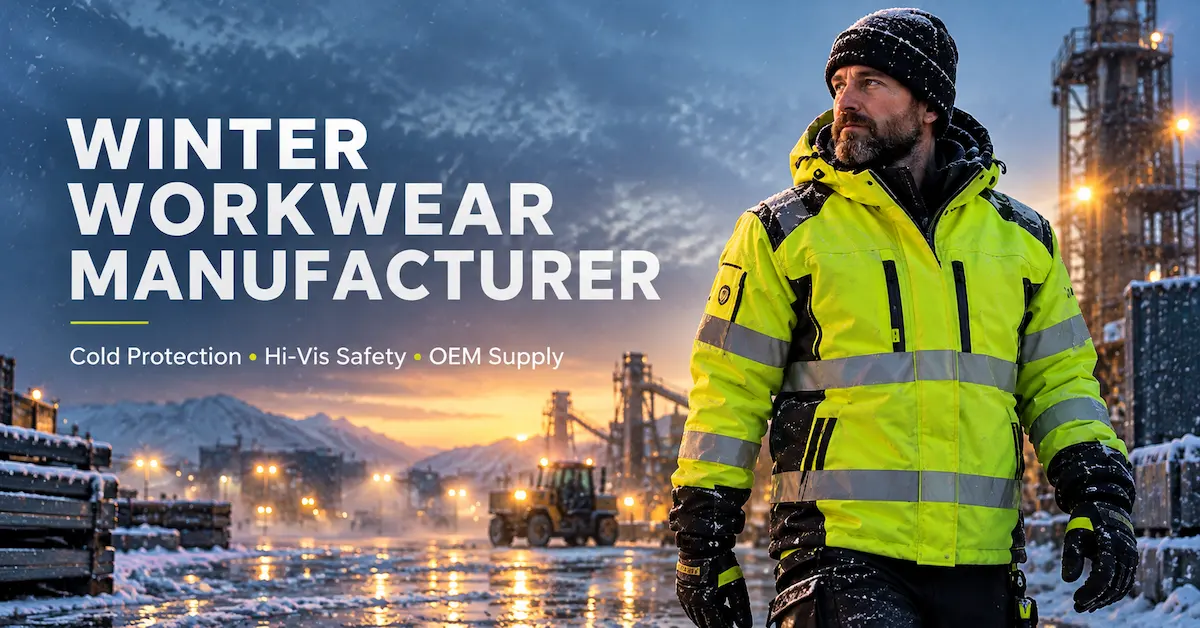
| Hi-vis winter jacket | Visibility and seasonal outerwear | Supports work near moving vehicles | Complete-garment compliance must be checked |
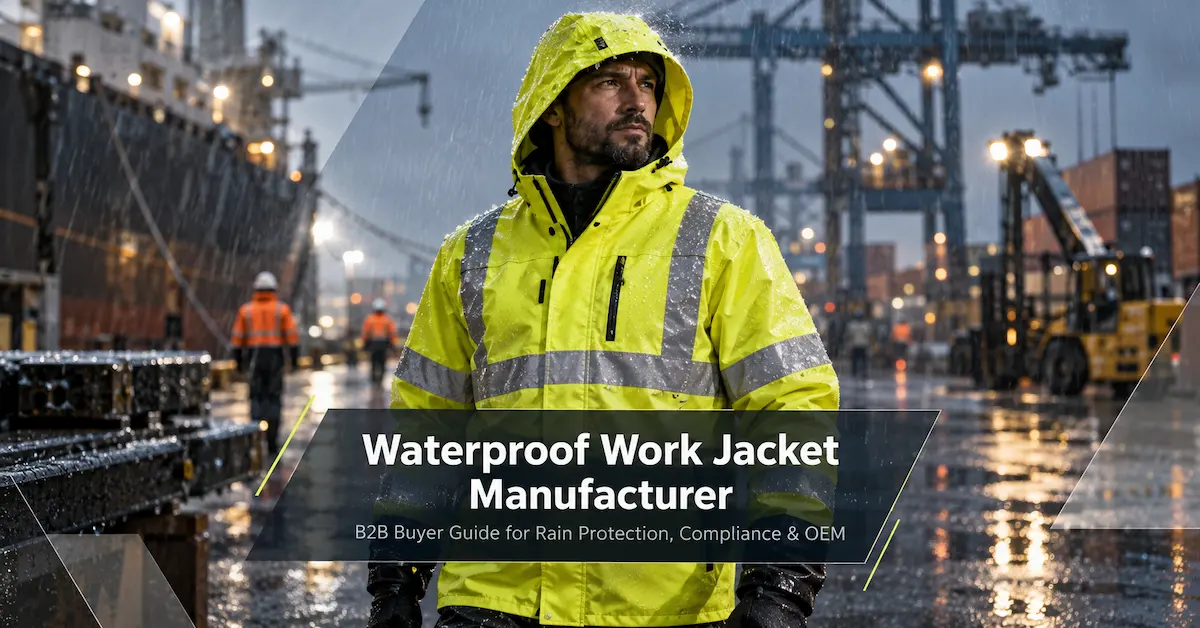
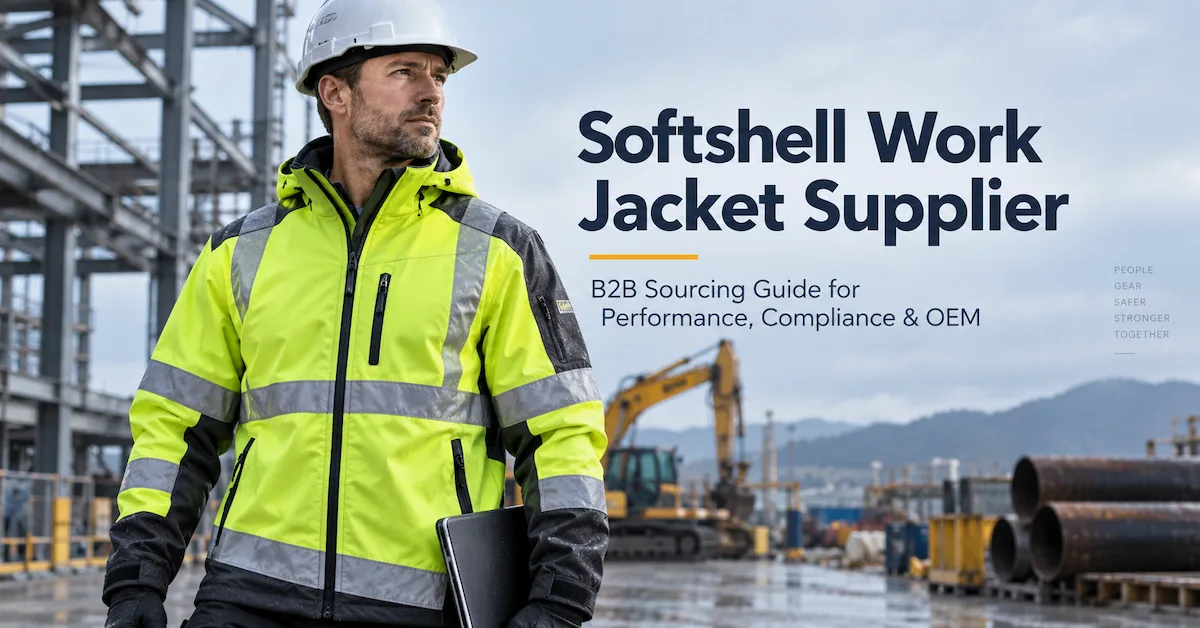
For lighter outdoor work, the related softshell work jacket sourcing guide provides more detail about the flexibility–weather-resistance trade-off. For persistent wet conditions, see AOKENEW's waterproof work jacket manufacturer guide.
A useful sourcing strategy is to standardize a core outer jacket and offer compatible insulating options for different teams. That can simplify color and branding consistency while allowing buyers to address varied tasks. However, changing the combination of layers can affect a tested protective ensemble, so any certified cold-protection claim must follow the tested configuration.
AOKENEW · B2B WORKWEAR
Discover Winter-Ready Workwear
Explore AOKENEW's reflective clothing categories and discuss styles suited to your project.
5. Materials and Insulation: What Actually Determines Warmth?
Winter workwear performance is produced by a system of insulation, trapped air, outer fabric, fit, and moisture conditions. No single fiber label or fabric-weight number tells the whole story.
Shell materials
Polyester and polyamide woven textiles are common outer-fabric options. Their properties depend on yarn type, weave, coating, membrane, finishing, and reinforcement. Buyers may prefer abrasion-resistant fabrics for equipment-intensive work or lighter constructions for more active roles.
A shell that resists wind may improve thermal comfort, but the level of air permeability should be specified and verified. For wet-weather applications, distinguish water repellency from measured resistance to water penetration.
Synthetic insulation and loft
Polyester-based battings and similar synthetic fills are used in many insulated garments. Performance depends on the fibers, loft, distribution, construction, compression behavior, and care history.
Fill weight expressed in grams per square meter helps identify how much material is present. It is not an independent temperature rating. Two products using the same fill weight can have different warmth because of quilting, air gaps, shell properties, seam design, and garment fit.
Fleece and brushed linings
Fleece offers another way to retain insulating air. It can be comfortable as a mid-layer and can make certain jackets easier to wear across varied tasks. Buyers should still check pilling, dimensional stability, drying performance, and compatibility with the chosen shell.
Brushed linings add a warm hand feel, but surface softness cannot substitute for objective thermal-performance evidence when a contract requires measured protection.
Quilting and cold spots
Quilting holds insulation in position. Excessive stitch lines, poorly distributed filling, and compressed regions can create variations in insulation. Production samples should be examined around shoulders, elbows, sides, and pockets—not only across a flat front panel.
Moisture and laundering
Insulation can behave differently when exposed to rain, humidity, perspiration, and repeated cleaning. Buyers should specify intended care methods and determine whether the garment retains acceptable function after relevant pre-treatment and washing.
Practical material-selection checklist
- Request the full outer-fabric construction, not only “100% polyester.”
- Identify the insulation type, construction, and fill-weight specification.
- Check the lining against the intended base and mid-layers.
- Ask how quilting and seams affect performance in high-motion areas.
- Confirm relevant water, air-permeability, and moisture tests where necessary.
- Evaluate a washed and conditioned sample as well as a new sample.
- Keep material reference swatches linked to the approved production specification.
A supplier who can explain these trade-offs is more useful than one offering a generic promise of “maximum warmth.”
6. Winter Workwear Technical Specifications Buyers Should Request
Specifications turn vague adjectives into a common language between the importer, manufacturer, laboratory, and end customer. They also reduce the risk of comparing two quotations built around entirely different garments.
| Specification | What to document | Why it matters |
|---|---|---|
| Shell fiber and construction | Composition, weave, finish, fabric reference | Durability and weather response |
| Shell fabric weight | GSM plus test method | Material identity, not a warmth guarantee |
| Insulation | Fiber, structure, placement, fill-weight specification | Consistent garment build |
| Thermal performance | Applicable garment or ensemble test and result | Cold-protection assessment |
| Air permeability | Test method and result | Wind penetration and comfort |
| Water resistance | Fabric and, where needed, garment-level assessment | Rain/snow suitability |
| Water-vapor resistance | Method and reported value | Moisture-management comparison |
| Fit and sizes | Measurement points and tolerances over layers | Workforce coverage and mobility |
| Reflection and color | Materials, placement, tested class if applicable | Visibility in vehicle areas |
| Closures and trims | Zipper, cuffs, hood, pockets, reinforcement | Worksite practicality |
| Washing durability | Care conditions and acceptance after cycles | Uniform service life |
| Branding and labeling | Artwork limits, care, compliance and traceability | Repeatable private-label supply |
Thermal insulation is not the same as a “minus-degree rating”
An unqualified label such as “suitable for −20°C” can be misleading. A garment's suitability depends on exposure duration, wind, movement, the rest of the clothing ensemble, and individual conditions. For protective clothing assessed under EN 342, relevant thermal insulation methods involve the garment or ensemble rather than just the weight of one piece of fabric.
What ISO 11092 contributes
ISO 11092:2026 specifies methods for measuring the thermal resistance and water-vapor resistance of textile materials and multilayer assemblies under steady-state conditions. It is useful for comparing materials using a consistent method, but a fabric result alone is not a finished-jacket certificate or a prediction of safe wearing duration.
Wind and water tests serve different purposes
Air-permeability results describe airflow through a textile under test conditions. Surface water-repellency testing examines wetting behavior. Water-penetration testing measures a different property. A buyer should avoid treating one test as a substitute for the others.
If a garment must protect against prolonged rain, include seam and closure requirements. If the intended product is a dry-weather insulated jacket, do not pay for irrelevant features simply because they appear in a competing supplier's catalog.
7. Cold Protection, High-Visibility and Other Standards: What Does Each One Prove?
Winter garments can perform several protective functions, but certifications are not interchangeable. A declaration about high-visibility clothing does not prove cold protection; a warm lining does not prove rain resistance; and neither automatically gives protection against flame or electrical hazards.
| Standard or framework | Main concern | Key procurement question |
|---|---|---|
| EN 342:2017 | Protective clothing ensembles and garments for cold environments | Was the relevant garment or ensemble assessed in the claimed configuration? |
| EN 14058:2017+A1:2023 | Garments for cool environments | Does this standard match the exposure and project requirements? |
| EN ISO 20471 | High-visibility protective clothing | What compliant garment class and design are documented? |
| ANSI/ISEA 107 | High-visibility safety apparel for the US market | Which Type and Performance Class are applicable? |
| ISO 11092:2026 | Thermal and water-vapor resistance of textile materials | What test method and material results support the comparison? |
| Relevant rain-protection standards | Protection against precipitation | Is the finished garment, including seams, suitably assessed? |
| Workplace cold-stress procedures | Exposure assessment, training and administrative controls | What controls beyond clothing are required? |
EN 342: cold-protective clothing
EN 342:2017 is associated with ensembles and garments intended for cold protection, typically in environments at or below −5°C as described by the standard's scope. Its evaluation considers thermal insulation of clothing, including garment or ensemble characteristics. Other performance requirements and marking rules also matter.
The −5°C distinction is about the standard's scope—not a promise that an EN 342 label automatically makes a worker safe at every temperature below that point. Buyers need the actual test results, performance designation, intended combination of garments, use limitations, and instructions.
EN 14058: cool environments
EN 14058:2017+A1:2023 addresses garments for cool environments above −5°C. Its intended use and performance requirements differ from those for more severe cold protection. The relevant choice should follow the expected exposure and contract specification, not simply whichever standard sounds stronger.
High visibility in winter
Cold weather often means low-angle light, early or late shifts, rain, and vehicles working nearby. Where high-visibility PPE is required, fluorescent background materials and retroreflective elements must be arranged and assessed as a finished garment.
For European markets, buyers may need EN ISO 20471 conformity; American buyers may specify ANSI/ISEA 107 Type and Class designations. A logo, dark contrast panel, hood, or detachable liner may alter the garment configuration. Confirm whether such changes affect the tested design and labeling.
Document control and verification
Ask for the actual product identification, applicable edition, test or conformity documents, issuer, validity, and labeling. Verify that the garment style, materials, reflective layout, and size range correspond to the evidence. A company listing multiple standards on its About page does not establish that every winter garment is certified to each one.
For jobs involving arc flash, flame, chemicals, or other specialized hazards, arrange an additional application-specific review. Ordinary winter workwear should never be substituted for protective clothing certified for a different hazard.
8. Workmanship and Fit: Details That Affect Cold-Weather Performance
A technical fabric can be let down by poorly designed garment construction. A jacket that rides up while reaching, exposes wrists while driving, or prevents a worker from closing a collar around an approved helmet system may be unsuitable even if the material itself tests well.
Movement over real layers
Fit approval should be carried out over the base and mid-layers workers will actually wear. Check reaching overhead, crouching, bending, carrying tools, and sitting in a vehicle. The sleeves must provide coverage without creating excess fabric that catches equipment.
Collar, hood, cuffs and hem
A high collar and suitable hood can improve weather coverage, but visibility, hearing, helmet compatibility, and escape from machinery entanglement hazards also matter. Adjustable cuffs may reduce air entry; the adjustment must still work with gloves. An excessively loose hem can expose the waist to wind, while one that is too tight can restrict movement.
Zippers, pockets and hardware
Cold hands and gloves change how closures are used. Test zipper pull size, snap accessibility, pocket position, and radio access. Pocket seams and reinforcement should withstand repeated loads without damaging the insulating layers or outer protective system.
Insulation distribution
Inspect quilting, fill continuity, and areas where layers are compressed. Shoulder straps, elbow movement, and deep folds can create localized wear. A golden sample should show how the manufacturer intends to control these areas during production.
Compatibility with other PPE
A winter jacket must not interfere with high-visibility material coverage, fall-protection harness fit, respirators, helmets, gloves, or other critical equipment. Compatibility should be confirmed by the employer's risk assessment and the relevant PPE instructions.
9. Quality Control: Test the Jacket You Intend to Buy
Effective winter workwear QC begins with material approval and continues through bulk production. Final visual inspection cannot uncover every issue in insulation, moisture performance, or conformity.
| Stage | Example checks | Evidence to request |
|---|---|---|
| Material approval | Shell specification, insulation type, reflective materials | Approved technical data and supplier references |
| Incoming inspection | Shade, width, fabric defects, fill identity | Material inspection records |
| Cutting | Correct panels, grain direction, size allocation | Cutting reports and shade controls |
| Sewing and assembly | Stitch quality, insulation placement, reinforcement | In-process checks |
| Weatherproof construction | Seams, closures, hood and cuff assembly | Applicable seam or garment test records |
| Reflective application | Width, position, continuity, attachment | Approved layout and relevant tests |
| Size measurements | Chest, sleeve, garment length, tolerance | Measurement reports by size |
| Functional inspection | Zips, pockets, adjustment, movement | Functional checklist and sample sign-off |
| Washing and aging | Shrinkage, appearance, reflective and insulation performance | Test conditions and acceptance criteria |
| Final release | Labels, packaging, quantity, shipment identity | Final inspection and packing report |
New samples and washed samples
Inspecting only a fresh sample can hide problems. Relevant laundering or aging procedures may reveal loft reduction, pilling, lining damage, shrinkage, color changes, reflective tape deterioration, or zipper performance issues. The selected tests should reflect the care instructions and expected workwear program.
Full size-range approval
Do not approve one medium-size sample and assume every size scales correctly. Large jackets can develop disproportionate hood, sleeve, or pocket placement. Small sizes may leave insufficient visible background area for some high-visibility constructions. Sample at least the critical ends of the proposed size range and verify graded measurements.
Traceability and change control
Keep a record of the approved outer fabric, insulation, trims, color reference, size specifications, artwork, and label version. Changes must be assessed before production, especially where they may affect a performance claim. Repeat-order fidelity matters more than an attractive first sample.
Quality questions worth asking a factory
Can the supplier show a material-to-product identification process? Which inspection stages happen before garments are packed? Who decides whether a substitute fabric is acceptable? How are failed tests or defective garments handled? What records will a buyer receive before shipment?
These are actionable questions. An unsupported claim of “100% quality control” is not a substitute for agreed methods and records.
10. OEM and Private Label Winter Workwear: Build a Product, Not Just a Logo
OEM development may involve fabric selection, size engineering, color changes, insulation, functional pockets, reflective layouts, branding, packaging, and care labels. For winter workwear, each change can affect both user comfort and manufacturing repeatability.
Custom fabric and insulation
Buyers may request lighter insulated jackets for active teams or more protective assemblies for longer outdoor exposure. The manufacturer should explain material sourcing options, minimum commitments, and the testing needed to approve the requested design.
Reflective design and corporate colors
Brand colors can be incorporated without making unverified compliance claims. If the jacket is intended to meet a high-visibility standard, decorative panels, reflective tape position, and logo size must be reviewed against the finished-garment requirements. Replacing fluorescent fabric with dark fabric solely to match a brand palette may not be acceptable.
Logo methods
Embroidery, screen printing, and heat-transfer decoration have different effects on materials. Embroidery penetrates fabric; heat-transfer methods require compatible temperature and adhesive conditions; printing must meet agreed wash durability. A logo should not interfere with weather protection, reflective coverage, or mandatory labeling.
Sizes and market fit
International orders need an explicit graded size chart, garment measurement points, fit intentions, and tolerance limits. A size name such as XL is insufficient because size systems and expected layering differ across markets.
Private labels and packaging
A private-label order may require woven labels, care instructions, carton marks, barcodes, hangtags, and individual packaging. Packaging should protect garments during transport and support accurate warehouse receiving. The user-facing information must match the approved protective claims.
AOKENEW covers OEM and private-label topics in its private label workwear sourcing guide. A practical project begins with a detailed design brief, followed by an approved physical sample and controlled production documentation.
11. What AOKENEW Can Contribute to a Winter Workwear Program
Jinhua Aoke New Materials Co., Ltd., operating under the AOKENEW name, presents reflective clothing and safety workwear as its core business. Its website includes jacket, rainwear, and winter-workwear directions alongside vests, shirts, fleece, softshell, and woven workwear.
AOKENEW reports operating since 2010 and serving more than 300 domestic and international customers. The company also describes two technical sample rooms for customer-specific development.
According to the company's published profile, it operates three garment manufacturing locations with different roles:
- Jinhua: About 50,000 pieces of stated monthly garment capacity, positioned for smaller or more customized orders.
- Chongqing: About 200,000 pieces of stated monthly garment capacity, focused on medium-scale reflective-clothing manufacture.
- Myanmar: About 1.5 million pieces of stated monthly garment capacity, with 20 sewing lines for larger-scale garment production.
These figures are company-reported overall garment capacities, not established winter-jacket-specific capacity, actual monthly shipments, or a delivery guarantee. A buyer should request a product-specific production allocation and confirm which facility will make the proposed style.
The manufacturer-selection value lies in asking targeted questions: Which proposed fabrics and insulation can be sourced? Can the chosen facility produce the required construction? Which garment tests are available? How is the production sample approved? What controls prevent substitutions? How will replenishment orders remain consistent?
For background on the company and its stated manufacturing capabilities, see About AOKENEW.
AOKENEW · B2B WORKWEAR
Evaluate the Manufacturing Partner
Review the company's published facilities, development background and customization direction.
12. Winter Workwear Pricing: Compare the Total Program Cost
A winter workwear quotation reflects more than sewing labor. Fabric, insulation, garment complexity, reflective materials, testing, size assortment, packaging, and seasonal production demand can all influence the price.
| Cost driver | Why it changes the quotation | Smart buyer action |
|---|---|---|
| Outer fabric | Construction, finishing, color and sourcing | Compare like-for-like material references |
| Insulation | Fiber, loft, placement, quilting | Specify the intended performance and build |
| Garment details | Pockets, reinforcements, zippers, hoods | Separate essential features from optional ones |
| Visibility components | Fluorescent fabric, reflective materials, layout | Maintain required conformity |
| Performance testing | Laboratory work and documentation | Clarify what is included and who pays |
| Colors and sizes | Material lots, changeovers and grading | Provide a realistic size/color breakdown |
| Branding | Logo technique, labels, packaging | Approve artwork and durability method |
| Logistics | Volume, cartons, shipping terms | Compare on the same Incoterm and destination |
| Repeat supply | Material continuity and minimum commitments | Discuss annual forecast and reorder strategy |
A useful comparison is Total Program Cost = Purchase Price + Sampling and Testing + Inspection + Freight and Duties + Replacement and Reorder Costs.
The cheapest initial unit price can be expensive if garments are returned for poor fit, lose required performance after washing, or cannot be reordered in matching colors and specifications.
MOQ and lead time are product-specific
A standard fabric with an existing pattern may be easier to source than a custom-developed insulated high-visibility garment. MOQ can vary by style, color, size distribution, decoration, and fabric minimums. Lead time also depends on sample changes, material procurement, testing, production schedules, and inspection.
Do not assume a small-order promotional offer for a standard safety vest applies to newly developed winter jackets. Request the applicable conditions in writing for the actual project.
Seasonal purchasing and reorders
Winter programs face demand peaks. A late order may coincide with tighter fabric availability or factory scheduling. Planning should identify critical dates for size confirmation, sampling, compliance verification, material ordering, and shipping. For a multi-season program, keep approved construction records and agree on how substitutions or discontinued components will be handled.
The broader production logic is covered in AOKENEW's bulk workwear production guide.
13. How to Prepare a Winter Workwear RFQ That Gets Better Quotations
A strong request for quotation removes ambiguity. It also makes competitor quotes more comparable and shows suppliers that the buyer understands the technical requirements.
| RFQ field | Information to include |
|---|---|
| Market and buyer | Destination country, PPE distributor or direct-use program |
| Application | Job role, movement, exposure duration, wet/dry conditions |
| Climate | Expected temperature range, wind, snow or rain |
| Garment program | Jacket, parka, shell, fleece, trousers or ensemble |
| Shell and insulation | Preferred materials or performance targets |
| Compliance | Exact standard and edition, if required |
| Fit | Size chart, layers underneath, fit testing needs |
| Design | Pockets, hood, cuffs, reflective layout, logos |
| Quantity | Initial units per color/style/size and annual forecast |
| Tests and inspections | Agreed evidence, methods and acceptance criteria |
| Packaging | Care labels, barcodes, individual packs, carton marks |
| Commercial terms | Sample requirements, MOQ, Incoterm, delivery milestones |
Ten-step sourcing and approval workflow
- Define the workplace risks and exposure profile.
- Identify the intended user groups and required garment combinations.
- Specify the applicable protective standards without assuming a certificate exists.
- Set measurable material, construction, sizing, and washing requirements.
- Ask manufacturers for technical options and project-specific commercial terms.
- Develop samples using identified fabric and trim references.
- Test the samples, including fit over actual layers and any required lab verification.
- Approve a golden sample, size chart, artwork, packaging and revision number.
- Monitor incoming materials, production, inspection and change control.
- Release shipment only after the agreed checks and plan for controlled reorders.
Questions to include with the RFQ
Can the manufacturer explain the exact insulation system? Is the proposed garment being sold as ordinary weatherwear or as certified protective clothing? Are test documents for that configuration available? What happens if an approved shell fabric becomes unavailable? Which size range can be repeated on future orders? How will the supplier show that the shipment matches the approved sample?
A serious buyer should receive specific responses, not generic assurances.
AOKENEW · B2B WORKWEAR
Ready to Specify Your Winter Workwear?
Share your application, target market, fabric needs, quantities and delivery plan for a project-specific discussion.
14. Five Costly Winter Workwear Buying Mistakes
Mistake 1: Treating heavier fabric as proof of better protection. Fabric GSM and insulation fill weight are useful specifications, but neither independently establishes safe use in a given climate. Ask for relevant garment or material results.
Mistake 2: Buying one design for every team. A stationary guard and an active delivery worker have different thermal and mobility needs. Segmented layering programs can be more practical than a single heavy jacket.
Mistake 3: Assuming every reflective winter jacket is certified. The complete garment, including visible material area and actual configuration, must satisfy any claimed standard. Request model-specific evidence.
Mistake 4: Neglecting post-wash and size testing. Fresh samples may look excellent even when later washing causes shrinkage, pilling, insulation shifting, or reflective damage. Define testing before the production run.
Mistake 5: Failing to plan the second order. Brand and uniform programs depend on repeatability. Control fabric references, grading, trims, labels, and acceptable replacements from the first order onward.
15. Frequently Asked Questions About Winter Workwear Manufacturing
1. What does a winter workwear manufacturer produce?
A winter workwear manufacturer develops and produces garments intended for cooler or cold working environments, such as insulated jackets, high-visibility winter outerwear, fleece layers, weather-protective shells, trousers, and coveralls.Actual protective performance depends on the product's specification and any relevant testing or certification.
2. Is winter workwear the same as EN 342-certified protective clothing?
No. “Winter workwear” is a broad product description. EN 342:2017 applies to defined protective clothing and ensembles for cold environments. A particular garment must have the appropriate evidence and marking before a supplier can claim conformity. Do not infer certification from appearance, insulation thickness, or a manufacturer's general company profile.
3. How does EN 14058 differ from EN 342?
EN 14058:2017+A1:2023 addresses garments for cool environments above −5°C, while EN 342:2017 addresses cold-protective garments and ensembles within its defined cold-environment scope. They have different evaluation requirements. The buyer should identify the applicable standard from the worksite risk assessment and target-market rules.
4. Which insulation is best for industrial winter jackets?
There is no universal best insulation. Evaluate the intended activity, outer fabric, desired flexibility, weather conditions, care method, and measurable thermal performance. A lighter layered system may be more suitable for mobile work than a bulky jacket. Fill weight alone cannot establish performance.
5. Can winter jackets meet high-visibility requirements?
Yes, a jacket can be designed to meet relevant high-visibility requirements, but it must be assessed as a complete garment. Buyers should verify applicable EN ISO 20471 or ANSI/ISEA 107 claims for the exact product configuration. Colors and reflective tape added solely for appearance are not proof of certification.
6. Are insulated winter work jackets waterproof?
Not necessarily. Insulation provides warmth-related properties; waterproof performance depends on the shell and finished-garment construction, including seams and openings. For wet conditions, request the relevant water-resistance evidence and consider the applicable rain-protective garment requirements.
7. What is the minimum order quantity for custom winter workwear?
MOQ varies with fabric availability, insulation, style, colors, size distribution, labeling, and packaging. A repeat design made from stocked materials may have different conditions from a newly developed private-label winter parka. Ask the supplier for an MOQ specific to the requested configuration.
8. How should buyers test a winter jacket sample?
Use the intended base and mid-layers, check movement and PPE compatibility, and review measurements and closures. Verify claimed thermal, rain, or visibility performance with suitable documentation. Test washing durability and critical size grades where appropriate. Approve both the sample and its technical specification.
9. How can an OEM winter workwear supplier support private labels?
Private-label development may include materials, color layouts, pattern adjustments, logos, woven labels, care labels, retail packaging and shipping marks. Protective claims and required marking still need to remain accurate. A repeatable manufacturing record is essential for future orders.
10. What should I send AOKENEW to request a winter workwear quotation?
Send the intended market, applications, expected exposure conditions, garment type, quantity and size breakdown, performance requirements, compliance documents needed, reference images or artwork, branding and packaging requirements, and desired delivery schedule. The team can then discuss available options and the feasibility of a project-specific design.
Conclusion
Choosing the right winter workwear manufacturer means verifying the complete clothing system—not simply buying the heaviest jacket. Prioritize job-specific insulation, suitable wind and moisture protection, accurate high-visibility claims, practical fit, tested durability, and documented production control. Those decisions protect both end users and the buyer's long-term uniform budget.
For OEM, private-label, or bulk winter workwear projects, contact AOKENEW to discuss your specifications and request a tailored quotation.