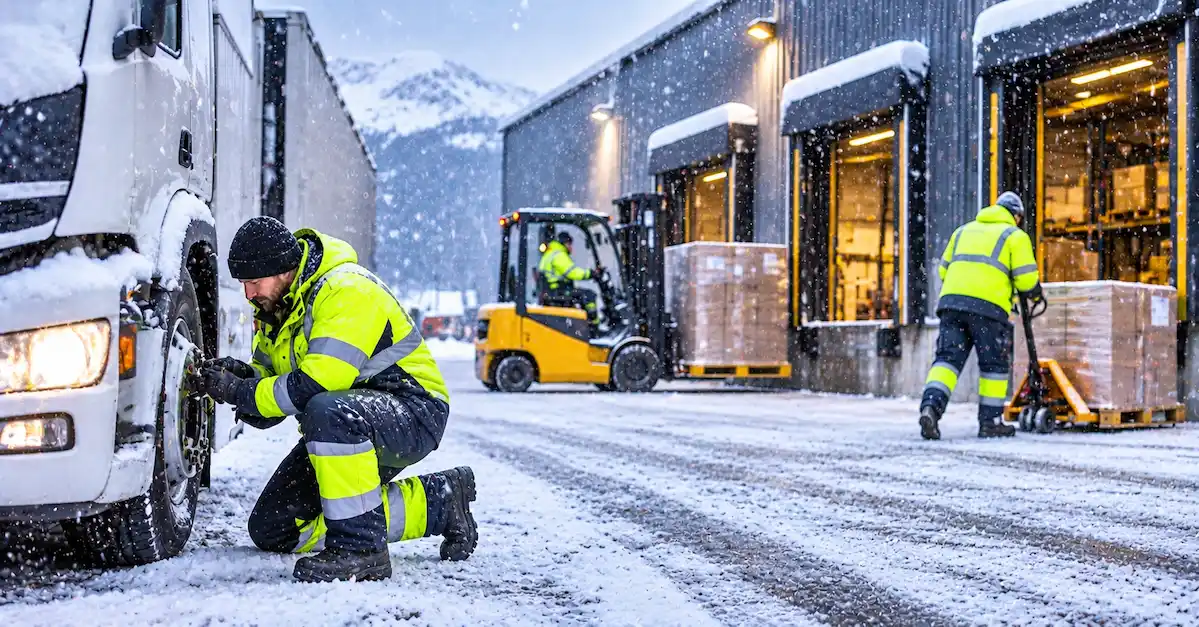
Cold conditions create different challenges for workers who move constantly and those who remain in one place. A warehouse loading team may generate considerable body heat while handling goods, while a security officer or outdoor maintenance worker may experience prolonged cold exposure with relatively little movement.
Both groups need suitable protective clothing, but the same heavy winter jacket may not be appropriate for both.
Choosing workwear for cold environments requires buyers to consider temperature, wind, moisture, working intensity, exposure duration and the complete clothing system rather than insulation thickness alone.
For industrial uniform buyers, PPE distributors, municipal contractors and private-label workwear brands, the challenge is identifying a practical combination of layers that supports warmth, mobility, moisture management and any additional safety requirements.
Quick Answer: The most effective workwear for cold environments uses a task-specific layering system. A moisture-managing base layer helps control perspiration, an insulating mid-layer reduces heat loss, and a suitable outer garment addresses wind and precipitation. Active workers may need adjustable, lower-bulk clothing, while stationary workers may need greater verified insulation and additional cold-exposure controls. Buyers should assess the complete clothing ensemble, not just one jacket.
This guide explains how to compare cold-weather garment types, design suitable clothing systems, verify protective performance and prepare reliable OEM workwear orders.
1. Why the Right Cold-Environment Workwear Matters
Working in cold conditions can affect comfort, manual dexterity, concentration and physical performance.
More importantly, prolonged or severe cold exposure can contribute to cold-related illness and injury.
Three environmental factors deserve particular attention.
Cold Air and Low Activity
Workers generate body heat through metabolic activity.
Someone performing physically demanding work may produce substantially more heat than a worker standing at a fixed post.
Consequently, two employees working in the same temperature may need different clothing configurations.
Wind Exposure
Wind can increase heat loss from exposed surfaces and through air-permeable clothing.
A thick garment with inadequate wind protection may perform poorly in an exposed working environment.
Rain, Snow and Perspiration
Moisture is a major challenge.
Workers may become wet from precipitation or perspiration. Damp clothing can reduce thermal comfort and increase the risk of heat loss.
A suitable cold-weather clothing system should therefore address insulation, moisture movement and the expected exposure to wind and water.
Key purchasing principle: More insulation is not always better. The correct amount depends on the activity and environmental conditions.
2. Active vs. Stationary Workers: Why One Winter Uniform Is Not Enough
One of the most useful distinctions in cold-weather clothing procurement is the worker's activity level.
Cold-Environment Workwear Selection Matrix
| Work Activity | Typical Working Conditions | Clothing Priority | Main Purchasing Concern |
|---|---|---|---|
| Active warehouse loading | Repeated lifting and indoor-outdoor movement | Adjustable layers and moisture management | Overheating and perspiration |
| Construction and infrastructure work | Bending, walking, tool use and wind exposure | Mobility, weather protection and appropriate insulation | Restricted movement |
| Outdoor equipment inspection | Intermittent walking and stationary checks | Flexible insulation and weather protection | Temperature changes |
| Stationary security or gate duties | Extended periods of limited movement | Greater verified thermal protection | Prolonged cold exposure |
| Municipal maintenance | Alternating physical work and waiting | Removable layers and suitable outerwear | Changing activity levels |
| Cold storage operations | Controlled low-temperature environment | Task-specific protective clothing | Exposure duration and equipment compatibility |
These combinations are starting points for workplace assessment, not temperature ratings or guarantees of protection.
High-Activity Work
Employees performing intensive tasks may become warm even when the surrounding air is cold.
Excessive insulation can contribute to perspiration.
When the worker stops moving, damp layers may become uncomfortable and increase heat loss.
For these jobs, the purchasing focus should include moisture management, ventilation, flexible construction and the ability to adjust layers.
Low-Activity Work
Workers who remain stationary for extended periods generate less heat through movement.
They may require additional insulation, suitable protection for extremities and access to warm areas.
Clothing must form part of a wider cold-stress prevention program.
Mixed-Activity Work
Some roles alternate between demanding physical work and extended periods of lower activity.
This creates a strong case for modular clothing systems.
A worker can adjust suitable layers as conditions change without relying on a single excessively bulky garment.
3. How to Build a Three-Layer Clothing System
A practical approach to workwear for cold environments is to evaluate the clothing system in three functional layers.
Each layer performs a different task.
Cold-Weather Layer Comparison
| Clothing Layer | Main Function | Typical Material Options | Buyer Evaluation |
|---|---|---|---|
| Base layer | Manage moisture near the skin | Suitable wool or synthetic constructions | Fit, drying behavior and comfort |
| Mid-layer | Provide adjustable insulation | Fleece or other insulating textiles | Warmth, bulk and movement |
| Outer layer | Address wind and precipitation | Specified protective shell or insulated jacket | Weather performance, fit and safety compatibility |
These examples describe general clothing-system functions. Material performance and product suitability must be verified for the intended use.
Base Layer: Manage Moisture First
The innermost layer sits close to the skin.
Its primary function is to help manage moisture generated during work.
For demanding physical activity, buyers should evaluate the fabric's moisture-management behavior and drying characteristics.
A garment that becomes excessively damp can create discomfort when the worker's activity level decreases.
Base layers should fit comfortably without restricting circulation or movement.
Procurement questions:
-
What is the fabric composition?
-
How does the material behave when damp?
-
Is the fit compatible with insulating layers?
-
What care instructions apply?
-
Is the proposed material suitable for the workplace?
Mid-Layer: Add Controlled Insulation
The middle layer provides adjustable warmth.
Fleece and other insulating textiles may be suitable depending on the exposure and intended use.
However, fabric thickness alone is not a reliable measurement of finished-garment thermal protection.
Buyers should examine the construction, fit, laundering behavior and relevant thermal performance evidence.
An insulating garment should leave sufficient room for movement and should not become excessively compressed beneath the outer layer.
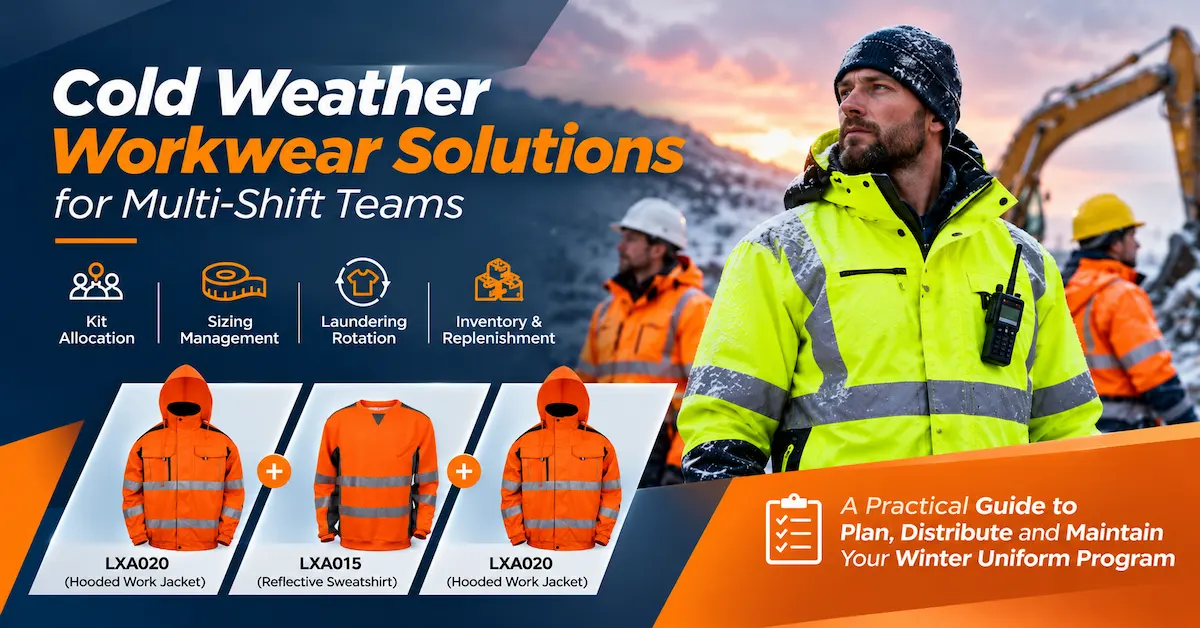
AOKE's LXA015 Reflective Sweatshirt is an existing workwear style reference for buyers discussing sweatshirt construction and layering.
Its actual insulation properties and suitability for a particular cold environment must be confirmed through product-specific information.
Outer Layer: Manage Wind and Wet Conditions
The outer layer faces the working environment.
Depending on the application, it may need to reduce wind penetration, resist rain or snow, provide insulation and maintain the required high-visibility performance.
Important design considerations include the hood, collar, cuffs, hem, zipper, pockets, seams and sleeve mobility.
A water-resistant fabric is not automatically a waterproof finished garment.
Where sustained precipitation protection is required, buyers should verify relevant material and garment-level evidence.
AOKE's LXA020 Reflective Work Jacket provides a reference for discussing hooded outerwear design, pockets, closures and reflective material placement.
The model should not be represented as certified cold-protective clothing without supporting product-level documentation.
4. How to Choose Insulated Workwear Without Excessive Bulk
Winter workwear is often marketed using descriptions such as heavyweight, thermal, insulated or extreme cold.
These terms are not substitutes for measured performance.
Four Factors Buyers Should Compare
Insulation construction: Consider the type, distribution and durability of insulating materials.
Garment fit: Allow appropriate space for underlying layers without creating unnecessary bulk or restricting movement.
Wind management: Evaluate the outer fabric and construction for the expected conditions.
Moisture behavior: Determine how the clothing system performs during active work and when exposed to rain or perspiration.
Does More Insulation Always Mean Greater Protection?
No.
Thermal performance depends on the complete garment or ensemble, the environmental conditions and the worker's activity.
A bulky jacket may be unsuitable for an employee repeatedly climbing into vehicles or handling equipment.
Similarly, a lightweight sweatshirt may not provide enough protection for a worker remaining stationary in exposed conditions.
The purchasing specification should describe the work, not simply request the thickest available garment.
5. Insulated Jackets vs. Bib Overalls vs. Coveralls
Cold-weather garments provide different levels of body coverage and flexibility.
Buyers should consider them as alternative clothing-system components rather than interchangeable products.
Cold-Weather Garment Comparison
| Garment Type | General Advantage | Main Limitation to Evaluate | Potential Application |
|---|---|---|---|
| Insulated work jacket | Upper-body insulation and flexibility | Limited lower-body coverage | Mobile outdoor work |
| Insulating sweatshirt | Adjustable warmth beneath outerwear | May offer limited wind or rain protection | Mixed indoor-outdoor work |
| Insulated bib overalls | Extended torso and leg coverage | Bulk, fit and ease of removal | Suitable lower-body cold exposure |
| Insulated coveralls | Integrated body coverage | Temperature adjustment and access | Specialized cold-work applications |
| Weather-protective shell | Protection against specified wind or precipitation | Insulation may need to be provided separately | Wet or windy conditions |
When Might Insulated Bib Overalls Be Useful?
Bib-style garments can provide coverage across the torso and legs.
For buyers considering them, important details include waist and shoulder adjustment, bending comfort, footwear compatibility, closure construction and whether the garment can be worn safely with other equipment.
When Might Coveralls Be Preferable?
Coveralls provide a different clothing configuration that may suit certain prolonged exposure or specialized operations.
However, they can be less convenient when employees frequently move between cold and warm areas.
The correct decision depends on the task and protective requirements.
AOKE product availability note: The company's verified public product references used in this guide are reflective sweatshirts and jackets. Insulated bib overalls and coveralls are discussed as general industry alternatives, not confirmed AOKE products. Buyers should ask AOKE whether any such development or sourcing project is feasible.
6. Traditional Insulation vs. Electrically Heated Workwear
Some cold-weather clothing systems rely on conventional insulation, while others incorporate electrically powered heating elements.
These are different technologies with different purchasing considerations.
Insulation vs. Active Heating
| Evaluation | Conventional Insulated Clothing | Electrically Heated Clothing |
|---|---|---|
| Heat source | Retains body-generated heat | Adds heat from an electrical power source |
| Primary consideration | Thermal insulation and garment design | Heating system plus underlying protective clothing |
| Maintenance | Garment-specific care instructions | Electrical components, battery and laundering restrictions |
| Main risk to assess | Inadequate protection or overheating | Battery, electrical, temperature-control and durability risks |
| Buyer documentation | Relevant garment testing | Garment evidence and additional electrical-system documentation |
Should Stationary Workers Use Heated Clothing?
Powered heating may be considered in some specialized applications, but it should not be treated as a universal solution.
Buyers must evaluate product safety, operating limitations, battery performance, the complete clothing system and the workplace's protective requirements.
Heated clothing does not replace warm shelters, work-rest procedures, monitoring or the need to address serious cold exposure.
AOKE does not have a verified electrically heated garment in the reviewed product references. Such products should not be advertised as part of its existing range without confirmation.
7. Protect the Hands, Feet, Head and Face
A suitable outer jacket does not complete the cold-weather protection system.
Cold exposure can affect the hands, feet, face and ears.
Head and Face
Choose suitable head and face protection for the assessed conditions.
If a safety helmet is required, any winter liner or covering must be compatible with that helmet and must not compromise its protective performance.
Hands
Gloves should provide appropriate thermal protection while permitting the necessary dexterity.
Workers handling tools, controls or small components may need different glove constructions from workers performing stationary tasks.
Feet
Cold and wet conditions may require appropriately insulated, water-resistant or waterproof footwear.
Fit is important because excessively tight footwear or socks can restrict circulation.
Slip resistance and other workplace footwear requirements should be evaluated separately.
Eyes
Outdoor winter conditions may also involve glare from snow or ice.
Suitable eye protection should be selected according to the workplace hazards and applicable requirements.
For complete protection, employers should evaluate these items alongside the upper-body clothing system rather than assume a jacket resolves every exposure risk.
8. Which Cold-Protection Standards Should Buyers Check?
Where buyers require protective clothing with defined cold-performance characteristics, product-specific technical evidence is essential.
Relevant Standards
| Standard or Framework | What It Addresses | Buyer Consideration |
|---|---|---|
| EN 342:2017 | Garments and ensembles for protection against cold | Verify the intended ensemble and performance documentation |
| EN 14058:2017+A1:2023 | Garments for protection against cool environments | Confirm applicable garment classes and performance |
| EN ISO 20471 | High-visibility protective clothing | Verify relevant finished-garment conformity |
| Relevant rain-protection standards | Protection against precipitation | Check material and garment construction |
| Workplace cold-stress guidance | Assessment and prevention of cold-related risks | Clothing is only one part of the safety program |
EN 14058 covers specified cool-environment conditions above −5°C, including the effects of wind and humidity.
EN 342 addresses garments and ensembles within its defined cold-environment scope at or below −5°C.
These temperature boundaries describe the scope of the standards. They do not establish a universal safe operating temperature for every garment or worker.
Can a Reflective Jacket Be Considered Cold-Protective PPE?
Only when appropriate evidence supports the relevant protective claim.
A reflective jacket may provide useful clothing coverage, but fluorescent material and reflective tape do not independently establish thermal insulation performance.
Similarly, an insulated garment does not automatically meet high-visibility requirements.
Buyers should verify each necessary protective function.
9. How Should Buyers Evaluate Cold-Environment Workwear Samples?
A properly approved sample establishes the production reference.
Before accepting a bulk quotation, buyers should assess garment construction and technical performance.
Sample Approval Checklist
| Inspection Item | What Buyers Should Check |
|---|---|
| Fabric identity | Approved material and construction |
| Insulation | Specified material and placement |
| Garment measurements | Fit over the intended clothing layers |
| Shoulder mobility | Reaching and lifting comfort |
| Cuffs and hem | Adjustment and coverage |
| Hood and collar | Compatibility with head protection |
| Zippers and pockets | Operation with appropriate gloves |
| Reflective elements | Placement and relevant evidence |
| Care instructions | Washing and maintenance requirements |
| Performance documentation | Applicable tests and product identification |
Why Layer Compatibility Matters
A jacket that fits correctly over a thin shirt may become restrictive when worn over an insulating sweatshirt.
Buyers should assess the intended clothing combination.
Evaluate shoulder movement, arm extension, bending, seated comfort and compatibility with required PPE.
The approved size chart should reflect the intended fit and layering requirements.
A practical wearer evaluation cannot replace laboratory testing or formal protective conformity assessment.
10. How Can OEM Customization Support Cold-Weather Workwear Programs?
Private-label workwear brands and industrial buyers may require specific colors, logos, materials, sizes, pockets and labeling.
Customization can improve workforce identification and purchasing consistency, but protective requirements must remain the priority.
Common OEM Development Requirements
| Customization | Procurement Consideration |
|---|---|
| Company logo | Position and application method |
| Fabric selection | Approved construction and relevant performance |
| Insulation specification | Material consistency and appropriate testing |
| Hood modification | Coverage and PPE compatibility |
| Pocket design | Access while wearing gloves |
| Reflective tape layout | Applicable visibility requirements |
| Custom size grading | Fit over layers |
| Packaging | Identification and repeat-order consistency |
How Should Buyers Control Design Changes?
The approved garment should have a documented technical specification.
If the supplier proposes changing fabrics, insulation, reflective materials or construction details, the buyer should assess whether the change affects the intended performance or conformity documentation.
The same controls should apply to later production runs.
For multi-shift distribution and replenishment planning, buyers can consult AOKE's Cold Weather Workwear Solutions Guide.
11. What Determines the Cost of Workwear for Cold Environments?
Cold-weather workwear pricing depends on the required materials, garment construction, manufacturing processes, customization and order volume.
However, comparing unit prices without comparing technical specifications can lead to unsuitable purchasing decisions.
Important Cost Factors
| Cost Factor | Commercial Impact |
|---|---|
| Main fabric | Material construction and sourcing |
| Insulation | Material type, placement and manufacturing |
| Weather protection | Fabric and assembly requirements |
| Reflective components | Material and design specifications |
| Size range | Pattern development and production planning |
| OEM branding | Artwork, printing or other decoration |
| Testing | Required technical verification |
| Quality control | Inspection and documented acceptance |
| Logistics | Packing, freight and delivery |
| Replenishment | Repeat-order planning and replacement |
A useful comparison is:
Total Procurement Cost = Garment Price + Sampling + Testing + Customization + Inspection + Shipping + Replacement Costs
The lowest quoted price does not necessarily represent the most suitable product.
What About MOQ and Lead Time?
Minimum order quantities and delivery schedules depend on the actual garment design, materials, customization and testing requirements.
Buyers should request project-specific information for sampling, materials, production, inspection and shipping.
A generic production promise for an existing garment should not be applied automatically to a new insulated clothing design.
12. AOKE Workwear References for Cold-Environment Projects
Jinhua Aoke New Materials Co., Ltd. manufactures reflective clothing and industrial workwear for B2B buyers.
The company's published information describes garment manufacturing facilities, technical sample-development capabilities and customization services.
For businesses developing cold-weather workwear programs, the following existing products offer relevant garment design references.
LXA015 — Reflective Sweatshirt
The LXA015 Reflective Sweatshirt can be reviewed for sweatshirt-style workwear, reflective tape placement, fit and compatibility with outer jackets.
It should not be presented as a certified thermal mid-layer without the applicable product evidence.
LXA020 — Reflective Work Jacket
The LXA020 Reflective Work Jacket provides a reference for hooded outerwear, front closures, pockets and reflective workwear construction.
Buyers should confirm its actual weather-protection, insulation and conformity characteristics before selecting it for a cold-weather operation.
Choosing Between the Two Styles
| Product Reference | Garment Style | Main Evaluation |
|---|---|---|
| LXA015 | Reflective sweatshirt | Layering, mobility and fit |
| LXA020 | Hooded reflective jacket | Coverage, closures and outerwear suitability |
These are real AOKE garment references, not a comparison of certified thermal ratings.
Buyers can also browse the AOKE Reflective Clothing Collection to examine additional styles.
What Should Buyers Ask AOKE?
A procurement inquiry should explain the intended temperature range, worker activity, wind and precipitation exposure, garment preferences, required standards, expected order volume and customization requirements.
AOKE can then confirm its available product options, manufacturing feasibility and supporting technical documentation.
13. Cold-Environment Workwear RFQ Checklist
A complete request for quotation helps manufacturers understand the required clothing system.
| RFQ Field | Information to Provide |
|---|---|
| Buyer type | Distributor, contractor, industrial operator or workwear brand |
| Destination market | Country and relevant standards |
| Working environment | Outdoor site, warehouse, cold storage or mixed location |
| Exposure conditions | Temperature, wind, moisture and duration |
| Work activity | Active, stationary or mixed |
| Clothing requirement | Base, mid, outer or complete system |
| Protective standards | Applicable cold, rain and high-visibility requirements |
| Materials | Approved fabric and insulation specifications |
| Size breakdown | Quantities and measurements |
| Customization | Branding, labels and construction |
| Testing | Required product evidence |
| Order quantity | Initial volume and expected future orders |
| Delivery | Destination and schedule |
Request a Custom Cold-Weather Workwear Quote
The most useful starting point is a description of the actual work environment rather than a generic request for a heavy winter jacket.
For example, explain whether the employees are active for most of the shift, exposed to wind and rain, required to wear high-visibility clothing, or regularly moving between indoor and outdoor areas.
Explore AOKE Workwear Products
Contact AOKE for Cold-Environment Workwear Development and Bulk Pricing
14. Frequently Asked Questions
1. What is the best workwear for cold environments?
The best clothing depends on temperature, wind, moisture, exposure duration, physical activity and required protective performance. A suitable layered system may be more adaptable than one heavily insulated jacket.
2. How many layers should workers wear in cold conditions?
OSHA recommends a three-layer approach for cold work: a moisture-managing inner layer, an insulating middle layer and an outer layer addressing wind and rain. The actual configuration must suit the assessed conditions.
3. What is the difference between base layers and mid-layers?
Base layers help manage moisture near the skin. Mid-layers provide adjustable insulation. Both should fit together without restricting movement or circulation.
4. Are insulated work jackets better than fleece sweatshirts?
Neither is universally better. An insulated outer jacket and a fleece or sweatshirt-style layer serve different functions. The correct choice depends on the intended clothing system and working conditions.
5. Do stationary workers need more insulation?
Workers performing little physical activity may require greater thermal protection than employees performing continuous heavy work in similar conditions. The actual requirements depend on the workplace risk assessment.
6. Is electrically heated workwear necessary?
Not routinely. Powered heating may be considered for certain applications, but buyers must evaluate electrical safety, garment construction, workplace requirements and appropriate supporting controls.
7. Can high-visibility jackets also protect against cold?
Yes, when the finished garment has verified performance supporting both functions. Reflective tape alone does not establish thermal protection, and insulation alone does not establish high-visibility conformity.
8. What is the difference between EN 342 and EN 14058?
EN 342 addresses cold-protective garments and ensembles within its defined cold-environment scope. EN 14058 addresses garments for cool environments above −5°C. Buyers should verify the applicable standard and product-specific performance evidence.
9. Can AOKE customize cold-weather workwear?
AOKE publicly describes reflective workwear manufacturing and customization capabilities. Buyers should submit their design, materials, performance requirements, quantity and delivery needs to confirm feasible options.
10. How can B2B buyers order workwear for cold environments?
Provide the intended working conditions, activity level, garment configuration, size breakdown, applicable standards, customization requirements and estimated volume. Request technical documentation and sample approval before placing a bulk order.
Conclusion
Selecting workwear for cold environments requires more than choosing a jacket that looks thick or warm.
The most effective clothing system depends on how workers perform their duties, the length of their exposure, the surrounding temperature, wind conditions, moisture and any additional workplace hazards.
Active employees may benefit from adjustable layers that help manage perspiration and movement, while stationary workers may require greater verified insulation and additional cold-exposure precautions.
For industrial buyers, the key is to evaluate the complete clothing system.
A moisture-managing base layer, suitable insulation and an appropriate outer garment should function together without compromising fit, mobility or other required protection.
The purchasing process should also include material verification, sample approval, size consistency, OEM change control and reliable repeat production.
AOKE provides reflective clothing manufacturing and customization capabilities for international B2B buyers.
Businesses developing cold-weather workwear programs can contact AOKE to discuss suitable garment references, material requirements, sample development, applicable documentation and bulk purchasing options.
View AOKE Reflective Clothing Products
Contact AOKE for Custom Cold-Environment Workwear and Bulk Pricing