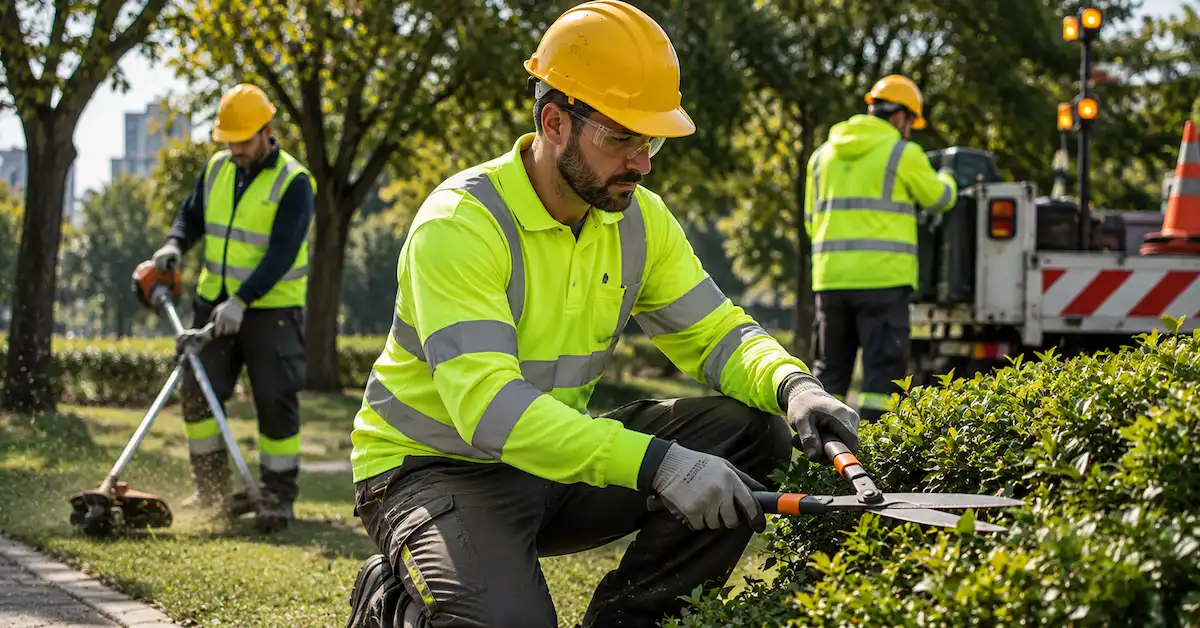
Outdoor workers face a combination of hazards that can change throughout the same shift. A grounds maintenance employee may begin the morning in direct sunlight, work near moving maintenance vehicles at midday, and finish in cooler, rainy conditions.
Choosing safety clothing for outdoor workers therefore requires more than selecting a fluorescent vest or a heavy-duty jacket.
For municipal procurement teams, utility contractors, grounds maintenance companies, and PPE distributors, the challenge is balancing visibility, thermal comfort, sun protection, garment durability, and any additional job-specific protective requirements.
Quick Answer: Effective outdoor safety clothing starts with an assessment of the worker's tasks, exposure to vehicles, heat, ultraviolet radiation, and changing weather conditions. Buyers should select garments that meet applicable protective requirements while evaluating breathability, coverage, fit, and compatibility with other PPE. No single garment automatically provides every form of protection, and clothing selection must be supported by workplace controls, appropriate testing, and verified product specifications.
This guide explains how to develop a practical outdoor workwear specification, compare garment styles, approve samples, and source customized clothing for multi-site operations.
1. Key Takeaways for Outdoor Safety Workwear Buyers
-
Select workwear based on actual hazards, not job titles alone.
-
Do not compromise required high-visibility performance to improve comfort.
-
Lightweight clothing may help workers manage heat, but fabric performance and garment design still matter.
-
Long sleeves or bright colors do not automatically establish a tested ultraviolet protection rating.
-
High-visibility, UV protection, rain protection, and thermal comfort are separate performance considerations.
-
Review clothing compatibility with helmets, harnesses, gloves, and other required PPE.
-
Require product-specific documentation before approving claims about protective performance.
-
Use approved samples, specifications, and quality controls to maintain consistency across bulk orders.
The purchasing objective is to create an appropriate clothing system for each working environment rather than relying on one universal outdoor uniform.
2. What Is Safety Clothing for Outdoor Workers?
Safety clothing for outdoor workers includes occupational garments selected to address identified workplace risks and operational needs.
Depending on the application, these may include high-visibility vests, reflective shirts, work jackets, rainwear, sun-protective clothing, and specialized protective garments.
However, not every outdoor work garment is certified PPE.
An ordinary uniform shirt may provide basic coverage and company identification without being suitable for vehicle-related visibility hazards.
Likewise, a reflective vest does not automatically provide protection against heat stress, harmful UV exposure, chemical hazards, or electric arcs.
The appropriate garment depends on the assessed exposure.
Who Needs Outdoor Safety Clothing?
Common B2B purchasing applications include municipal maintenance, landscape management, electrical utility support, outdoor logistics, parks and grounds services, facility maintenance, and general field operations.
Specialized industries may require additional protections that ordinary reflective workwear cannot provide.
The supplier and buyer should establish the intended use before developing the product specification.
3. The Three-Way Challenge: Heat, Sun Protection and Visibility
One of the most important outdoor workwear purchasing decisions involves balancing three competing priorities.
Priority 1: Managing Heat Exposure
Hot-weather workwear should be evaluated for fabric weight, fit, air movement, moisture management, and interaction with required PPE.
However, clothing alone cannot prevent occupational heat illness.
Priority 2: Reducing Sun Exposure
Suitable coverage can help reduce direct exposure of the skin to sunlight.
Fabric construction, coverage, and tested UV protection characteristics may all be relevant.
Priority 3: Maintaining Visibility
Where workers operate near vehicles, machinery, or other visibility hazards, the clothing must satisfy the applicable high-visibility requirements.
A lightweight garment is not automatically compliant merely because it is brightly colored.
The Workwear Trade-Off Matrix
| Purchasing Priority | Potential Advantage | Possible Trade-Off | What Buyers Must Verify |
|---|---|---|---|
| Lightweight fabric | Reduced garment weight | Material may have different durability or protective characteristics | Required fabric and garment performance |
| Loose-fitting design | Improved comfort and movement | Poor fit may interfere with tasks | Size specifications and practical fit |
| Long sleeves | Greater skin coverage | Additional thermal burden in some conditions | Comfort and verified UV properties if claimed |
| High-visibility materials | Improved conspicuity | Garment construction may affect comfort | Applicable finished-garment conformity |
| Water-resistant outerwear | Some protection against light moisture | May reduce heat and moisture release | Actual rain resistance and breathability |
| Multiple clothing layers | Adaptability to different conditions | Increased bulk or heat burden | Compatibility and outermost protective garment |
The correct choice is not necessarily the lightest, thickest, or brightest garment. It is the garment configuration that meets the required protection while remaining practical for the task.
4. Match Clothing to Outdoor Jobsite Exposure
A useful purchasing framework is to develop an outdoor exposure profile for each employee group.
This helps buyers distinguish roles that may share a company uniform but face different conditions.
Outdoor Workwear Exposure Matrix
| Worker Group | Common Exposure | Garment Selection Priority |
|---|---|---|
| Municipal grounds crews | Sun, heat, equipment, occasional vehicle activity | Appropriate visibility, comfort and coverage |
| Utility field technicians | Outdoor work, access equipment, varying site conditions | Task-specific protection and equipment compatibility |
| Landscaping teams | Physical activity, direct sunlight, vegetation | Mobility, durable construction and sun coverage |
| Outdoor warehouse and yard workers | Moving vehicles, loading operations | Applicable high-visibility performance and fit |
| Parks maintenance teams | Long outdoor shifts and changing weather | Comfortable workwear with appropriate protection |
| Facility inspection teams | Walking between outdoor work areas | Lightweight, practical clothing suited to assessed risks |
This matrix supports specification development; it does not prescribe a specific PPE class.
For example, employees working near industrial vehicles may need high-visibility clothing, while an electrical technician may also require specialized arc-rated protection.
Those requirements must be assessed independently.
5. How to Select Clothing for Hot Outdoor Work
Heat exposure depends on several interacting factors, including temperature, humidity, sunlight, workload, air movement, and clothing.
The US Occupational Safety and Health Administration explains that some types of PPE, particularly impermeable clothing, can increase heat-related illness risks.
Its official Occupational Heat Exposure Guidance highlights the need to consider clothing and working conditions when managing heat hazards.
Important Hot-Weather Garment Characteristics
Fabric construction: Consider appropriate fabrics that support the intended wearing comfort, durability, and required protective performance.
Garment fit: Avoid unnecessarily restrictive designs that interfere with normal movements.
Moisture management: Ask whether relevant performance claims are supported by test evidence.
Sleeve and collar design: Balance worker coverage with comfort and the required wearing configuration.
Garment weight: Compare actual product constructions rather than assuming that one GSM value is ideal.
Is a Reflective Vest Always Cooler Than a High-Visibility Polo?
Not necessarily.
A vest may be lightweight, but its performance depends partly on the clothing worn underneath.
A high-visibility polo may offer a different wearing configuration.
Buyers should compare the complete outfit, including the underlying clothing, activity level, and required protective classification.
Clothing Cannot Replace a Heat Prevention Program
Employers must address heat exposure through appropriate measures, potentially including work scheduling, shade, access to water, acclimatization, rest breaks, training, and emergency procedures.
A product described as breathable should never be marketed as eliminating heatstroke risk.
6. How Should Outdoor Buyers Evaluate UV Protection?
Outdoor workers can experience significant exposure to ultraviolet radiation during normal duties.
The US National Institute for Occupational Safety and Health explains that sunlight exposure can increase the risk of sunburn and skin cancer.
Its official Sun Exposure at Work Guidance recommends appropriate clothing and additional sun-protection measures.
Important UV-Related Purchasing Questions
Does the garment provide adequate coverage?
Review sleeve length, collar design, exposed skin, and compatibility with head protection.
Does the supplier claim a UPF rating?
If so, request a relevant test report identifying the material or product configuration.
How does the fabric perform when worn?
Stretching, moisture, fabric construction, and wear conditions may influence protection.
Is the clothing comfortable for extended use?
A theoretically suitable garment may be difficult to use correctly if workers find it excessively restrictive or uncomfortable.
Does Fluorescent Fabric Automatically Protect Against UV?
No.
A fluorescent appearance is not evidence of a tested ultraviolet protection factor.
Likewise, reflective tape is designed for visibility-related functions, not as proof of UV protection.
Buyers should request dedicated evidence for any advertised UPF or UV-protection claim.
Sun protection may also require suitable headwear, sunscreen, shade, scheduling changes, and other controls.
7. When Do Outdoor Workers Need High-Visibility Clothing?
High-visibility workwear becomes important when the risk assessment identifies a need for workers to be conspicuous.
Potential exposure settings include maintenance yards, logistics areas, roadside facilities, and sites with moving industrial vehicles.
The applicable garment design depends on the workplace and destination market.
US High-Visibility Standard
ANSI/ISEA 107-2026 establishes performance requirements for high-visibility safety apparel used in roadway, non-roadway, and public safety environments.
It defines garment types and performance classes, as well as requirements for fluorescent background materials, retroreflective materials, construction, marking, testing, and care.
Buyers can review the International Safety Equipment Association's official high-visibility standard information.
European High-Visibility Requirements
EN ISO 20471 is commonly used for high-visibility protective clothing in European markets.
Where the EU PPE framework applies, buyers should also verify the relevant conformity assessment and documentation.
The exact standard edition and legal obligations must be confirmed for the destination market.
Why Product-Level Verification Matters
A garment with reflective strips is not automatically equivalent to a compliant high-visibility garment.
Buyers should ask for the approved model identification, relevant performance classification, test evidence, and required labeling.
An existing company certificate does not necessarily establish conformity for every model or customization.
8. How Should Outdoor Clothing Change When Weather Conditions Change?
Outdoor crews may experience direct sun, rising temperatures, cooler evenings, and intermittent rain during one working day.
The key is to define which clothing changes remain suitable for the intended work.
Outdoor Clothing Transition Guide
| Changing Condition | Possible Clothing Response | Essential Check |
|---|---|---|
| Cool morning to warm afternoon | Change to an appropriate lighter garment | Maintain necessary protective coverage |
| Strong direct sunlight | Use suitable coverage and sun protection measures | Check comfort and documented UV claims |
| Dry weather to rain | Add suitable protective rainwear | Confirm outermost garment remains compliant |
| Daylight to low light | Use appropriate high-visibility configuration | Verify required conspicuity |
| High activity to lower activity | Review thermal comfort and layering | Avoid unsuitable overheating or cold exposure |
This is a practical clothing-planning guide rather than a replacement for a weather hazard assessment.
Severe weather conditions may require stopping work, moving to shelter, or implementing other controls.
Why the Outermost Garment Matters
A compliant high-visibility shirt can become obscured when worn beneath an ordinary dark jacket.
Where high-visibility clothing is required, the actual outermost clothing arrangement must continue to meet the relevant requirements.
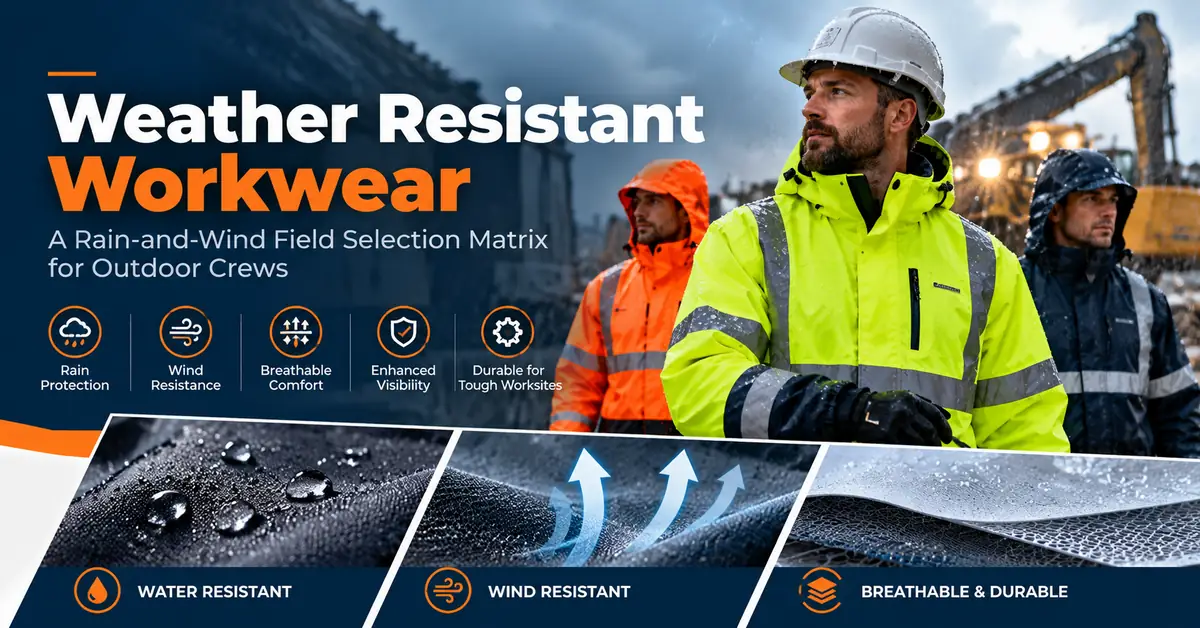
For detailed rain and wind selection, see AOKE's Weather Resistant Workwear Buyer Guide.
9. Which AOKE Workwear Styles Are Relevant to Outdoor Teams?
AOKE's published reflective clothing range provides several garment styles that buyers can use as initial design references.
AOKE Outdoor Workwear Style Comparison
| Product Model | Garment Style | Practical Evaluation |
|---|---|---|
| LXA001 | Reflective safety vest | Layering, fit and lightweight workwear configurations |
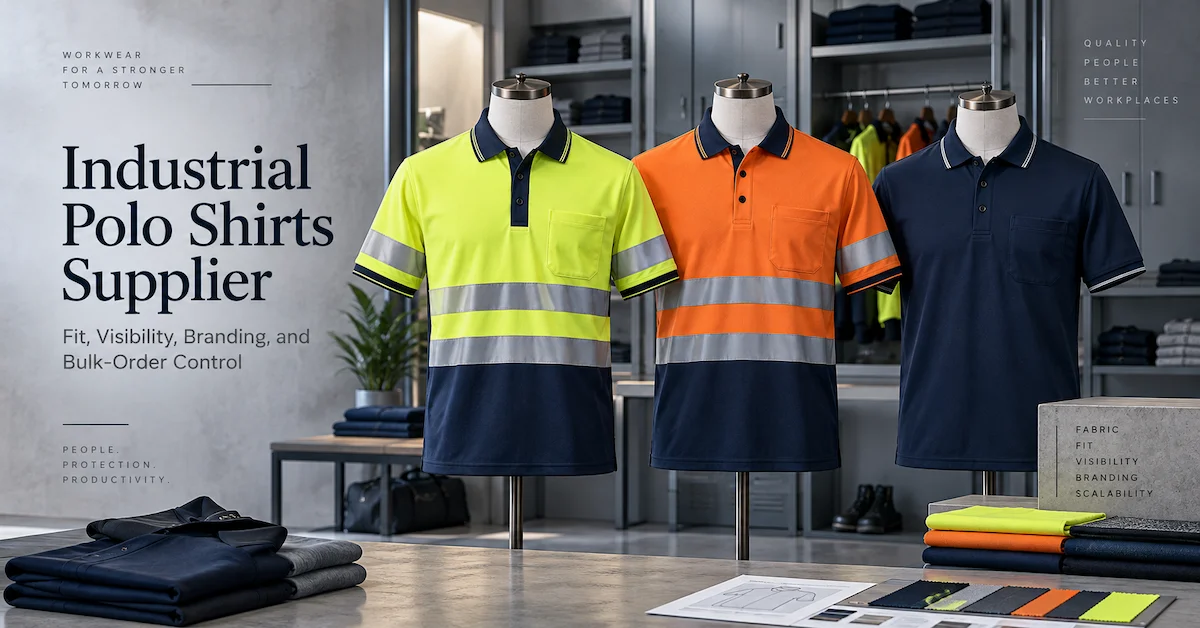
| LXU018 | Reflective polo shirt | Warm-weather usability and visibility design |
| LXA012 | Long-sleeve reflective polo | Coverage, sleeve mobility and comfort |
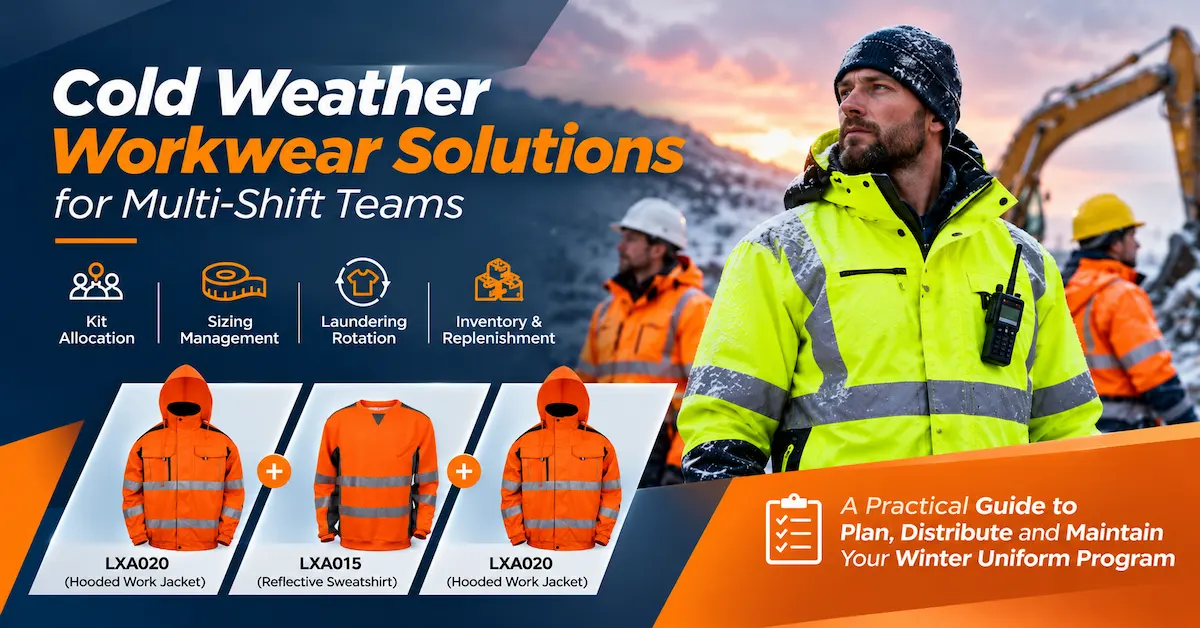
| LXA015 | Reflective sweatshirt | Cooler-weather working conditions |
| LXA020 | Hooded reflective work jacket | Outerwear fit, pockets, closures and weather exposure |
LXA001 Reflective Safety Vest
The LXA001 Reflective Safety Vest provides a starting point for discussing vest-based visibility and layering requirements.
LXU018 Reflective Polo
The LXU018 Reflective Polo is a useful style reference for discussing lightweight high-visibility workwear in warmer conditions.
LXA012 Long-Sleeve Reflective Polo
The LXA012 Reflective Polo allows buyers to evaluate sleeve coverage, collar design, mobility, and visibility layout.
LXA015 Reflective Sweatshirt
The LXA015 Reflective Sweatshirt can serve as a reference for cooler outdoor environments.
LXA020 Reflective Work Jacket
The LXA020 Reflective Work Jacket provides a reference for hood design, closures, pockets, and outerwear construction.
Important: These are existing AOKE garment references, not verified claims that every style has a tested UPF rating, a specific EN ISO 20471 class, or a particular waterproof performance level.
Buyers should confirm the exact product specification and relevant documentation before approval.
For additional designs, visit the AOKE Reflective Clothing Collection.
10. Technical Specifications for Outdoor Safety Clothing
A purchasing specification should combine necessary protective evidence with practical construction requirements.
Outdoor Workwear Technical Specification Table
| Technical Item | What Buyers Should Request |
|---|---|
| Intended application | Job function, working conditions and relevant hazards |
| Fabric composition | Approved fiber content and construction |
| Fabric weight | GSM and approved material reference |
| Moisture management | Appropriate evidence if claimed |
| UV protection | UPF test report if a specific rating is advertised |
| High-visibility performance | Relevant type, class and garment evidence |
| Retroreflective material | Component specification, placement and performance |
| Fit | Approved measurements and tolerances |
| Stitching and seams | Construction specification and workmanship criteria |
| Closures | Zippers, fasteners and adjustment features |
| Branding | Position, size and approved application method |
| Care instructions | Washing, maintenance and replacement guidance |
| Packaging | Size identification and production traceability |
Which Specifications Are Mandatory?
Mandatory specifications depend on the intended garment function, workplace hazards, target market, and buyer contract.
For example, a garment marketed as UV-protective should have substantiation appropriate to its claim.
A garment sold as certified high-visibility PPE requires relevant conformity evidence.
General durability or comfort statements should also be supported where specific measurable performance is advertised.
11. How Should Buyers Approve Outdoor Workwear Samples?
Sampling is particularly important when buyers are developing a uniform program for different outdoor duties.
An approved garment should be evaluated for both protective requirements and practical usability.
Recommended Sample Approval Process
Step 1: Define the work environment. Identify sun exposure, activity level, vehicle movement, and additional site risks.
Step 2: Review product documentation. Examine relevant protective standards, material specifications, and any advertised performance claims.
Step 3: Check garment fit. Evaluate a representative size range and compatibility with necessary equipment.
Step 4: Assess normal movements. Review reaching, bending, walking, and other routine activities in a safe test environment.
Step 5: Inspect construction. Examine seams, reflective attachment, labels, pockets, and closures.
Step 6: Confirm care requirements. Determine whether garments can be maintained according to the intended uniform program.
Step 7: Approve the final specification. Retain the agreed reference sample and record every material and design detail.
A short field evaluation cannot establish laboratory properties such as UPF, reflective performance, or certified protective classifications.
Those claims require appropriate evidence.
12. OEM Customization: What Changes Require Technical Review?
Private-label brands and industrial buyers often request modified garments.
Common requirements include company logos, colors, additional pockets, different sleeves, labels, and revised size distributions.
However, customization can affect the garment's original performance.
OEM Customization Risk Matrix
| Customization | Potential Issue | Recommended Action |
|---|---|---|
| Large printed logo | May cover qualifying high-visibility material | Review approved placement |
| New fabric | Different breathability or protective properties | Verify material and performance |
| Modified sleeve length | Changes coverage and fit | Review technical requirements |
| Alternative reflective tape | Changes visibility-related performance | Verify approved components |
| Additional pockets | Changes construction or visible area | Review design |
| New color scheme | May affect required background material | Confirm applicable requirements |
| Alternative labels | Inaccurate product or conformity information | Check marking requirements |
Buyers should approve the final artwork and garment construction before bulk production.
Where a modification affects protective performance, an additional technical assessment may be required.
Discuss Custom Outdoor Workwear with AOKE
13. How to Control Quality Across Bulk Outdoor Workwear Orders
For repeat orders, consistency matters as much as the first approved sample.
A change in fabric, reflective material, printing method, or size grading can affect product performance and usability.
Recommended Quality-Control Checkpoints
| Production Stage | Quality-Control Focus |
|---|---|
| Incoming materials | Approved fabrics and component identification |
| Cutting | Pattern accuracy and size consistency |
| Sewing | Seams, sleeves and closures |
| Reflective attachment | Placement and workmanship |
| Printing and branding | Approved artwork |
| In-process inspection | Production deviations |
| Final inspection | Dimensions, appearance and labels |
| Technical verification | Applicable protective-performance requirements |
| Shipment records | Style, size and batch traceability |
General workmanship inspections should not be used as a substitute for mandatory protective-performance testing.
Where a safety-critical requirement is not met, the supplier and buyer should investigate the affected production lot.
Why Material Traceability Matters
Buyers should be able to connect an approved product to its materials, style revision, production batch, and supporting records.
This is especially important when the same outdoor uniform is purchased repeatedly over several seasons.
14. What Determines the Cost of Bulk Outdoor Safety Clothing?
The price of outdoor safety clothing depends on garment design, material selection, reflective components, customization, protective testing, production quantity, and logistics.
Cost Comparison Framework
| Cost Factor | What Influences the Price |
|---|---|
| Fabric construction | Material composition and sourcing |
| Protective performance | Required testing and conformity |
| Garment design | Complexity of sewing and assembly |
| Reflective components | Approved material and layout |
| OEM customization | Printing, labels and pattern changes |
| Order volume | Production efficiency |
| Quality control | Inspection and verification |
| Shipping | Packaging and destination |
| Repeat orders | Material availability and replacement planning |
A useful purchasing model is:
Total Procurement Cost = Garment Cost + Sampling + Testing + Customization + Inspection + Freight + Replacement Costs
This framework allows buyers to compare suppliers offering equivalent specifications.
How Should Buyers Evaluate MOQ and Lead Time?
MOQ depends on the selected product, material requirements, customization scope, and production arrangements.
Lead time may include sampling, technical review, material preparation, production, inspection, and shipping.
Buyers should request a project-specific quotation rather than assume that a promotional delivery promise applies to every custom garment.
15. AOKE's Manufacturing Capabilities for Outdoor Workwear Buyers
Jinhua Aoke New Materials Co., Ltd. manufactures reflective clothing and industrial workwear for international B2B customers.
According to its published company information, AOKE has manufacturing facilities in Jinhua, Chongqing, and Myanmar, supporting customization and garment production at different scales.
Its product range includes reflective safety vests, polos, sweatshirts, and work jackets.
The company also describes technical sampling facilities and quality-control processes.
These capabilities provide a basis for discussing outdoor workwear development.
However, the company profile should not be interpreted as proof that every individual garment has a particular UV, waterproof, or high-visibility certification.
What Should Outdoor Workwear Buyers Confirm?
Buyers should request confirmation of the proposed garment style, approved materials, available technical documentation, sample options, OEM development possibilities, quality-control arrangements, MOQ, and lead time.
For specialized protective applications, product-specific evidence is essential.
Explore AOKE Reflective Workwear
16. Outdoor Safety Clothing RFQ Checklist
To obtain an accurate quotation, provide sufficient information about the intended working conditions.
| RFQ Field | Information to Provide |
|---|---|
| Buyer type | Municipality, contractor, distributor or private-label brand |
| Destination market | Country and applicable requirements |
| Job application | Grounds work, utility maintenance, yard operations or other |
| Main hazards | Heat, UV exposure, vehicle movement, weather and other risks |
| Garment styles | Vest, polo, sweatshirt, jacket or combination |
| Required standards | Applicable protective performance criteria |
| Fabric requirements | Composition, construction and relevant test results |
| Size breakdown | Quantities for each size |
| Branding | Logo, labels and color requirements |
| Sample approval | Required garment versions and testing |
| Order quantity | Initial and estimated repeat demand |
| Delivery | Destination and requested schedule |
Ready to Source Outdoor Safety Workwear?
Share your outdoor working conditions, required performance criteria, garment preferences, quantity, size distribution, and branding requirements.
AOKE can then discuss available products, customization options, technical feasibility, and a project-specific quotation.
Contact AOKE for Outdoor Safety Clothing Samples and Bulk Pricing
17. Frequently Asked Questions
1. What is the best safety clothing for outdoor workers?
The best clothing depends on the assessed hazards, climate, work activity, and required protection. Buyers should verify relevant garment performance while evaluating fit, coverage, comfort, and compatibility with other PPE.
2. Can high-visibility clothing be suitable for hot weather?
Yes, where the garment meets the required visibility specification and its construction is suitable for the working conditions. Lightweight or breathable designs may be useful, but heat hazards also require appropriate workplace controls.
3. Does fluorescent workwear provide UV protection?
Fluorescent color alone does not establish a tested UPF rating. Buyers should request appropriate test evidence for any advertised UV-protection claim.
4. Should outdoor workers wear long sleeves in hot weather?
The appropriate clothing depends on sun exposure, thermal conditions, task requirements, and any additional hazards. Long sleeves can provide greater coverage, but comfort and actual protective performance must be assessed.
5. What is the difference between reflective clothing and sun-protective clothing?
Reflective or high-visibility clothing is designed to improve conspicuity under specified conditions. Sun-protective clothing focuses on reducing UV exposure. The two characteristics require different performance evidence.
6. Can a reflective vest replace a high-visibility shirt?
Possibly, if the selected garment and complete wearing configuration satisfy the applicable requirements. Buyers should not assume the two designs are automatically equivalent.
7. Can outdoor safety clothing protect workers from heatstroke?
No garment alone can guarantee prevention of heatstroke. Employers need an appropriate heat illness prevention program addressing workplace conditions, hydration, rest, shade, acclimatization, and emergency response.
8. Can AOKE customize safety clothing for outdoor workers?
AOKE publicly describes reflective workwear manufacturing and customization services. Buyers should confirm the proposed design, material options, protective requirements, MOQ, and available documentation for their specific project.
9. How should buyers choose an outdoor workwear supplier?
Evaluate product suitability, technical documentation, garment construction, sample quality, manufacturing controls, customization support, commercial terms, and repeat-order consistency.
10. How do I request a bulk outdoor workwear quotation?
Contact AOKE with your intended applications, destination market, expected quantity, garment preferences, sizing information, branding details, and required technical performance. Request sample and documentation review before final approval.
Conclusion
Choosing safety clothing for outdoor workers requires a balanced approach to protective performance, comfort, environmental exposure, and purchasing reliability.
Outdoor teams may encounter heat, sunlight, vehicle movement, rain, and changing temperatures throughout the same working day.
For municipal departments, utility contractors, grounds maintenance companies, and PPE distributors, the best purchasing decision begins with an accurate understanding of these working conditions.
A suitable garment program should address high-visibility requirements where applicable, sun coverage, thermal comfort, practical fit, and compatibility with other protective equipment.
Buyers should also verify product-specific performance evidence and carefully review changes introduced through OEM customization.
By combining workplace hazard assessment, technical specifications, approved samples, and consistent manufacturing controls, procurement teams can reduce sourcing uncertainty and develop more reliable outdoor uniform programs.
AOKE offers reflective clothing manufacturing and customization capabilities for international B2B customers.
Companies planning outdoor workwear purchases can contact AOKE to discuss garment designs, material options, technical documentation, sampling, and bulk order requirements.
Explore AOKE Reflective Clothing Products
Contact AOKE for Outdoor Workwear Development and Bulk Pricing