
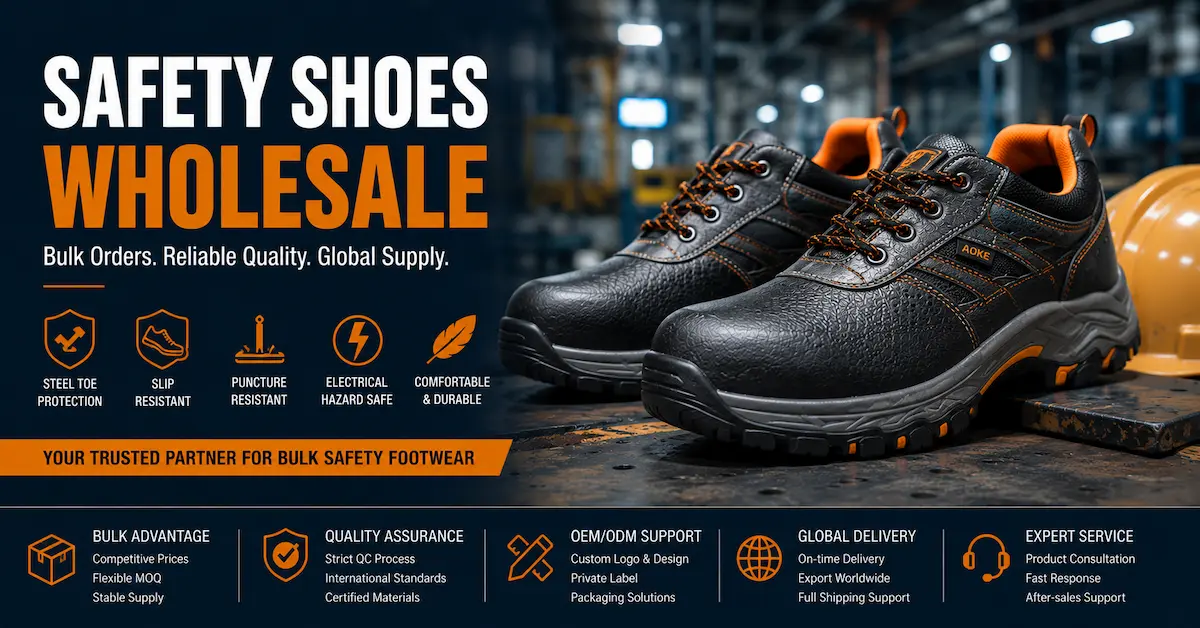
Why Buying Safety Shoes Wholesale Requires More Than a Low Price
For a PPE distributor, buying manager, construction supplier, or private-label brand, a wholesale safety shoe order can represent thousands of pairs, multiple sizes, several production batches, and months of inventory.
That changes the purchasing question.
It is not simply:
“Who has the cheapest safety shoes?”
A better question is:
“Which supplier can provide the right protection, consistent quality, acceptable documentation, predictable delivery, and workable commercial terms at the required volume?”
That distinction matters because safety footwear is a protective product. The wrong specification can create problems long after the purchase order has been approved.
A practical wholesale evaluation should cover:
- Workplace hazards
- Toe protection
- Sole construction
- Materials
- Slip and puncture requirements
- Applicable standards
- Sample quality
- Production consistency
- MOQ
- Lead time
- Packaging
- OEM requirements
- Total landed cost
For companies purchasing repeatedly, supplier reliability can be just as important as the first quotation.
Who Buys Safety Shoes Wholesale?
The safety shoes wholesale market includes several distinct B2B buyer groups.
| Buyer Type | Typical Order | Main Purchasing Priority |
|---|---|---|
| PPE distributor | Repeated mixed-size orders | Product range and consistency |
| Safety footwear wholesaler | Large-volume orders | Cost and availability |
| Construction supplier | Project-based orders | Protection and durability |
| Industrial procurement team | Workforce quantities | Hazard suitability |
| Contractor | Project quantities | Delivery schedule |
| Private-label brand | OEM production | Product development and branding |
| Government/project supplier | Specification-based orders | Documentation and compliance |
PPE Distributors
Distributors usually need products that can be reordered without major changes in specifications.
Their concerns often include:
- Size availability
- Consistent product quality
- Stable pricing
- Packaging
- Replenishment lead time
Industrial Buyers
Industrial companies may purchase footwear for employees working in:
- Manufacturing
- Warehouses
- Logistics
- Construction
- Maintenance
- Heavy industrial environments
Here, the product should be selected around the actual hazards rather than simply around appearance.
Private-Label Brands
Private-label buyers have another layer of requirements.
They may need:
- Custom colors
- Logo application
- Branded insoles
- Shoe boxes
- Labels
- Barcodes
- Carton markings
That makes supplier development capability particularly important.
Define the Workplace Before Choosing Bulk Safety Shoes
A good safety shoes supplier should ask what the footwear will be used for.
OSHA requires protective footwear where employees face risks such as falling or rolling objects, objects piercing the sole, or certain electrical hazards.
That means a buyer should identify the work environment first.
Construction Sites
Typical concerns may include:
- Falling materials
- Sharp debris
- Uneven surfaces
- Slips
- Heavy equipment
Manufacturing Plants
A factory may require a combination of:
- Toe protection
- Slip resistance
- Puncture resistance
- Electrical properties
- Abrasion-resistant soles
Warehouses and Logistics
Workers may spend many hours walking and handling loads.
In these environments, buyers often need to balance:
- Protection
- Weight
- Traction
- Comfort
- Durability
Maintenance Operations
Maintenance work can expose employees to different hazards depending on the equipment and location.
The footwear specification should therefore be linked to the actual risk assessment.
What Specifications Should You Confirm Before Buying in Bulk?
A wholesale inquiry should define the product before the supplier gives a final quotation.
| Specification | What the Buyer Should Confirm |
|---|---|
| Product type | Low-cut shoe, boot, work shoe, etc. |
| Toe protection | Steel, composite, or other specified construction |
| Upper | Leather, synthetic, textile, mesh, etc. |
| Outsole | Material and required performance |
| Puncture protection | Required or not required |
| Slip resistance | Applicable test or requirement |
| Electrical properties | Required or not required |
| Size range | Target market sizing |
| Weight | Target or acceptable range |
| Color | Standard or custom |
| Branding | Logo, label,packaging |
| Packaging | Individual box, carton, pallet |
This document should become the reference for sampling and mass production.
Steel Toe or Composite Toe: Which Is Better for Wholesale Buyers?
There is no single answer for every workplace.
Steel Toe
Steel toe caps are widely used in industrial safety footwear and provide strong mechanical protection.
Potential advantages include:
- Familiar construction
- Robust mechanical protection
- Broad industrial application
Potential considerations include:
- Weight
- Thermal conductivity
- Metal-free workplace requirements
Composite Toe
Composite toe constructions are often selected where buyers want a non-metallic alternative.
Potential advantages include:
- Lower thermal conductivity
- Potentially lower weight
- Suitability for some metal-free environments
The correct choice depends on the application and applicable standard.
For wholesale procurement, the important point is to compare the complete footwear configuration, not just the toe-cap material.
Safety Footwear Standards: What B2B Buyers Should Verify
Standards are particularly important when purchasing safety footwear for regulated markets.
ASTM F2413-24
ASTM F2413-24 is the active ASTM specification for protective safety-toe footwear. It covers minimum design, performance, testing, classification, fit, and function requirements for footwear intended to protect against various workplace hazards.
The specification covers areas including:
- Toe impact resistance
- Toe compression resistance
- Metatarsal protection
- Conductive properties
- Electrical hazard protection
- Static dissipative properties
- Puncture resistance
- Chain-saw cut resistance
- Dielectric insulation
Not every safety shoe needs every protection category.
The product should be matched to the actual requirement.
ISO 20345:2021
ISO 20345:2021 specifies basic and additional requirements for general-purpose safety footwear, including mechanical risks, slip resistance, thermal risks, and ergonomic behavior. Specialized risks may require complementary standards.
For an international wholesale order, buyers should identify:
- Destination market
- Applicable standard
- Required protection class
- Product model
- Test documentation
Do not treat a generic statement such as “CE certified” or “ISO certified” as a complete technical specification.
Why Samples Matter Before a Wholesale Order
A product photograph cannot tell you how a safety shoe feels after several hours of wear.
Before approving bulk production, buyers should inspect a physical sample.
Construction
Check:
- Stitching
- Sole bonding
- Toe-cap position
- Upper material
- Insole
- Outsole
- Overall symmetry
Fit
If possible,have representative users evaluate:
- Toe room
- Heel stability
- Weight
- Flexibility
- Comfort
- Breathability
Specification
Compare the physical sample against:
- Technical sheet
- Size chart
- Product model
- Packaging
- Test documentation
The approved sample should be retained as a production reference.
How a Safety Shoes Supplier Should Control Wholesale Quality
Bulk purchasing creates a different quality challenge from buying a few samples.
A supplier needs to control the process from incoming materials to finished goods.
| Production Stage | Key Control |
|---|---|
| Material receiving | Verify approved materials |
| Cutting | Check dimensions and consistency |
| Stitching | Inspect seams and alignment |
| Component assembly | Verify correct placement |
| Sole bonding | Check bonding consistency |
| Toe-cap assembly | Confirm specified construction |
| Finished shoe inspection | Check size, appearance and workmanship |
| Functional testing | Verify applicable performance |
| Packaging | Check size, labels and quantities |
| Pre-shipment inspection | Sample the completed order |
The important concept for a distributor is repeatability.
A supplier may produce an excellent sample but still be unsuitable for long-term wholesale business if the next production batch uses different components or construction methods.
Material Changes Can Affect Compliance
This is particularly important for OEM and private-label projects.
ASTM F2412-24 identifies changes such as changing the protective toe-cap material or manufacturer, changing the footwear construction method or factory, significant changes to upper or insole thickness, changing the sole system or hardness, and changing the last as reasons that can require retesting.
For procurement teams, this creates a simple rule:
Do not change critical components after sample approval without checking the impact on testing and compliance.
This applies to seemingly minor changes as well.
A new insole, outsole hardness, or different toe-cap supplier may not be equivalent to the original tested configuration.
How to Compare Safety Footwear Wholesale Suppliers
When comparing suppliers, use the same specification for everyone.
| Evaluation Factor | What to Compare |
|---|---|
| Product specification | Exact model and construction |
| Sample | Physical quality and fit |
| Protection | Required performance |
| Documentation | Applicable reports and records |
| MOQ | Trial and regular order quantity |
| Price | Comparable product configuration |
| Packaging | Carton and pallet configuration |
| Lead time | Production + shipping schedule |
| OEM | Branding and development options |
| QC | Inspection and approval process |
| Repeat supply | Ability to reproduce the model |
A quotation is only comparable when the underlying products are comparable.
For example, a lower price may exclude:
- Branded packaging
- Higher-grade materials
- Additional testing
- Different reflective or protective components
- Specific carton requirements
This is why purchasing teams should compare landed cost for an approved specification, rather than unit price alone.
What Determines Safety Shoes Wholesale Pricing?
The price of bulk safety footwear depends on the product configuration and commercial terms.
Common factors include:
Product Construction
More complex footwear generally requires more components and production steps.
Materials
Upper, outsole, insole, protective toe, and other components can significantly affect cost.
Order Quantity
Larger orders can improve production efficiency, but the relationship between quantity and price depends on the supplier's production setup.
Customization
OEM branding, packaging, colors, and special components can add development or production costs.
Packaging
Individual boxes and customized cartons affect both packaging cost and shipping volume.
Testing and Documentation
Market-specific requirements may create additional testing or documentation costs.
Logistics
Safety shoes occupy significant shipping volume.
Therefore, the relevant number for an importer is often the landed cost per usable pair, not the factory quotation alone.
How to Reduce Risk When Buying Bulk Safety Shoes
A sensible wholesale process can be broken into several stages.
Stage 1: Define the Requirement
Identify:
- Application
- Target market
- Protection requirements
- Size range
- Quantity
- Branding requirements
Stage 2: Screen Suppliers
Review:
- Product experience
- Documentation
- Production capability
- QC process
- Communication
Stage 3: Request Samples
Compare the samples using the same checklist.
Stage 4: Approve the Specification
Record:
- Materials
- Components
- Dimensions
- Weight
- Color
- Packaging
- Branding
Stage 5: Confirm Commercial Terms
Discuss:
- MOQ
- Price
- Payment terms
- Lead time
- Inspection
- Shipping
Stage 6: Control Mass Production
The approved sample should remain the reference throughout production.
Stage 7: Inspect Before Shipment
A pre-shipment inspection helps identify quantity, appearance, packaging, and specification issues before the goods leave the supplier.
OEM Safety Shoes: What Private-Label Buyers Should Plan
The keyword safety shoes OEM represents a stronger purchasing intent than a simple product search.
Private-label buyers usually need a longer cooperation cycle.
The project may involve:
- Product selection
- Sample development
- Logo design
- Packaging
- Labeling
- Size range
- Color selection
- Testing documentation
- Production approval
OEM Workflow
Requirement → Product Selection → Sample → Testing/Verification → Artwork → Approval → Bulk Production → Inspection → Shipment
The key is to finalize technical details before artwork and mass production are locked.
A brand should also clarify which components can be changed without affecting the applicable compliance position.
When Should You Choose a Safety Footwear Wholesale Program?
Wholesale purchasing makes sense when the business has:
- Predictable demand
- Repeat customers
- Multiple projects
- Distributor inventory requirements
- Private-label plans
- Regular PPE procurement
For smaller trial orders, a stock model may be more practical.
For established distributors, a repeatable wholesale program can provide better inventory planning and more predictable sourcing.
Can One Supplier Handle Multiple PPE Categories?
For many B2B buyers, safety footwear is only one part of the procurement list.
A construction or industrial customer may also require:
- Safety helmets
- Work gloves
- Hearing protection
- Reflective clothing
- Traffic cones
- Warning posts
- Caution tape
AOKE currently lists Safety Shoes together with these types of workplace safety products in its Stock Safety Products category.
This can be useful for buyers who want to consolidate inquiries across related safety-product categories.
For high-visibility workwear, buyers can also review AOKE's Reflective Clothing category.
AOKE's Role in B2B Safety Product Sourcing
AOKE's public company information describes Jinhua Aoke New Materials Co., Ltd. as a brand manufacturer since 2010. The company reports more than 300 domestic and international customers, three production facilities, and quality systems including ISO 9001 and BSCI. Its published product certifications are primarily associated with reflective clothing and safety garments, including EN ISO 20471, ANSI, AS/NZS, OEKO-TEX 100, EN 1149, EN 11612, EN 14116, UL, and NFPA 2112.
The company also reports dedicated sample rooms for customized services and different production facilities for customization and larger-scale reflective-clothing production.
For safety shoes wholesale, however, buyers should qualify the specific footwear model separately. AOKE's public website lists Safety Shoes under Stock, but does not currently publish a detailed footwear-specific factory specification or complete shoe certification package on that page.
That means the correct procurement process is to request:
- Exact safety shoe model
- Product specification
- Manufacturing source
- Applicable test documentation
- Available sizes
- MOQ
- Sample
- Packaging
- Current availability
- Lead time
This avoids applying reflective-clothing certifications or production claims to footwear without model-specific verification.
What Should Be Included in a Wholesale Safety Shoes RFQ?
A good RFQ saves time for both buyer and supplier.
Include:
Product Requirements
- Safety shoe or boot
- Toe protection
- Upper material
- Sole requirements
- Puncture protection
- Slip resistance
- Electrical properties
Order Requirements
- Trial quantity
- Bulk quantity
- Expected annual volume
- Size breakdown
Market Requirements
- Country
- Industry
- Applicable standard
- Project requirements
OEM Requirements
- Logo
- Color
- Packaging
- Label
- Barcode
Logistics
- Delivery destination
- Required arrival date
- Carton requirements
- Pallet requirements
For a wholesale inquiry, buyers can provide these details through AOKE's Contact Us page.
Wholesale Safety Shoes Supplier Evaluation Checklist
Before placing the order,confirm:
- Workplace application defined
- Target market identified
- Product specification approved
- Toe protection confirmed
- Sole requirements confirmed
- Applicable standards identified
- Documentation reviewed
- Physical sample approved
- Size range confirmed
- MOQ confirmed
- Lead time confirmed
- Packaging approved
- OEM artwork approved
- QC process agreed
- Pre-shipment inspection arranged
- Landed cost calculated
This checklist is especially useful when comparing several industrial safety shoes suppliers.
Frequently Asked Questions
What is the best way to buy safety shoes wholesale?
Start by defining the workplace hazards and target market, then compare suppliers using the same product specification.Approve samples and documentation before moving to bulk production.
How do I find a reliable safety shoes supplier?
Look beyond price. Evaluate product specifications, samples, documentation, QC procedures, MOQ, lead time, production consistency, packaging, and after-sales responsibility.
What is the difference between safety shoes wholesale and safety footwear wholesale?
They generally describe the same B2B purchasing concept, although “safety footwear” can cover a broader range of protective shoes and boots.
Are bulk safety shoes cheaper than small orders?
Larger quantities can improve production economics, but the final price depends on product configuration, customization, packaging, quantity, and logistics.
What MOQ should I expect for wholesale safety shoes?
MOQ varies by model, size assortment, customization, packaging, and supplier. Stock products and OEM projects can have very different requirements.
Can I order different sizes in one wholesale order?
Many B2B programs use a size breakdown within the total order quantity.The available assortment and minimum quantity per size should be confirmed with the supplier before production.
Can safety shoes be customized for private-label brands?
Yes, depending on the supplier and product. OEM programs can include logos, colors, insoles, packaging, labels, and other branding requirements.
Does OEM customization affect safety shoe compliance?
It can. Changes to critical components or construction may affect the tested configuration. ASTM F2412-24 specifically identifies several footwear component and manufacturing changes that can require retesting.
What standards should I ask for when buying safety shoes?
The applicable standard depends on the target market and product. U.S. buyers may need to evaluate ASTM requirements, while ISO 20345:2021 is an important international safety-footwear standard.
Should I test samples before a bulk order?
Yes. Samples allow buyers to verify physical construction, fit, materials, size, packaging, and the relationship between the supplied product and its documentation.
What affects the wholesale price of safety shoes?
Material selection, protective components, sole construction, order quantity, size assortment, OEM customization, packaging, testing, and logistics can all affect the final price.
Can I source safety shoes and other PPE from AOKE?
AOKE's website lists Safety Shoes within its Stock Safety Products category alongside products such as work gloves, safety helmets, traffic cones, warning posts, and caution tape. Buyers should confirm the exact footwear model, source, documentation, MOQ, and lead time before ordering.
Conclusion
Buying safety shoes wholesale is a procurement decision that combines product safety, quality control, compliance, logistics, and commercial planning.
The strongest B2B purchasing process is not:
Find the lowest price → Place the order.
It is:
Define the hazard → Specify the footwear → Check the applicable requirements → Compare suppliers → Approve samples → Confirm QC → Calculate landed cost → Control production → Inspect before shipment.
For distributors, contractors, industrial buyers, and private-label brands, this approach reduces the risk of receiving footwear that looks right in a catalog but does not match the approved specification.
AOKE provides a broader workplace-safety product range through its Stock Safety Products. For safety footwear specifically, buyers should provide the required application, target market, quantity, size breakdown, protection requirements, and OEM needs so the exact product and documentation can be evaluated.
For wholesale or private-label sourcing, buyers can submit their requirements through Contact Us.