
Why Choosing the Right Noise Protection Earmuffs Manufacturer Matters
Industrial noise exposure is one of the most common workplace safety challenges in manufacturing, construction, transportation, maintenance, and industrial facilities.
For companies purchasing hearing protection products in bulk, selecting the right noise protection earmuffs manufacturer is not only a sourcing decision. It directly affects worker safety, product reliability, customer satisfaction, and long-term supply stability.
Many buyers initially compare suppliers based on unit price. However, professional PPE procurement requires a broader evaluation:
- Does the manufacturer understand industrial hearing protection requirements?
- Can the supplier provide consistent production quality?
- Are technical documents available for target markets?
- Can products be customized for distributors or private brands?
- Can the manufacturer support repeat orders?
A reliable manufacturing partner should help buyers reduce supply risks while providing products suitable for real workplace environments.
Who Needs a Noise Protection Earmuffs Manufacturer?
A professional hearing protection manufacturer typically works with organizations that require stable production capacity and consistent product quality.
Common customers include:
| Customer Type | Purchasing Requirements |
|---|---|
| PPE distributors | Stable supply and competitive pricing |
| Safety equipment wholesalers | Multiple safety product categories |
| Industrial suppliers | Reliable products for factories and contractors |
| Construction safety providers | Durable hearing protection solutions |
| Manufacturing companies | Employee hearing protection programs |
| Private-label brands | OEM production and customized packaging |
| Project contractors | Large-volume safety equipment supply |
Unlike retail customers, B2B buyers usually focus on:
- Manufacturing capability
- Product consistency
- Documentation support
- Production lead time
- Customization ability
- Long-term cooperation
Understanding Industrial Noise Protection Requirements
Before selecting a manufacturer, buyers should understand the application environment.
Different workplaces create different noise challenges.
Examples include:
| Industry | Typical Noise Sources |
|---|---|
| Manufacturing | Machinery, production lines, equipment operation |
| Construction | Drills, cutting tools, heavy machinery |
| Metal processing | Grinding, stamping, machining |
| Transportation | Engines, equipment movement |
| Maintenance | Power tools and repair equipment |
The right hearing protection solution depends on:
- Noise intensity
- Exposure duration
- Communication requirements
- Other PPE being worn
- Worker comfort expectations
According to OSHA occupational noise standards, employers must implement hearing conservation programs when employee noise exposure reaches specific levels. Hearing protectors are part of a broader workplace noise-control strategy.
What Should Buyers Look for in a Noise Protection Earmuffs Manufacturer?
Manufacturing Experience and Production Capability
A qualified manufacturer should demonstrate more than the ability to supply finished products.
Buyers should evaluate:
- Production facilities
- Assembly capability
- Quality management process
- Manufacturing experience
- Product development capability
- Production scalability
For distributors and industrial suppliers, manufacturing stability is critical because customers expect the same product performance from every batch.
A supplier that cannot maintain consistent specifications may create problems such as:
- Customer complaints
- Product returns
- Replacement costs
- Delivery delays
Product Design Knowledge and Application Support
Noise protection earmuffs are not one-size-fits-all products.
A professional manufacturer should understand different application requirements.
Important product factors include:
Noise Reduction Performance
The primary purpose of earmuffs is reducing harmful noise exposure.
However, higher attenuation does not always mean better protection.
The correct product should balance:
- Required protection level
- Worker comfort
- Communication needs
- Working environment
Wearing Comfort
Workers may wear hearing protection for several hours each day.
Important design considerations include:
- Cushion softness
- Headband pressure
- Product weight
- Adjustment range
- Long-term wearing comfort
Poor comfort may reduce worker acceptance and increase the possibility of incorrect usage.
PPE Compatibility
Industrial workers often wear multiple protective products together.
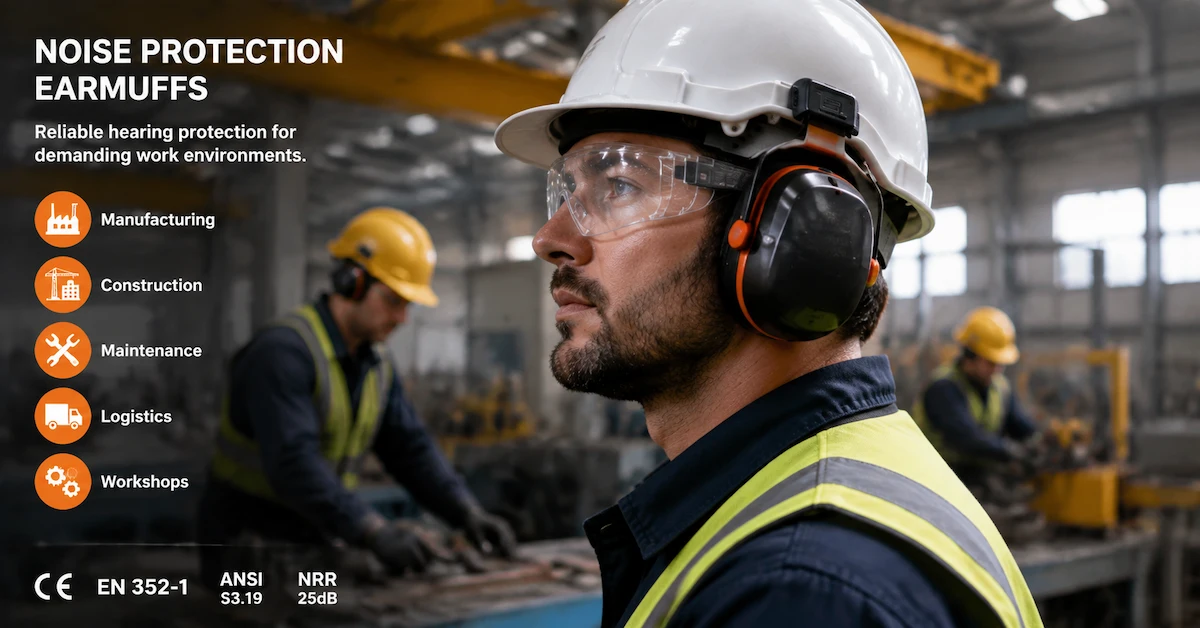
Manufacturers should consider compatibility with:
- Safety helmets
- Safety glasses
- Face shields
- Respiratory protection
For example, construction applications may require helmet-mounted hearing protection rather than standard over-the-head earmuffs.
Types of Noise Protection Earmuffs Manufacturers Can Provide
Different industries require different product configurations.
| Product Type | Application | Advantages |
|---|---|---|
| Passive earmuffs | General industrial environments | Simple structure and reliable performance |
| Helmet-mounted earmuffs | Construction and industrial sites | Compatible with safety helmets |
| Electronic earmuffs | Communication-focused environments | Supports additional functions |
| Level-dependent earmuffs | Variable noise environments | Helps maintain environmental awareness |
| Custom earmuffs | Private-label programs | Supports branding requirements |
Before choosing a manufacturer, buyers should define their target market and application.
Evaluating Noise Reduction and Technical Performance
Professional buyers should review technical information instead of relying only on product appearance.
Important technical factors include:
- Noise Reduction Rating (NRR)
- Attenuation data
- Product specifications
- Testing documentation
- Applicable market requirements
For U.S. buyers, the Noise Reduction Rating (NRR) is an important reference for hearing protector labeling under 40 CFR Part 211.
However, real-world protection also depends on:
- Proper fitting
- Correct wearing method
- Product comfort
- Worker compliance
The National Institute for Occupational Safety and Health (NIOSH) emphasizes that hearing protection selection should consider workplace exposure, fit, and worker acceptance.
How Manufacturers Control Noise Protection Earmuffs Quality
A reliable manufacturer should have a structured quality-control process.
| Quality Control Stage | Purpose |
|---|---|
| Material inspection | Confirm component quality |
| Incoming inspection | Prevent unsuitable materials entering production |
| Assembly inspection | Maintain product consistency |
| Functional testing | Verify product performance |
| Appearance inspection | Maintain product presentation |
| Packaging inspection | Prevent shipment errors |
| Final inspection | Confirm bulk order quality |
For B2B buyers, QC should not be only a supplier statement.
Important questions include:
- How are production batches inspected?
- Are samples retained?
- How are defects handled?
- Is there a production approval process?
- Can quality records be provided?
Compliance and Documentation Requirements
Different countries and industries may require different documentation.
A professional noise protection earmuffs manufacturer should help buyers understand:
- Target-market requirements
- Product documentation
- Testing information
- Labeling requirements
- User instructions
For European markets, buyers should consider applicable requirements under the EN 352 hearing protection standard series depending on product type.
The exact compliance path depends on:
- Product design
- Market destination
- Certification requirements
- Customer application
Buyers should always verify documents against the exact product model being purchased.
OEM and Private Label Noise Protection Earmuffs
Many PPE distributors and safety brands require customized products.
OEM solutions may include:
- Company logo
- Custom colors
- Packaging design
- Product labels
- Distributor information
- Retail packaging
A capable manufacturer should support the complete customization process:
- Requirement confirmation
- Sample development
- Design approval
- Production preparation
- Quality inspection
- Bulk delivery
Before starting an OEM project, buyers should confirm:
- MOQ requirements
- Development timeline
- Packaging specifications
- Documentation requirements
Factors Affecting Noise Protection Earmuffs Pricing
Price is influenced by multiple factors.
| Factor | Impact on Cost |
|---|---|
| Product structure | Different designs require different manufacturing processes |
| Materials | Component selection affects durability and comfort |
| Order quantity | Larger volume may reduce unit cost |
| Customization | Branding and packaging affect production complexity |
| Testing requirements | Additional documentation may influence cost |
| Packaging | Retail and export packaging affect total cost |
The lowest quotation is not always the most economical option.
A professional buyer should consider:
- Product lifespan
- Customer satisfaction
- Quality consistency
- Supply reliability
Common Mistakes When Choosing a Manufacturer
Selecting Only Based on Price
Low-cost suppliers may create hidden risks:
- Inconsistent quality
- Documentation problems
- Customer complaints
- Unstable repeat orders
Ignoring Sample Evaluation
Samples allow buyers to verify:
- Product comfort
- Appearance
- Construction quality
- Packaging
- Actual usability
before committing to bulk production.
Not Defining Requirements Clearly
Manufacturers need clear information about:
- Application
- Quantity
- Target market
- Product type
- Customization needs
Incomplete requirements often lead to inaccurate quotations.
Choosing a Supplier Without Checking Production Capability
A supplier should be evaluated based on actual manufacturing ability, not only website information.
Buyers should confirm:
- Production experience
- Quality process
- Communication ability
- Delivery capability
How to Request a Quote From a Noise Protection Earmuffs Manufacturer
A detailed RFQ helps manufacturers provide accurate solutions.
Buyers should include:
- Product requirements
- Target industry
- Order quantity
- Destination market
- Certification expectations
- Packaging requirements
- Customization needs
- Delivery schedule
The more complete the information, the easier it is for manufacturers to recommend suitable products.
For buyers looking for integrated workplace safety solutions, AOKE provides additional industrial safety products through the Stock Safety Products category.
Why Long-Term Manufacturing Partnerships Matter
Industrial PPE is often a repeat-purchase category.
Distributors and companies need suppliers that can provide:
- Stable product quality
- Reliable communication
- Consistent production
- Flexible customization
- Long-term support
A strong manufacturing relationship reduces purchasing risks and helps businesses build reliable safety product programs.
You can learn more about AOKE's company capabilities through the About Us page.
Frequently Asked Questions
What does a noise protection earmuffs manufacturer do?
A noise protection earmuffs manufacturer designs, produces, tests, and supplies hearing protection products for industrial and commercial applications.
How do I choose a reliable earmuffs manufacturer?
Evaluate manufacturing capability, product quality, technical documentation, customization options, QC processes, and long-term supply reliability.
What industries use noise protection earmuffs?
Common applications include construction, manufacturing, workshops, maintenance, transportation, and industrial facilities.
Are higher NRR earmuffs always better?
No. The correct hearing protection depends on workplace noise exposure, application requirements, comfort, and worker usage.
Can manufacturers provide OEM noise protection earmuffs?
Yes. Many manufacturers support private-label programs including logo customization, packaging, and product branding.
What documents should buyers request?
Buyers should request product specifications, applicable testing documents, labeling information, and other market-specific documentation.
How important is comfort in industrial earmuffs?
Comfort is critical because workers are more likely to wear hearing protection correctly when products are comfortable for extended periods.
What is the difference between supplier and manufacturer?
A manufacturer controls production, while a supplier may source products from different factories. Buyers should select according to their requirements.
How can buyers reduce quality risks?
Use sample approval, clear specifications, supplier evaluation, and production quality checks before bulk ordering.
Can earmuffs be supplied together with other PPE products?
Yes. Many industrial buyers source hearing protection together with safety helmets, gloves, shoes, reflective clothing, and other workplace safety products.
Conclusion
Choosing the right noise protection earmuffs manufacturer is an important decision for PPE distributors, industrial buyers, and safety equipment brands.
The best manufacturing partner is not simply the lowest-cost supplier. A reliable manufacturer should combine product knowledge, production capability, quality control, technical support, and customization flexibility.
By evaluating application requirements, hearing protection performance, manufacturing processes, compliance documentation, and supplier reliability, businesses can build a safer and more stable PPE supply chain.
For industrial safety sourcing projects, you can contact AOKE through the Contact Us page to discuss product requirements, customization options, and bulk purchasing solutions.