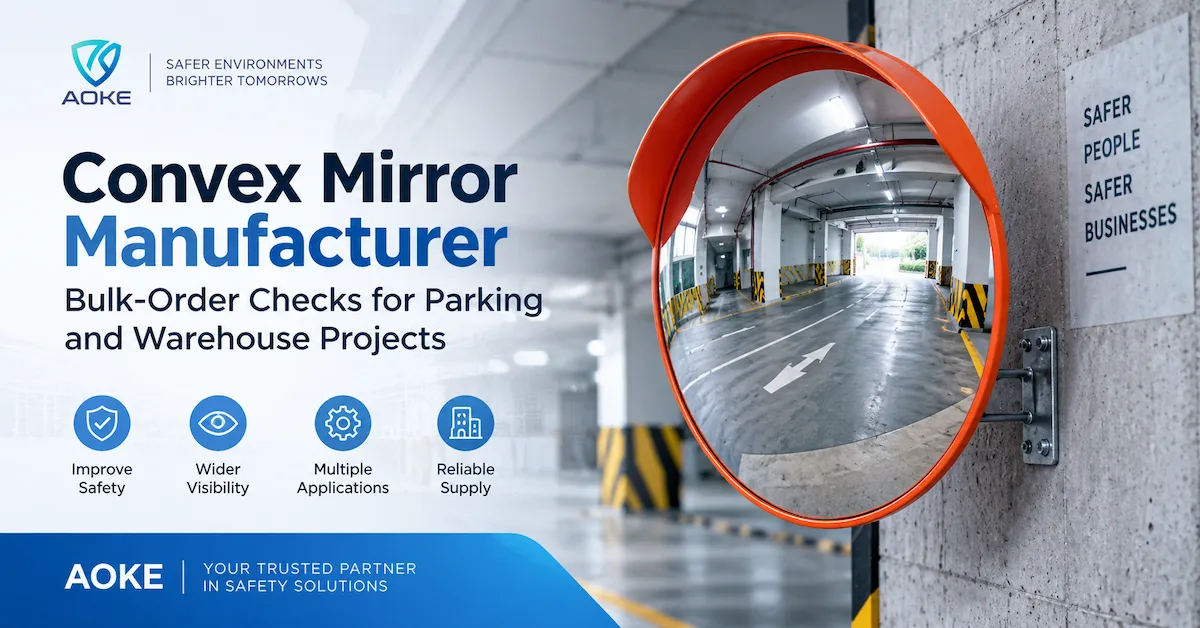

How to Plan Convex Traffic Mirror Wholesale Orders
For convex traffic mirror wholesale purchases, define exactly what you will receive and resell before negotiating quantity discounts. Does one unit include the reflective face, housing, mounting bracket, required assembly hardware, instructions and protective packaging? Which installation-specific fittings remain outside the offer? Use that complete set as the basis for every quotation. Then compare the proposed assortment, delivered purchasing cost, sample acceptance and repeat-order conditions. A lower mirror-face price is not a comparable saving when another offer includes components you still need to purchase separately. The objective is a clearly specified product that arrives ready for your agreed distribution or project process.

Build a Wholesale Assortment Around Customer Demand
Treat stock replenishment and project purchasing as different order plans. For a distributor, begin with recurring customer enquiries and actual sales records; separate regularly requested configurations from products that should remain quotation-only. For a contractor, organize quantities by approved site requirements and installation phases rather than a general catalogue assortment. Define a stock-keeping unit, or SKU, by the complete configuration—not diameter alone. As an illustrative calculation, three sizes multiplied by two face materials and two mounting kits already create twelve combinations before color or packaging changes. This is not an AOKE catalogue count. For a first convex traffic mirror wholesale order, prioritize configurations backed by identifiable demand instead of adding variants merely to reach a discount tier. A single unresolved installation is better handled through application review and sampling than speculative bulk purchasing.
Keep Viewing Requirements Separate From Stock Availability
Parking exits, factory entrances and restricted internal traffic routes are among the applications discussed in AOKE’s road safety mirror selection guide. Avoid turning these application labels into automatic size recommendations. For each project enquiry, request the observer position, hidden approach, proposed mirror position, relevant distances and mounting photographs. Maintain that application information separately from the warehouse stock code: having a mirror available does not establish that it suits a particular blind spot. Keep final site suitability and the supporting structure under the responsible project team’s review, and treat the mirror as supplementary visibility equipment rather than a replacement for other traffic controls.
Create a Specification Sheet for Every Orderable SKU
For a convex traffic mirror wholesale quotation, require each proposed SKU to have its own specification revision and packing information. Distinguish supplier-confirmed values from buyer requirements and unresolved questions. The following is a proposed procurement template, not verified AOKE model data. Use it to request comparable information before allocating quantities or approving a sample.
| Specification Area | Information to Record | Purchasing Purpose |
|---|---|---|
| Product identity | Supplier model, buyer SKU and specification revision | Connect quotations, samples and repeat orders |
| Dimensions | Usable reflective-face size and overall housing dimensions, with units | Avoid confusing mirror size with outside dimensions |
| Face construction | Material identification, relevant thickness and reflective construction | Define what has actually been approved |
| Viewing reference | Observer and target positions used for sample evaluation | Make comparisons repeatable |
| Housing and backing | Materials, finish and intended exposure conditions | Establish the proposed assembly |
| Mounting kit | Wall or pole interface, adjustment, compatible dimensions and hardware quantities | Define a complete kit and its exclusions |
| Workmanship | Agreed surface, edge, fit and appearance acceptance criteria | Make inspection more specific than “good quality” |
| Unit packaging | Protective layers, hardware separation, instructions and label version | Approve the package delivered to your customer |
| Shipping data | Units per carton, external carton dimensions, gross weight and pallet details where relevant | Obtain a shipment-specific logistics quotation |
| Commercial terms | MOQ by variant, quantity breaks, spare parts and dispatch milestones | Separate product requirements from order conditions |
Compare Configurations Before Expanding the Product Range
Do not build a price list around unsupported labels such as “standard,” “premium” or “heavy-duty.” Define what changes between the offers and what evidence justifies the distinction. The comparison below outlines enquiry configurations rather than verified AOKE models, rankings or prices. Use it to decide which options deserve sample review; confirm actual availability and cost for each proposed configuration.
| Enquiry Configuration | Features to Define | Potential Purchasing Benefit | Best-Fit Order Type | Main Cost Questions |
|---|---|---|---|---|
| Wall-mounted parking mirror | Face, housing, adjustable bracket and hardware exclusions | A defined package for a specific mounting interface | Approved parking or garage projects | Is the bracket included, and what must the installer supply? |
| Pole-mounted outdoor mirror | Pole compatibility, backing, clamp and environmental requirements | Clearer installation and documentation requirements | Approved yard, gate or private-site applications | What changes with the clamp, housing and exposure requirement? |
| Impact-focused assembly | Proposed material and evidence relevant to the complete product | A configuration evaluated against an identified risk | Projects with an explicit impact requirement | What testing or construction differences support the additional cost? |
| Private-label distributor set | Approved mirror assembly, labels, instructions and packing | Consistent identification across distribution channels | Repeat wholesale orders | Are artwork, printed cartons and setup charges separate? |
Control Materials, Optical Workmanship and Mounting Changes
When considering acrylic or polycarbonate convex mirrors, ask for the actual proposed construction rather than approving a material name alone. Record the housing, backing, bracket, hardware finish and any supporting information for impact or outdoor claims. On the sample, examine the reflective surface, edges, housing fit and bracket operation; require agreement on which variations are unacceptable. Evaluate the view from a consistent, safely controlled observer position, not only through close-up product photographs. AOKE’s traffic convex mirror procurement guide addresses this relationship between optical evaluation, outdoor configuration and mounting. For wholesale orders, carry the accepted details into the SKU record and require written review before substitutions.
Approve a Packed Sample Before Releasing Bulk Production
For your convex traffic mirror wholesale approval process, request a dispatch-ready sample containing the mirror, the complete accessory kit, instructions, labels and proposed protective packaging. Unpack it in the sequence your dealer or installer will follow. Check for loose hardware near the reflective face, incomplete accessory bags, unclear identification and assembly problems. Review the unpacked product against the agreed viewing and workmanship criteria, then retain photographs of both the product and packing arrangement. AOKE’s bulk-order sample approval guide provides a related reference for linking the accepted sample to production specifications. Agree separately on any transport testing required for the intended distribution route; a photographed carton is not evidence that such testing has been completed.
Calculate Carton Volume Before Committing to Quantity
Put carton volume beside unit price in your convex traffic mirror wholesale comparison. The following calculation is illustrative and does not describe an AOKE product or approved package. Assume one complete mirror set per carton, with external dimensions of 0.66 × 0.66 × 0.15 meters. That equals 0.06534 cubic meters per carton, or 6.534 cubic meters for 100 cartons, excluding pallets and other packing. A hypothetical package of 0.66 × 0.66 × 0.12 meters would total 5.2272 cubic meters for the same quantity—a 20% reduction in carton volume. This is not a promised freight saving or permission to reduce protection. Require renewed packing approval before adopting a thinner carton, and give the freight provider both gross weight and actual packed dimensions for a quotation. For mixed sizes, calculate each carton group separately rather than applying one average size to the entire order.
Compare Cost per Complete, Saleable Set
Material, size, frame design, accessories, customization and packaging are among the pricing variables identified in AOKE’s convex safety mirror supplier guide. Build your comparison using the same included components, shipment scope and agreed delivery point. Separate one-time setup costs from recurring product and packing costs. For an incoming-stock check, use cost per saleable set = total costs included in the comparison ÷ complete, conforming sets available for sale. As a hypothetical example, a $3,000 delivered purchase containing 100 sets represents $30 per set. If only 92 are initially complete and accepted, the cost is $32.61 per saleable set before credits or replacements. This is arithmetic, not an AOKE quotation, expected defect rate or acceptable quality threshold. Define how later recoveries are recorded so replacements and credits are not counted twice.
Negotiate MOQ by Configuration, Not Just Total Order Quantity
In convex traffic mirror wholesale negotiations, ask whether the minimum order quantity applies to the full purchase, each size, each material, each mounting kit or each printed packaging version. Submit a quantity matrix rather than one aggregate number. For example, ask the supplier to confirm the minimum and price break for each proposed line, followed by the terms for the combined shipment. Do not assume mixed configurations share the same minimum. Request separate quotations for the initial order and a smaller replenishment order using the same approved specification. Keep forecasts distinct from purchase commitments, and ask whether custom cartons or other unused materials create storage obligations or additional charges. A discount is only useful when the associated quantity and configuration fit your purchasing plan.
Confirm Supply Responsibility, Capacity and Dispatch Milestones
Review who controls the mirror specification, critical components, assembly, final inspection and corrective action. Use AOKE’s company profile as background, then request order-specific confirmation of the mirror supply arrangement and production allocation. Separate available finished stock from planned production; obtain the configuration, quantity, reservation conditions and proposed dispatch date in writing. For new production, define the milestones for sample approval, artwork approval, materials readiness, assembly, inspection and dispatch. Specify what starts the quoted lead time and whether split deliveries are available. For convex traffic mirror wholesale replenishment, review actual elapsed time from approval to receipt before selecting a reorder trigger, and discuss how delays or product changes will be communicated.
Make Batch Inspection and Documentation Part of the Purchase
Set an inspection plan for convex traffic mirror wholesale shipments before the goods are ready. Require checks against the approved SKU and revision, including dimensions, surface condition, assembly, hardware counts, carton identification and agreed functional evaluation. For mixed shipments, identify how each configuration will be represented in the inspection rather than treating one size as proof of the entire order. Agree defect definitions, sampling arrangements, rejection handling and reinspection responsibility with the supplier; do not invent a universal acceptance percentage. Where a project requires test reports or other compliance documentation, match the document to the supplied configuration, test method, result and applicable scope. Keep inspection photographs and batch identifiers connected to the shipment. Describe claims only as far as the supporting evidence allows; a company-level certificate should not become an unsupported product-performance claim.
Separate Private Labeling From OEM or ODM Changes
A private-label convex traffic mirror wholesale enquiry should distinguish artwork changes from product development. Ask separately about product labels, barcodes, instruction languages, carton printing and accessory-bag identification. Then identify any requested changes to the face, housing, backing, bracket or mounting interface. For OEM or ODM work, define the design responsibility, drawings, tooling costs and ownership, sample revisions and any further validation before agreeing a production schedule. Do not treat a different bracket as merely another color option. Approve product and packaging revisions together, and establish whether replacement brackets or other service parts can be ordered independently. All customization scope and minimum quantities should be confirmed for the actual offer.
Agree on Replacement and Replenishment Terms Before Shipment
Before placing repeat orders, establish how the supplier will distinguish transport damage, missing components and product nonconformity. Agree the evidence needed for a claim, such as carton photographs, packing labels, batch references and details of the affected units. Define reporting periods, response expectations and the agreed remedy, including responsibility for replacement freight or other costs where applicable. Ask whether small components can be supplied separately, subject to availability and installation suitability, rather than assuming every issue requires another complete mirror. For discontinued or revised products, request advance notice and a clear approval process. Treat these terms as negotiated purchase conditions, not as warranty promises inferred from a website headline.
Prepare a Convex Traffic Mirror Wholesale Enquiry for AOKE
Prepare one enquiry package containing the destination market, buyer type, intended applications, proposed SKU quantities, mounting requirements, packaging preference and delivery target. Add site photographs for project-specific configurations and previous sales or order information where it helps explain replenishment needs. Request model-specific specifications, sample and packed-sample options, MOQ by variant, quantity pricing, carton dimensions, gross weight, customization feasibility and applicable documentation. AOKE provides an enquiry form and contact details through its Contact Us page. Use that channel to request a written proposal, marking unresolved requirements clearly. Confirm available models, mirror-specific capabilities and commercial conditions against the resulting quotation rather than treating a category label as an inventory commitment.
Frequently Asked Questions
1. What quantity qualifies for convex traffic mirror wholesale pricing?
There is no quantity stated here that applies to every configuration. Request the supplier’s MOQ and price breaks for each proposed SKU, then confirm whether mixed sizes or mounting kits can share an order threshold.
2. Can I combine different mirror sizes in one bulk order?
Ask for a line-by-line confirmation covering quantities, packing, minimums and dispatch timing. Keep each configuration identifiable on the order and packing list. Do not assume a supplier’s acceptance of a total quantity covers every requested variant.
3. Should mounting hardware be included in the wholesale price?
Specify what you need included and require a complete parts list. Distinguish the mirror’s assembly hardware from site-specific anchors or other installation fittings. Compare suppliers using the same kit scope and clearly stated exclusions.
4. Is acrylic or polycarbonate better for a distributor’s range?
Choose after reviewing customer requirements and the actual proposed assemblies. Request material identification and evidence for relevant performance claims. Do not add both options automatically unless their differences serve a defined customer need.
5. How should I estimate shipping volume for mixed mirrors?
Multiply each carton’s external length, width and height in meters by its carton count, then add the results. Include separate packing or pallet dimensions as applicable, and ask the freight provider to confirm the shipment quotation.
6. Does a “stock” category mean the mirrors are ready to dispatch?
Treat stock status as an order-specific question. Request the exact configuration, available quantity, reservation terms and dispatch date. Keep that confirmation separate from a general catalogue or category description.
7. How can I review packaging before a wholesale shipment?
Approve a complete packed sample, check hardware separation and identification, and agree protection requirements for the intended route. Request evidence for any specified transport testing. Keep the approved packing revision linked to the order.
8. Can wholesale mirrors carry my own brand?
Submit the proposed label, carton, instructions and barcode requirements for feasibility review. Ask about setup charges and packaging minimums. Product changes need a separate technical review; branding approval does not approve a modified assembly.
9. What documents should I request with the order?
Request the approved specification, packing details, agreed inspection records and shipment identification. Add any documentation required by your project or destination market, confirming its relevance with the responsible party rather than assuming a universal certificate list.
10. How can I keep repeat orders consistent?
Reference the approved SKU, specification revision, sample and packing version in every purchase order. Require notice before substitutions and record approved changes. Review replenishment terms and spare-part availability before releasing another batch.
Conclusion
Plan convex traffic mirror wholesale purchases around a defined assortment, complete mounting kits, approved packing and comparable delivered costs. Keep project suitability separate from inventory availability, calculate carton volume before increasing quantities, and connect every shipment to an approved specification. For distributors, the commercial goal is stock that matches demand and can be replenished on clear terms—not simply the largest initial discount. Send your quantity matrix, application details, packaging requirements and delivery target through AOKE Contact Us to request product-specific options and a wholesale quotation.