
Choose a Convex Mirror Manufacturer by the Complete Installed Result
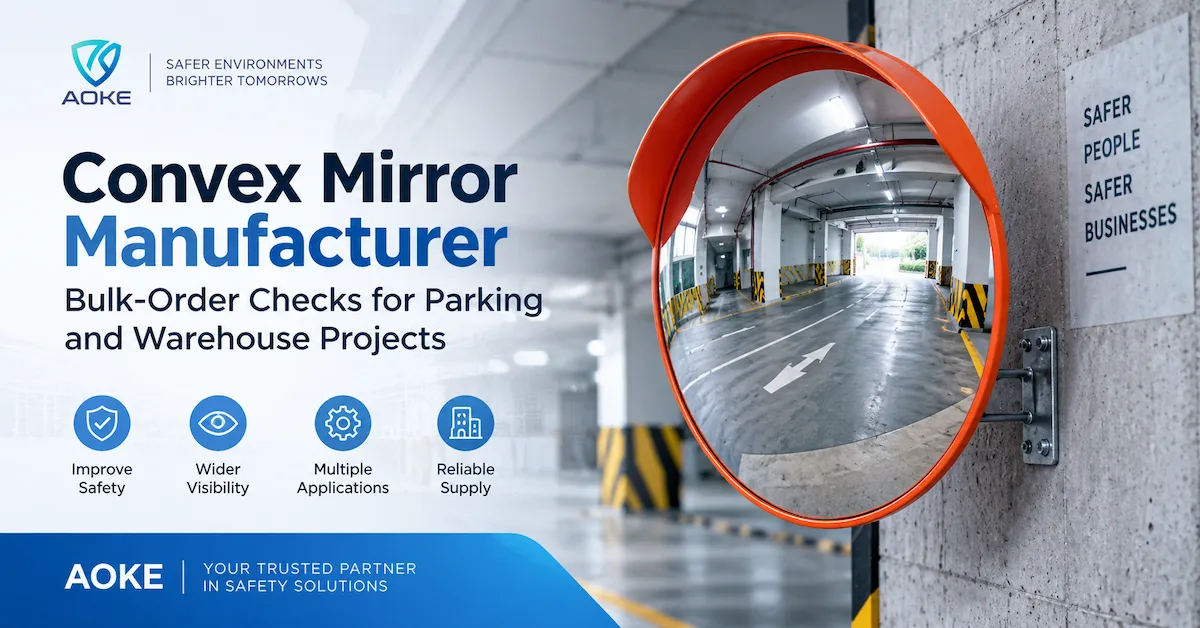
A convex mirror manufacturer should help you establish three things before a bulk order: the required view, the complete mounting arrangement, and an approval standard that production must follow. A product photograph and a diameter are not enough to define that purchase. For parking-equipment distributors, warehouse contractors and facility buyers, the objective is to order a mirror assembly that can be checked against a written specification—not simply a reflective surface in a carton. This guide concerns fixed facility mirrors, rather than vehicle replacement mirrors or precision optical components. Start with the installation requirement, approve a representative sample, and carry the approved specification into production and shipment inspection. For broader sourcing questions, AOKE’s convex safety mirror supplier guide provides a related starting point.
Translate the Blind Spot into a Site-Specific Brief
Parking entrances, garage ramps and warehouse corners are common applications for convex safety mirrors. Describe your location more precisely than “parking mirror” or “industrial use.” Mark the intended observer position, mirror position, hidden approach and area that must become visible. Record the observer-to-mirror distance separately from the mirror-to-target distance, and include photographs taken from the relevant eye level. For a warehouse, distinguish a pedestrian viewpoint from a seated vehicle operator’s viewpoint; for a parking exit, identify the approach direction and any obstruction. Ask the site’s responsible person to review the proposed use alongside existing traffic controls. Treat the mirror as supplementary visibility equipment, not a replacement for traffic separation, direct checks or a site-specific safety assessment.
Verify Who Controls Manufacturing and Product Changes
When comparing a convex mirror manufacturer with a broader safety-products supplier, focus on responsibility rather than the company description alone. Ask who produces the mirror face, manages the reflective finish, assembles the housing, supplies the bracket and releases finished goods. Whether an operation is performed internally or by a production partner, identify the party responsible for defects and specification changes. Request evidence relevant to mirrors: an assembly drawing, a sample identification record and an inspection example. General factory information is useful background, but your purchasing file should connect the quoted product to its actual production and inspection arrangements. Review AOKE’s company profile, then request mirror-specific information for the configuration under discussion.
Define the Specification Before Comparing Quotations
Give each convex mirror manufacturer the same specification sheet so that price differences can be investigated rather than guessed. Define dimensions, materials and mounting requirements separately; avoid combining them into a description such as “large outdoor mirror with accessories.” Ask the supplier to distinguish confirmed values, proposed alternatives and unresolved items. The following table is a purchasing template, not a list of published AOKE product specifications. Complete it with the supplier before sample approval, and use the same revision when requesting quotations from different sources.
| Specification Item | Information to Confirm | Evidence to Request |
|---|---|---|
| Intended application | Parking exit, garage ramp, warehouse corner or another defined location | Site photographs and a marked layout |
| Mirror dimensions | Usable reflective-face dimensions and overall dimensions, with units | Dimensioned product drawing |
| Face material | Acrylic, polycarbonate or another proposed material; grade and relevant thickness | Material declaration linked to the proposed model |
| Viewing requirement | Observer position, target area, distances and proposed mounting position | Agreed sample-evaluation arrangement |
| Housing and backing | Materials, construction and intended exposure conditions | Assembly details and supporting product information |
| Mounting kit | Wall or pole fitting, pole diameter where relevant, adjustment range and included hardware | Bracket drawing and complete parts list |
| Environmental claims | Specific outdoor, temperature or corrosion requirements for the project | Applicable test details and their product scope |
| Packaging and service parts | Carton dimensions, packed weight, kit layout and replacement-part references | Packing sample or photographs and parts quotation |
Compare Face Materials Without Overlooking the Assembly
Acrylic is commonly considered for clarity and low weight, while polycarbonate is considered where impact resistance is a priority. Glass requires attention to weight and breakage. These distinctions are a starting point, not a complete product specification. Ask the convex mirror manufacturer to identify the actual material and the evidence supporting any impact, outdoor-use or cleaning claim. Do not approve “plastic mirror” as an adequate material description. Review the face together with its reflective finish, housing and backing, and record any permitted substitutions. A change in material or construction should trigger a written review rather than being treated as an interchangeable component simply because the outside dimensions remain unchanged. A material name is not a finished-product guarantee.
Inspect Optical Consistency and Workmanship on the Sample
Make the sample review repeatable. Under controlled conditions, with vehicle movements excluded from the evaluation area, mark the observer and target positions and compare samples using the same setup. Check whether the intended target can be distinguished across the area you need to observe. Look for localized ripples, abrupt image changes, surface scratches, edge damage and irregular assembly—not merely whether the mirror looks bright in a close-up photograph. Do not use a “zero distortion” promise as the sole acceptance criterion; define the image usability your application requires. Ask the convex mirror manufacturer to record the accepted sample’s identification, material, dimensions and bracket version. Keep dated photographs of the setup and agreed defect examples. This is a proposed purchasing check, not a substitute for required laboratory testing or professional site assessment.
Approve the Bracket and Outdoor Configuration Together
Outdoor mirror selection needs to consider weather exposure, housing and mounting accessories, not only the reflective face. Review the proposed bracket as part of the purchased assembly: wall-fixing details or pole-clamp compatibility, available adjustment, locking method, hardware finish and access for maintenance. Ask the installer to confirm compatibility with the actual supporting structure and site conditions. For a sample, check the view after the assembly has been secured according to its instructions; do not approve the mirror while overlooking the hardware that will hold its position. Require supporting information for any wind, corrosion or weathering claim, including the tested configuration. A hood or an outdoor label alone should not close that review.
Agree on Quality Checks from Sample Approval to Shipment
Before production, ask the convex mirror manufacturer to turn the approved sample into a controlled order record: product drawing, material list, bracket specification, packing arrangement and inspection requirements. Define which defects are unacceptable, which cosmetic variations need agreement and how nonconforming goods will be handled. Request inspection records tied to the actual shipment rather than relying only on a demonstration sample. For technical reports, check the issuing organization, test method, tested product, conditions and result; then establish whether they support the claim in your purchase order. Do not assume a document covering another product category proves mirror performance. Keep material or bracket substitutions subject to written approval, and agree how corrective action and reinspection will be documented.
Compare Purchasing Configurations, Not Diameter Alone
Use a configuration comparison to shortlist the assemblies that deserve sample evaluation. The table below compares purchasing requirements rather than named AOKE models; material availability, dimensions and performance must be confirmed for the actual offer. A useful comparison should explain why a configuration is being considered and what evidence is still needed, not award “best quality” or “lowest cost” labels without a common basis.
| Purchasing Configuration | Priority for the Quotation | What to Evaluate on the Sample | Condition Before Approval |
|---|---|---|---|
| Indoor wall-mounted mirror | Required view, wall fitting and maintenance access | Image usability from the agreed observer position; complete bracket fit | Installer confirms mounting compatibility |
| Outdoor parking or yard mirror | Defined exposure, backing, bracket and hardware | Required view, adjustment and assembly details | Outdoor claims match the offered configuration |
| Impact-focused project option | Evidence for the proposed face material and complete assembly | Surface quality, construction and mounting arrangement | Impact claims are supported rather than inferred from a material name |
| Private-label distributor package | Approved mirror plus labels, instructions and packing | Correct parts, identification, protective packing and unpacking sequence | Product and packaging revisions are approved together |
Confirm MOQ, Capacity and Lead Time for the Actual Order
Ask for minimum order quantity by configuration, not only for the order as a whole. A mixed purchase may need separate answers for each diameter, material, bracket, housing color or printed carton. Have the convex mirror manufacturer separate sample preparation, sample approval, production, inspection, dispatch and transport in the proposed schedule. Define when each period starts, which approvals are needed and what happens when artwork or specifications change. For staged deliveries, identify quantities and release dates individually. Ask whether repeat orders will use the same approved components and how changes will be communicated. Treat available stock and scheduled production as different commitments, and obtain written confirmation for the specific goods you plan to buy.
Separate Private Labeling from OEM and ODM Development
An OEM convex mirror enquiry should distinguish branding an existing product from changing the product itself. Start by identifying whether the request concerns labels, carton artwork and instructions, or a different face, housing, bracket or mounting arrangement. Ask the manufacturer to identify feasible changes, development costs, sample requirements and any new tooling before committing to a launch date. Where ODM development is proposed, clarify design responsibility, drawing ownership, tooling ownership and the approval process. Make product changes visible in the revision record instead of hiding them inside a packaging request. No customization option should be treated as confirmed until the supplier has reviewed the actual requirement and included it in the offer.
Compare Complete Purchase Cost, Not the Headline Unit Price
Mirror material, dimensions, accessories, customization and packing can affect the quoted price. Build your comparison around the same included items and delivery basis. As a hypothetical example—not an AOKE quotation—a mirror priced at $25 with a separate $4 bracket and $6 allocated freight costs $35 before installation and taxes. A $28 offer that includes the required bracket, with the same $6 freight allocation, totals $34 on that basis. The higher product price is therefore the lower comparable purchase cost. Ask the convex mirror manufacturer to identify all inclusions, exclusions, packing quantities and spare-part prices. Separately assess installation, damage-handling and replacement arrangements rather than assuming they are covered by the initial unit price.
Prepare an AOKE Enquiry That Can Be Quoted Accurately
Send a marked site photograph or layout, the intended application, destination, quantity by configuration and your required delivery date. Include any preferred face material, dimensions, mounting details, inspection requirements and private-label artwork; mark unknown items as requiring a recommendation rather than inventing a specification. For a combined safety-products order, use AOKE’s Stock category as an enquiry starting point and confirm each item’s current availability separately. Submit the project brief through the AOKE contact page, requesting proposed specifications, a sample arrangement, packing details and a quotation with clear exclusions. That gives the discussion a concrete basis without assuming an unconfirmed model, certification or dispatch commitment.
Frequently Asked Questions
What should I request first from a convex mirror manufacturer?
Request a specification sheet, mounting-kit details, a proposed sample and a description of production and inspection responsibilities. Provide your site brief at the same time so the supplier can respond to the actual viewing requirement rather than recommend a diameter without context.
How should I choose a mirror diameter for a parking exit?
Record the observer position, target area, distances and proposed mounting location. Ask for a recommended configuration and evaluate it in a controlled arrangement representative of the site. Do not accept a diameter-to-distance shortcut as final approval for every location.
Should I choose acrylic or polycarbonate?
Compare the actual offers against the project’s optical, impact, environmental and maintenance requirements. Ask for material identification and evidence supporting relevant claims. Select the configuration that meets the written brief, rather than treating either material name as an automatic guarantee.
Can one approved sample cover several different sites?
Use the sample to assess product construction and finish, but review the viewing and mounting requirements of each distinct site. Document which locations share a configuration and which require a separate evaluation, different hardware or another proposed size.
What evidence should support an outdoor-use claim?
Ask which environmental conditions the claim covers, what evidence supports it and whether that evidence matches the proposed assembly. Review the face, backing, housing and mounting hardware together. Have the installer assess the supporting structure separately.
Can the supplier substitute a bracket after sample approval?
Require a written change request identifying what differs and why. Review dimensions, compatibility, adjustment and supporting evidence before acceptance. Update the drawing and parts list, and determine whether a replacement sample or further evaluation is necessary.
What should a pre-shipment inspection cover?
Agree checks for identification, dimensions, surface condition, assembly, hardware completeness, packing and the specified functional evaluation. Define the sampling arrangement, rejection criteria and corrective-action process before inspection; do not invent a universal acceptance threshold after goods are ready.
How can I obtain an accurate MOQ and delivery estimate?
Provide quantities by configuration, customization details, destination and required dates. Ask the supplier to distinguish sample lead time, production lead time and transport, and to state the approvals or other conditions that start each period.
What should private-label buyers approve besides the mirror?
Approve labels, product identifiers, instructions, carton artwork, hardware lists and the packing arrangement. Confirm that the information matches the actual product and that any required warnings or market-specific documentation have been reviewed by the responsible parties.
How should repeat orders and replacement parts be managed?
Refer to the approved product revision, sample identifier and parts list in each purchase order. Ask the convex mirror manufacturer to disclose proposed changes before production and quote replacement mirrors, brackets or hardware where available, with applicable order conditions.
Conclusion
Choosing a convex mirror manufacturer is a specification and approval exercise before it becomes a price negotiation. Define the required view, evaluate the mirror with its mounting kit, document material and construction requirements, and compare complete offers on the same basis. Keep optical acceptance, environmental evidence, production responsibility and delivery commitments tied to the actual configuration. For parking and warehouse projects, send your convex mirror requirements to AOKE with site photographs, quantities and mounting details to begin a product-specific sourcing discussion.