

What Should a Caution Tape Manufacturer Actually Provide?
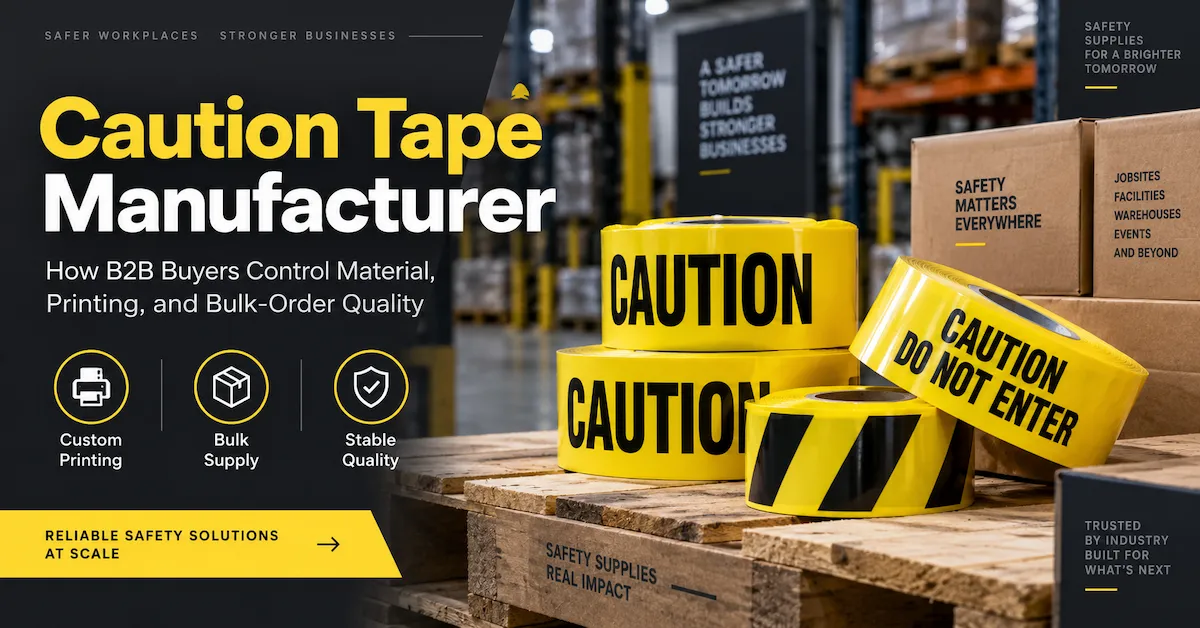
A caution tape manufacturer should provide a clearly defined product rather than simply quote “yellow warning tape” by roll. For safety-equipment distributors, construction suppliers, contractors, industrial procurement teams, facility managers, and private-label brands, the important purchasing questions include tape format, material, width, thickness, roll length, printing method, warning message, print orientation, color, packaging, carton quantity, and repeat-order consistency.
The first qualification step is therefore specification control. Two products may look similar in a catalogue while using different film structures, dimensions, print coverage, core sizes, packaging, or outdoor-use assumptions. Those differences can influence application, handling, freight cost, shelf presentation, and customer expectations.
AOKE currently places Caution Tape within its broader safety-product structure. Buyers sourcing warning tape together with other safety products can start from the AOKE product range and Firstsafe Ready-to-Ship section. Exact caution-tape models, manufacturing source, specifications, MOQ, stock status, and customization options should still be confirmed for the quotation rather than inferred from another AOKE product category.
Who Typically Buys Caution Tape in Bulk?
Different buyers need different caution-tape programs. A PPE or safety-equipment distributor may require standard products that can be stocked and repeatedly reordered. A construction supplier may need warning tape for temporary exclusion areas. Industrial plants may use it during maintenance or temporary hazard control, while facility-management companies may require it for restricted zones, repairs, cleaning, or short-term access control.
Traffic-safety and project suppliers may purchase caution tape together with cones, warning posts, mirrors, or other temporary traffic-management products. AOKE’s PE traffic cone supplier guide shows why related safety products should also be evaluated around specification, packaging, repeatability, and project suitability rather than price alone.
Private-label buyers have another priority: consistency. The tape, printed message, carton artwork, product code, barcode, and packing quantity may all become part of their catalogue. A product that changes between batches can create relabeling, inventory, and customer-service problems even when the material still appears acceptable.
Caution tape is not the right product for every access-control requirement. A lightweight warning tape can communicate a boundary or warning, but it should not automatically be treated as a physical barrier. Where people or vehicles must actually be prevented from entering an area, the responsible safety or project team may require posts, barricades, fencing, cones, or other controls.
Define the Type of Caution Tape Before Requesting a Quote
One of the biggest sourcing mistakes is treating every product described as “warning tape” as the same item. Before contacting a caution tape manufacturer, define what category you actually require.
Non-adhesive barricade or warning tape is commonly used to mark temporary areas and is generally tied between supports or used with a suitable barrier system. Adhesive floor-marking tape is a different product and needs to bond to a defined surface. Underground warning tape is installed for buried-utility identification and may require a different construction. Retractable barrier tape systems combine tape with a housing or post mechanism and should be evaluated as an assembly rather than as film alone.
These products can look similar in search results but have different specifications and purchasing risks. Do not request “100,000 meters caution tape” until the product type has been clearly stated.
Build a Technical Specification Before Comparing Prices
The following table is a buyer-side RFQ template rather than published AOKE caution-tape specifications. It should be completed with the proposed supplier before sample approval.
| Specification Item | What the Buyer Should Confirm | Why It Matters |
|---|---|---|
| Product type | Non-adhesive warning tape, adhesive marking tape, underground tape, retractable system, or another defined format | Prevents quotation of the wrong category |
| Material | Proposed film or substrate and relevant grade | Establishes the actual construction |
| Width | Required finished width and tolerance | Affects application and material usage |
| Thickness | Required thickness and tolerance where relevant | Helps control consistency |
| Roll length | Finished length per roll | Necessary for price and inventory comparison |
| Core | Inner diameter and material where applicable | Affects dispensing and packaging |
| Base color | Yellow, red, white, striped or project-defined color | Controls appearance |
| Printed message | CAUTION, DANGER, custom language, logo, or other text | Defines identification |
| Print format | Single/double-side appearance, repeat length and orientation where relevant | Prevents artwork misunderstandings |
| Ink/print requirement | Required print durability or application condition | Supports appearance consistency |
| Outdoor requirement | Actual exposure to sunlight, rain, temperature or other conditions | Prevents unsupported outdoor claims |
| Packaging | Individual wrapping, label, carton quantity, carton size | Important for distribution and logistics |
| Private label | Barcode, product label, carton artwork or manual | Defines branding scope |
| Quantity | Trial, initial order and forecast volume | Supports commercial planning |
This document should distinguish four statuses: buyer requirement, supplier proposal, approved specification, and unresolved item. That approach makes later revisions easier to track.
Material Should Be Specified, Not Described as “Good Quality”
A caution-tape quotation should identify what the tape is actually made from. Material selection can influence flexibility, handling, tear behavior, print performance, weight, cost, and the way the product behaves under different environmental conditions.
The correct material depends on the application. Buyers should avoid assuming that a thicker product is automatically superior, or that one polymer name guarantees outdoor durability. Instead, request the exact proposed material and define the characteristics that matter to your application.
If the tape will be used outside, tell the supplier whether the expected exposure is a few hours, several days, repeated project use, direct sunlight, rain, low temperatures, or another condition. A caution tape manufacturer should be asked to support any specific weathering or durability claim with relevant product information rather than relying on vague terms such as “weatherproof” or “heavy duty.”
For indoor temporary marking, the priorities may be different. There may be no value in paying for a feature that the application does not require.
Printing Quality Matters More Than the Warning Message Alone
For printed caution tape, the wording is only one part of the specification. Buyers should confirm text size, print color, message repeat, orientation, logo placement, language, and whether the finished artwork remains readable when the tape is installed in the intended direction.
A sample should be reviewed for blurred lettering, uneven ink, missing print, inconsistent spacing, alignment problems, color variation, and contamination. If the product is printed on both sides or is expected to remain readable from both directions, clarify exactly how that appearance is achieved.
Custom text also needs artwork control. A private-label distributor should approve a final artwork file with a version number rather than send several logo or wording files through email without identifying the production version.
Where multilingual text is required, the buyer should provide and approve the final wording. The manufacturer should not be expected to determine legal warning language for every destination market without written confirmation from the responsible buyer.
Roll Dimensions Need Measurable Acceptance Criteria
A roll described as “100 m × 75 mm” sounds straightforward, but bulk purchasing needs more precision. Define whether the quoted length and width are nominal values, what tolerances apply, how length is verified, and how the finished roll is identified.
For distributors, roll-to-roll inconsistency can create commercial problems because customers often purchase the product based on an expected usable quantity. The same applies to thickness when it forms part of the agreed specification.
Instead of approving one roll by appearance, a buyer can request measurements from several samples and then establish an agreed production inspection method. The objective is not to create unnecessary laboratory work. It is to make sure purchasing, production, and quality teams are measuring the same specification.
What Should Be Checked on a Pre-Production Sample?
The pre-production sample should represent the proposed bulk product as closely as practical. Check the material, dimensions, roll construction, core, print message, color, orientation, packaging, labels, and carton presentation.
Unroll enough material to evaluate consistency rather than inspecting only the first meter. Look for print interruptions, wrinkles, edge irregularities, splices if they are permitted, contamination, unexpected color changes, and problems that could affect dispensing.
If the product is intended to be tied, tensioned, dispensed from a holder, adhered to a surface, or installed underground, evaluate the sample using the relevant intended method. Do not approve one product format by testing it as though it were another.
A buyer should then retain or document the approved sample together with the specification revision. This becomes much more useful for repeat orders than a general message saying “sample approved.”
How Should a Caution Tape Manufacturer Control Bulk Quality?
For large orders, quality control should connect incoming material, printing, converting, roll formation, packaging, and final inspection. The exact manufacturing sequence depends on the proposed product, but the buyer should understand which characteristics are controlled and where defects are identified.
A practical order-level QC plan may include:
| QC Stage | Possible Check | Purchasing Risk Controlled |
|---|---|---|
| Incoming material | Material identification, color and agreed dimensions | Unapproved material substitution |
| Printing | Artwork version, color, print repeat and legibility | Incorrect warning message |
| Converting | Width and edge condition | Dimensional inconsistency |
| Roll formation | Roll appearance, length control, core and winding | Short or poorly formed rolls |
| Finished product | Appearance and specification checks | Batch inconsistency |
| Packaging | Labels, roll count and carton information | Distribution errors |
| Pre-shipment inspection | Sampling against approved specifications | Bulk-order risk |
The actual checks should be defined for the product being purchased. Do not assume that every item above applies identically to every caution-tape format.
Manufacturer or Supplier: Which Matters More?
The word “manufacturer” can be useful, but supply-chain transparency matters more than the label itself. A buyer evaluating a caution tape manufacturer should ask who produces the film or substrate, who prints it, who converts it into finished rolls, who packs the product, and who performs final quality control.
A company may perform all operations internally, outsource selected production stages, or coordinate the product through qualified manufacturing partners. These structures can all work if responsibility is clear and repeatability is controlled.
AOKE’s published manufacturing information is primarily focused on reflective clothing and workwear. Its broader Stock product structure also includes caution tape and other safety products. Therefore, buyers should review the company background on About AOKE but separately confirm the caution-tape manufacturing source, available specifications, QC arrangement, MOQ, documentation, and current production or inventory status for the actual order.
This avoids incorrectly transferring clothing-manufacturing capabilities or certifications to a different safety-product category.
Compare Caution Tape Configurations by Application
The following table illustrates different purchasing directions. These are application configurations, not confirmed AOKE models.
| Product Direction | Main Requirement | Typical Buyer Focus | Key Qualification Question |
|---|---|---|---|
| General non-adhesive warning tape | Visible temporary demarcation | Construction and safety distributors | What material, size, print and roll length are supplied? |
| Custom printed barrier tape | Brand or project-specific warning | Private-label brands and contractors | How are artwork and repeat printing controlled? |
| Outdoor temporary warning tape | Defined environmental exposure | Construction and maintenance buyers | What evidence supports the requested exposure conditions? |
| Adhesive marking tape | Adhesion to a defined surface | Facility and warehouse buyers | What surfaces and conditions is the product designed for? |
| Underground warning tape | Buried identification application | Utility and infrastructure buyers | What construction and marking requirements apply? |
| Retractable warning system | Reusable barrier arrangement | Facility and industrial buyers | What tape, housing and mounting components are included? |
Do not ask one supplier to quote all six formats unless you genuinely require them. A focused enquiry improves technical accuracy and makes quotations easier to compare.
MOQ, Capacity, and Lead Time Should Be Product-Specific
Minimum order quantity may be influenced by material, tape width, print artwork, color, packaging, carton printing, and order configuration. Standard tape and fully customized private-label tape may therefore have different commercial conditions.
Ask the supplier to separate sample timing, artwork approval, material preparation, printing or production, packaging, inspection, and transport. Clarify which event starts the production lead time.
For repeat orders, ask whether the same material, print specification, carton quantity, and artwork version will be maintained. If any component changes, define how the buyer will be informed.
AOKE’s Firstsafe Ready-to-Ship section can be used as a starting point when discussing available safety products, but a page or category name should not be interpreted as confirmation that a particular caution tape specification is currently in stock. Request written confirmation for the exact item, quantity, and dispatch timing.
Bulk Cost Is More Than Price per Roll
A lower price per roll may not create a lower total purchasing cost if the roll length, thickness, carton quantity, packaging, or freight volume is different.
Compare offers on the same specification and commercial basis. Relevant cost elements can include product price, custom printing, artwork setup, individual packaging, printed cartons, inspection, logistics, import costs, and replacement costs.
A simple purchasing metric is:
Comparable cost per usable roll = total included purchasing cost ÷ accepted saleable rolls
As a hypothetical example—not an AOKE quotation—an order costing $2,400 for 1,000 accepted rolls equals $2.40 per usable roll. If another $2,200 order produces only 900 complete accepted rolls before credits or replacement, the initial figure becomes approximately $2.44 per usable roll.
The purpose of this calculation is not to predict defect rates. It shows why a nominal unit price should not be compared without matching specifications and acceptance results.
Packaging Can Change the Economics of a Bulk Order
Caution tape is relatively simple compared with many industrial products, but packaging can still influence distribution efficiency. Confirm rolls per inner pack, rolls per carton, external carton dimensions, gross weight, label position, barcode requirements, pallet arrangement if applicable, and whether custom printed packaging has its own MOQ.
For distributors, carton quantities should match practical warehouse and dealer requirements. A carton that minimizes freight volume but creates inconvenient resale quantities may not be commercially ideal.
For export orders, request actual packed dimensions before final logistics calculation. Do not assume the carton dimensions shown for one tape width or roll length apply to another configuration.
How Should Private-Label Caution Tape Be Managed?
Private-label orders require two separate approvals: product approval and branding approval.
Product approval covers material, dimensions, print performance, roll construction, and packaging. Branding approval covers logos, warning text, product labels, barcode, inner packaging, and cartons.
If the warning text itself is customized, treat it as part of the product artwork rather than only a marketing label. Control spelling, translation, text direction, colors, and message repeat.
A private-label caution tape manufacturer or supplier should also explain whether artwork changes, film colors, custom widths, or printed cartons change the MOQ. Buyers should confirm whether setup charges are one-time or recurring and what happens to unused custom packaging after an order.
What Should You Send AOKE for a Caution Tape Enquiry?
A structured RFQ should include the product type, intended application, target market, material preference if already defined, width, thickness requirement if applicable, roll length, base color, warning text, print colors, single- or multi-language artwork, quantity, packaging, private-label needs, destination, and required delivery date.
If you do not know the appropriate material or specification, explain the application rather than copying an unverified competitor specification. A supplier can then propose an available configuration for review.
Buyers sourcing a broader package can review AOKE safety products and combine related requirements such as traffic cones, warning posts, work gloves, safety footwear, or other products in the same sourcing discussion where appropriate.
Submit the completed requirements through AOKE Contact Us and request the exact caution-tape configuration, manufacturing or sourcing arrangement, sample option, MOQ, packaging data, documentation, current availability, and quotation.
Frequently Asked Questions
1. What should I ask a caution tape manufacturer before ordering?
Ask for the product type, material, width, thickness where relevant, roll length, print specification, color, core, packaging, MOQ, lead time, customization options, manufacturing source, and quality-control method. Make sure the quotation corresponds to one defined configuration.
2. What material is best for caution tape?
There is no universal best material. The correct choice depends on whether the tape is temporary, adhesive, outdoor, underground, reusable, or intended for another specific application. Ask the supplier to identify the proposed material and its suitability for your use.
3. How do I compare two caution tape quotations?
Standardize the material, width, thickness, roll length, printing, packaging, quantity, delivery terms, and included customization. Comparing only price per roll can be misleading when the specifications differ.
4. Can caution tape be used as a physical safety barrier?
A lightweight warning tape primarily communicates a boundary or warning and should not automatically be treated as a physical access-control barrier. Where actual entry prevention is required, the responsible safety team should determine whether posts, barricades, fencing, or other controls are necessary.
5. Can the warning text and logo be customized?
Customization may be possible depending on the available product and order conditions. Buyers should submit final artwork, required colors, text, languages, repeat pattern, packaging, and quantity for feasibility and MOQ confirmation.
6. What should I check on a caution tape sample?
Check material, dimensions, roll length, print clarity, warning text, color, edges, winding, core, packaging, labels, and any application-specific characteristic included in the specification.
7. How can I control quality across repeat orders?
Use an approved specification and sample with a revision number. Require the supplier to notify you before changing materials, dimensions, artwork, packaging, or other agreed characteristics.
8. What affects caution tape wholesale pricing?
Material, dimensions, roll length, printing, colors, quantity, customization, packaging, carton printing, and logistics can all influence cost. Request a breakdown for unusual custom requirements.
9. Does AOKE manufacture caution tape directly?
AOKE’s public website lists caution tape within its broader safety-product structure, while its detailed published manufacturing information primarily covers reflective clothing. Buyers should therefore request confirmation of the exact caution-tape manufacturing or sourcing arrangement for the proposed item rather than assume it is produced in the same facilities.
10. How do I request a caution tape quotation from AOKE?
Prepare the application, product format, dimensions, warning text, print requirements, quantity, packaging, private-label requirements, destination, and delivery target. Submit them through AOKE Contact Us for product-specific confirmation and quotation.
Conclusion
Choosing a caution tape manufacturer should begin with a clearly defined product specification and end with a repeatable bulk-supply arrangement. B2B buyers should distinguish non-adhesive warning tape from adhesive, underground, or retractable barrier products; then confirm material, width, thickness where relevant, roll length, artwork, printing, packaging, sample approval, QC, MOQ, and delivery terms before comparing prices. For distributors and private-label brands, revision control and repeat-order consistency are especially important because changes in material, print, or packaging can affect inventory and customer expectations long after the first shipment. AOKE lists caution tape within its wider safety-product offering, while item-specific manufacturing source and technical details should be verified for each order. Review the AOKE product range and submit your required tape format, specifications, quantity, branding, packaging, and delivery conditions through AOKE Contact Us to request a product-specific proposal.