

What Should an Industrial Polo Shirts Supplier Actually Help Buyers Control?
An industrial polo shirts supplier should help B2B buyers control more than garment appearance. A polo used for warehouse teams, logistics operators, industrial maintenance, roadside work, corporate field service, or distribution programs may be worn for long shifts, washed repeatedly, ordered across multiple sizes, customized with company identification, and replenished months after the first shipment. That makes fabric stability, sizing, collar construction, reflective configuration, branding, workmanship, packaging, and repeat-order control part of the purchasing decision. AOKE’s current reflective clothing range includes work shirts and polo-related models within its broader safety-workwear portfolio, and its website positions polo shirts for applications including logistics, factories, warehouses, construction, and road-related work.
The first question should therefore not be “What is your cheapest polo?” but “What garment specification will remain consistent when this becomes a uniform program?” A shirt that performs acceptably for a promotional event may not be the right product for daily industrial use, while a high-visibility polo introduces additional requirements that a standard corporate polo does not have. A professional supplier should make those distinctions clear before sampling and quotation.
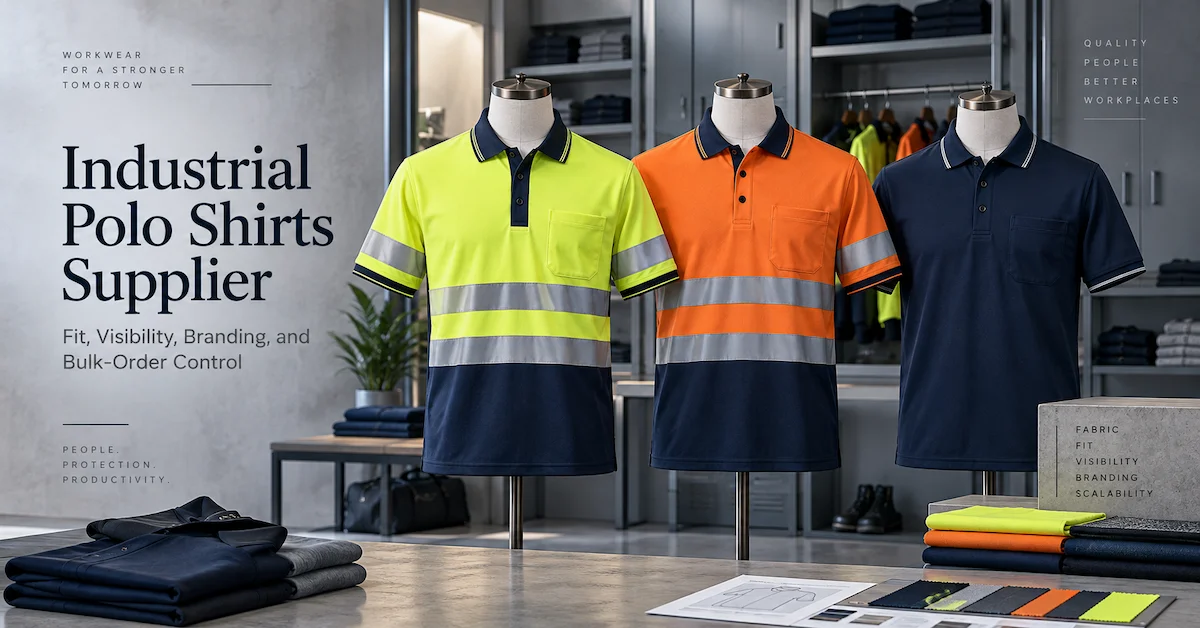
Decide Whether You Need an Industrial Uniform Polo or a High-Visibility Polo
“Industrial polo shirt” can describe very different products. One buyer may need a professional knitted polo for maintenance or service teams; another may need a fluorescent work polo with reflective bands for employees working near vehicles or in low-light conditions. These two sourcing projects should not share the same approval checklist.
For standard industrial uniforms, the focus may be fabric stability, color consistency, collar shape, sizing, logo durability, comfort, and appearance after repeated washing. For high-visibility workwear, the buyer also needs to define the intended market, reflective-material configuration, fluorescent background material, garment design, and any required product standard. AOKE’s LXA012 reflective polo is currently described as an orange high-visibility polo with reflective bands, contrasting black collar and cuffs, and a chest pocket, while LXU018 is described as a fluorescent-yellow reflective polo with contrasting dark sections and a three-button placket. These are useful product references, but buyers should still confirm the exact specification and applicable documentation for the version being ordered.
This distinction matters because adding reflective tape to an ordinary polo does not automatically establish that the finished garment meets a particular high-visibility requirement. The complete garment configuration needs to be reviewed rather than treating the reflective strip as an independent proof of compliance.
Match Polo Shirt Design to the Actual Working Environment
An industrial polo shirts supplier should understand where and how the garment will be worn before recommending fabric or design. Warehouse employees who move continuously between picking areas may prioritize lightweight fabric and freedom of movement. Logistics and delivery teams may need garments suitable for long shifts and regular laundering. Factory supervisors may place greater emphasis on a clean professional appearance and stable sizing, while road-service teams may need visibility features that go beyond those of a conventional uniform polo.
Buyers should therefore provide information about indoor or outdoor use, working temperature, physical activity, wash frequency, visibility requirements, expected service life, branding, and whether employees will wear the polo as a primary garment or beneath jackets and other PPE. AOKE’s existing industrial workwear sourcing guide similarly separates polo shirts and hi-vis T-shirts from heavier workwear categories according to jobsite conditions.
A shirt can look professional in a catalogue and still be poorly matched to the work environment. Application definition should come before fabric, color, or price selection.
Build a Polo Shirt Specification Before Requesting Prices
A structured specification allows competing quotations to be compared on the same basis. The following table is a buyer-side RFQ framework, not a list of verified specifications for every AOKE polo model. Unknown fields should be marked for confirmation instead of being filled with assumptions.
| Specification Area | What the Buyer Should Define or Confirm | Why It Matters |
|---|---|---|
| Product type | Standard industrial polo or high-visibility reflective polo | Establishes the correct product direction |
| End use | Warehouse, logistics, factory, road service, maintenance, corporate field team | Determines performance priorities |
| Fabric composition | Fiber composition and blend | Influences comfort, stability and care |
| Fabric construction | Knit type or other relevant construction | Affects feel and dimensional behavior |
| Fabric weight | Required GSM and tolerance | Helps control garment consistency |
| Color | Standard shade, fluorescent shade or custom brand color | Important for appearance and repeat orders |
| Size range | Required sizes and quantities | Supports production and stock planning |
| Garment measurements | Chest, length, sleeve and other key points | Controls fit |
| Collar/cuff structure | Rib, fabric type and construction | Influences appearance after use and washing |
| Reflective design | Material, width, position and garment requirement | Critical for hi-vis variants |
| None, chest pocket or custom requirement | Application and styling consideration | |
| Branding | Heat transfer, screen printing, reflective printing or approved method | Determines logo appearance |
| Labels | Main label, size label, care label and private label | Required for branded programs |
| Packaging | Individual bag, size sticker, carton marks and carton quantity | Supports warehouse distribution |
| Testing/documentation | Market- and model-specific requirements | Avoids unsupported certification assumptions |
| Quantity | Sample, pilot, initial bulk order and forecast | Supports production planning |
Fabric Selection Should Be Based on Measurable Requirements
Fabric is one of the main reasons work polo shirts perform differently after repeated use. Instead of accepting descriptions such as “premium fabric,” “breathable,” or “industrial grade,” buyers should request measurable information relevant to their program. Useful fields can include composition, fabric weight, construction, dimensional stability after washing, colorfastness, pilling behavior, moisture-management requirements, surface appearance, and care conditions.
The correct combination depends on the working environment. A lightweight knitted fabric may be attractive for active logistics teams, while another application may prioritize structure, opacity, shape retention, or a different hand feel. High-visibility garments add another consideration: changes in fabric shade or material can potentially affect the approved garment configuration, so substitutions should not be made casually after sampling.
AOKE’s LXU018 product page describes its reflective polo as lightweight and breathable with moisture-management characteristics, but the page does not provide a complete public fabric specification such as verified composition, GSM, shrinkage result, or pilling result. Buyers should therefore request those details for the offered production version rather than treating marketing descriptions as a technical data sheet.
Collar, Placket, Cuffs, and Seams Need Their Own Sample Review
Industrial polo shirts often fail visually before the main body fabric reaches the end of its useful life. Collars can curl, plackets can twist, seams can become uneven, and cuffs can lose structure. These are workmanship and material-selection issues that should be evaluated during sample approval.
Check whether the collar lies consistently after washing, whether the placket remains centered, whether buttons and buttonholes are stable, and whether shoulder, sleeve, side, and hem seams remain balanced. Where the design has contrasting cuffs or panels, confirm that the different materials behave consistently after care. A chest pocket should be checked for placement, reinforcement, shape, and interaction with the logo or reflective layout.
For high-visibility polos, the reflective sections should also be inspected where they cross seams, transition around the body, or interact with sleeve and shoulder construction. A supplier should be able to explain how the garment is assembled without making unsupported claims that every design detail delivers the same result in every fabric.
Sizing Is a Supply-Chain Issue, Not Just a Garment Detail
One of the most expensive mistakes in a uniform program is an unclear size specification. A letter size such as M, L, or XL is not sufficient because grading and body expectations vary by market and buyer.
Before production, create an approved measurement chart with defined measurement points, tolerances, and size increments. Request samples that represent the intended size range, especially if the order includes unusually small or large sizes. If an existing buyer size chart must be followed, send the document during quotation rather than after production fabric has already been ordered.
For repeat orders, use the same approved chart and version number. If the pattern changes, buyers should know before production because even a seemingly small adjustment to garment width or length can affect employee acceptance and replacement demand.
A reliable industrial polo shirts supplier should therefore treat sizing information as controlled production data rather than an informal preference.
High-Visibility Polo Shirts Require Product-Specific Compliance Review
AOKE’s website lists company- and product-related certifications including EN ISO 20471, ANSI, AS/NZS and OEKO-TEX 100, and specific polo pages also describe high-visibility standard claims. The company page additionally lists other certification categories across its wider workwear business.
For purchasing, however, the important question is not whether a standard name appears somewhere on the supplier’s website. The buyer should confirm whether the actual polo model, color combination, reflective arrangement, size range, and customized version fall within the relevant documentation. Adding a logo, modifying reflective placement, changing background fabric, or substantially changing a garment design can create a need for additional review.
This is especially important for private-label buyers. The product should not be advertised under a compliance claim that is supported only by a different garment or a company-level certificate. The RFQ should state the target market and required standard at the beginning of the project so the supplier can confirm the appropriate product configuration.
Branding Should Be Approved as Part of the Garment, Not Afterward
For many industrial buyers, the polo is both workwear and corporate identification. Logo position, size, color, application method, labels, packaging, and garment color therefore need to be approved together.
AOKE’s current product pages list heat-transfer printing, screen printing, and reflective-ink options. Direct embroidery is shown on relevant product pages but is marked “Available Soon,” so buyers should not assume that embroidery is currently a standard production option for every polo order without confirmation.
Heat-transfer printing may suit detailed graphics, screen printing can be commercially practical for larger runs, and other methods may be proposed depending on the garment and logo. The buyer should confirm appearance, wash requirement, placement, and whether the branding process affects functional areas of the garment.
For a complete private-label program, branding can extend beyond the front logo. AOKE’s private label workwear guide discusses labels, packaging, size identification, carton marks, colors, and other elements that buyers may need to control across a product line.
Approve a Pre-Production Sample Against a Written Checklist
A sample is useful only when both parties know what it is approving. Record the model or development code, fabric, color, size, measurement chart, collar, cuffs, pocket, reflective layout, logo artwork, label version, packaging, and any approved deviations.
Evaluate fit on an appropriate wearer or fit form, inspect garment balance, and compare measurements with the approved chart. After the agreed care treatment where applicable, recheck the dimensions, collar, placket, seams, logo, reflective details, and overall appearance. If the sample changes after review, assign a new version instead of continuing to refer to both versions as “the approved sample.”
This process helps the industrial polo shirts supplier reproduce the same garment during bulk production and gives the buyer a clear reference during pre-shipment inspection.
Compare AOKE Polo References by Published Product Direction
AOKE currently publishes several reflective workwear references within its clothing range. The following comparison uses only information visible in the current website descriptions; it is not a complete technical specification or a quality ranking, and buyers should confirm fabric, dimensions, standards, MOQ, pricing, and availability for the actual quotation.
| Current Product Reference | Published Design Direction | Potential Buyer Use | Details to Confirm Before Ordering |
|---|---|---|---|
| LXA009 | Website content references a hi-vis long-sleeve polo/work-shirt direction with contrasting colors | Teams needing additional sleeve coverage | Exact fabric, garment measurements, reflective configuration and applicable documentation |
| LXA012 | Orange reflective polo, dark collar/cuffs, reflective bands and chest pocket described online | Industrial and field teams wanting a structured hi-vis polo appearance | Fabric data, size chart, tape specification, standards scope and customization |
| LXU018 | Fluorescent-yellow reflective polo with contrasting dark details, short sleeves and three-button placket | Logistics, warehouse, roadside or active-team applications | Fabric composition, GSM, sizing, reflective details and project-specific compliance |
The value of a comparison table is not to decide which model is universally “best.” It helps buyers identify which configuration deserves a sample based on the work environment and purchasing requirement.
Quality Control Should Follow the Approved Polo Specification
For mass production, QC should be linked to the approved sample and specification. Relevant checks may include fabric identification, color, garment dimensions, cutting, panel matching, collar and cuff appearance, seam quality, button attachment, reflective material placement, logo position, labels, final appearance, packing, and carton information.
Where a buyer has specific wash, colorfastness, reflective, dimensional, or other performance requirements, define how they will be checked and what evidence is required. Do not rely on a general statement such as “strict quality control” when the purchase order requires measurable results.
AOKE states that its main warehouse in Jinhua is responsible for material testing and shipping, and its broader company information describes quality-control systems across the clothing business. These are useful company-level capabilities, but a buyer should still confirm the inspection plan that applies to the particular polo order.
Manufacturing Capacity Must Be Connected to the Actual Order
AOKE publishes a three-facility clothing-production structure: its Jinhua operation is described as suitable for smaller and highly customized orders, Chongqing for medium-scale reflective clothing production, and Myanmar for larger-scale production. The company lists monthly capacities of 50,000, 200,000, and 1.5 million garments respectively, with the Myanmar facility also described as suitable for knitted and woven clothing. These are company-level published capacities, not a guaranteed allocation for a specific polo order.
For an industrial polo shirts supplier evaluation, buyers should therefore ask which facility or production arrangement is proposed for their order, what quantity is practical for that configuration, when material becomes available, whether the same setup can support repeat orders, and what event starts the production lead time.
The polo product pages currently display a generic customization module that refers specifically to customized safety vests, including a 5-piece MOQ and four-day production statement. Those vest-specific terms should not automatically be transferred to an industrial polo project. Obtain written polo-specific MOQ, sample timing, bulk production timing, and shipping conditions instead.
OEM and Private Label Orders Need Revision Control
OEM polo programs usually involve more than placing a logo on an existing shirt. Buyers may request a different fabric, corporate color, fit, pocket, collar, reflective arrangement, label system, size sticker, hang tag, packaging, or carton mark. Each approved change should be captured in the production specification.
If the manufacturer develops a substantially modified garment, separate product-development approval from artwork approval. A correct logo does not mean the fit has been approved, and an approved fabric does not mean the reflective layout or packaging has been approved.
The final bulk release should identify the garment model or buyer code, specification revision, size chart, fabric, color, reflective materials where applicable, logo artwork, labels, packaging and inspection requirements. This information becomes the basis for repeat orders and reduces the risk of a future order silently changing.
How Should Buyers Compare Industrial Polo Shirt Cost?
Unit price should be compared only after the specification has been normalized. One quotation may use a different fabric weight, reflective layout, size range, logo method, label package, carton quantity, or testing scope from another. Those differences make a simple price comparison unreliable.
A useful commercial comparison can separate the garment, branding, labels, packaging, testing or inspection if required, transport, and replacement risk. For a uniform program, also consider the cost of inconsistent sizing or color because replacement garments and employee complaints can create administrative costs that are not visible in the first quotation.
As a simple hypothetical example—not an AOKE quotation—if a 1,000-piece program costs $8,500 including the agreed garment and branding package, the initial comparable cost is $8.50 per garment before freight and other excluded costs. If another offer appears cheaper but requires separate logo application, labels, or repacking, add those items before deciding which offer has the lower purchasing cost.
What Information Should You Send With an Industrial Polo Shirt RFQ?
To obtain a useful quotation, send the product type, end-use environment, target market, required quantity by size, fabric preference or performance requirements, garment color, reflective requirements if applicable, size chart, logo file, logo position, labels, packaging, sample requirement, destination, and desired delivery date. If you already have an existing polo that needs to be matched, provide a physical sample or complete specification and identify which features must remain unchanged.
If you are not sure whether a standard polo or high-visibility polo is appropriate, describe the workers, environment, visibility conditions, laundering arrangement, and required market instead of copying another brand’s specification. Buyers can review the wider AOKE reflective clothing range and company manufacturing background on the About Us page before submitting a project-specific request.
For product-specific confirmation, use AOKE Contact Us and request the proposed polo model, specification, sample process, applicable documentation, MOQ, bulk lead time, packaging, and customization terms.
Frequently Asked Questions
1. What should I look for in an industrial polo shirts supplier?
Evaluate whether the supplier can define fabric, fit, sizing, collar construction, workmanship, reflective details where required, branding, labels, packaging, quality checks, production planning, and repeat-order control. The strongest supplier is not simply the company offering the lowest unit price.
2. What fabric is best for industrial polo shirts?
There is no single best fabric for every job. The choice should reflect working temperature, activity level, wash frequency, required appearance, visibility needs, comfort, durability, and target price. Ask for measurable fabric information rather than relying on broad marketing terms.
3. What is the difference between an industrial polo and a hi-vis polo?
An industrial polo may simply be a durable professional work uniform. A hi-vis polo uses fluorescent and reflective elements for defined visibility requirements. If compliance is required, the complete garment and applicable documentation need to be reviewed.
4. Should I request a sample before bulk production?
Yes. Use the sample to confirm fabric, fit, dimensions, color, collar and cuff structure, logo position, reflective configuration, labels, workmanship, and packaging. Record the approved version so bulk production can be compared with it.
5. How should I control sizing for an international workforce?
Use a garment measurement chart with defined measurement points and tolerances rather than relying only on S, M, L, and XL labels. Review representative samples and confirm grading before production.
6. Can industrial polo shirts include custom logos?
Branding options depend on the garment and project. AOKE’s current product pages list heat transfer, screen printing and reflective printing options, while direct embroidery is currently shown as “Available Soon” on relevant pages. Confirm the production method for your specific polo before ordering.
7. Does every AOKE polo have the same certifications?
Do not assume so. AOKE publishes certification information at company and product level, but buyers should verify that the required standard and documentation apply to the actual model, color, design and customized version being purchased.
8. What affects the MOQ for custom industrial polo shirts?
MOQ can be influenced by fabric, custom color, reflective material, printing, labels, packaging, size distribution and development requirements. The website’s generic custom-vest terms should not automatically be treated as polo MOQ conditions; request project-specific confirmation.
9. How can I reduce repeat-order quality differences?
Keep a controlled specification, approved sample, size chart, color reference, logo artwork, label files, packaging version and inspection requirements. Require relevant material or design changes to be approved before the next production run.
10. What should I send AOKE for an industrial polo shirt quotation?
Send the intended application, target market, quantity and size breakdown, fabric or performance requirements, garment color, reflective requirements, branding files, packaging, destination and target delivery date through AOKE Contact Us. This gives the team enough information to confirm an available model or evaluate a custom solution.
Conclusion
Choosing an industrial polo shirts supplier is ultimately about controlling a repeatable workwear program rather than purchasing a generic shirt. B2B buyers should first determine whether they need a standard industrial uniform polo or a high-visibility work polo, then define fabric, fit, size grading, collar and seam construction, reflective requirements, branding, labels, packaging, sample approval, QC, MOQ and delivery terms before comparing prices. AOKE currently presents reflective polo references including LXA012 and LXU018, supported by a wider reflective-clothing manufacturing structure described on its About Us page. Model-specific specifications, certification scope, MOQ and lead time should still be confirmed for the actual order rather than inferred from generic website statements. For a project-specific evaluation, submit your application, size breakdown, branding requirements, target market and estimated quantity through AOKE Contact Us to request an appropriate industrial polo shirt solution.